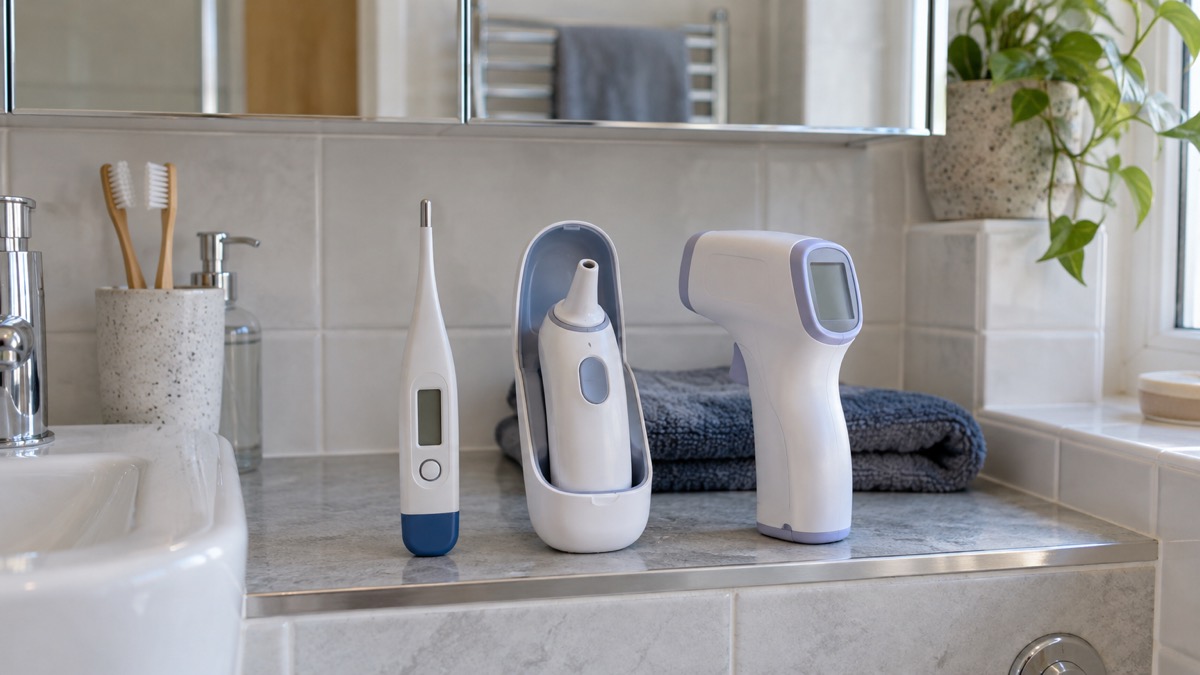
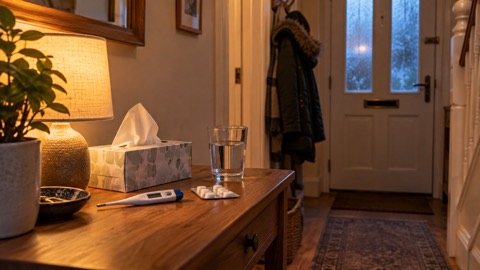
A thermometer is one of the small, inexpensive items that official guidance again and again tells UK households to keep at home. NHS and local authority advice on stocking a family medicine chest lists a thermometer for checking fevers1, a GP practice listing what to keep in a first aid kit specifies one "preferably digital"2, and self-care guidance from an NHS integrated care board describes exactly how the different types perform3. The short answer for most households: buy a digital stick thermometer, use it in the mouth for adults and older children, and under the armpit for children under five4.
The reason to have one ready is that fever is one of the clearest signals that someone at home is unwell, and a number helps you describe it. NHS guidance for parents in north east London goes as far as to say you should always test your child's temperature before contacting or visiting a health professional5. Without a working thermometer you are guessing, and during an evening, a weekend or a power cut, a guess is not something NHS 111 can act on.
There is one thing to get right at the outset, because the UK regulator has warned about it directly. In July 2021 the Medicines and Healthcare products Regulatory Agency (MHRA) issued a caution about infrared thermometers being sold in the UK that did not comply with the Medical Devices Regulations 20026. Infrared thermometers became widely available during the COVID-19 pandemic, and not all of them meet the rules that medical devices must meet. This page explains what to check before you buy one, and when you should walk away.
Use a digital thermometer for checking a fever at home
Every piece of official guidance on what to keep at home for minor illness converges on the same item. The family medicine chest guidance lists "Thermometer, For checking fevers"1. The first aid kit advice from a GP surgery says to keep a thermometer, "preferably digital"2. Medicine cabinet guidance from a primary care network says plainly that "Digital thermometers help you check for fevers"8. None of these sources asks for anything elaborate: a basic digital stick thermometer is the item being recommended.
What makes it the right choice for an ordinary household is the combination of speed and accuracy. Self-care guidance from Birmingham and Solihull ICB adds the detail on accuracy: "digital thermometers that you put in your mouth produce very accurate readings"3. A single device of this kind serves the whole household, because the same thermometer can be used to check a temperature whether the person unwell is a baby, a child or an adult, and official advice is to always test your child's temperature before contacting or visiting a health professional4.
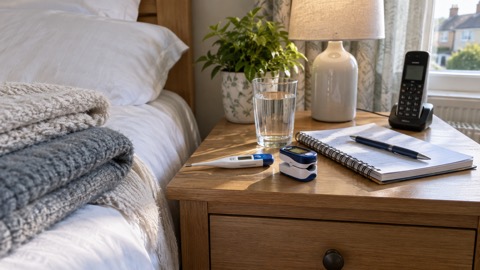
The practical point is to have it before you need it. Fevers in children often start in the evening or overnight, when shops are shut, and the guidance to always test a child's temperature before contacting a health professional5 means the thermometer has to be in the drawer, with working batteries, at the moment the fever appears. Keep it with the rest of your medicine cabinet supplies so it is easy to find in the dark or in a hurry, and check the battery occasionally in the same way you would check a torch.
A thermometer also earns its place in the wider household emergency kit. Neath Port Talbot council's emergency kit checklist and North Hertfordshire's guidance on preparing for emergencies both include a thermometer, preferably digital, on their lists of what a household should have ready9. A fever does not wait for convenient circumstances, and a power cut or a storm is exactly when you want to be able to judge whether someone at home is running a temperature. Our page on staying at home when ill covers what to do once you have the reading.
Mouth, under-arm or ear: how accurate each reading is
Where you put the thermometer matters as much as which type you buy, and the official guidance is specific about each site. The clearest statement comes from Birmingham and Solihull ICB: digital thermometers used in the mouth produce very accurate readings, while an under-arm or ear thermometer may be better for babies and young children3. That single sentence is the basis for most household decisions about which type to buy and how to use it.
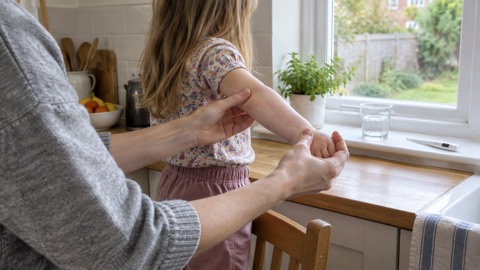
For children under five, the instruction is firm. NHS guidance in Wales says to always use the thermometer under the armpit with children under five, leaving it in place for the time stated in the manufacturer's instructions4. The maker's instruction leaflet is not small print here: the holding time is what makes the reading trustworthy, and it differs between models. Read the leaflet when you buy the thermometer, not during the fever.
Ear thermometers, sometimes called tympanic thermometers, trade a little accuracy for speed. The Welsh NHS guidance describes them this way: "They take the child's temperature in one second and do not disturb the child, but they're expensive. Ear thermometers may give low readings when not correctly placed in the ear"4. For a sleeping baby or a distressed toddler, that one-second reading is the whole appeal; the cost is that a thermometer angled wrongly in the ear canal can tell you the child is cooler than they are. If a reading surprises you, take it again and make sure the probe is properly placed.
| Reading site | Who it suits | How accurate | What to watch |
|---|---|---|---|
| Mouth | Adults and older children | Very accurate readings3 | Not for young children |
| Under the armpit | Children under five, always4 | Accurate when used correctly4 | Leave in for the time in the maker's instructions4 |
| Ear | Babies and young children3 | May give low readings if not correctly placed4 | Takes one second, does not disturb the child4 |
| Forehead strip | None recommended | Shows skin temperature, not body temperature4 | Not an accurate way to take a child's temperature4 |
One older type is now off the table entirely. NHS guidance in Wales states that mercury-in-glass thermometers are no longer available to buy4, and its companion page is blunter still: "Do not use mercury thermometers. If your child is exposed to mercury, get medical advice immediately"7. If an old mercury thermometer is still in a drawer somewhere in the house, the advice is not to use it. Mercury thermometers can break, releasing small shards of glass and highly poisonous mercury7.
Infrared thermometers: what they claim and what they cannot do
Infrared thermometers, the gun-shaped devices that read temperature from a distance without touching the skin, became far more visible in the UK during the COVID-19 pandemic. The MHRA's safety notice records that "This type of device has become increasingly available in the UK during the COVID-19 pandemic"6. They appeared at building entrances and workplace doorways, and many households bought one on the strength of that familiarity.
The regulatory problem is what they claim. The MHRA's notice explains that when these thermometers are sold with claims that they can be used for a medical purpose, such as taking a person's body temperature to check for fever, they fall within the Medical Devices Regulations 2002, which means "they should have been assessed to make sure they meet the essential requirements of the Medical Devices Regulations 2002"6. A device sold simply as an industrial or general-purpose surface thermometer does not go through that assessment, and a seller's claim on a marketplace listing is not the same thing as a compliant medical device.
The MHRA is also explicit about a limit that no infrared thermometer gets around: they are not a reliable way to detect if people have the virus6. Temperature screening at a door catches some fevers and misses infections without fever, so an infrared thermometer bought for COVID-19 screening is being asked to do something the regulator says it cannot do. If your concern is COVID-19, our page on COVID-19 symptoms and testing sets out the current approach.
For an ordinary household, the honest summary is this. A compliant infrared thermometer, used exactly as its instructions say, can give a quick indication of temperature. But the official guidance for home fever checking points to digital and ear thermometers, not infrared ones3, and the regulator's caution exists precisely because many infrared thermometers on sale in the UK have not been assessed as medical devices at all6. If you want one device for the household medicine chest, make it a digital stick thermometer, and treat infrared devices as a separate purchase that needs careful checking first.
Non-compliant infrared thermometers sold in the UK
The core of the MHRA's July 2021 caution is a statement about the UK market: "The MHRA has become increasingly aware of infrared thermometers being sold in the UK that do not comply with the regulations"6. These are not counterfeit luxury goods; they are health devices sold with medical claims that have not been through the assessment the law requires for medical devices.
This pattern is not unique to thermometers, and the wider product safety system shows how it is handled. A 2025 product safety notice for the Aico Ei3014 heat detector stated that "The product does not meet the requirements of the General Product Safety Regulations 2005"11. A 2024 notice for Morco gas water heaters found the products "are not in conformity with the requirements of Regulation 2016/426"12. A 2023 notice for a reptile heat lamp found a noncompliant and counterfeit fuse "which can allow the product to become live under fault conditions"13. In each case the mechanism is the same: a product reaches UK buyers without meeting the regulations that apply to it, and the regulator publishes a notice so buyers and sellers know.
What this means for a thermometer buyer is that compliance is something you verify yourself, at the point of sale, rather than something you can assume. The MHRA's notice lists what to look for, and the next section works through it. The date matters too: the caution was issued on 27 July 20216, and it has not been withdrawn, so it stands as current guidance on what to check.
Check the maker's name and address before you buy
The MHRA's notice gives buyers a concrete checklist, and the first item on it is the manufacturer's details: "Name and address of the manufacturer"6. A thermometer sold for a medical purpose should carry, or come with, the name and address of the manufacturer. If it is not there, or the seller cannot provide it, the notice is direct about what to do: "If it is not there or the seller can't provide it, you should not buy the thermometer"6.
The same principle runs through official buying advice for other household products, which is worth knowing because it tells you this is standard consumer safety practice rather than a special rule for thermometers. Fire and rescue service advice on buying heaters says to buy from recognised manufacturers and retailers to reduce the risk of buying a counterfeit and unsafe heater14. Surrey Fire and Rescue Service says to always purchase from recognised and trusted brands15. Armagh City, Banbridge and Craigavon council advises checking that a heater carries the CE mark before purchasing16. The Scottish Government's guidance on smoke and heat alarms even names a product that will not meet the standard, so that buyers know a familiar brand is not automatically a compliant one17.
Applied to thermometers, the checks before you buy are:
- CE or UKCA marking: the MHRA's notice points to detailed information on the CE and UKCA marking, which shows the device has been assessed against the Medical Devices Regulations 20026
- Maker's name and address: it should be on the device or its packaging; if the seller cannot provide it, do not buy6
- A recognised manufacturer or retailer: the fire and rescue services advise buying heaters from recognised manufacturers and retailers to reduce the risk of buying a counterfeit and unsafe product, and the same principle holds for a thermometer14
- Instructions: the maker's instructions matter in use as well, because the under-arm holding time for children under five comes from them4
When you should not buy a thermometer
The clearest instruction on this page is the MHRA's: if the manufacturer's name and address is not there or the seller cannot provide it, you should not buy the thermometer6. That applies to any thermometer sold with a medical claim, and it applies most often to infrared thermometers sold through online marketplaces, where the listing may name no maker at all.
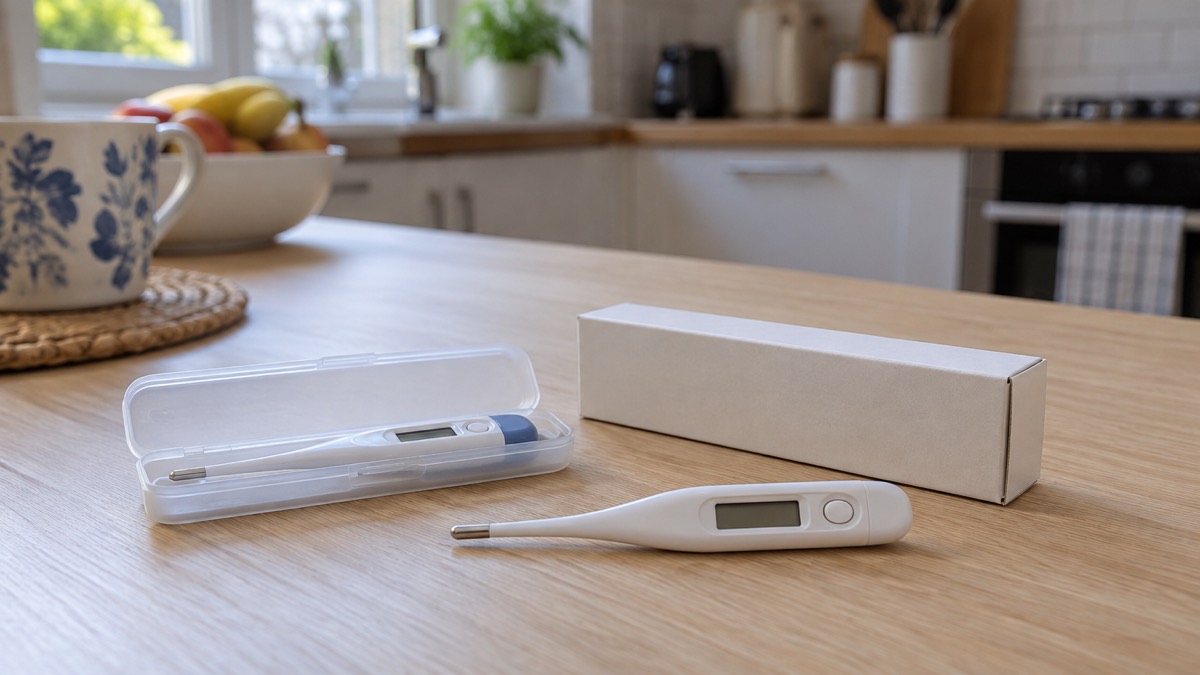
The second thing not to buy is mercury. Mercury-in-glass thermometers are no longer available to buy4, and the guidance is not to use old ones because of the poison and broken glass risk7. There is no circumstance in which a mercury thermometer is the right choice for a household today.
Third, be careful with second-hand devices. The official analogies come from heater safety advice, which is directly on point for anything electrical you rely on in an emergency: Lincolnshire's guidance says do not buy portable heaters second hand18, and Manchester Fire and Rescue Service says to avoid buying second-hand heaters but if you need one, check it closely for damage and get the instruction manual, and if in doubt, avoid it19. A second-hand thermometer without its instructions is a poor purchase for a specific reason: you cannot follow the maker's stated holding time, which is what makes an under-arm reading on a child trustworthy4. A new basic digital thermometer is the item every official source recommends1, and that is what to buy.
Finally, do not buy any thermometer, infrared or otherwise, expecting it to screen people for COVID-19. The MHRA states these devices are not a reliable way to detect if people have the virus6. Buy a thermometer to check fevers at home, and follow testing guidance for infection.
Reporting a faulty thermometer to the MHRA
If a thermometer you have bought gives erratic readings, arrives without the marking or maker details it should have, or you otherwise suspect it is non-compliant, report it. The MHRA's own notice instructs users to "Report any problems with the thermometer to the MHRA or your national reporting authority"6. The route for this in the UK is the Yellow Card Scheme. West Yorkshire Fire and Rescue Service's guidance on medication and medical devices puts it simply: "To report any concerns about medicines or medical devices visit - MHRA Yellow Card Scheme"20.
Reporting is not just a complaint mechanism. The MHRA has become increasingly aware of infrared thermometers being sold in the UK that do not comply with the regulations, which is why its 2021 caution exists6. Reports from households are how the agency learns of such problems in the first place. A household that reports a faulty thermometer is contributing to that.
The same habit applies to the other devices in your home. Fire safety advice encourages registering appliances so you hear about faults and recalls21, and checking appliances for faulty wiring or overheating21. For the thermometer itself, the practical routine is: check it works and its batteries are live from time to time, follow the maker's instructions when you use it, and report anything that seems wrong through the Yellow Card Scheme20.
A room thermometer for keeping the home warm
There is a second thermometer worth having in a UK household, and it is a different device for a different job. A room thermometer does not check fevers; it tells you whether your home is warm enough to be healthy, which matters most for older people, babies and anyone unwell.
Official guidance across the UK is consistent about the number. Nottinghamshire County Council's keeping warm advice says to use a room thermometer, and that your living room should be between 18 and 21C22. Its easy-read version says the same: "Use a room thermometer. Your living room should be between 18 to 21 degrees Celsius"23. The Scottish Government's ready campaign advice for cold weather says to heat your home to at least 18C in the rooms you regularly use, if you can24. nidirect guidance on hypothermia, for Northern Ireland, advises keeping your home at a temperature of at least 18C and using a room thermometer25.
The health reason behind the number is straightforward: winter safety guidance advises trying to maintain an even temperature of 18 to 21 degrees centigrade in all rooms in your home, and if that is not possible, keeping one room warm and using that during the cold weather26. Cold homes put real strain on people who are already vulnerable, and a room thermometer is how you know the problem exists before it shows in a person.
| Source of advice | What it says about home temperature |
|---|---|
| Nottinghamshire County Council | Use a room thermometer; living room 18 to 21C22 |
| Scottish Government ready campaign | Heat to at least 18C in rooms you regularly use, if you can24 |
| nidirect (Northern Ireland) | Keep your home at least 18C; use a room thermometer25 |
| 2014 report on minimum temperatures | Overnight, the 18C threshold may be less important for healthy people aged 1 to 64 with sufficient bedding and clothing26 |
A room thermometer is a simple, cheap device that sits on a shelf or windowsill. Keep it in the living room or the room where someone unwell is resting, read it in the evening when temperatures drop, and act on it: heat the rooms you use, keep doors of unused rooms closed, and use blankets and layered clothing, as household emergency guidance advises10. If someone at home is ill and you are managing both their fever and the warmth of the room, the two thermometers do different jobs, and you need both. Our heating and cooking and gas and heating failures pages cover what to do when the heating itself fails.
Sources (26)
- The Family Medicine Chest, Vallance Medical Centre, 2026
- What should I keep in my first aid kit, Collingwood Surgery, 2026
- Self care advice, Birmingham and Solihull ICB, 2026
- Newborn essentials and first aid, NHS 111 Wales, 2021
- What to do if your child is unwell, NHS North East London ICB, 2024
- Infrared (IR) thermometers: caution in use, Medicines and Healthcare products Regulatory Agency, 2021
- Safety and your first aid kit, NHS 111 Wales, 2021
- Stock up your medicine cabinet, Firsdown Primary Care Network, 2023
- NPT Prepared emergency kit checklist, Neath Port Talbot Council, 2026
- Preparing for emergencies, North Hertfordshire District Council, 2015
- Product recall: Aico Ei3014 heat detector, Office for Product Safety and Standards, 2025
- Product safety report: Morco gas water heaters Primo MP / EUP, Office for Product Safety and Standards, 2024
- Product recall: Nomoy Pet reptile heat lamp, Office for Product Safety and Standards, 2023
- Heating your home, North Yorkshire Fire and Rescue Service, 2026
- Fire safety at home, Surrey County Council Fire and Rescue Service, 2026
- Safe use of heaters and generators, Armagh City, Banbridge and Craigavon Borough Council, 2026
- Where and what to buy: fire and smoke alarms in Scottish homes, Scottish Government, 2024
- Heaters and electric blankets, Lincolnshire County Council, 2026
- Stay fire safe, Manchester Fire and Rescue Service, 2026
- Medication and medical devices, West Yorkshire Fire and Rescue Service, 2026
- Stay safe in the kitchen this autumn, North Yorkshire Fire and Rescue Service, 2025
- Keeping warm in winter, Nottinghamshire County Council, 2026
- Keeping warm in winter (easy read), Nottinghamshire County Council, 2026
- Cold, snow and ice, Scottish Government Ready Campaign, 2026
- Hypothermia, nidirect, 2025
- Minimum temperature threshold for homes in winter, Department of Health, 2014
 Medicine Cabinet Checklist
 Sick at Home Supplies Kit
 Caring for Someone Ill at Home
 Pandemics and UK Household Plans
 Outbreaks Near You
 UK Health Security Agency
 Staying Home When Ill
 Stopping Infections at Home
 Caring for a Sick Person at Home
 Keeping Prescription Medicine
 Medicine Shortages Explained
 Storing Medicines Safely
 Urgent Care and A&E
 Vaccines Against Outbreaks
 Flu Symptoms and Getting Help