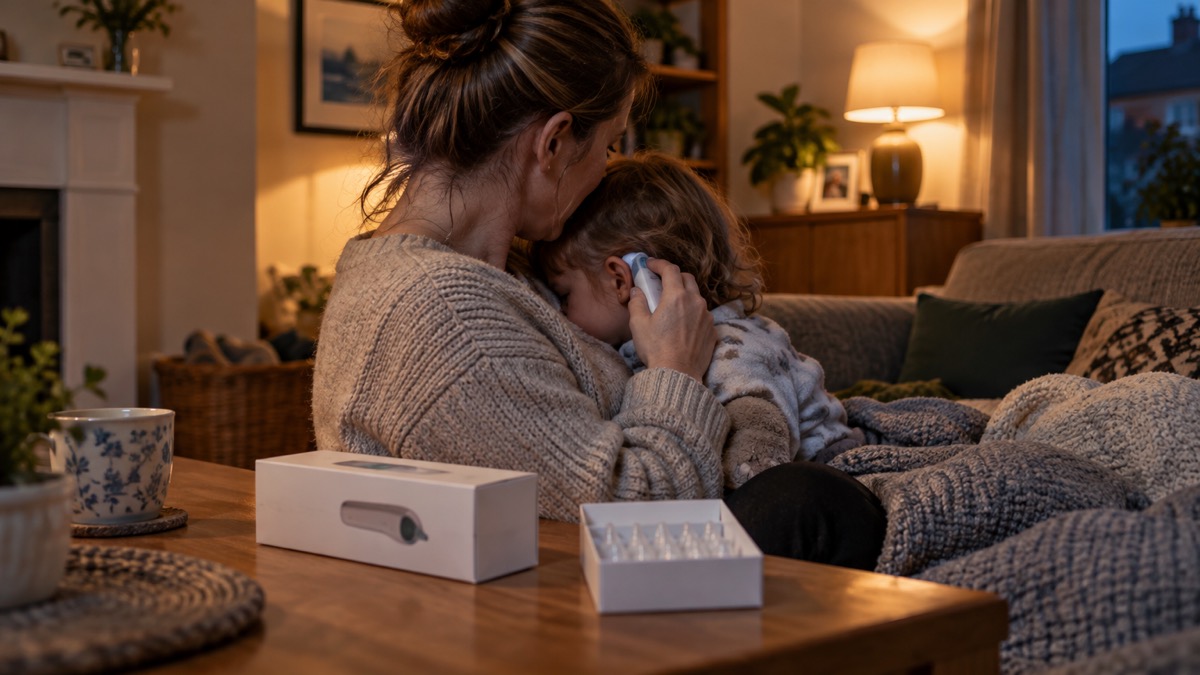
If you are thinking about a Braun ThermoScan 7, or you have one in the cupboard and want to use it properly, the essentials are simple. It is an ear thermometer, model IRT6520, that reads the infrared heat given off by the eardrum and the tissue around it1. It comes with 21 Braun Hygiene Caps, a storage box, a Quick Start Guide and 2 AA batteries, so it is ready to use out of the box1. It stores the last 9 readings and has a backlit display with a nightlight for checking someone in the dark1.
What sets it apart from a basic thermometer is the way it interprets a reading. You set the age of the person first, in one of three groups (0 to 3 months, 3 to 36 months, or 36 months and over), and the thermometer applies fever guidance suited to that age1. The screen then shows green for no fever, yellow when a fever is present and red for a high fever1. The maker says the wide-angle probe can be used on newborns without going fully into the ear canal, and that the thermometer is clinically proven to be as accurate as rectal measurement in newborns1.
It is a home device, not a clinical instrument: the maker states plainly that it is not intended for clinical use in a professional environment and is for home usage only, and that it is not intended to interpret hypothermic temperatures1. Used within those limits, with a fresh hygiene cap each time and the probe placed properly, it gives a household a quick, repeatable way to check for fever. This page sets out what it does, how to take a reading you can trust, how to keep it clean, and what to check before you buy one in the UK.
What the ThermoScan 7 is and how it measures
The ThermoScan 7 is an infrared ear thermometer. Rather than sitting under the tongue or the arm, it is placed at the opening of the ear and reads the infrared heat generated by the eardrum and the surrounding tissue1. The maker's explanation for choosing the ear is that the eardrum shares a blood supply with the temperature control centre in the brain, so the ear reflects changes in core body temperature well2. That is the maker's case for the ear as a measurement site, and it is why the reading is taken in seconds rather than minutes.
Two design features matter for accuracy. The first is the pre-warmed tip, which the maker says is held at 34°C, close to your own body temperature3. The reasoning is that a probe already near body temperature is less likely to chill the ear canal during the reading. The second is the ExacTemp stability indicator: a light and a beep confirm that the device is stable in the ear and that the reading is accurate1. In practice that means you position the probe, wait for the confirmation, and only then trust the number on the screen.
The thermometer also carries the features a household will actually use day to day. It stores the last 9 temperature readings, so you can compare the current reading with the ones before it1. The display is backlit with a nightlight, which the maker says makes it easy to take a temperature when it is dark1. It runs on 2 AA batteries, included1.
It is worth being clear about what the device is for. The maker states that these thermometers are not intended for clinical use in a professional environment and are for home usage only1. It is a household tool for checking whether someone has a fever, not a substitute for a clinician's assessment. If you are weighing up ear against other kinds of thermometer for your household, our guide to thermometers for checking a fever at home sets the types side by side.
Age Precision: readings matched to three age groups
A fever means different things at different ages, and the ThermoScan 7 is built around that. Before you take a reading you select the person's age group, and the thermometer interprets the measurement according to it: 0 to 3 months, 3 to 36 months, or 36 months and over1. The same measured temperature can therefore be presented differently for a newborn and for an adult, because the threshold the maker applies is age-specific.
| Age group | What you select on the thermometer | Why it matters |
|---|---|---|
| 0 to 3 months | The youngest setting | Fever guidance is applied for the youngest babies1 |
| 3 to 36 months | The middle setting | Guidance matched to toddlers and young children1 |
| 36 months and over | The oldest setting | Guidance matched to older children and adults1 |
The practical consequence is that you should not hand the thermometer to someone else without resetting the age. A reading taken on the newborn setting and then repeated on an adult without changing the group will not be interpreted correctly. Set the age first, every time, and check the setting if more than one person in the house is being monitored.
Age Precision is the maker's name for this age-adjustable fever guidance, and it is the feature that most distinguishes this kind of thermometer from a plain digital stick that simply shows a number. The maker states that the technology correctly interprets the measurement according to age, using the bands 0-3 months, 3-36 months and 36+ months2.
Colour-coded fever guidance: green, yellow and red
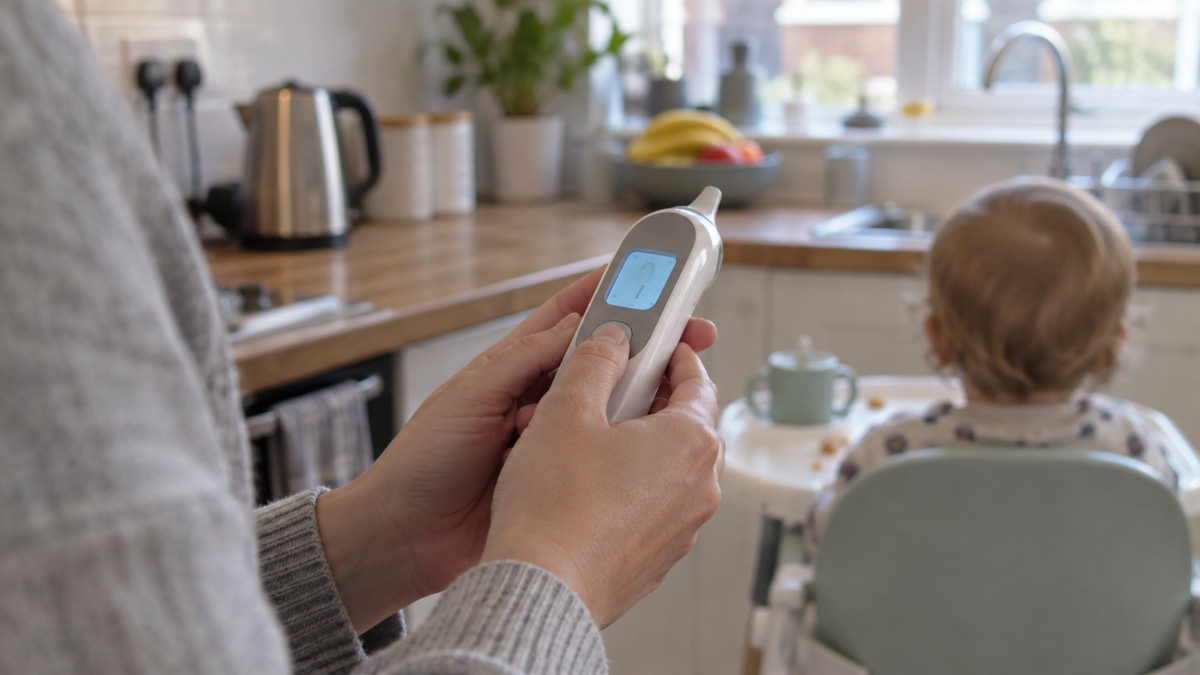
Once the reading is taken, the ThermoScan 7 does not just show a number. The screen is colour-coded: green indicates no fever, yellow indicates when a fever is present, and red indicates a high fever1. The colour is the quick read, useful in a dim room or when you are half awake at 3am; the number is there for recording and comparing.
The colour system is consistent across the maker's range, which helps if you have more than one thermometer in the house or are used to a different Braun model2. On the ThermoScan 4, for example, the maker pairs the colours with beeps: a green screen with one beep for a normal result, a yellow screen with two beeps for a fever, and a red screen with four beeps for a high fever5. The ThermoScan 7 itself is described by its colour guidance rather than by a beep count, so rely on the colour and the number on screen.
A colour is a prompt, not a diagnosis. Green tells you the thermometer has not registered a fever at that moment; it does not rule out illness, and it does not replace watching how the person is behaving, drinking and breathing. Yellow and red tell you a fever is present or high according to the maker's age-adjusted thresholds, and that is the point to think about who to contact. For what to do next, including when to call NHS 111 rather than 999, see when to call 111 and when to call 999.
Taking an accurate reading with the wide-angle probe
The ThermoScan 7 uses a wide-angle probe, which the maker says gives accurate measurements, including on newborns3. Accuracy depends on placement: the probe needs to sit steadily at the ear opening, and the ExacTemp indicator confirms with a light and a beep when the device is stable and the reading is accurate1. If you do not get that confirmation, reposition and try again rather than accepting the number.
A simple routine helps:
- Fit a fresh hygiene cap before the reading1.
- Switch on and select the correct age group1.
- Place the probe at the ear opening and hold it steady until the light and beep confirm stability1.
- Read the number and the colour, and note the time if you are tracking a fever1.
- Replace the cap before using it on anyone else5.
NHS Wales offers a caution that bears directly on ear thermometers: they take a child's temperature in one second without disturbing the child, but they may give low readings when not correctly placed in the ear6. That is the main way an ear reading goes wrong, and it is why the stability confirmation matters. If a reading seems out of keeping with how the person looks and feels, check the placement and take it again.
Using it on newborns: the probe need not go fully into the ear
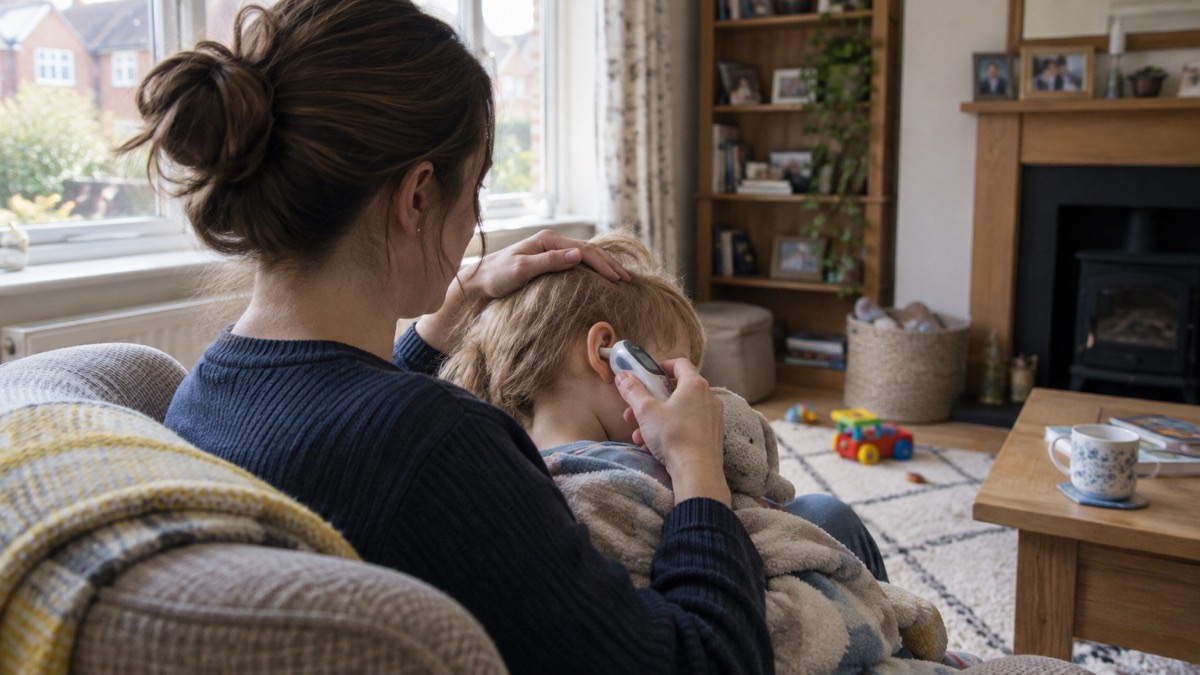
Newborns are the group parents most often worry about, and the maker addresses them directly. The probe does not have to be fully inserted into the ear canal to get an accurate measurement on newborns, and the maker says it can safely be used to measure their temperature on that basis1. That matters because a small ear canal makes full insertion difficult and uncomfortable, and the wide-angle probe is designed to work without it3.
The maker also states that the ThermoScan 7 is clinically proven to be as accurate as rectal measurement in newborns1. That is the maker's claim for its own device, and it is the strongest accuracy statement in the product information. It does not change the basic rule that a young baby with a fever needs advice quickly: a thermometer tells you the number, not what to do about it.
If you are looking after a newborn and want the wider picture on what to keep at home and when to seek help, NHS Wales publishes newborn essentials and first aid guidance6. Our own guide to looking after someone who is ill at home covers the household routines around a fever.
Hygiene caps and avoiding cross-contamination
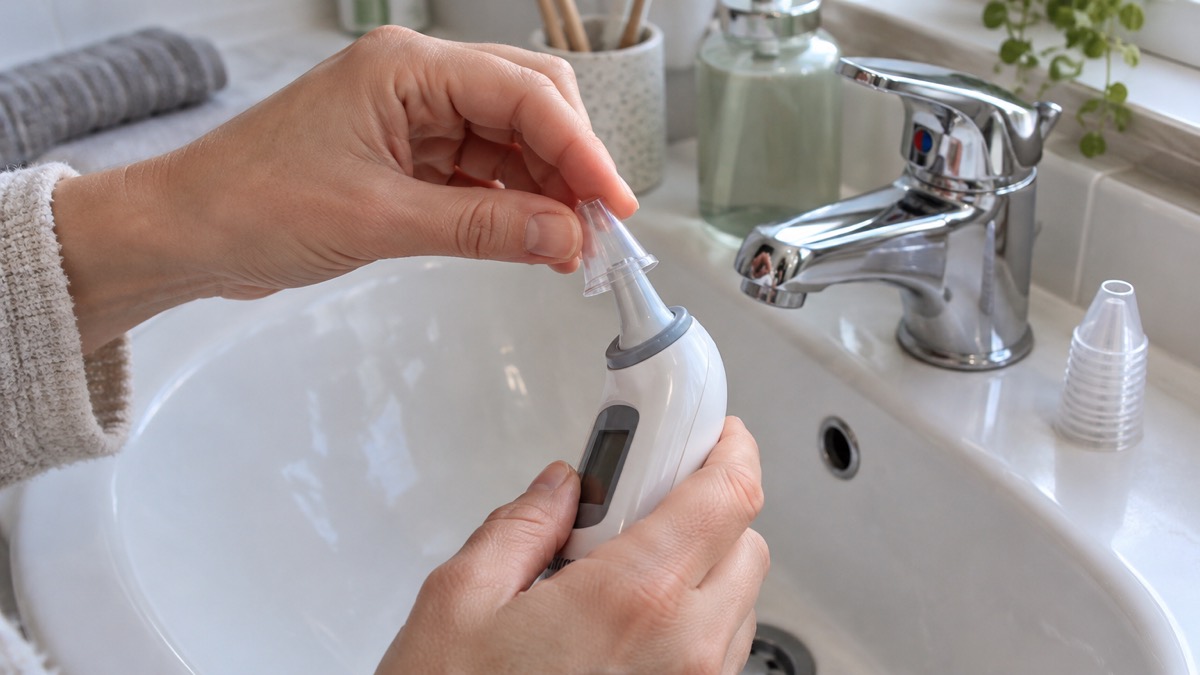
The ThermoScan 7 comes with 21 Braun Hygiene Caps, which are disposable probe covers designed to avoid cross-contamination between users1. They do two jobs: they protect the thermometer's lens and keep it clean and free from obstructions that could affect accuracy, and they help prevent cross-contamination when the same device is used by several people5. The maker's instruction is straightforward: remove the used cap and replace it with a new one5.
That routine is what makes a single household thermometer safe to pass between a baby, a child and an adult. Fit a fresh cap before each person, and do not reuse one. Keep the spare caps with the thermometer in its storage box so they are to hand when someone is ill in the night.
The maker's manuals for its thermometers also give general care advice worth applying here: keep the device out of reach of children under 12 years, and never insert a sharp object into the scanner area or any other open surface7. For cleaning the casing, the maker's manual for its non-contact model specifies an alcohol swab or cotton swab moistened with 70% isopropyl alcohol, no liquid into the interior, no abrasive cleaners, thinners or benzene, and never immersing the device in water7. Those are the maker's instructions for its own product; follow the cleaning guidance supplied with your thermometer.
Limits: home use only and not for low body temperatures
The ThermoScan 7 has clear limits, and knowing them is part of using it well. The maker states that it is not intended for clinical use in a professional environment and is for home usage only1. It is not intended to interpret hypothermic temperatures1. In other words, it is built to help a household spot and track a fever, not to assess someone who is dangerously cold or to replace a clinician's judgement.
NHS advice on what to keep at home treats a thermometer as a basic item for checking fevers, and recommends a digital thermometer, preferably digital, in the first aid kit8. NHS Birmingham and Solihull notes that digital thermometers placed in the mouth produce very accurate readings, and that an under-arm or ear thermometer may be better for babies and young children8. That is the fair summary of where an ear thermometer fits: convenient and quick for young children, with the caveat from NHS Wales that poor placement can give low readings6.
If you want to compare the options for your household before buying, our comparison of infrared or digital stick thermometers sets out which suits which circumstances. And if a fever is part of a wider illness in the house, the health emergencies section covers outbreaks, staying home and when to seek help.
Buying a genuine infrared thermometer in the UK
Infrared thermometers are regulated as medical devices in the UK. The MHRA's safety notice explains that they fall under the Medical Devices Regulations 2002, which means they should have been assessed to make sure they meet the essential requirements of the regulations11. The same notice records that the MHRA had become increasingly aware of infrared thermometers being sold in the UK that do not comply with the regulations11. That warning dates from 2021, but the principle still applies when you buy.
The MHRA's notice sets out what to check on the labelling, including that if the manufacturer is not in the EU or UK, the name and address of the European representative or UK Responsible Person should be given11. In practice, buy from a reputable retailer or directly from a known manufacturer rather than an unverified third-party online seller. That is the consistent advice from UK fire and rescue services and electrical safety bodies on electrical and battery products generally: buy from reputable sellers, check that items meet UK product safety standards and display the UKCA or CE safety mark, and be wary of counterfeit goods12.
| What to check | Why it matters |
|---|---|
| Buy from a reputable retailer or the manufacturer | Unverified sellers may supply products that do not meet UK safety standards13 |
| Look for the UKCA or CE safety mark | Shows the item is declared to meet UK product safety standards12 |
| Check the manufacturer and, where relevant, the UK Responsible Person | Required labelling for a medical device under the 2002 regulations11 |
| Keep the packaging and instructions | Gives you the maker's guidance and a record of what you bought11 |
The Braun ThermoScan 7 is made by Braun, and the maker's own product pages are the place to confirm the model number and what is included before you buy1. If you are building a household medicine kit around it, our medicine cabinet checklist covers the other items worth keeping.
Sources (15)
- Braun ThermoScan 7 Ear thermometer, Braun Healthcare, 2025-08-27
- Braun ThermoScan 6, Braun Healthcare, 2025-08-27
- Braun ThermoScan 7 Black, Braun Healthcare, 2025-08-27
- Braun Sensian 7, Braun Healthcare, 2025-08-27
- Braun ThermoScan 4, Braun Healthcare, 2026-04-02
- Newborn essentials and first aid, NHS 111 Wales
- Braun Sensian 3 non-contact forehead thermometer manual, Braun Healthcare, 2024-11-13
- Self-care advice, NHS Birmingham and Solihull ICB
- What should I keep in my first aid kit, Collingwood Surgery
- The family medicine chest, Vallance Medical
- Infrared (IR) thermometers: caution in use, MHRA, 2021-07-27
- Electrical fire safety leaflet, Greater Manchester Fire and Rescue Service
- Electric fans safety advice, Electrical Safety First
- Lithium-ion batteries, Scottish Fire and Rescue Service
- Electrical fire safety, Cheshire Fire and Rescue Service