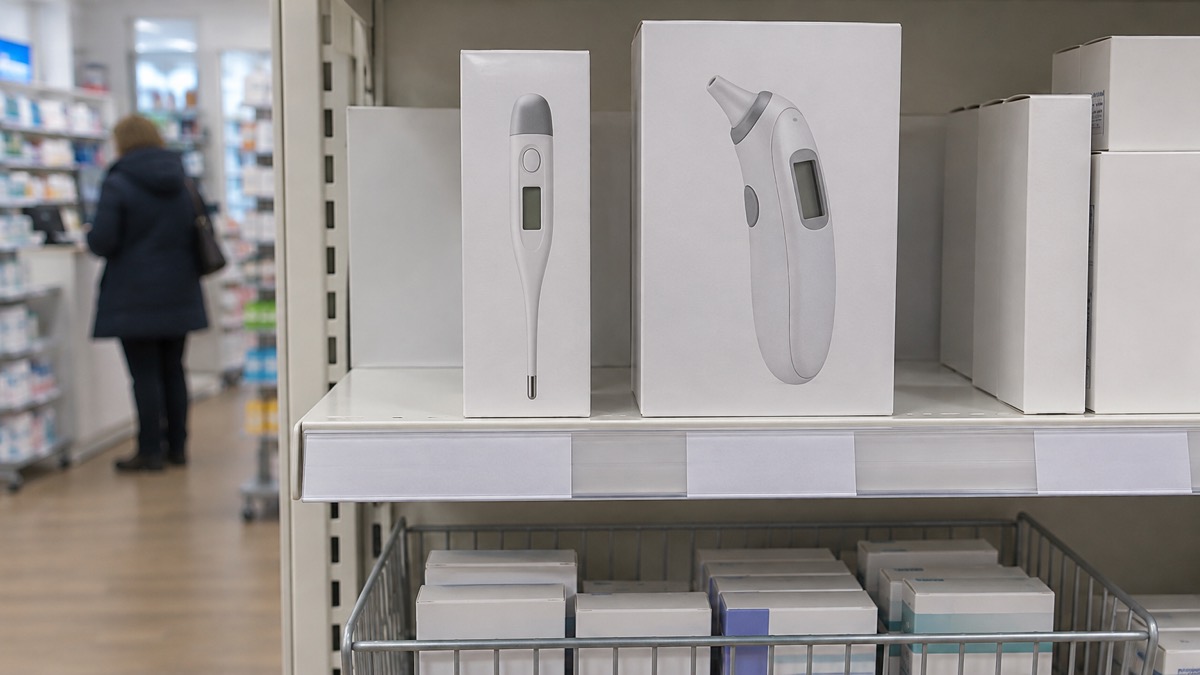
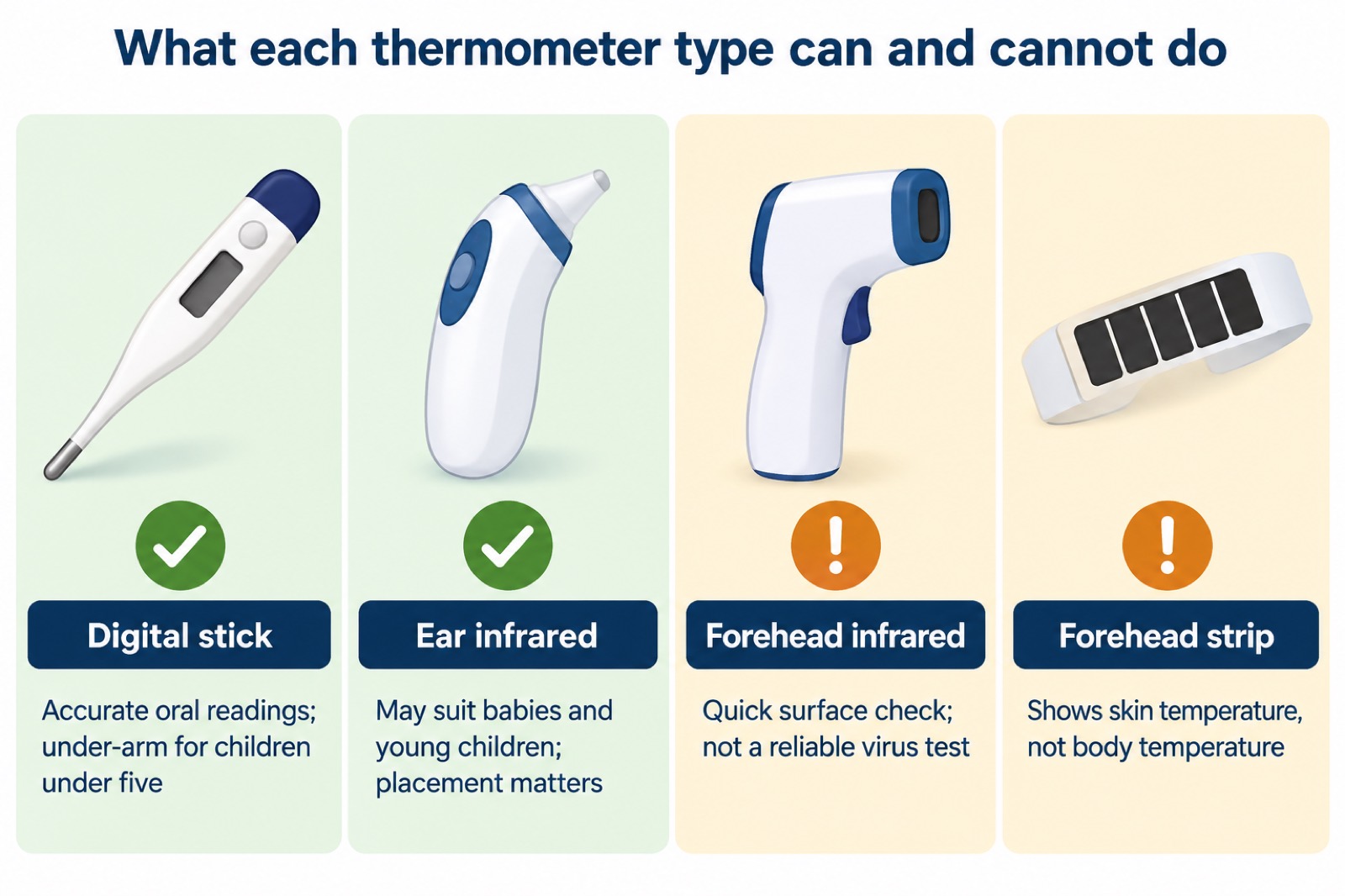
For most UK households, the thermometer to keep at home is a plain digital stick thermometer. NHS guidance lists a thermometer, preferably digital, among the basics of a first aid kit1, and NHS self-care advice says digital thermometers that you put in your mouth produce very accurate readings, while an under-arm or ear thermometer may be better for babies and young children2. That single sentence covers most of the decision: a digital stick thermometer is the default, and an ear or under-arm reading is a sensible alternative for small children.
Infrared thermometers, the kind you point at a forehead or ear without touching, are a different proposition. They are widely sold, but the Medicines and Healthcare products Regulatory Agency (MHRA) issued a caution in July 2021 about infrared thermometers sold in the UK that do not comply with the Medical Devices Regulations 2002, and warned that they are not a reliable way to detect if people have the virus3. That does not make every infrared thermometer a bad buy. It does mean you should know what you are buying, check the packaging before you pay, and understand what a temperature reading can and cannot tell you.
This page sets out what the official advice says, where you take the reading and why it matters, what to check before buying an infrared thermometer, when not to buy one at all, and how to report a faulty device. If you want the wider picture on fever checking, the thermometers guide covers the types and how to choose between them.
Digital stick or infrared: the official advice is preferably digital
The starting point is simple. NHS guidance on what to keep in a first aid kit lists a thermometer, preferably digital1. NHS self-care advice goes further, explaining that digital thermometers you put in your mouth produce very accurate readings, and that an under-arm or ear thermometer may be better for babies and young children2. A digital stick thermometer is cheap to run, needs no calibration, works without batteries in some models, and gives a reading you can write down and pass on.
That matters because a temperature reading is often the first thing a health professional asks for. NHS guidance for parents says you should always test your child's temperature before contacting or visiting a health professional5. A reading taken at home, noted with the time, helps a GP, NHS 111 or a walk-in service decide how urgently to see someone. The NHS 111 guide explains how to use the service when you are unsure.
Infrared thermometers have their place. An ear thermometer can be quicker with a restless child, and a forehead thermometer avoids waking someone. But the official advice does not single them out as the preferred choice for household fever checking, and the MHRA's caution means the infrared market needs more care than the digital one.
| Type | How it reads | Best suited to | Watch for |
|---|---|---|---|
| Digital stick | In the mouth, under the armpit or rectally | Most households, older children and adults | Keeping still for the time stated in the maker's instructions4 |
| Ear (infrared) | In the ear canal | Babies and young children who will not sit still2 | Correct placement in the ear |
| Forehead (infrared) | Pointed at the forehead | Quick checks, sleeping children | Strip-type forehead thermometers are not accurate4 |
| Mercury-in-glass | Glass and mercury | Nobody: no longer available to buy4 | Can break, releasing glass and poisonous mercury6 |
A maker's product page shows what a typical digital stick thermometer offers: measurement methods of oral, axillary (underarm) and rectal, a flexible tip, a temperature range in °C and °F, and audible alerts including a peak temperature beep and fever alarm7. Those are the features that decide whether a stick thermometer suits a household with young children.
Where you take the reading changes how accurate it is
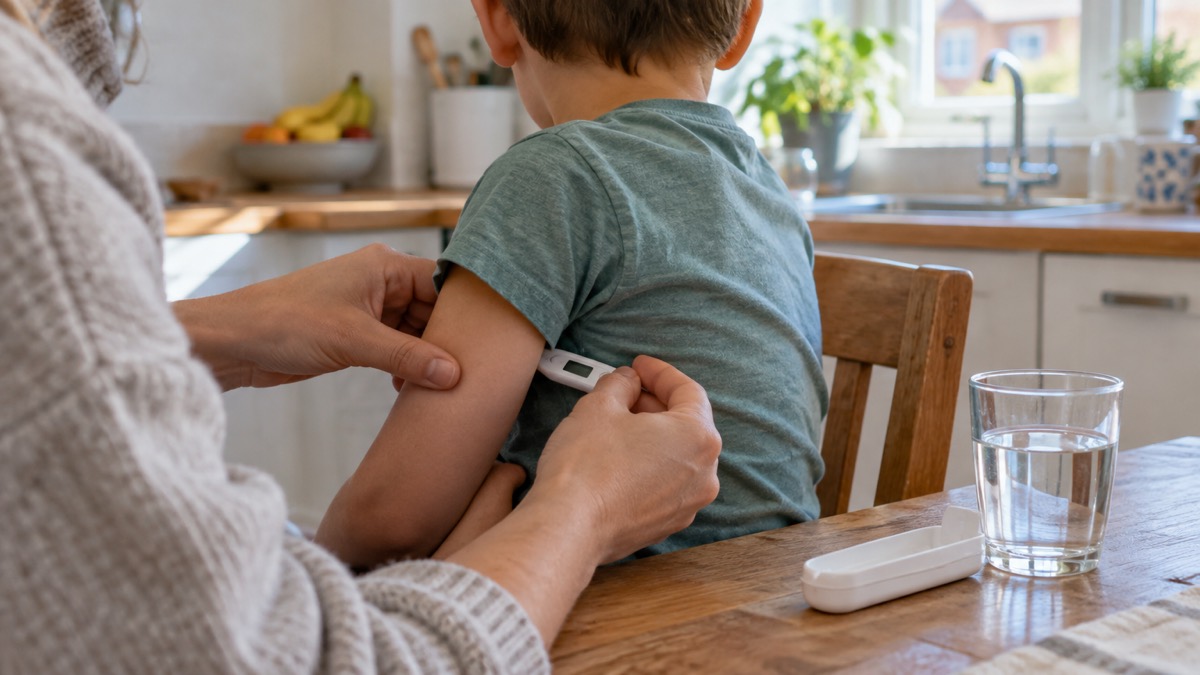
The same thermometer can give different readings depending on where it goes. NHS guidance is specific: digital thermometers are quick to use, accurate and can be used under the armpit, and you should always use the thermometer under the armpit with children under five, leaving it in place for the time stated in the manufacturer's instructions4. That last point is the one people skip. A stick thermometer pulled out early reads low.
Forehead strip thermometers are a separate case. NHS guidance states plainly that strip-type thermometers, which you hold on your child's forehead, are not an accurate way of taking their temperature, because they show the temperature of the skin, not the body4. If you already own one, treat it as a rough indicator at best and use a digital stick thermometer for a reading you would act on.
Ear thermometers sit in between. The reading depends on the probe being placed correctly in the ear canal, so follow the maker's instructions for your model. If you are considering a specific ear thermometer, the Braun ThermoScan 7 page describes one model in detail.
The principle behind all of this is the same one that applies to other home monitoring devices. NHS guidance on pulse oximeters explains that they measure blood oxygen by transmitting light through a finger and are more accurate than smart watches or phones, which make less accurate readings by reflecting light off the skin8. Where you measure, and with what, decides how much you can trust the number.
What an infrared thermometer can and cannot tell you
An infrared thermometer measures surface temperature, usually at the forehead or in the ear, and converts it to an estimated body temperature. Used properly, that is useful: it is quick, it does not disturb a sleeping child, and it avoids contact. What it cannot do is tell you whether someone has a specific infection.
The MHRA is explicit on this point. Its 2021 caution states that infrared thermometers are not a reliable way to detect if people have the virus3. A fever is one sign of illness among many, and plenty of people with an infection do not have a raised temperature at the moment you check. If you are worried about COVID-19 symptoms, the COVID-19 guide sets out what to look for and when to stay at home, and the lateral flow tests page explains home testing.
The same caution applies to other devices that promise more than they deliver. NHS guidance notes that some new devices such as smartwatches can measure blood oxygen levels, but these devices are generally not medically accurate and should not be used for monitoring oxygen levels of someone with coronavirus9. A thermometer, whatever type, is a fever-checking tool, not a diagnostic device.
Non-compliant infrared thermometers sold in the UK
In July 2021 the MHRA published a caution about infrared thermometers being sold in the UK that do not comply with the regulations3. The notice explains that this type of device had become increasingly available in the UK during the COVID-19 pandemic, and that these thermometers are making claims that they can be used for a medical purpose3. That claim is what brings them within the Medical Devices Regulations 2002, which means they should have been assessed to make sure they meet the essential requirements of those regulations3.
The practical consequence for a household is that the infrared thermometer market contains products that have not been through that assessment. The MHRA's concern is not that infrared technology cannot work; it is that some devices sold as medical thermometers have not been shown to meet the requirements. A device that has not been assessed cannot be assumed to give a reading you can act on.
This is not unique to thermometers. UK product safety notices regularly flag goods that do not meet the regulations they are sold under. A cordless tyre inflator was found not to meet the requirements of the Electrical Equipment (Safety) Regulations 201610, and a rechargeable hand warmer sold through online marketplaces was found not to meet the same regulations11. The pattern is the same: a product reaches buyers without the conformity assessment the law requires.
For a thermometer, the risk is quieter than a faulty heater, but it matters. A parent who trusts an inaccurate reading may delay seeking help, or may act on a fever that is not there. The MHRA's checklist, set out below, is designed to catch that before you buy.
Checks before you buy an infrared thermometer
The MHRA's caution includes a short list of things to look for. Work through it before you pay, whether you are in a shop or buying online.
- The manufacturer's name and address. The MHRA asks for the name and address of the manufacturer on the product or packaging3. It is how the device can be traced back to whoever is responsible for it.
- The CE or UKCA marking. The notice points to detailed information on the CE and UKCA marking3. A legitimate medical device should carry the appropriate marking for the market it is sold in.
- The medical claim. If the packaging says the device is for checking fever or body temperature, it is making a medical claim and should meet the Medical Devices Regulations 20023.
- The instructions. Read them before you rely on a reading, and follow the maker's instructions for your model.
General product safety advice from the Office for Product Safety and Standards adds a further step: check product reviews before buying12. Reviews are not a substitute for the conformity information, but they can flag a device that repeatedly reads wrongly or arrives without the paperwork.
When you should not buy the thermometer
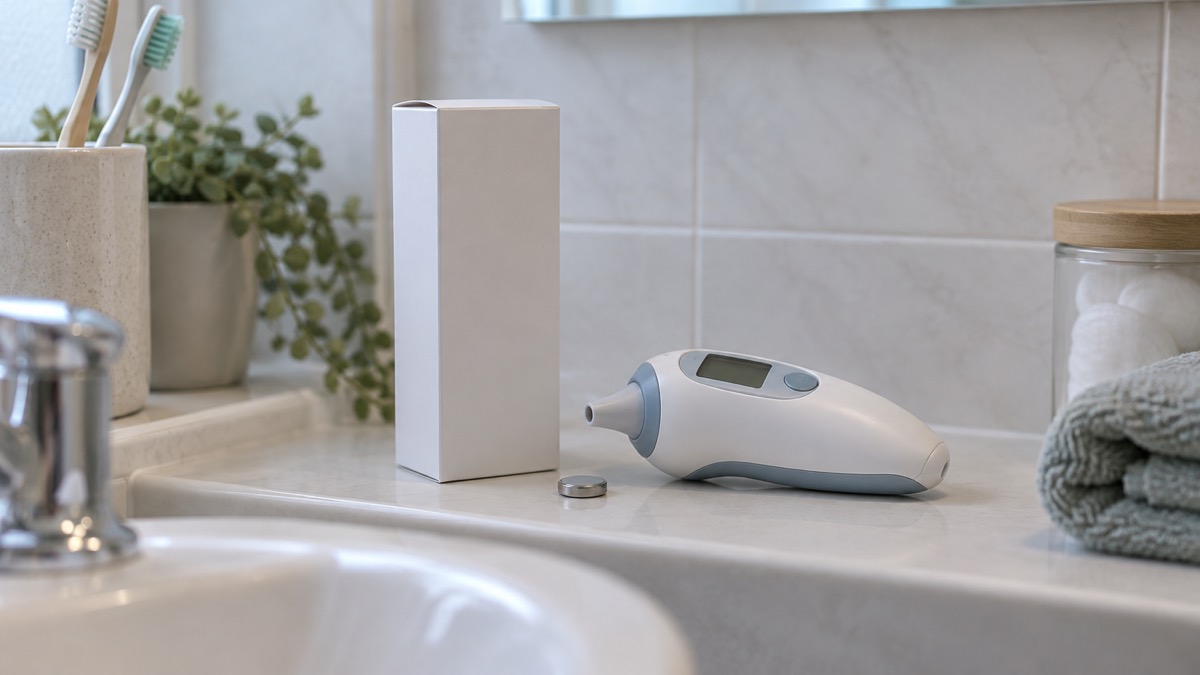
There are clear cases where the answer is to walk away. The first is the one the MHRA sets out: if the manufacturer's name and address are missing and the seller cannot provide them, you should not buy the thermometer3. That applies equally to a market stall, a online listing and a shop.
The second is a thermometer that makes health claims you cannot verify. The MHRA's caution exists because devices were being sold with medical claims that had not been assessed3. If a seller cannot tell you what the device is and who made it, that is the answer.
The third is second-hand equipment more generally. Official fire safety guidance is consistent on this: do not buy portable heaters second hand13, and avoid buying second-hand paraffin heaters because they may not meet current safety standards14. A thermometer is a lower-risk purchase than a heater, but the principle holds: you cannot know the history or conformity of a second-hand medical device.
There is also a category of thermometer you should not use even if you own one. Mercury-in-glass thermometers are no longer available to buy4, and NHS guidance says not to use them because they can break, releasing small shards of glass and highly poisonous mercury6. If you find one in an old first aid kit, dispose of it safely rather than putting it in a child's mouth.
| Situation | What to do | Why |
|---|---|---|
| No manufacturer name or address | Do not buy3 | The device cannot be traced or verified |
| Seller cannot confirm the medical claim | Do not buy3 | It may not meet the Medical Devices Regulations 2002 |
| Second-hand thermometer of unknown history | Avoid | Conformity and condition cannot be confirmed |
| Old mercury-in-glass thermometer | Do not use6 | Risk of broken glass and poisonous mercury |
Reporting a faulty thermometer to the MHRA
If a thermometer you own turns out to be faulty, gives readings you cannot trust, or arrives without the information the MHRA asks for, report it. The MHRA's caution says to report any problems with the thermometer to the MHRA or your national reporting authority3. In the UK, concerns about medicines or medical devices go through the MHRA Yellow Card Scheme15.
Reporting is not just a complaint. It is how a device that should not be on sale gets looked at, and it protects the next household that considers buying one. Keep the packaging, the receipt and any instructions, and note what went wrong and when.
If the thermometer is part of a wider home health set-up, it is worth knowing how other devices are handled. NHS guidance on home oxygen monitoring says that where digital monitoring options are available, all patients should be offered a paper alternative9, a reminder that a device reading should always sit alongside a person's actual condition. The pulse oximeters guide explains the limits of another home monitor in more detail.
For a household first aid kit, the practical conclusion is straightforward. Keep a digital stick thermometer, use it under the armpit for children under five and in the mouth for older children and adults, and write down the reading and the time before you call for advice1. If you want an infrared thermometer as well, buy one that carries the manufacturer's name and address and the conformity marking, and treat its reading as one piece of evidence rather than a diagnosis3. The medicine cabinet checklist and the first aid guide set out what else belongs alongside it.
Sources (15)
- What should I keep in my first aid kit?, Collingwood Surgery (NHS), 2026
- Self-care advice, Birmingham and Solihull ICB, 2026
- Infrared (IR) thermometers: caution in use, MHRA, 27 July 2021
- Safety first aid kit, NHS 111 Wales, 19 April 2021
- What to do if your child is unwell, North East London ICB, October 2024
- Newborn essentials first aid, NHS 111 Wales, 19 April 2021
- Rapid Digital Thermometer, Steroplast, 2026
- COVID oximetry at home, NHS England, 2026
- FAQs for COVID virtual wards and COVID oximetry at home, NHS England, 2026
- Product recall: Ring Automotive cordless tyre inflator, OPSS, 23 July 2025
- Product safety report: electric rechargeable hand warmer, OPSS, 11 February 2025
- OPSS safety awareness leaflet, Office for Product Safety and Standards, 2024
- Heaters and electric blankets, Lincolnshire Fire and Rescue, 2026
- Portable heaters, Cheshire Fire and Rescue Service, 2026
- Medication and medical devices, West Yorkshire Fire and Rescue Service, 2026