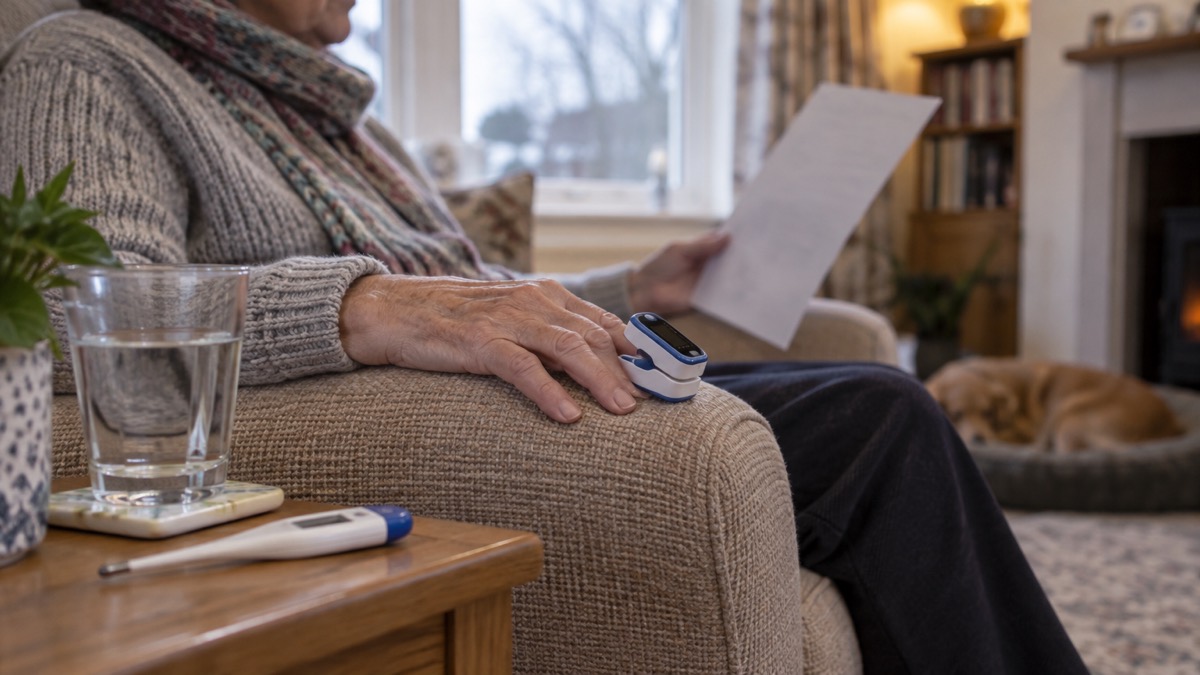
A pulse oximeter is a small medical device that you put on the tip of your finger to check someone's oxygen levels1. It works by transmitting light through the finger, and it shows two numbers on its display: an estimate of how saturated your blood is with oxygen, and your heart rate. During the coronavirus pandemic the NHS used these devices at scale, giving them to people with COVID-19 so that falls in oxygen could be caught early at home1.
Two things matter before you rely on one. First, a home pulse oximeter gives an estimate, not a measurement: NHS England states that oximeters secured through the NHS Supply Chain Framework are stated by manufacturers to provide an estimation of blood oxygen level within a range of 2 to 3% accuracy2. Second, the NHS has received reports that pulse oximeters can be less accurate for people with darker skin, because they may show higher readings of the oxygen level in the blood2. Both points change how you should read the numbers, and this page explains how.
If you are using an oximeter because you are ill, the device is a tool for spotting change, not for diagnosing yourself. NHS England asks everyone offered an oximeter by the NHS to speak to a health or care professional before using it, and to tell them about any concerns and questions2.
What a pulse oximeter is and what it measures
A pulse oximeter is a small medical device, usually a plastic clip, that is put on the tip of a finger to check someone's oxygen levels1. Inside it are light sources and a sensor. The device measures the oxygen saturation of the blood, shown on the display as the %SpO2 figure, alongside a pulse rate and a pulse amplitude reading2. That saturation figure is the proportion of the haemoglobin in the blood that is carrying oxygen.
The reason this is useful at home is that oxygen levels can fall before a person feels seriously unwell. NHS England notes that pulse oximetry can help with earlier detection of silent hypoxia, where people have low oxygen levels in the absence of significant shortness of breath1. In other words, someone can be breathing comfortably and still have oxygen levels that need medical attention. A finger clip is one of the few pieces of household kit that can flag that change before it becomes an emergency, which is why the NHS built a whole monitoring service around it during the pandemic.
It is worth being clear about what the device is not. It is not a treatment and it does not deliver oxygen. Home oxygen therapy is a separate matter: the Devon and Somerset Fire and Rescue Service states plainly that oxygen should not be administered or used without direction from a medical professional3. An oximeter only tells you something, and what it tells you is an estimate, as the next sections explain.
Finger oximeters are more accurate than smart watches and phones
Many smart watches and some phones now claim to measure blood oxygen. NHS England draws a clear line between these and a proper finger oximeter: pulse oximeters measure blood oxygen levels by transmitting light through a finger, and they are more accurate than smart watches or phones, which make less accurate readings by reflecting light off the skin1.
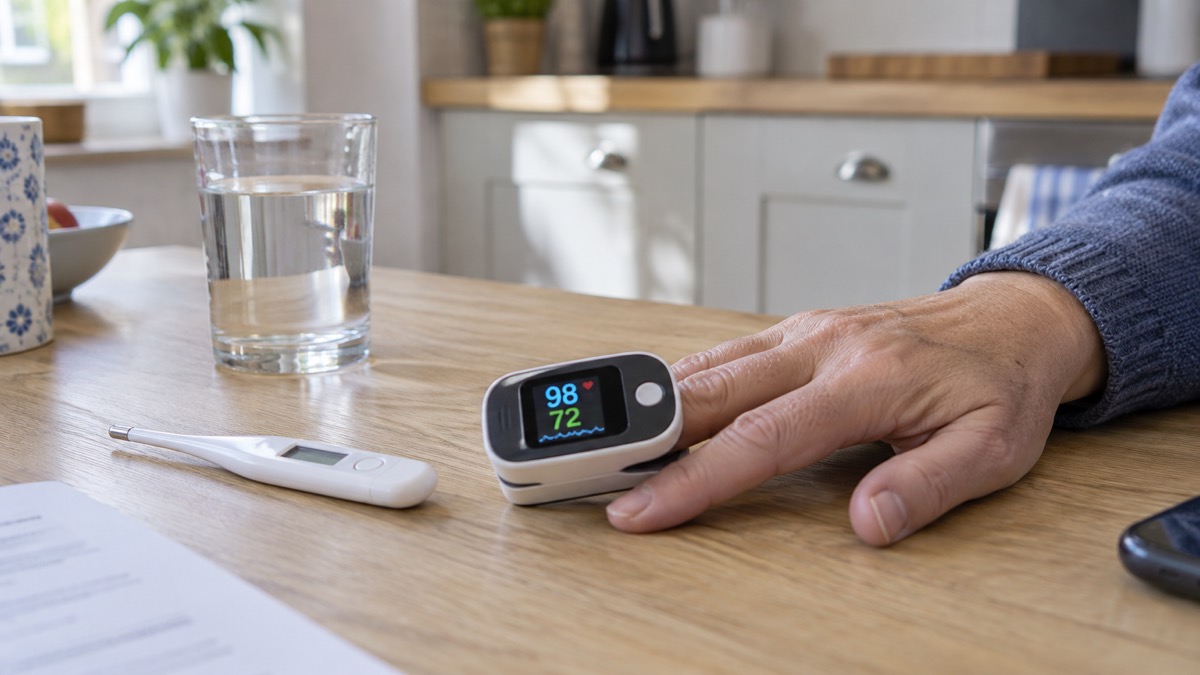
The NHS is blunter still about watches. Its guidance on virtual wards and home oximetry states that while some new devices such as smartwatches can measure blood oxygen levels, these devices are generally not medically accurate and therefore should not be used for monitoring the oxygen levels of someone with coronavirus2. The difference is the measurement method: light passed through the thin tissue of a fingertip gives the sensor much more to work with than light bounced off the surface of a wrist.
The practical rule for a household is simple. If you are checking the oxygen of someone who is unwell, use a finger oximeter, not a watch or an app. A watch reading might be interesting, but it is not the basis for deciding whether someone needs help, and treating it as such could delay that help. If you are buying a device for this purpose, buy a finger oximeter, and check the safety marks covered later on this page.
The same principle of using the right device for the job applies elsewhere in the home medicine cabinet. NHS guidance on what to keep for children notes that a digital thermometer is best to use for a fast and accurate reading4, and that strip-type thermometers held on a child's forehead are not an accurate way of taking their temperature because they show the temperature of the skin, not the body5. Digital thermometers are quick to use, accurate and can be used under the armpit, always under the armpit with children under five6. For more on that, see our page on thermometers for checking a fever at home.
Accuracy: an estimate within 2 to 3%
A home pulse oximeter does not measure the oxygen in your blood directly. NHS England states that pulse oximeters secured through the NHS Supply Chain Framework are stated by manufacturers as providing an estimation of blood oxygen level within a range of 2 to 3% accuracy2. Note the chain of words there: the manufacturers state the figure, and the devices supplied to the NHS through its framework are the ones it applies to. A device bought elsewhere may not carry the same stated accuracy.
What does a 2 to 3% range mean in practice? It means the number on the display is a band, not a point. A displayed figure sits within roughly 2 to 3% of the true value, so a single reading should never be treated as an exact measurement of what is happening in the bloodstream. NHS England's guidance to staff makes the corresponding point from the clinical side: it asks that clinical judgement is used when interpreting readings provided by patients2. If doctors are told not to take a single home reading at face value, a household should not either.
This is why the NHS frames home oximetry around change rather than absolute numbers. Its guidance says patients should respond to changes from their baseline, rather than a single reading in isolation2. Take readings when the person is well, or at the start of monitoring, and watch what the numbers do over time. A steady reading that sits where it always sits means something different from a reading that has drifted downwards across a day, even if both display the same figure at one moment.
The limits of home measurement come up in other first aid contexts too, and they are a useful reminder that no household check is definitive. Resuscitation guidance notes that checking the carotid pulse, or any other pulse, is an inaccurate method for confirming the presence or absence of circulation for lay providers7. The lesson generalises: household devices and checks are screening tools that tell you when to get help, not diagnostic instruments that tell you what is wrong.
Readings can be too high on darker skin
This is a known and acknowledged limitation, not a fringe concern. NHS England's own guidance on home oximetry carries the warning that there have been reports that pulse oximeters can be less accurate for people with darker skin because they may show higher readings of the oxygen level in the blood2. Because the device works by passing light through tissue and reading what comes back, skin pigmentation affects the signal. A reading that is too high is the dangerous kind of wrong: it can reassure a household that all is well when it is not.
The wider lesson, which NHS sources repeat across many conditions, is that visual and device-based signs can behave differently on darker skin, so you should know which signs to look for instead. NHS guidance on heat exhaustion notes that a change in skin colour can be harder to see on brown and black skin8. Guidance on sepsis in children says that on darker pigmented skin, colour changes may show on the inside of the forearms or palms9. Public Health Wales notes that on dark skin, the spots or rash of meningococcal disease can be more difficult to see10. And guidance on hypothermia says that blue or grey skin and lips may be easier to see on black or brown skin on the palms of the hands or the soles of the feet11.
So for a household monitoring someone with darker skin, the approach is twofold. Use the oximeter, but weight the trend rather than any single figure, and be readier to act on symptoms: how the person looks, sounds and behaves matters as much as the number. If in doubt, contact your GP or healthcare provider, as NHS guidance on home oxygen puts it: if you are unsure, please ask your GP or healthcare provider12.
Oxygen level or heart rate: reading the display
A pulse oximeter shows two different numbers, and it matters that everyone in the household knows which is which. NHS England guidance asks that patients know the difference between oxygen saturations and heart rate on the oximeter2. The oxygen saturation figure is the one that monitoring services are interested in; the heart rate figure is the pulse. Confusing the two, or reading the wrong one out to a nurse on the phone, gives a false picture.
Both numbers have their uses. Heart rate is one of the things clinicians check when diagnosing serious illness: NHS inform in Scotland notes that sepsis is often diagnosed by testing your temperature, heart rate, breathing rate and blood13. A fast heartbeat is also listed as a symptom of heatstroke14, and being too hot is listed as a cause of fainting15. So a pulse rate that is unusually fast for the person, alongside other symptoms, is itself a reason to seek advice, whatever the oxygen figure says.
The habit to build is to record both numbers, with the time, each time you take a reading. That gives whoever you contact a picture of the trend rather than a snapshot, and it matches the NHS's own instruction to respond to changes from baseline rather than a single reading in isolation2. A simple written log, or notes on a phone, is enough.
Talk to a health professional before relying on readings
The single most important instruction on this page is NHS England's: speak to a health or care professional before using the pulse oximeter, and tell them if you have any concerns and questions2. This applies to everyone offered an oximeter by the NHS, and it is sound practice for anyone who has bought their own. A health professional can tell you what figures are normal for the person being monitored, what change should prompt a phone call, and who to call.
There are several routes to that advice, and the right one depends on how urgent things feel:
- Your GP practice: if you have coronavirus and think you are eligible for the COVID Oximetry @home service, contact your GP1. If you are unsure about your oxygen, ask your GP or healthcare provider12.
- NHS 111 online: the North East Ambulance Service, which runs 111 online in its area, describes the outcomes you can expect, including that during daytime weekday hours, you might be advised to contact your GP, and that a nurse will give you a call to discuss your symptoms and advise you on what to do next16. See our guide to NHS 111: what it can help with and how to use it.
- Your maternity team, if you are pregnant: NHS England says pregnant women referred to a COVID Oximetry @home service should also be asked to contact their maternity team for specific advice around pregnancy and COVID-191.
- 999, in an emergency: the Welsh Ambulance Service lists among its reasons people call that for cardiac arrest you should phone 999 immediately and start CPR, and that its call handlers can guide you through the process17. Our page on when to call 111 and when to call 999 sets out the difference.
A few related cautions from official guidance are worth having in mind. Continue taking all prescribed medicines unless advised not to by a medical professional, and call NHS 111 if you have health concerns18. Follow the advice given by a health care professional when treating any illness at home, as Derbyshire County Council's scarlet fever guidance puts it19. And if you suspect someone has taken an overdose or been poisoned, do not try to treat them yourself: get medical help immediately20.
Spotting silent hypoxia and rapid deterioration at home
Silent hypoxia is where people have low oxygen levels in the absence of significant shortness of breath, and it has been noted in some coronavirus patients2. It is occasionally, and misleadingly, referred to as 'happy' hypoxia, because the person does not look or feel as ill as their oxygen levels suggest. This is the specific danger that home oximetry exists to catch: NHS England states that using a pulse oximeter means rapid deterioration and silent hypoxia are more likely to be identified, and people can get the help they need as quickly as possible2.
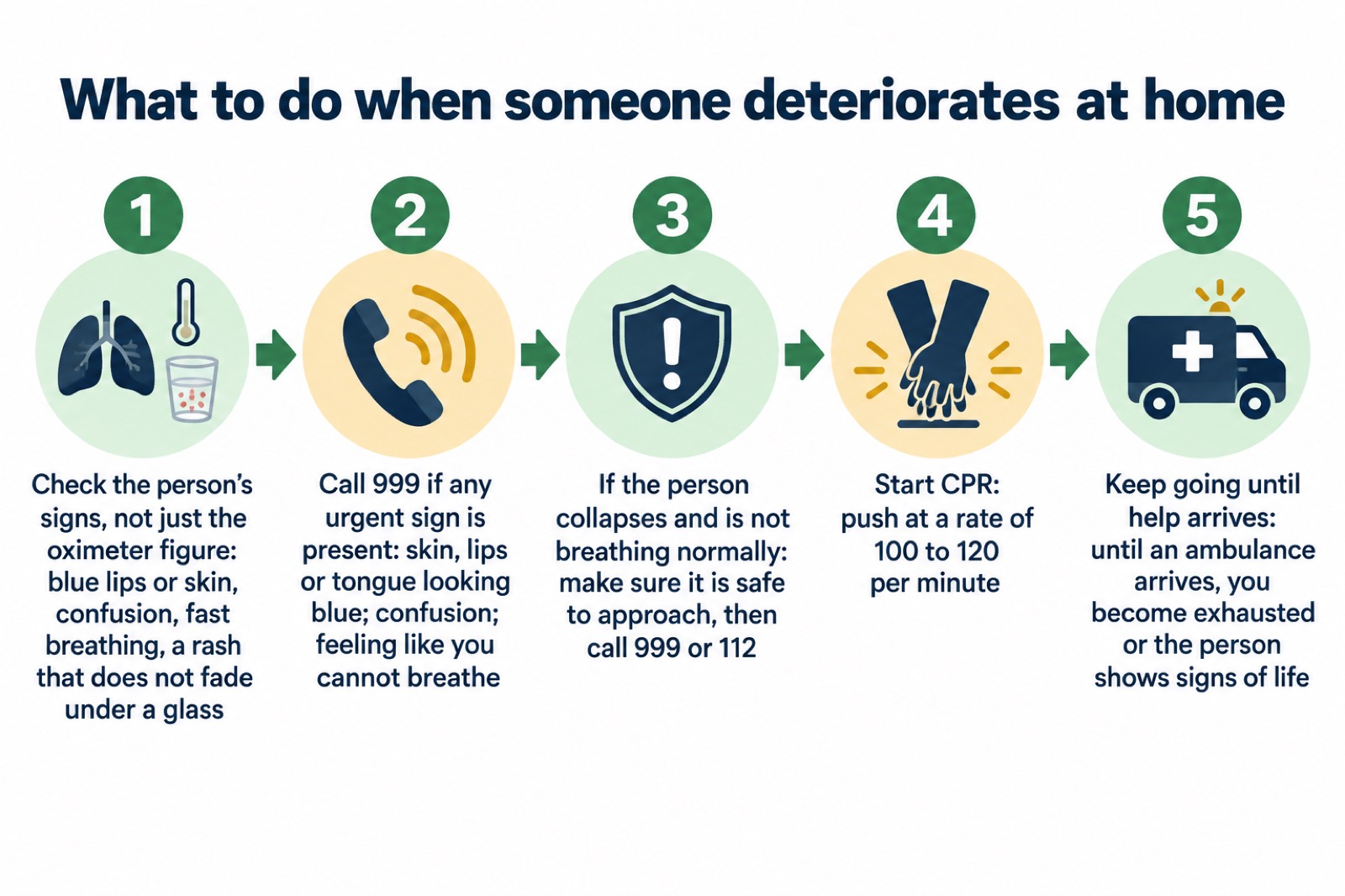
Because the oximeter is an estimate with known limits, pair it with the signs of deterioration that need no device at all. Sepsis is the body's extreme response to infection, and NHS guidance lists the signs that should prompt an urgent 999 call: skin that looks lighter than normal; skin, lips or tongue looking blue; red patches on the skin or a rash that does not go when you roll a clear glass over it; feeling confused; changes in speech or levels of confusion and difficulty communicating as usual; and feeling like you cannot breathe or breathing fast21. On darker pigmented skin, colour changes may show on the inside of the forearms or palms9, and on dark skin the spots or rash of meningococcal disease can be more difficult to see10. Our pages on meningitis and meningococcal disease and the glass test for a meningitis rash cover those signs in detail.
If someone does collapse and is not breathing normally, act immediately. NHS guidance on CPR says: if you find someone collapsed, make sure it is safe to approach, check response by shaking shoulders and asking loudly 'are you ok?', shout for help and ask a helper to call 999 or 112, or put your phone on hands-free and call yourself22. Push at a rate of 100 to 120 per minute22; NHS inform in Scotland gives the same rate, 30 compressions at a rate of 100 to 120 per minute23, and Yorkshire Ambulance Service's Restart a Heart guidance says to repeat compressions at a rate of 100 to 120 times a minute until an ambulance arrives, you become exhausted or the person shows signs of life24. The North West Ambulance Service teaches that for children and infants we still compress approximately 1/3 of the chest depth at the same rate, 100 to 120 compressions per minute25, and the North East Ambulance Service instructs adults to press down hard and fast 5 to 6cm on the chest26. Ambulance call handlers can guide you through the process and direct you to the closest public access defibrillator17.
COVID Oximetry @home: who could get an NHS oximeter
COVID Oximetry @home is the NHS England service through which people are provided with a pulse oximeter and supporting information to monitor their oxygen saturation levels at home for up to 14 days, supported by carers and/or family members where appropriate1. The service is usually offered by general practice working alongside community teams1. All clinical commissioning groups were recommended to set up such services for eligible patients in November 2020 as part of the NHS response to coronavirus1.
Eligibility, as NHS England sets it out, means being diagnosed with COVID-19, either clinically or by a positive test result, and symptomatic, and either aged 65 years or older, or under 65 and at higher risk from COVID-19, or where clinical judgement applies, considering individual risk factors such as pregnancy, vaccination status, learning disability, caring responsibilities and/or deprivation1. If you have coronavirus and think you are eligible for the service, contact your GP1.
Two special cases are worth knowing. Pregnant women referred to the service should also be asked to contact their maternity team for specific advice around pregnancy and COVID-191. And in Northern Ireland, the arrangement differs: patients who have tested positive for or are suspected of having COVID-19 in the community are seen at GP COVID Centres, and patients have to be referred to these centres by their own GP or by GP Out of Hours27.
| Aspect | England (COVID Oximetry @home) | Northern Ireland |
|---|---|---|
| Who supplies the oximeter | The service, usually offered by general practice working alongside community teams1 | GP COVID Centres for positive or suspected COVID-19 cases27 |
| How to access it | Contact your GP if you think you are eligible1 | Referred by your own GP or by GP Out of Hours27 |
| Main eligibility | Diagnosed, symptomatic, and 65 or older, or under 65 and at higher risk, or clinical judgement applies1 | Tested positive for or suspected COVID-19 in the community27 |
| Duration | Up to 14 days of monitoring1 | Set by the referring service |
A related NHS arrangement is the COVID virtual ward: on discharge to the virtual ward, patients are provided with a pulse oximeter in addition to any other treatment and support they may require2. If you are looking after someone with COVID-19 at home more generally, our pages on looking after someone who is ill and staying at home when ill cover the rest of the picture.
How long monitoring lasts, and returning the device
Monitoring under COVID Oximetry @home runs for up to 14 days1. If, after 14 days of the onset of symptoms, patients show no signs of deterioration with coronavirus, they are appropriately discharged from the service1.
When the monitoring period ends, do not post the device back. NHS England is explicit: oximeters must not be sent via postal services due to contamination risks to staff and the general population2. Follow the return arrangements given with your device, or ask the GP practice or community team that supplied it how they want it collected or returned.
Safety standards and reporting a faulty oximeter
All medical devices on the UK market must meet a series of requirements for safety and performance under the UK Medical Device Regulations 2002 (SI 2002 No 618, as amended)2. Pulse oximeters provided by the NHS through COVID Oximetry @home and COVID virtual ward services have been secured through the NHS Supply Chain Framework, are CE marked and meet the ISO standard 80601-2-61:20172. If you are buying your own device rather than receiving one from the NHS, check for a CE mark, which signals the maker's declaration that the device meets the applicable requirements.
If a device seems faulty, gives erratic readings or worries you in any way, report it. NHS England states that safety concerns regarding pulse oximeters should be reported to the MHRA via the COVID Yellow Card scheme, selecting 'other devices/equipment' from the drop-down list, and that details should be sent to the national team at NHS England and NHS Improvement; local clinical engineering departments and medical device safety officers (MDSOs) should also be informed2. If the device came from an NHS service, tell the practice or team that supplied it as well, so they can replace it and flag the problem.
"safety concerns regarding pulse oximeters should be reported to the MHRA via the COVID Yellow Card scheme (select 'other devices/equipment' from the drop-down list)"
It is worth knowing that unsafe medical and care products do reach UK households and get recalled. A 2026 product safety report from the UK Government's product safety system concerned an ALEENFOON Caregiver Pager, a caregiver 'pager' device with an SOS buzzer and a chiming plug, sold via Amazon, which does not meet the requirements of the Electrical Equipment (Safety) Regulations 2016 or the Plugs & Sockets etc (Safety) Regulations 199428. The lesson for a household is to buy from sources that make the maker and the standards clear, and to report anything that seems unsafe.
If someone in your household uses medical equipment that needs electricity, a few fire safety habits apply. Warwickshire County Council advises people using medication and medical equipment at home to regularly check electrical cords, plugs and sockets for damage and to avoid using extension leads or overloaded electrical outlets29. That advice sits alongside our general guidance on backup power at home if you are preparing for power cuts.
Where to get help, and what to have ready
An oximeter is one item in a household's readiness for illness. Alongside it, keep the basics that official guidance recommends for checking and caring for someone unwell at home: a digital thermometer, which gives a fast and accurate reading4, and a properly stocked medicine cabinet, which our medicine cabinet checklist covers. If you are caring for someone at risk of falls or seizures, telecare services can include devices such as an epilepsy monitor, worn on the wrist or placed on the bed, that can activate a call in the event of certain types of seizures.
For people at higher risk during hot weather, official guidance is to continue taking all prescribed medicines unless advised not to by a medical professional, and to call NHS 111 with health concerns18. Very hot weather can affect people with diabetes: sitting in the sun for long periods may raise sugar levels if you are less active, and if you take insulin to treat your diabetes, it may be absorbed more quickly from the injection site, which increases the risk of sugar levels falling30. In cold weather, watch out for signs of hypothermia: uncontrollable shivering, slow or slurred speech, memory lapse and drowsiness31, with Ceredigion County Council adding memory loss, disorientation, incoherence and apparent exhaustion to the list, and advising that you move the person to a warm location, remove wet clothing, warm them from the inside with a warm non-alcoholic drink if they are conscious, and get medical help immediately32. In hospital treatment for hypothermia, your heart rate will be monitored and you may be given oxygen to help you breathe11.
The help routes, in short:
- GP practice: for eligibility for home oximetry, for advice before using a device, and whenever you are unsure about oxygen levels1.
- NHS 111 or 111 online: for health concerns when you are not sure how urgent they are; you may be advised to contact your GP during daytime weekday hours, or a nurse may call you back16.
- 999: for the urgent signs listed above, for suspected cardiac arrest, and for suspected poisoning, where you should get medical help immediately21.
- Pharmacist: the Northern Ireland Ambulance Service advises talking to your local pharmacist before calling 999 for a non-life-threatening situation33, and our page on Pharmacy First explains what a pharmacist can treat.
For the wider picture of preparing your household for illness and outbreaks, start with our guide to health emergencies, and for the specific question of what to do with a positive COVID-19 test, see COVID-19 now: symptoms, testing and staying at home.
Sources (33)
- COVID Oximetry @home, NHS England
- FAQs for COVID virtual wards and COVID Oximetry @home, NHS England
- Specialist health equipment, Devon and Somerset Fire and Rescue Service, 2026
- What to keep in your medicine cabinet, Healthier Together (Hampshire, Isle of Wight and Surrey), 2026-10-28
- Newborn essentials and first aid, NHS 111 Wales, 2021-04-19
- Safety: first aid kit, NHS 111 Wales, 2021-04-19
- Adult basic life support and automated external defibrillation, East London NHS Foundation Trust, 2015
- Heat exhaustion and heatstroke, NHS 111 Wales, 2026-06-22
- Sepsis, Mid and South Essex NHS Foundation Trust, 2026-10-29
- Meningitis, Public Health Wales, 2026-10-15
- Hypothermia, NHS 111 Wales, 2025-05-14
- Oxygen, Keeping My Chest Healthy (Barking and Dagenham, Havering, Redbridge and Waltham Forest CCG), 2026-10-25
- Sepsis, NHS inform Scotland, 2026-09-28
- Staying well in hot weather, Berkshire Healthcare NHS Foundation Trust, 2026-10-29
- Fainting, NHS England, 2026-08-17
- 111 online, North East Ambulance Service NHS Foundation Trust
- Some of the reasons people call 999, Welsh Ambulance Services NHS Trust, 2026-10-29
- Beat the heat: staying safe in hot weather, UK Government, 2026-07-21
- Scarlet fever, Derbyshire County Council, 2026-10-29
- Poisoning, nidirect (Northern Ireland Government), 2021-06-27
- Recognising sepsis, Keeping My Chest Healthy (Barking and Dagenham, Havering, Redbridge and Waltham Forest CCG), 2026-10-29
- CPR, NHS England, 2026-10-29
- How to give an adult CPR, NHS inform Scotland, 2026-09-08
- How do I perform CPR?, Yorkshire Ambulance Service NHS Trust, 2026-10-29
- Learn to save a life, North West Ambulance Service NHS Trust, 2024-06-18
- Life saving skills, North East Ambulance Service NHS Foundation Trust, 2024-11
- COVID-19, Health and Social Care Northern Ireland, 2024-07-11
- Product safety report: ALEENFOON Caregiver Pager sold via Amazon, UK Government, 2026-08-10
- Fire safety: using medication and medical equipment, Warwickshire County Council, 2026-10-29
- Advice for vulnerable people: stay well this summer, NHS Norfolk and Waveney Integrated Care Board, 2026-05-29
- Travelling in heavy snow and ice, Met Office, 2026-10-25
- Snow and ice: severe weather advice, Ceredigion County Council, 2026-10-29
- When to call 999, Northern Ireland Ambulance Service
 Medicine Cabinet Checklist
 Sick at Home Supplies Kit
 Caring for Someone Ill at Home
 Pandemics and UK Household Plans
 Outbreaks Near You
 UK Health Security Agency
 Staying Home When Ill
 Stopping Infections at Home
 Caring for a Sick Person at Home
 Keeping Prescription Medicine
 Medicine Shortages Explained
 Storing Medicines Safely
 Urgent Care and A&E
 Vaccines Against Outbreaks
 Flu Symptoms and Getting Help