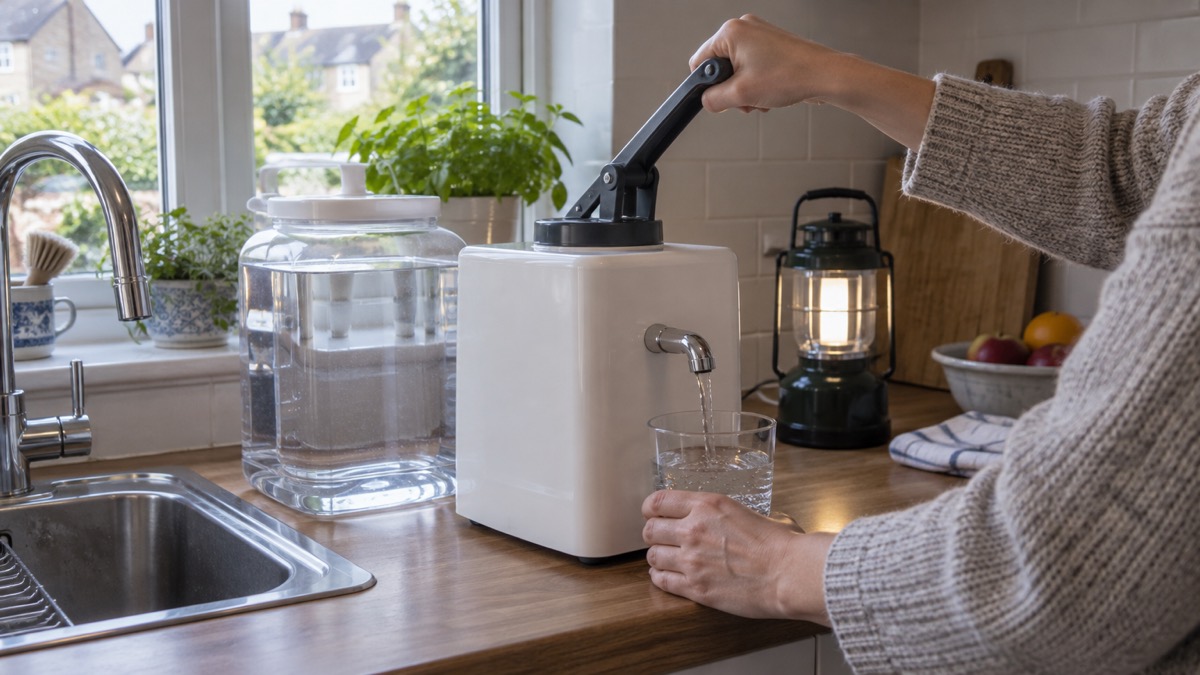
The LifeSaver Cube is a five litre container with a hand pump and an ultrafiltration cartridge built into it. You fill it from a freshwater source, pump to push the water through the filter, and draw clean water from the tap. The maker says one cartridge purifies up to 5,000 litres, removing 99.99% of viruses, bacteria, parasites and microplastics, and that it needs no batteries or power1. It is made in the UK and is small enough, at 20cm tall, wide and deep, to sit in a kitchen cupboard2.
For a UK household it is a backup, not a mains supply. The maker sells it for exactly the situations this site covers: a boil water alert at home, or the mains being cut off or compromised, with the emergency pack intended for purifying water from a water butt, pond or nearby river3. If you are weighing up whether a filter is the right answer for your household at all, our guide to emergency filters sets the types side by side, and what each filter removes explains the difference between hollow-fibre, ceramic, carbon and reverse osmosis.
What follows is what the maker states about its own product: what it holds and filters, what it takes out, the water it must never touch, how to prime and pump it, and what to do when the cartridge reaches the end of its life.
Specifications: 5 litres stored, 5,000 litres filtered
The Cube is a store-and-filter unit rather than a bottle or a gravity set. You fill the body, pump to pressurise it, and open the tap. The maker lists a storage capacity of 5 litres and a filtration capacity of 5,000 litres per cartridge2. The replacement cartridge is sold on the same 5,000 litre figure8.
| Specification | Maker's figure |
|---|---|
| Storage capacity | 5 litres2 |
| Water filtered per cartridge | 5,000 litres1 |
| Initial flow rate | 1.25 litres/min at 0.85 bar3 |
| Dimensions | 20cm tall, wide and deep2 |
| Power needed | None, no batteries2 |
| Certification | Independently tested and certified to NSF P2312 |
| Country of manufacture | Great Britain2 |
| Warranty | 2 years6 |
Two things in that table matter more than the rest. The first is the flow rate: 1.25 litres a minute is the maker's initial figure at 0.85 bar, and it will not stay there for the life of the cartridge3. The second is the certification. The maker states the Cube is independently tested and certified to meet NSF P231 for water purification2. Its own pages on independent testing describe the technology as a physical barrier against viruses, bacteria and cysts10. If you want to understand what a standard like that actually tests, our page on filter claims and certification explains NSF standards and log reduction.
The Cube comes with one pre-installed ultrafiltration cartridge, one replaceable Activated Carbon Disc, the pump and tap, a maintenance pack with a protective cartridge cap and two spare O-rings, and a paper manual6. The emergency preparedness pack adds a second foil-wrapped cartridge and two packs of six foil-wrapped carbon discs12.
What it removes: bacteria, viruses, cysts and microplastics
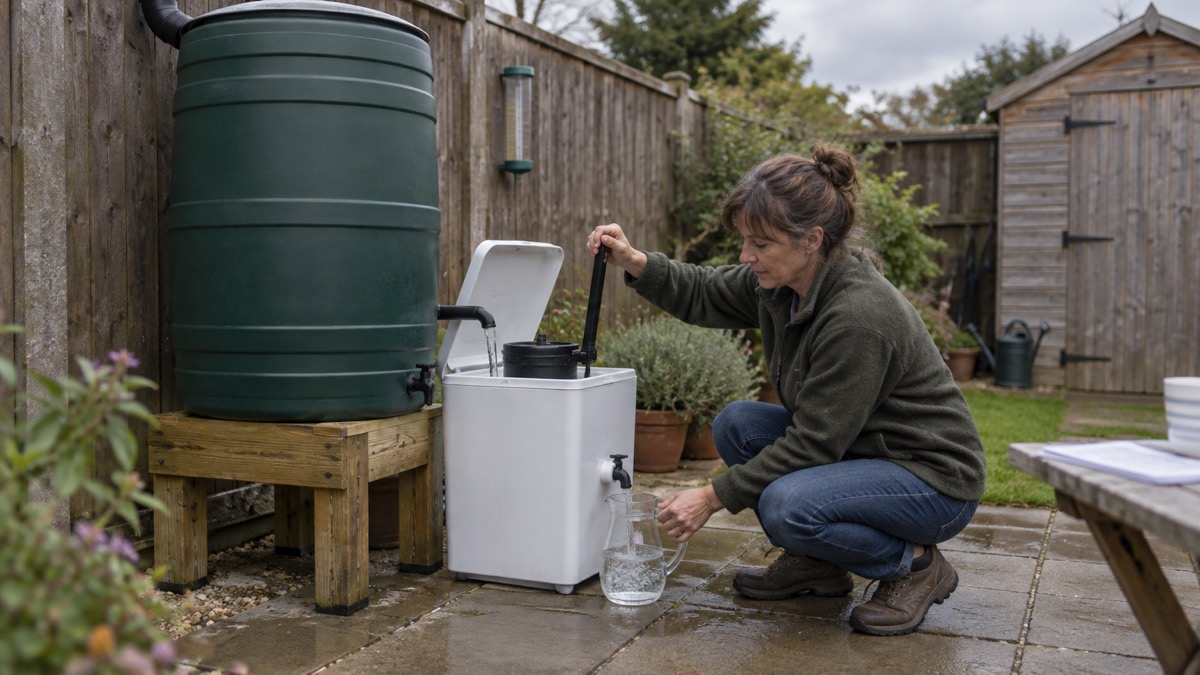
The maker's headline claim is that the Cube removes 99.99% of viruses, bacteria, parasites and microplastics using a single filter2. The technology is ultrafiltration: the maker describes the cartridge as a microbiological water filter that uses ultra filtration to filter out viruses, bacteria, cysts and parasites from contaminated water sources13. Its testing pages put it plainly: the purification technology provides a physical barrier against viruses, bacteria and cysts10.
The carbon disc does a different job. It filters out a range of heavy metal and chemical contaminants including chlorine, lead, nickel and cadmium2, and the maker rates each disc at up to 100 litres14. That is why the disc is the part that affects taste rather than safety. The maker states that water is still safe to consume without an Activated Carbon Filter installed3, and that once the carbon is exhausted the water will start to taste off, which is your cue to change it14.
A word on the numbers. The maker's pages give the removal figure as 99.99% for viruses, bacteria, parasites and microplastics, and the replacement cartridge is described the same way, removing 99.99% of viruses, bacteria and parasites from up to 20,000 litres of water10. What the Cube does not claim to do is remove dissolved chemicals, salt or fuel. That is the subject of the next section, and it is the limit that matters most.
Water it must never be used with
The maker is direct: do not use the Cube with saltwater or chemically contaminated water2. Ultrafiltration is a physical barrier, so it catches particles and organisms, but it does not take out dissolved salt or chemicals. A filter that has been used on fuel, pesticide run-off or salty water is not a filter you can trust afterwards.
The maker's intended sources are freshwater: rivers, lakes and streams2, and for the emergency pack, a water butt, pond or nearby river4. If you are drawing from a stream or river, read our guide to drinking from streams, rivers and other sources first, because the source you choose matters as much as the filter.
There is also a storage instruction that protects the water you have already cleaned. The maker recommends storing dirty water, either in the Cube or in other containers, and filtering it through the Cube as and when you need clean water, to prevent recontamination of previously filtered water9. In practice that means keeping the Cube charged with untreated water and drawing drinking water as you need it, rather than filling it with clean water and letting it sit.
Priming the Cube before you need it
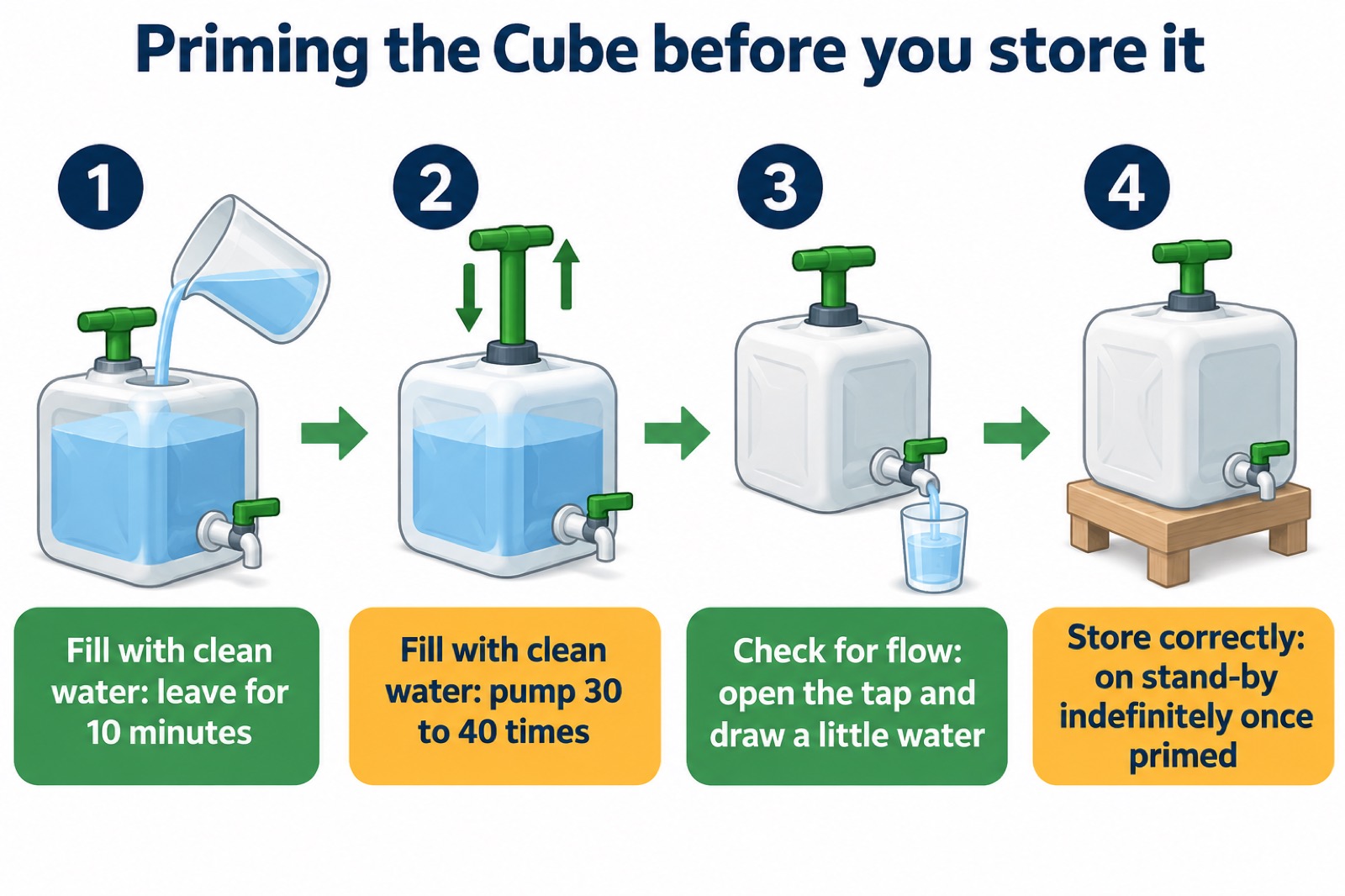
Priming is the step that decides whether the Cube works when you reach for it. The maker's own words on its tap page are blunt: "Priming is everything"16. A customer review makes the same point from the other side, recommending that you read the set-up instructions carefully and watch the maker's video on priming the container17.
The maker's manual sets out the priming sequence. Fill the Cube with clean water and leave it for 10 minutes5. Then fill with clean water and pump 30 to 40 times5. That pumping pressurises the unit and wets the membrane. Once primed, if stored correctly, the Cube can stay on stand-by indefinitely18.
Do the priming on a day when nothing is going wrong. It is the moment to find out that a seal is missing or the tap will not lock, while you still have mains water and time to order a part. Our supply interruption checklist sets this alongside the other jobs worth doing before an outage, and looking after a filter covers priming, cleaning and frost for filters generally.
Filtering water: pump 30 to 40 times, then open the tap
The routine is simple and the maker repeats it on its product pages: fill with water, pump the Cube, drink clean water9. Fill from a freshwater source, pump using the integrated hand pump to activate filtration, and open the tap to drink2.
The manual gives the working numbers. With the tap closed, pump 30 to 40 times5. Then open the tap. While the tap is open, continue pumping at a rate of approximately one pump per second to maintain flow5. The tap itself has two positions: press down for an instant flow of water, or lock it down for a continuous flow16.
- Fill the Cube from your chosen freshwater source.
- With the tap closed, pump 30 to 40 times5.
- Open the tap and draw water into a clean container.
- Keep pumping at about one pump per second while the tap is open5.
- Close the tap when you have what you need, and store the rest as dirty water until you next draw9.
The filter stops working at 5,000 litres so you cannot drink unfiltered water
The Cube's cartridge has a built-in end point. The maker states that the cartridge has an integrated failsafe mechanism that prevents water flow once it reaches capacity, ensuring you never drink unfiltered water2. When the cartridge reaches 5,000 litres it will automatically stop flowing, and you replace it with a genuine LifeSaver replacement cartridge2.
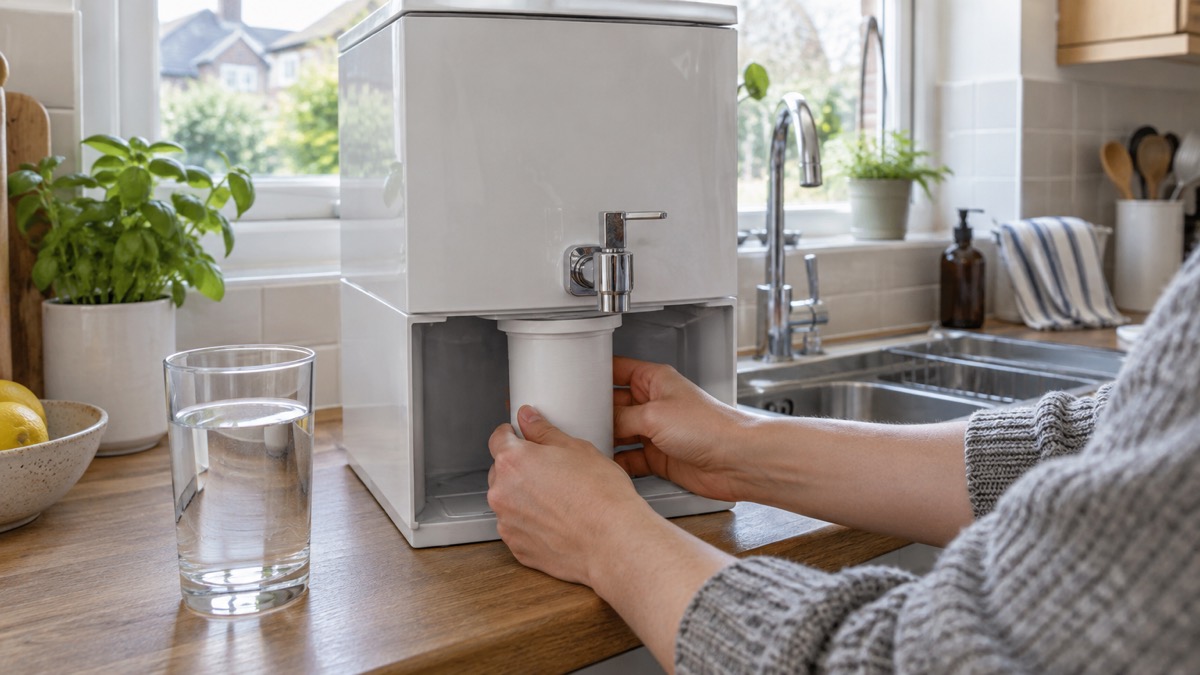
Before it stops altogether, the flow gives you warning. As the cartridge approaches end of life, the flow reduces and it becomes harder to pump20. The maker explains why: the pores in the filter membrane are becoming blocked and the FailSafe technology is starting to act21. Ultimately water flow will stop altogether, and you should replace the cartridge before that happens21.
That design is the reason the Cube is a reasonable thing to keep for an emergency. You cannot accidentally keep drawing water past the point where the filter has stopped protecting you, because the water stops coming. The trade-off is that you must keep a spare cartridge if you want the Cube to keep working beyond its first 5,000 litres. The emergency preparedness pack includes a second foil-wrapped cartridge for that reason12.
Storage, cleaning and replacement parts
Store the Cube in a cool, dry place when it is not in use, and rinse it with clean water periodically2. Replace the activated carbon filters as needed for fresh-tasting water2. Once primed and stored correctly it can stay on stand-by indefinitely18.
The parts that wear are all replaceable, and the maker sells them individually:
- Ultrafiltration cartridge: 5,000 litres per cartridge, supplied with a cartridge fitting pack8.
- Activated carbon discs: up to 100 litres each, sold in packs of six14.
- Tap: a replacement tap for use with the Cube, with a precise shut off23.
- Pump: a replacement pump, one per pack24.
- Maintenance pack: a protective cartridge cap and two spare O-rings, included with the Cube6.
On shelf life, the maker's pages do not all agree. The standard cartridge is given as 3 to 5 years from the date of purchase6, while the foil-sealed version is given as 10 years7. The Cube itself is sold foil-wrapped for a disaster kit, giving peace of mind for at least ten years2, and the emergency pack is listed with a shelf life of 10 years from the date of purchase4. Check the date on the packaging you actually hold rather than relying on the general figure.
The materials are worth noting for households with sensitivities: the maker states that product materials and water effluent are both BPA and BPS free8.
Tap faults and how to get a replacement
The most commonly reported fault on the Cube is the tap. Some customers report the tap leaking or being faulty, and the maker despatches a replacement straight away26. One reviewer describes the tap leaking pretty much the whole time through the head24, and another says the tap would not lock on for hands-free filling23. A third notes that the tap seems poorly placed, though this can be sorted by attaching a tube to the spout23.
The fix is straightforward. A replacement tap simply unscrews from the Cube and the new one screws on23. The maker's customer service record on this is good: customers who sent in a video of the defective tap say a replacement was sent straight away27. If your tap leaks or will not lock, contact LifeSaver through www.iconlifesaver.com28, describe the fault and offer a short video.
The pump is the other part that can need replacing. The maker says a Cube that has been dropped or over-pressurised by the user may need a new pump17. If the pump gets damaged, it is quick and easy to replace: unscrew the existing pump and screw in the new one25.
On support and warranty, the maker lists a two year warranty on the Cube and on its replacement cartridges6, and a 30 day money-back guarantee: return it within 30 days for a full refund, no questions asked2. The maker's manual adds that beyond its own document LifeSaver gives no further warranties, promises or representations28, so keep your proof of purchase and the manual.
Using the Cube during a boil water notice
A boil water notice is the situation the Cube is sold for. The maker describes it as ideal for a household emergency kit in case you get a boil water alert at home, and as backup purification if your mains water is cut off or compromised3. The emergency pack is intended for a boil water alert or a supply cut off completely, purifying water from a water butt, pond or nearby river4.
A notice is still a notice. Water companies tell households to boil water for drinking, preparing food, baby feeds, cleaning teeth and ice making29. The Cube is a backup for when you cannot boil, or when the supply has gone altogether, not a reason to ignore the instruction. Our guide to what to do if you get a boil water notice walks through the household steps, and the boil notice checklist is the version to keep by the kettle.
For households with babies, our page on babies and formula feeds when the supply is off or unsafe sets out the options. If you are deciding between a filter and other ways of making water safe, how to make water safe to drink in an emergency puts boiling, tablets and filters in context, and purification tablets or a gravity filter compares the two approaches directly.
Sources (29)
- LifeSaver Cube product page, Icon LifeSaver, 2026-10-28
- LifeSaver Cube collection page, Icon LifeSaver, 2026-10-28
- LifeSaver Cube (EU) product page, Icon LifeSaver, 2026-10-28
- LifeSaver Cube Emergency Preparedness Pack (EU), Icon LifeSaver, 2026-10-28
- LifeSaver Cube manual (PDF), Icon LifeSaver, 2021
- LifeSaver Cube product listing, Icon LifeSaver, 2026-10-29
- LifeSaver Cube Replacement Cartridge Foil Sealed (EU), Icon LifeSaver, 2026-10-29
- LifeSaver Cube Replacement Cartridge (EU), Icon LifeSaver, 2026-10-28
- LifeSaver Cube Replacement Cartridge, Icon LifeSaver, 2026-10-29
- Independently tested (NA), Icon LifeSaver, 2026-10-29
- Independently tested (EU), Icon LifeSaver, 2026-10-28
- LifeSaver Cube Emergency Preparedness Pack (NA), Icon LifeSaver, 2026-10-28
- LifeSaver Cube Replacement Cartridge (NA), Icon LifeSaver, 2026-10-28
- LifeSaver Cube Activated Carbon Filters 6 pack, Icon LifeSaver, 2026-10-29
- How to stay safe during a heatwave | Devon and Somerset Fire and Rescue Service, Devon and Somerset Fire and Rescue Service
- LifeSaver Cube Tap, Icon LifeSaver, 2026-10-28
- LifeSaver Cube Pump (MENA), Icon LifeSaver, 2026-10-28
- LifeSaver Cube Tap (NA), Icon LifeSaver, 2026-10-28
- LifeSaver Cube (NA), Icon LifeSaver, 2026-10-28
- How to change the filter cartridge on your LifeSaver Cube, Icon LifeSaver, 2026-10-28
- How to change the filter cartridge on your LifeSaver Cube (EU), Icon LifeSaver, 2026-10-28
- LifeSaver Cube Activated Carbon Filters 6 pack (MENA), Icon LifeSaver, 2026-10-28
- LifeSaver Cube Tap (EU), Icon LifeSaver, 2026-10-28
- LifeSaver Cube Pump (EU), Icon LifeSaver, 2026-10-28
- LifeSaver Cube Pump, Icon LifeSaver, 2026-10-29
- LifeSaver Cube Replacement Cartridge Foil Sealed, Icon LifeSaver, 2026-10-28
- LifeSaver Cube Activated Carbon Filters 6 pack (EU), Icon LifeSaver, 2026-10-28
- LifeSaver Wayfarer user manual (PDF), Icon LifeSaver, 2026
- Boil water notice, Dŵr Cymru Welsh Water, 2026-10-28
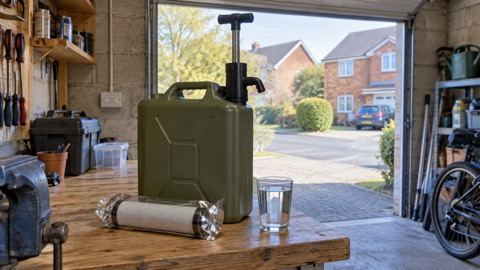 LifeSaver Jerrycan
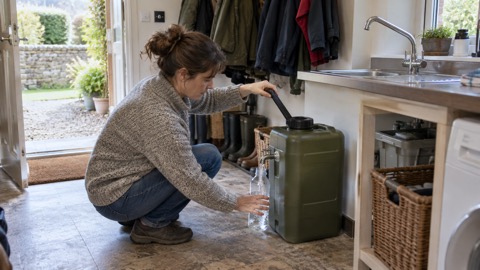 LifeSaver Jerrycan Graphene