The Graf Optimax-Pro is a self-cleaning rainwater filter that fits inside the turret of a Graf Carat or Rondus tank. Water arriving across its mesh pushes leaves and excess debris out to the overflow, so the water that reaches the tank is cleaner, and the maker says you keep over 95% of the rain that falls on the roof1. The three figures that decide whether it suits your set-up are the 0.35 mm mesh, the 165 mm height offset between inlet and outlet, and a maximum roof surface of 350 square metres1.
If you already have a Carat or Rondus tank, the practical questions are simpler: does it fit my tank, how much rain will I lose, and how often do I need to touch it? The maker describes it as very low in maintenance because of its patented, self-cleaning construction, and says the filter can be visually checked through its transparent cover without opening anything1. This page sets out what the filter does, the specifications that matter, how to check and clean it, and what the maker says about delivery and testing.
What the Optimax-Pro filter does in a rainwater tank
The Optimax-Pro is a self-cleaning rainwater filter with an integrated overflow siphon and inlet calming device, designed to fit inside the Carat tank turret2. Its job is to take the rain coming off the roof, pass it across a fine mesh so that leaves, moss and coarse debris are carried away rather than sinking into the tank, and let the cleaner water drop through into store. The maker calls it their preferred filter for the Graf Carat and Rondus tanks, and says it can be installed in all of them1.
Because the overflow siphon and the inlet calming device are built into the filter, the maker says you no longer need to cut holes in the turret other than the necessary ones4. That matters if you are fitting a filter to an existing tank rather than buying a complete system: less cutting means less to seal and fewer places for a leak to start.
The calming side of the design is worth understanding, because it affects water quality over months rather than minutes. Calmed inlets oxygenate the water in the tank and help prevent it from stagnating, and when the tank is full the overflow siphon diverts excess water to a drain or soakaway5. A skimming inlet on the overflow takes surface water first, which carries away further debris, pollen, oils and other floating contaminants6. In other words, the filter is doing two jobs at once: cleaning the water on the way in, and skimming the dirtiest layer off the top when the tank is full.
The maker also offers an optional Opticlean cleaning unit, which uses high-pressure rinsing to keep the filter surfaces free of persistent impurities2, and an optional hose connector that lets you connect a hose and wash the filter through more thoroughly from time to time7. Neither is needed for the filter to work; they are for households that want an easier deep clean.
Filter mesh: 0.35 mm across three layers
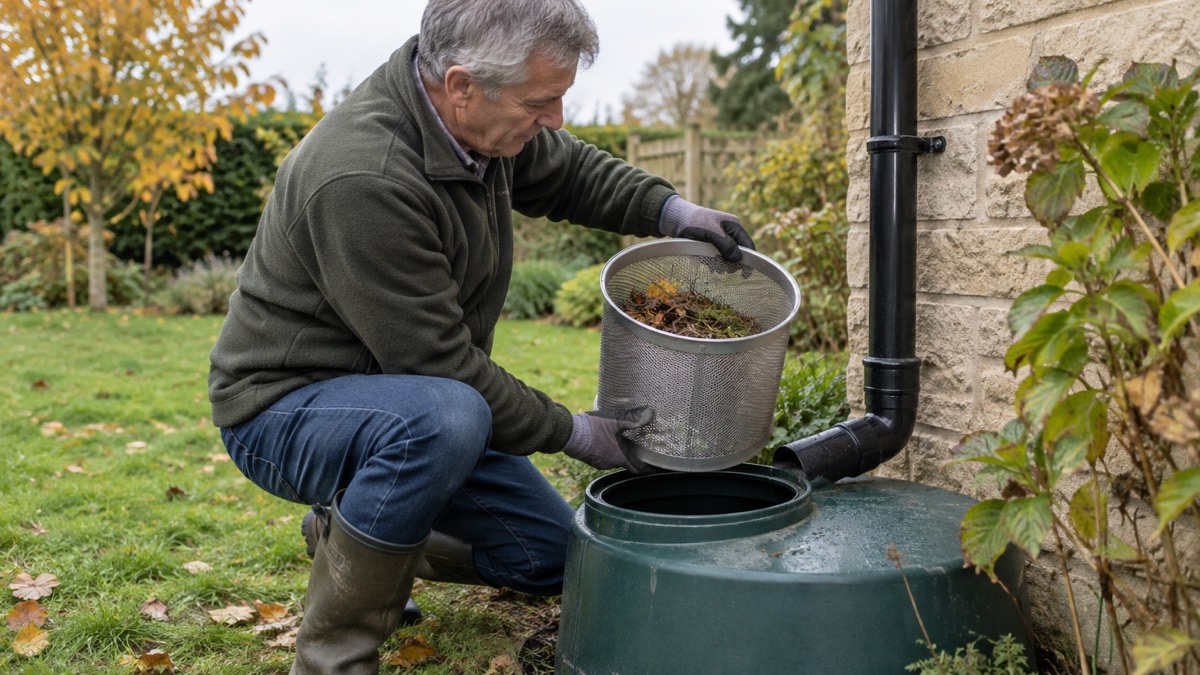
The mesh is the heart of the filter, and the maker is specific about it: 0.35 mm, which is 350 microns or 0.01 inches1. That is fine enough to hold back the leaf litter and grit that would otherwise settle on the tank floor, while still passing rainwater at the rate a roof delivers it.
The mesh is not a single sheet. The maker describes three layers: on top, a stainless steel fine filter with the 0.35 mm mesh; beneath it, a synthetic carrying surface with a diamond pattern; and below that, a collector surface for micro particles1. The stainless top layer does the filtering, the synthetic layer gives it support and structure, and the collector surface catches the finest material. The layered construction is why the filter can be both fine and self-cleaning: water sweeping across a supported mesh carries debris with it instead of pushing it into the weave.
| Specification | Figure | What it means for you |
|---|---|---|
| Filter mesh | 0.35 mm (350 microns)1 | Fine enough to keep leaves and coarse grit out of store |
| Filter layers | Three: stainless steel mesh, synthetic carrying surface, collector surface1 | A supported mesh that sheds debris rather than clogging |
| Water yield | Over 95%1 | Most of the rain that lands on the roof reaches the tank |
| Height offset | 165 mm between in and outlet1 | A shallow drop, so the filter fits inside the turret |
| Maximum roof surface | 350 square metres1 | Larger roofs need a different arrangement |
| Tank compatibility | All Graf Carat and Rondus tanks1 | Check your tank model before ordering |
The 350 square metre limit is the figure to check first if you have a large roof or an outbuilding with a big catchment. It is the maker's stated maximum, and it is a limit on the roof area feeding the filter, not on the size of tank it serves.
Water yield: over 95% of the rain collected
The maker states a water yield of over 95%, and puts the other side of that plainly: you might lose up to 5% of the rainwater, but it is cleaner and the leaf debris is removed to the soakaway or drain1. That is the trade the filter makes, and it is worth being clear about what the lost water is doing. It is not leaking away inside the tank; it is being sent out through the overflow carrying the debris with it, which is exactly the mechanism that keeps the stored water clear.
To put the percentage in context, Cambridge Water gives a useful benchmark for how much rain a roof can gather: the average roof collects about 85,000 litres of rainwater in a year8. The maker's own worked example is smaller and easier to scale: if 10 millimetres of rain falls on a 50 square metre roof catchment area, that represents approximately 500 litres of rainfall before losses9. A filter yielding over 95% would pass the great majority of that through to the tank, with the remainder going to the overflow.
The loss is not a fixed volume you can calculate once, because it depends on how much debris the roof sheds and how hard the rain arrives. A roof under trees will send more leaves across the mesh, and more water will be used to carry them away. That is the filter working as intended, but it is a reason to keep gutters clear before the autumn, so the mesh is dealing with leaves rather than a gutter load.
Fitting it: the 165 mm offset and what it suits
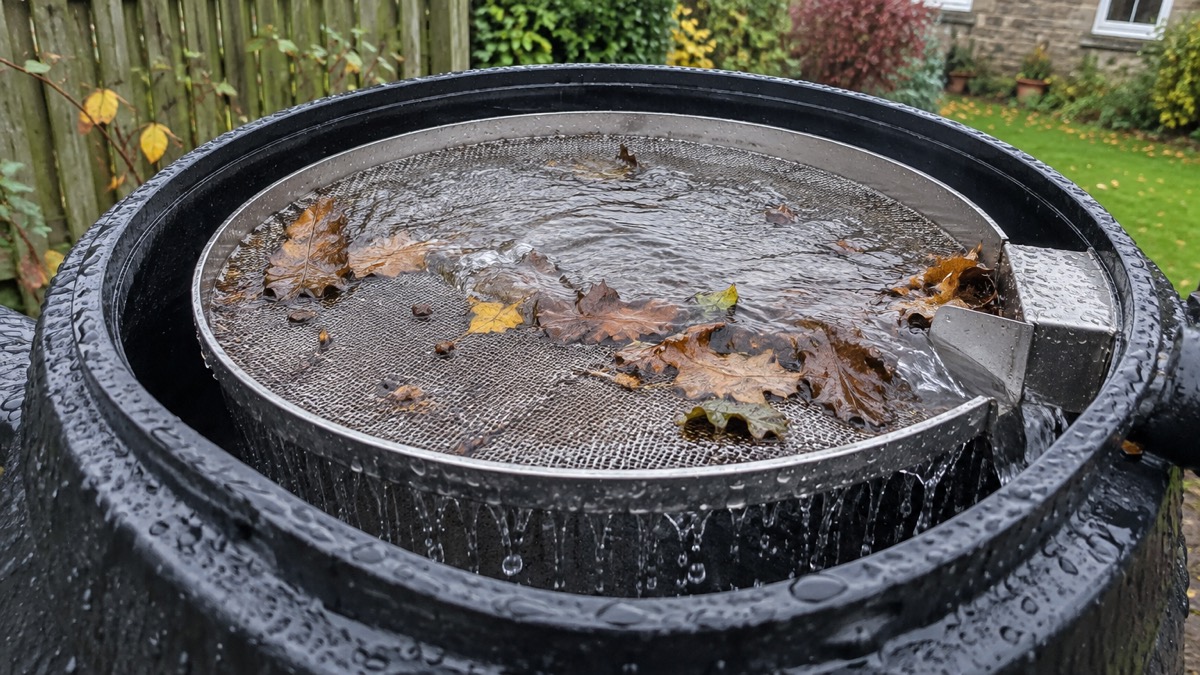
The height offset between the inlet and the outlet is just 165 mm, and the maker lists it alongside the mesh and the yield as one of the filter's three defining figures1. A shallow offset matters because the filter has to sit within the turret of the tank without forcing the pipework into a deep step. If you are replacing an older internal filter or planning a new installation, this is the dimension to compare against the space you have.
The filter is made for the Graf Carat and Rondus tanks, and the maker says it can be installed in all of them1. It is supplied as part of several complete Carat systems, in both rain director and rain backup in a box configurations9. If you are buying a complete system, the filter is often already specified; if you are buying the filter on its own, confirm the tank model first.
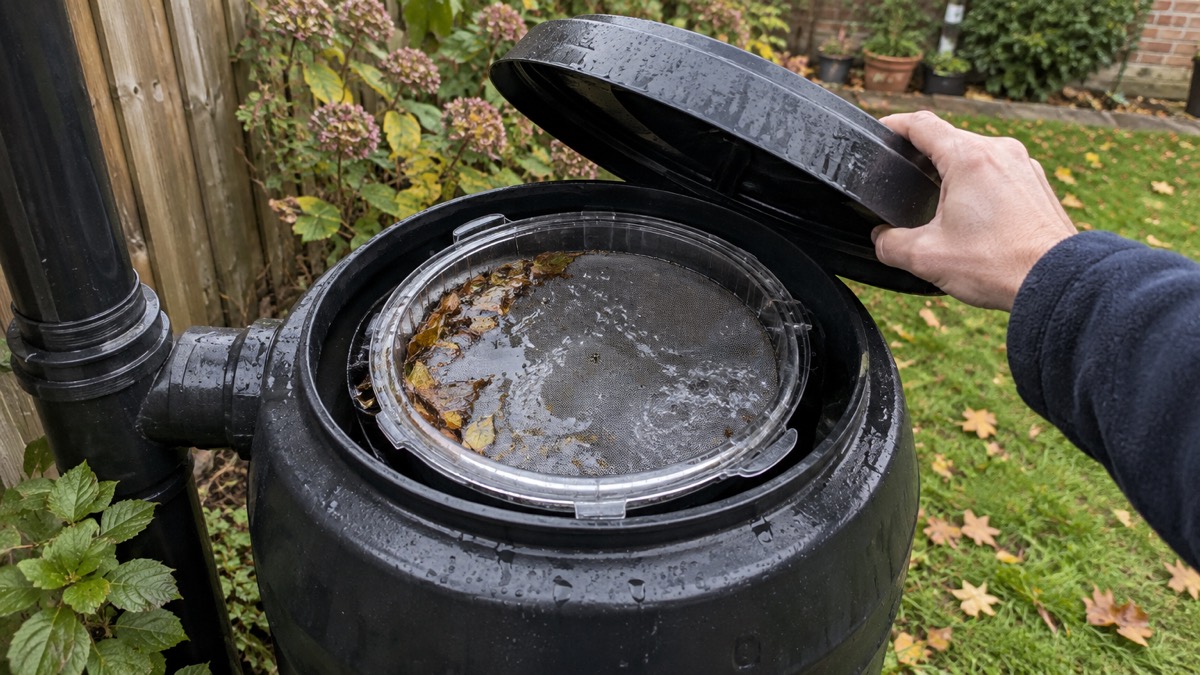
The maker also states that the filter housing can be removed for tank inspection1. That is a practical point for anyone who wants to look inside the tank at the water level, the condition of the inlet, or the build-up of sediment, without draining it down. The transparent cover supports the filter insert, so the cover and insert can be lifted together in one step when you want to check or clean the collector surface1.
Checking and cleaning the filter
The Optimax-Pro is designed to need little attention. The maker describes it as very low in maintenance due to its patented, self-cleaning construction, and says the filter can be visually checked when closed through the transparent cover, or the cover and filter can be lifted for further cleaning of the collector surface1. In normal use, that means a glance through the cover after heavy rain or a windy spell, and a lift-out when you can see debris sitting on the mesh.
The self-cleaning action is the reason the routine is short: water arriving across the filter mesh pushes excess debris and leaves to the overflow2. The filter is not collecting debris for you to remove later; it is sending it out of the system with the water it sheds. What remains is the material that clings, and that is what the occasional lift-out and rinse deals with.
- Check the filter visually through the transparent cover while it is closed, or lift the cover and filter together as required for further cleaning of the collector surface2.
- If debris is sitting on the surface, lift the cover and filter insert together in one step2.
- Rinse the collector surface, using the optional hose connector if you have one, which lets you wash it through more thoroughly from time to time11.
- Refit the insert and cover, and check that the overflow is running freely to the drain or soakaway2.
- Remove the housing when you want to inspect the tank itself2.
The wider principle is the same one that applies to any filter in the home: follow the maker's instructions for maintenance, and change any cartridge at the recommended frequency, or immediately if beads or black particles appear16. For the Optimax-Pro itself, the maker's instruction is the visual check and the occasional lift-out, not a scheduled replacement.
Safety testing, delivery and support
The maker describes the Optimax-Pro as TUV safety-tested1. That is the maker's statement about its own product; if you need the certificate for a building control query or an insurance schedule, ask the supplier for the documentation before you order.
On availability, the maker's product page says most items are normally in stock and shipped on a next day service if the order is received by midday, and that this product, unless delivered with a larger order, is delivered by a parcel carrier1. Stock levels and cut-off times are the supplier's and can change, so confirm them when you order.
If you are comparing how rainwater equipment is supplied more generally, check the delivery terms for your postcode, particularly in the Scottish Highlands, offshore islands and Northern Ireland, before you rely on a next day service17.
For the wider system the filter belongs to, the site's guides on rainwater harvesting at home and rainwater filters explain how downpipe, inline and in-tank filters differ, and keeping a rainwater system clean covers the year-round routine. If you are still choosing a tank, how to size a rainwater tank works through roof area, rainfall and demand, and what harvested rainwater can be used for sets out where non-potable water is appropriate.
Sources (19)
- Graf Optimax-Pro Filter, Rainwater Harvesting Ltd, 2025-11-19
- Carat 6500 Litre Rain Backup in a Box System, Rainwater Harvesting Ltd, 2026-07-01
- Graf Universal Filter 3 Internal, Rainwater Harvesting Ltd, 2025-11-19
- Carat 2700 Litre Rain Director System, Rainwater Harvesting Ltd, 2026-07-01
- 2,000 Litre Rainwater Harvesting Tank - Enduramaxx - UK Number 1 Tanks, Enduramaxx
- Rainwater Harvesting Filters for rainwater tanks - Enduramaxx, Enduramaxx
- Overflow Siphon, Rainwater Harvesting Ltd, 2025-11-19
- Saving Water FAQs, Cambridge Water, 2026-10-28
- Why Collect Rainwater in the Winter, Rainwater Harvesting Ltd, 2026-10-12
- Carat 3750 Litre Rain Director System, Rainwater Harvesting Ltd, 2026-07-01
- Carat 4800 Litre Rain Backup in a Box System, Rainwater Harvesting Ltd, 2026-07-01
- Carat 2700 Litre Garden System, Rainwater Harvesting Ltd, 2026-07-01
- Carat 6500 Litre Rain Director System, Rainwater Harvesting Ltd, 2026-07-01
- Protecting Your Private Water Supply, Drinking Water Inspectorate, 2026-10-28
- Water Filter Candles, Drinking Water Quality Regulator for Scotland, 2026-10-28
- Understanding Water, United Utilities, 2022
- Caravans and Motorhomes, Photonic Universe Ltd, 2026-10-25
- Flex Kits, Photonic Universe Ltd, 2026-10-25
- Glacier Plug-In Battery, EcoFlow UK, 2026-10-25