The Graf F-Line 5000 Litre Garden System is an underground rainwater harvesting kit: a flat 5000 litre tank, a filter and overflow kit, a Hydroforce Series 4 pump and the parts to take filtered rainwater to a garden tap1. It is sold by Rainwater Harvesting Ltd, which lists the systems as held in stock at its Peterborough warehouse2. If you are weighing one up, the things that decide it are the shallow dig, the pipework you still have to buy, and the fact that the water is for the garden, not the kitchen.
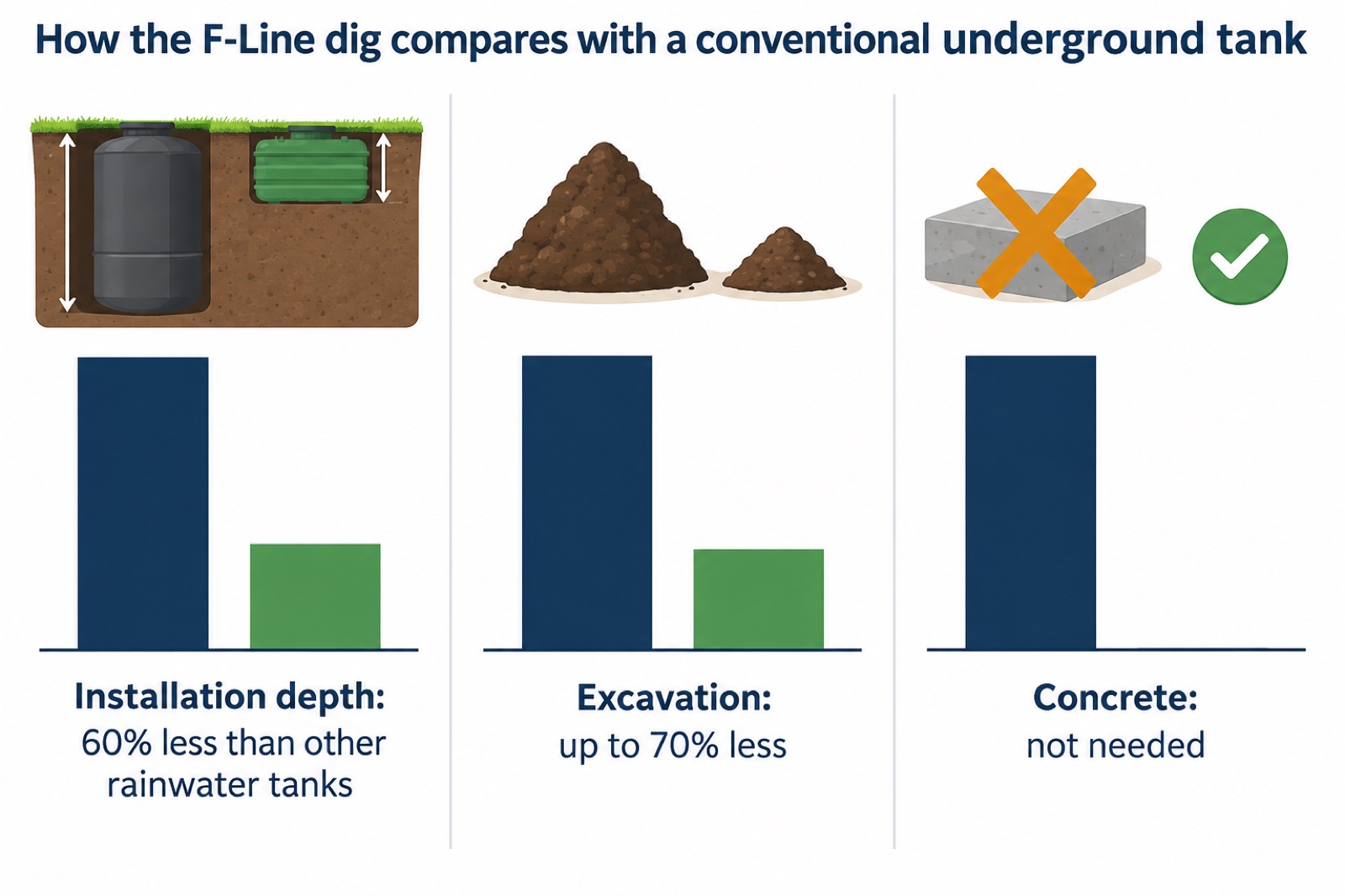
The dig is the reason most people look at this range. The maker states that the F-Line tanks are flat, that the installation depth is 60% less than other rainwater tanks, and that the excavation can be up to 70% less1. The tank can be installed without the need for concrete, and it can go into ground water up to the shoulder of the tank body1. For a household with a wet garden or a dislike of a deep hole, that changes the job from a contractor's project to something a capable household can plan.
What it will not do is give you drinking water. The maker is explicit that untreated rainwater is not for human consumption, and that the point of use should be clearly labelled to show rainwater is the source1. Plan the system around the garden, the washing of tools and outdoor jobs, and treat every tap it feeds as non-potable.
What the F-Line 5000 litre garden system is
The maker describes the product as a "Flat Tank F-Line 5000 litre underground garden rainwater harvesting system kit"1. In plain terms it is a buried store that catches rain from a roof, filters it, and pumps it to where you want it in the garden. The tank is a single moulded body, described by the maker as one of its highest quality, rotationally moulded, one piece tanks1. A one piece moulding has no seam in the tank wall, which is what makes the flat, shallow-buried shape possible.
The flat shape is the design idea. Conventional underground tanks are tall cylinders that need a deep hole; the F-Line is wide and shallow, so the maker states the installation depth is 60% less than other rainwater tanks and the excavation can be up to 70% less1. Less soil out of the ground means less to cart away, less to backfill and a smaller area of garden disturbed. The maker also states the tank can be installed without the need for concrete, which removes a delivery, a pour and a curing wait from the job1.
The kit is aimed at garden use rather than whole-house supply. The maker's description of what it delivers is clean rainwater to a garden tap1. If your reason for buying is hose bans, dry summers or the simple wish to water a vegetable plot from the roof, that is the job it is built for. If you want rainwater plumbed into toilets or a washing machine, the maker sells other versions of the same tank for that purpose, covered below.
What comes in the kit
The standard kit is more than a tank. The maker lists the contents as the shallow dig F-Line tank, a 635mm F-Line shaft, a pedestrian F-Line lid, the Hydroforce pump, the Rain Vantage filter, 25m of 25mm rainwater pipe, a rainwater label pack and delivery to mainland UK1. The maker's summary of the kit describes a 5000 litre shallow dig underground tank, an inline filter and overflow kit, a Hydroforce Series 4 pump and the accessories needed to deliver clean rainwater to a garden tap1.
| Part | What it does for the household | Included |
|---|---|---|
| F-Line 5000 litre tank | Stores the harvested rain underground | Yes1 |
| 635mm shaft and pedestrian lid | Gives access to the tank from ground level | Yes1 |
| Hydroforce Series 4 pump | Moves water from the tank to the garden tap | Yes1 |
| Rain Vantage filter | Filters the rainwater before it reaches the tank | Yes1 |
| 25m of 25mm black and green HDPE pipe | Carries water from tank to point of use | Yes1 |
| Rainwater label pack | Marks the point of use as rainwater | Yes1 |
| Standard external pipework and connectors | Connects the system to your downpipe and tap | No, buy separately1 |
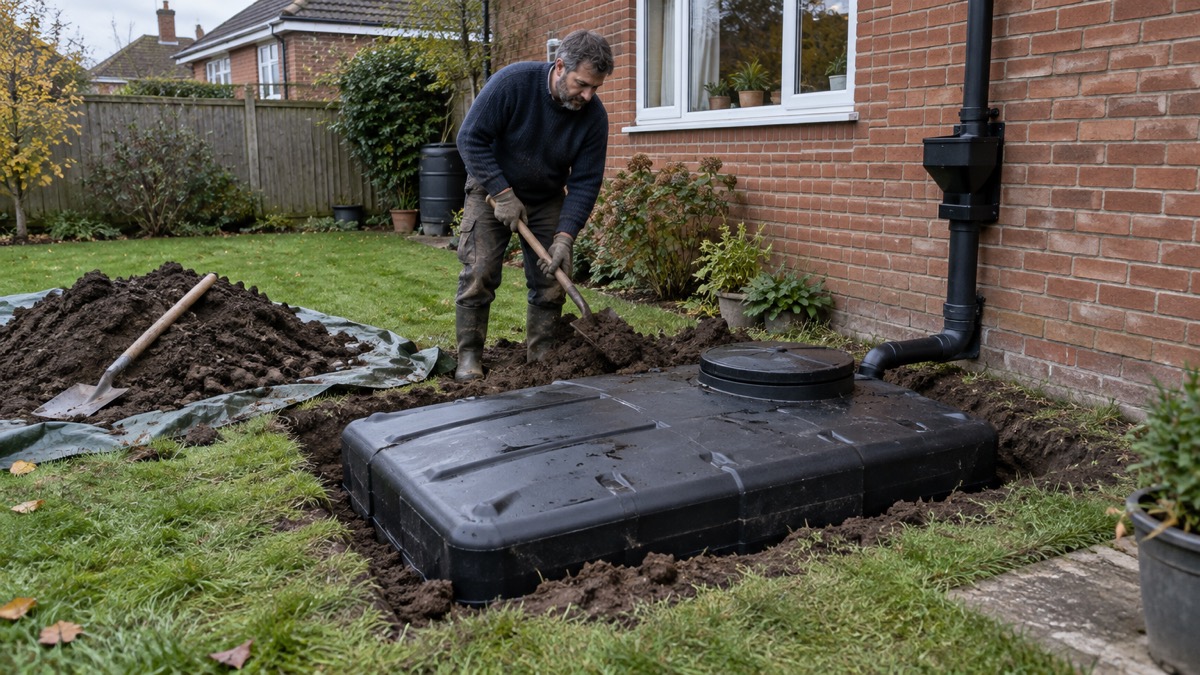
The shaft is worth understanding before you order. The 635mm shaft is the access route down to the tank, and the maker states that up to 400mm can be cut off the 635mm shaft on site so as to achieve your exact invert level1. That means the installer can trim the shaft to suit the depth the pipework actually lands at, rather than digging to a fixed depth and hoping. The maker also offers a driveable shaft and lid as an alternative to the pedestrian version, which matters if the tank has to go under a driveway or a track1.
The pump is the Hydroforce Series 4, a submersible pump that sits in the tank and pushes water up to the garden tap. There is a separate page on the HydroForce Series 4 Rainwater Pump if you want to understand the pump on its own. The filter is the Rain Vantage, an inline unit that takes debris out of the rain before it enters the store; the rainwater filters page explains how inline and in-tank filters differ.
Pipework you will need to buy separately
The kit includes 25m of 25mm black and green HDPE pipe and labels, with the option to buy further rolls of pipe1. It does not include everything. The maker states plainly that some standard external pipework and connectors will be needed but are not included in the kit, because the location of the system varies from house to house1. That is the honest reason: the run from your downpipe to the tank, and from the tank to your tap, depends entirely on your garden.
Before you order, walk the route and write down what it needs:
- The run from the downpipe to the tank inlet, including any bends and the connector into the filter.
- The run from the tank outlet to the garden tap, including the tap itself and its fixing.
- Any ducting or protection where the pipe crosses a path or a lawn edge.
- The extra pipe if your run is longer than the 25m supplied, bought as further rolls from the same supplier1.
The pipe specification is not arbitrary. The maker states that water companies recommend, and in some cases require, black and green HDPE pipe for piping rainwater from the tank to the point of use1. The colour coding is how anyone working on the pipe later can tell at a glance that it carries rainwater and not mains water. The pipe labelling page covers the labelling rules in more detail.
Shallow dig: up to 70% less excavation and no concrete
This is the section that decides whether the F-Line suits your garden. The maker states that the F-Line tanks are flat, that the installation depth is 60% less than other rainwater tanks, and that the excavation can be up to 70% less1. The maker also states the tank can be installed without the need for concrete, which it says minimises installation costs1.
What that means on the ground is a hole you can stand in rather than a pit you need a ladder to leave. The maker notes that shallow dig tanks can be lifted off vehicles by hand with enough people, which tells you the weight is manageable for a small team rather than needing a crane3. It also means the backfill is smaller, so less soil has to be moved to a skip or spread on a border.
The trade-off is footprint. A flat tank spreads its volume sideways, so it needs a wider area of ground than a tall cylinder of the same capacity. Before you dig, check what is under the lawn: drains, cables, water pipes and tree roots all matter, and the underground tank depth page sets out how to think about depth and services. The underground rainwater tanks page compares shallow dig, deep dig and flat designs side by side.
The maker's claim of no concrete is worth taking at face value only if you follow the installation instructions. A tank that is backfilled correctly, with the right material and compaction, does not need a concrete surround; a tank that is backfilled badly can move. If you are not confident, use an installer who has fitted F-Line tanks before. The planning permission page covers when a buried tank needs consent, which is usually about where it goes rather than what it is.
Installing in groundwater: up to the shoulder of the tank
Wet ground stops many underground tank projects. The F-Line is designed for it: the maker states the tank can be installed in ground water up to the shoulder of the tank body1. That is a specific limit, not a general promise. Up to the shoulder means the water table can sit at the level of the top of the tank body, and no higher, at the time of installation and after.
If your garden floods, or the hole fills with water as you dig, this is the figure to check against. A tank installed in ground water above the shoulder is outside the maker's stated tolerance, and the guarantee and the structural behaviour of the tank are not something to gamble on. The underground tank depth page explains how to judge the water table before you dig, and a local installer will know what the ground does in winter.
The other installation point is the shaft. The 635mm shaft can be cut down by up to 400mm on site to achieve the exact invert level1. In practice the installer sets the tank, connects the pipework, then trims the shaft so the lid sits flush with the ground. That is why the kit ships a shaft longer than most gardens need: it is meant to be cut, not buried whole.
Rainwater from the tank is not for drinking
The most important sentence on the maker's page is the safety one. The maker states that untreated rainwater is not for human consumption, and that the point of use should be clearly labelled to show that rainwater is the source1. The same warning appears on the gravity feed and direct feed versions of the system3. It is not a disclaimer buried in small print; it is the operating rule for the whole product.
"Untreated rainwater is not for human consumption and so water companies are recommending (and in some cases requiring) the use of black and green HDPE pipe."
The independent view agrees. Enduramaxx, a tank maker, states that in the UK rainwater is not considered suitable for drinking, bathing, or food preparation even though it is filtered before being transferred to the containing tank5. Filtration removes leaves and grit; it does not make water microbiologically safe. That is why the kit includes a label pack: the label is the barrier between a garden tap and a child, a visitor or a future owner who assumes a tap is a tap.
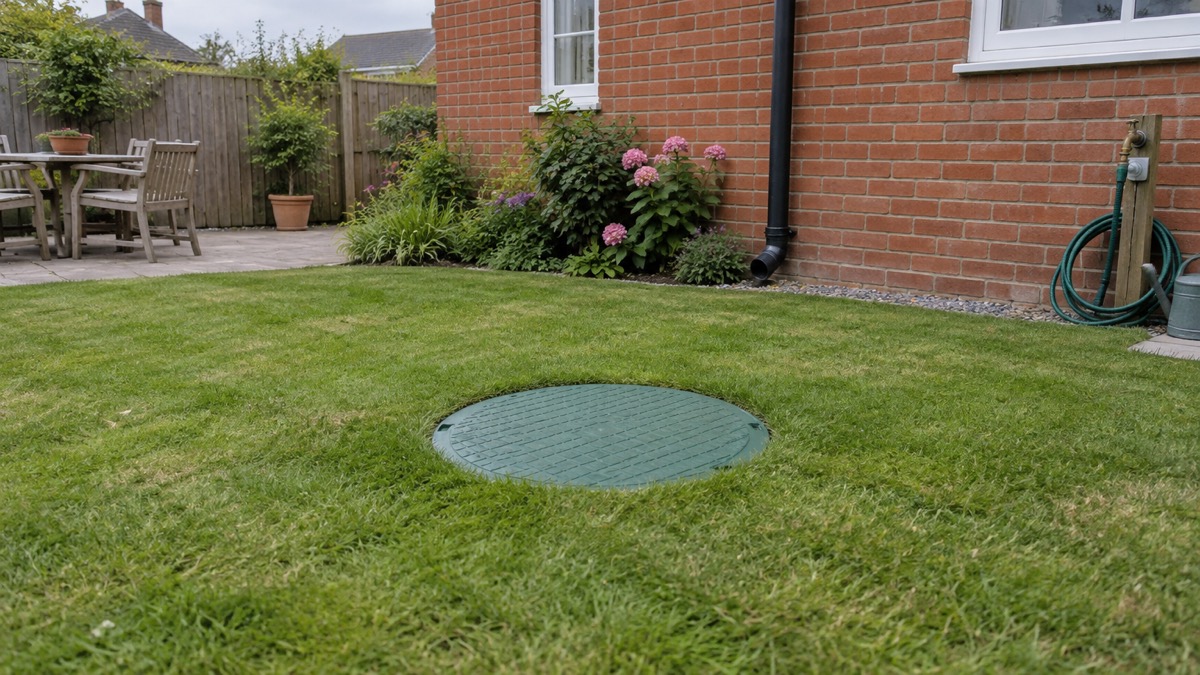
The garden uses are still substantial. Watering beds, filling a watering can, washing tools and boots, and cleaning paths are all jobs that do not need potable water. Cambridge Water notes that saving water matters and points to the scale of the infrastructure that supplies the region, including a 25km water pipeline being built between Grafham Reservoir and its supply region in partnership with Anglian Water6. A 5000 litre store fed by a roof is a small, household-scale version of the same idea: catch what falls rather than treat and pump what does not need to be treated.
Gravity feed or direct feed: which version to choose
The 5000 litre tank comes in more than one kit, and the differences matter. The garden system is the one described above: tank, filter, pump and pipework to a garden tap1. The gravity feed system includes a 5000 litre underground tank, a pre-fitted in-tank filter, an overflow and calmed inlet kit, a Hydroforce Series 4 submersible pump and the accessories to deliver rainwater to a garden tap and to flush toilets3. The direct feed system includes the tank, the pre-fitted in-tank filter, the overflow and calmed inlet kit and the Hydroforce Series 4 submersible pump, and the maker describes it as a domestic rainwater harvesting system kit with mains water backup4.
| Version | What it is set up to do | Mains backup |
|---|---|---|
| Garden system | Delivers clean rainwater to a garden tap1 | Not stated |
| Gravity feed system | Garden tap and toilet flushing3 | Not stated |
| Direct feed system | Domestic use with mains water backup4 | Yes4 |
The choice comes down to what you want the water to do. If the answer is "water the garden", the garden system is the direct fit. If you want to flush toilets as well, the gravity feed system is the version the maker lists for that job3. If you want a system that keeps supplying when the tank runs low, the direct feed system's mains water backup is the feature to look at4. The Direct Feed and Gravity Feed Rainwater Systems Explained page goes through how each works, and the Rainwater Harvesting at Home page covers the whole system from roof to outlet.
One practical point applies to all three: a pump needs power. If the electricity goes off, a pumped system stops delivering, which is worth knowing before you rely on it in a storm. The Will a Rainwater System Keep Working in a Power Cut? page explains what does and does not keep running.
Delivery, guarantee and buying the tank on its own
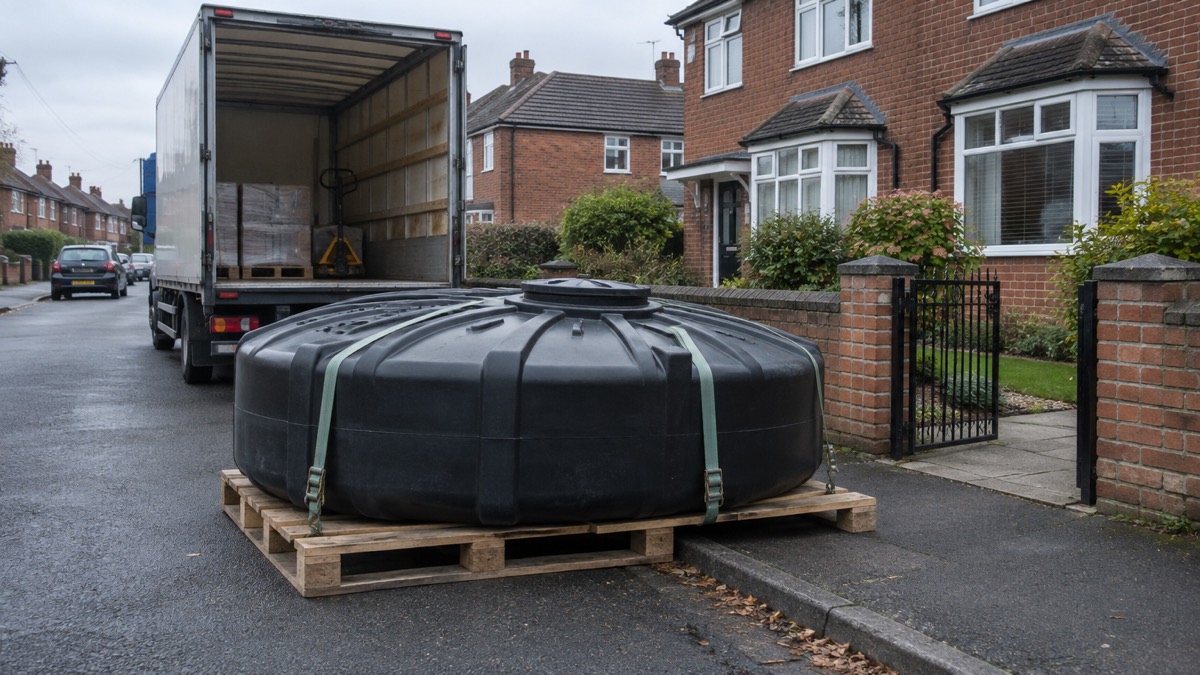
The maker states that mainland UK delivery is included with the garden system1. The delivery is kerbside and the offloading is the responsibility of the customer, so arrange enough people to lift the tank off the vehicle; the maker notes that shallow dig tanks can be lifted off vehicles by hand with enough people3. Have the route to the garden clear before the lorry arrives.
The guarantee is 25 years from the manufacturer, stated on the garden system, the gravity feed system and the tank itself1. Keep the order confirmation and the delivery paperwork, and fit the tank as instructed so the guarantee is not compromised by the installation. If you are buying in stages, the maker lists the F-Line 5000 litre tank on its own as an underground garden rainwater harvesting system tank, and states that the systems are held in stock at its Peterborough warehouse2. That suits a household that already has a pump, filter and pipework, or one that wants to spread the cost over a couple of seasons.
If you are still deciding whether a buried tank is the right choice at all, the Water Butt or Underground Tank? comparison sets out the trade-offs, and the Garden Rainwater Harvesting Kit Checklist lists everything a garden system needs, including the parts this kit leaves you to buy. For the wider picture of what a rainwater system can do for a household, start at Self-Reliance at Home.
Sources (6)
- F-Line 5000 Litre Garden System, Rainwater Harvesting Ltd, 2026-07-10
- F-Line 5000 Litre Tank, Rainwater Harvesting Ltd, 2026-07-01
- F-Line 5000 Litre Gravity Feed System, Rainwater Harvesting Ltd, 2026-07-07
- F-Line 5000 Litre Direct Feed System, Rainwater Harvesting Ltd, 2026-07-07
- Rainwater Tanks, Enduramaxx, 2026-10-29
- Why Should I Save Water?, Cambridge Water, 2026-10-28