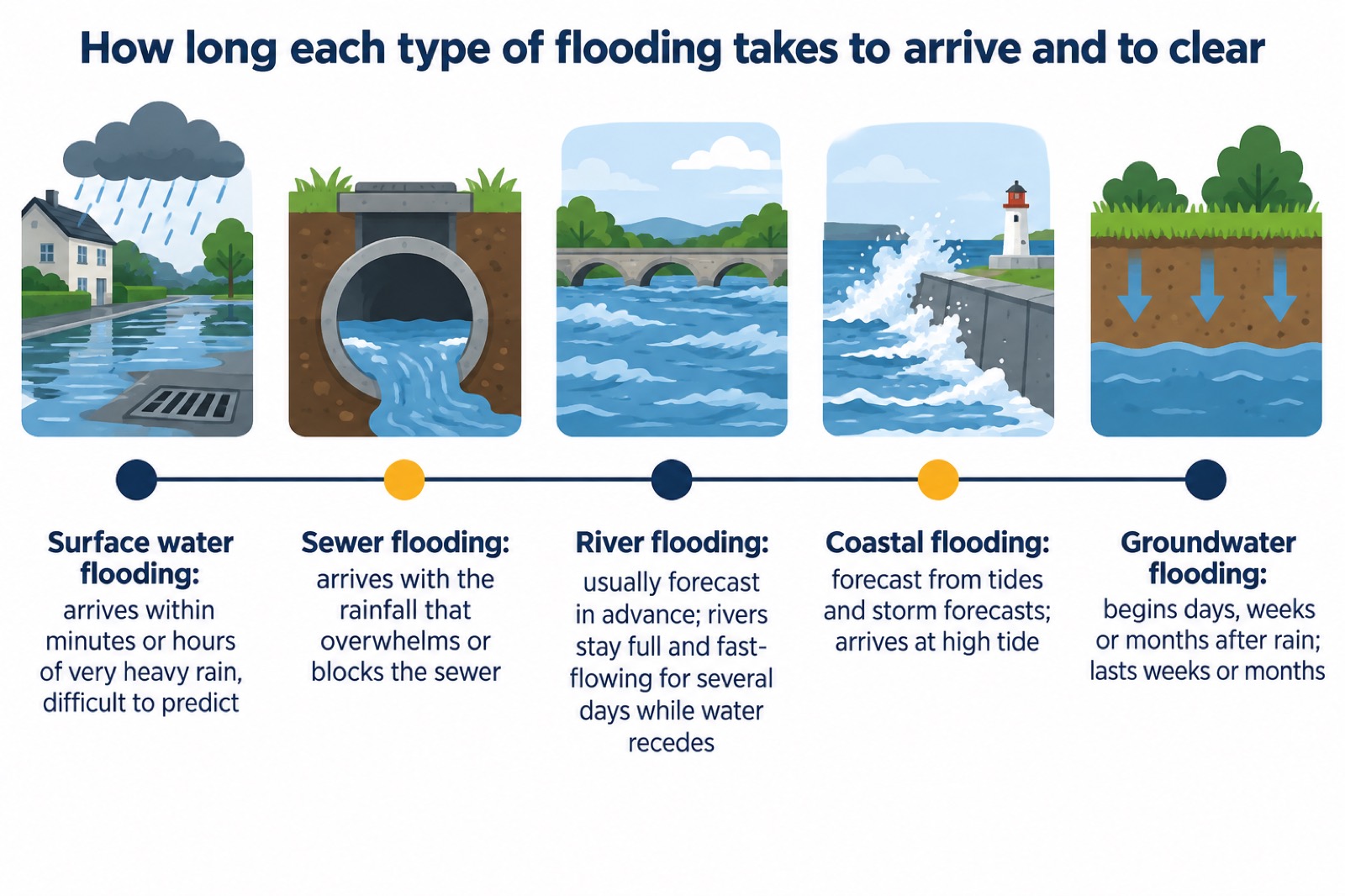
Flooding is not a single hazard. Water reaches a home in five main ways in the UK: from rivers overflowing, from the sea at high tide, from rain that cannot drain away, from sewers that back up, and from groundwater rising up through the ground itself. Each type behaves differently, and knowing which ones can reach your home changes what you should do and who to contact when it happens1.
The scale is large. Around 6.3 million properties, homes and businesses in England are in areas at risk of flooding from one or a combination of sources: rivers, the sea and surface water2. Across the UK as a whole, around one in six homes is at risk of flooding3. Flooding can often be predicted, but on occasions it occurs with very short notice and can be completely unexpected, so the type of flooding matters as much as the warning you receive.
This page explains each type of flooding, how quickly it arrives, how long it stays, what warnings exist for it, and who to contact when it happens. It links to more detailed pages on groundwater, coastal flooding, sewer flooding and the wider household guide to flooding.
The five types of flooding that can reach a UK home
Flood water comes from five distinct sources, and the official definitions are worth knowing because they determine who is responsible for helping you and what warnings you will receive.
| Type | Also called | What causes it | How fast it arrives |
|---|---|---|---|
| River flooding | Fluvial flooding | A river cannot contain the water draining into it from the surrounding land | Usually forecast in advance |
| Surface water flooding | Pluvial, flash flooding | Rain does not drain away or soak into the ground, and lies on or flows over the surface | Minutes to hours, little warning |
| Coastal flooding | Tidal flooding | High tides and stormy weather combine, overtopping sea defences | Usually forecast in advance |
| Sewer flooding | Sewers are overwhelmed by heavy rainfall or become blocked | With the rainfall, little warning | |
| Groundwater flooding | The water table below ground rises above the ground surface | Days, weeks or months after rain |
River flooding happens when a river is unable to contain the amount of water draining into it from the surrounding land7. Surface water flooding happens when rainwater does not drain away through the normal drainage systems or soak into the ground, but lies on or flows over the ground instead7. Coastal flooding is predominantly caused by high tides and stormy weather combining, leading to the overtopping of sea defences with seawater then encroaching onto the land3. Sewer flooding happens when sewers are overwhelmed by heavy rainfall or when they become blocked8. Groundwater flooding occurs when the water table, the water level below ground, rises above the ground surface9.
River and surface water flooding are sometimes grouped together under the general description of "inland flooding", because they can and do occur simultaneously10. Rising temperatures and sea levels, and an increase in the frequency and severity of extreme weather events, are likely to raise the risk of flooding in the UK over time10, so a home that has never flooded is not a home that never will.
River flooding: forecast in advance, but deep and fast-moving
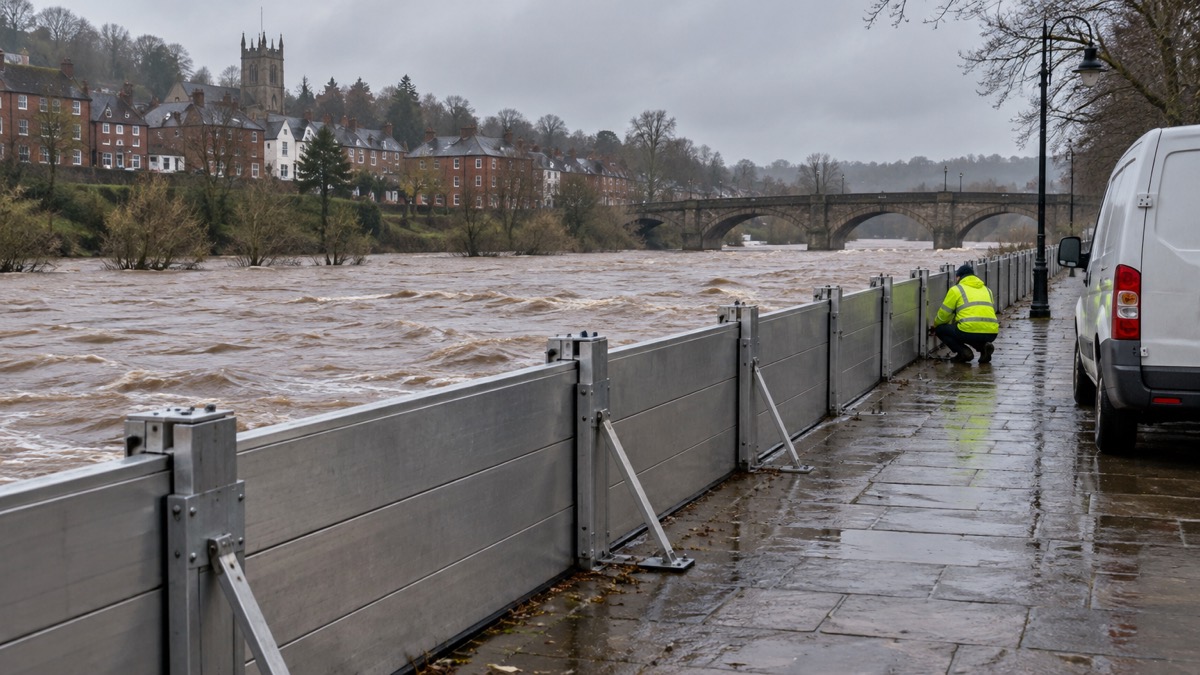
River flooding, often referred to as fluvial flooding, is caused by the flow exceeding the banks of a river and causing damage to the surrounding area, buildings and environment3. It happens when a watercourse cannot cope with the water draining into it from the surrounding land, for example when heavy rain falls on an already very wet catchment8. A river that has soaked its surroundings for weeks needs far less rain to overflow than one running through dry ground, which is why river flooding often follows a sequence of storms rather than a single downpour.
The practical advantage of river flooding is that it can usually be forecast. Flood Alerts are issued on forecasts that indicate flooding from rivers may be possible, including forecast intense rainfall for rivers that respond very rapidly11. That gives households time to act on a flood warning: to move belongings upstairs, put barriers in place and, if advised, leave early. Our page on what to do when a warning is issued sets out the steps in order.
The danger comes after the rain stops. While flood water is receding, many rivers and streams will remain very full and fast-flowing for several days, and Derbyshire County Council advises keeping away from riverbanks and paths close to rivers, as paths may have become unstable and slippery12. A river that has dropped a metre can still be deep enough and fast enough to sweep an adult off their feet, and flooded ground beside it may be hollow or unstable.
If you live beside a watercourse, you may also have legal responsibilities as a riparian owner, which our page on living next to a watercourse explains.
Surface water flooding can happen almost anywhere with little or no warning
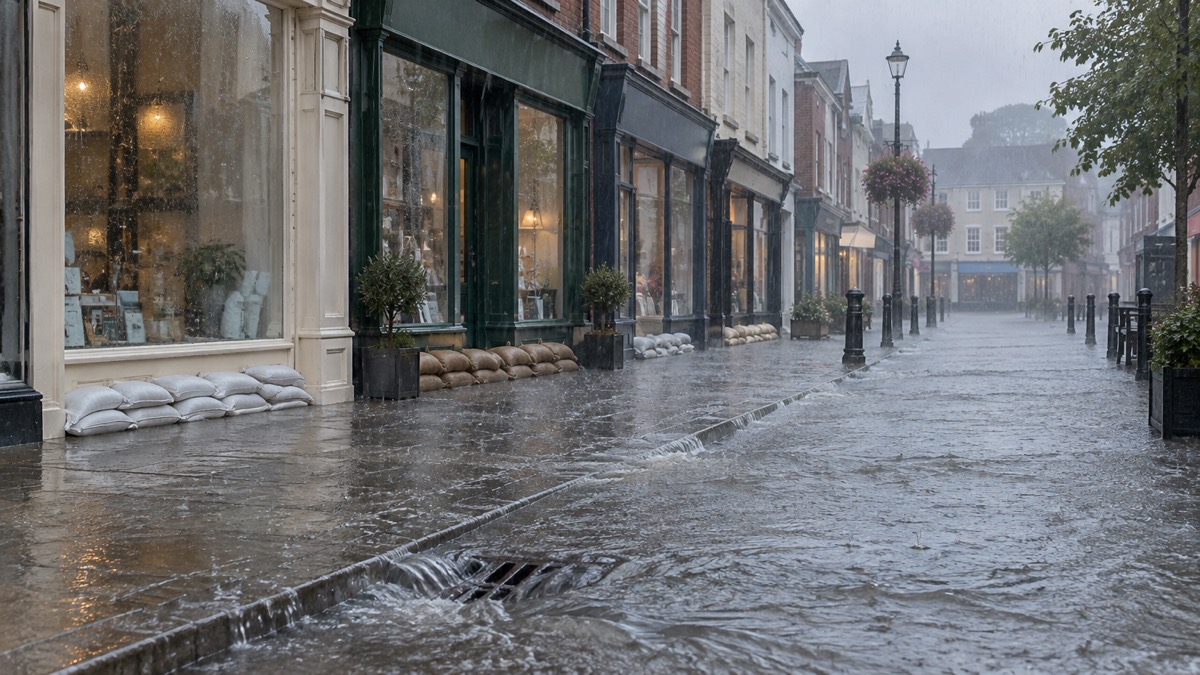
Surface water flooding, sometimes referred to as pluvial flooding, is the build-up of storm water on surfaces, often where those surfaces are hard paved, or where there is too much rainfall for the soil to handle13. It is also known as flash flooding, and the terms are used interchangeably4. Flash flooding can happen when very heavy rain falls on hard surfaces, overwhelming drainage and sewers14.
This is the type of flooding that catches households out, because it is difficult to predict and often happens quickly, with fast flowing water that could pose a risk to life14. There is no river to watch, no tide table to check. The warning you get is a Met Office severe weather warning for heavy rain, and the flooding can begin before that rain has even finished falling. For surface water flooding, the Met Office's severe weather alerts system is the alert system to rely on15, so sign up to Met Office weather warnings14.
Where you live shapes the risk. Surface water flooding happens more in urban and paved areas, where impermeable surfaces allow little or no infiltration and local drainage systems cannot cope with the amount of rainfall16. Urban areas with impermeable surfaces like concrete and asphalt are particularly prone17. But it can also happen naturally in rural environments, when heavy rain exceeds the soil's infiltration rates and flows as runoff over the land16. In London, surface water flooding is the main flood risk to the city, appearing on London's Risk Register4, and the Greater London Authority expects severe flooding to happen more often in the city as the climate changes14.
Surface water flooding is more likely during intense summer storms but can happen all year round4. It can happen almost anywhere, not just near rivers, and often occurs with little or no warning, which is why the advice for this type is about acting immediately rather than preparing over days:
- Move to a higher floor if water is entering, or to a neighbour's flat on a higher level if you live in a basement or ground floor flat14.
- Do not walk, cycle or drive through flood water18.
- Do not re-enter a flooded area until you are advised it is safe to do so14.
- If you are a vulnerable person, or know someone who is, sign up to the priority services registers for both power and water14.
Responsibility for surface water flooding sits with local authorities, designated as Lead Local Flood Authorities under the Flood and Water Management Act14. In London this means there are 33 responsible authorities, one for each London borough and the City of London14, so the council you report to depends on where the water is.
Groundwater flooding rises through the floor and can last for weeks or months
Groundwater flooding is the slowest and longest-lasting type. It occurs when the water table, the water level below ground, rises above the ground surface9, usually after prolonged periods of rainfall17. Official government guidance is blunt about the timescales: flooding usually happens days, weeks or months after lots of rain, and may last for a long time, weeks or months5.
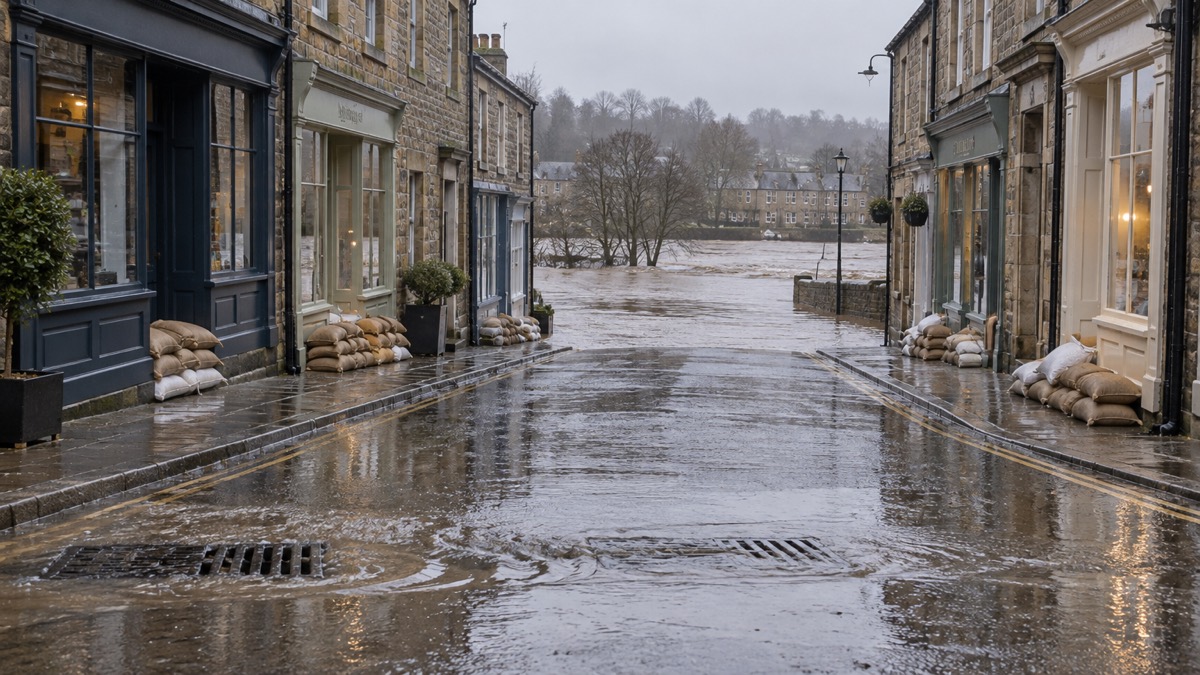
The tell-tale sign is where the water appears. With groundwater flooding, water will come up through the ground or the floor, rather than through doors5. If your cellar is filling with water while the street outside is dry, and there has been no rain for a fortnight, that is groundwater. During heavy rainfall, the water level in the ground may rise so much that it floods basements, or emerging groundwater at the surface may cause damage to properties and infrastructure13.
Because it is slow, groundwater flooding is usually slower than river flooding5, and it gives households time to prepare. But its length is what makes it exhausting: water levels may rise and fall for several weeks depending on drainage and any further rainfall1. A household that pumps out a cellar on Monday may find it refilling by Friday. You may need to pump water out after groundwater flooding5, but only pump when the water level outside is lower than inside, as this reduces the risk of structural damage19. Our pages on groundwater flooding and pumping water out cover this in detail.
Checking your risk in advance is harder than for other types. Derbyshire County Council's guidance states there are no free groundwater flood risk maps9, and Natural Resources Wales notes that flooding from groundwater from underground aquifers and underground mine systems is not shown on the Flood Risk Assessment Wales map20. The standard flood risk maps for England and Wales show risk for three types of flooding only: rivers, the sea, and surface water and small watercourses20. If you cannot check a map, watch for the pattern instead: prolonged wet weather followed by water rising from below.
Coastal flooding: high tides and storms together
Coastal flooding, also called tidal flooding, happens when high tides and stormy conditions occur at the same time, and a tidal surge may form which can cause serious flooding8. More simply: high tides, storm surges or tidal events bring seawater onto land17. The risk of coastal flooding is one of the most significant risks on the National Risk Assessment10.
The classic east coast of England scenario is a combination of low atmospheric pressure over the North Sea, high tide levels (Spring tides) and northerly gales driving a storm surge down the coast towards the English Channel10. Low pressure effectively lifts the sea surface, and the wind then pushes that raised water towards the shore. If it arrives at the same moment as a high spring tide, sea defences can be overtopped3.
The saving grace of coastal flooding is that tides are predictable years in advance and storms are forecast days ahead, so coastal flooding is usually covered by Flood Alerts and Flood Warnings issued in time to act11. Forecasts of high tides, surges or strong winds trigger a Flood Alert11. The constraint is that the flooding arrives on the tide's schedule, not yours: the window between the warning and the water can be short, and the water can return with the next high tide, several hours later, after appearing to have gone.
Coastal flooding brings its own hazards beyond the water: Flood Warnings for the coast can mean significant waves and spray21. Our page on coastal flooding, tidal surges and erosion covers preparation, and if you live near a reservoir, our page on reservoir flooding deals with that separate, rarer risk.
Sewer flooding: contaminated water that is highly dangerous
Sewer flooding happens when sewers are overwhelmed by heavy rainfall or when they become blocked8. Intense rainfall causes sewers to overflow, leading to contaminated water backing up into streets or properties17, and land and property can be flooded with water contaminated with raw sewage, while rivers can be polluted by sewer overflows8.
This is the most dangerous water in your home. Sewer flooding is highly dangerous mainly due to the presence of high levels of bacteria3. More broadly, the floodwater affecting your home may be contaminated with sewage, animal waste and other contaminants19. This is why the standing advice is to stay away from flood water, because it is dangerous and can be contaminated, and never to enter it on foot.
Sewer flooding often arrives alongside surface water flooding, since the same intense rain overwhelms both the drains and the sewers, but the two are managed by different bodies. Thames Water, for example, states it can only help with sewer flooding, not river, road or groundwater flooding22. If sewer flooding occurs inside your house, Thames Water pays compensation automatically22; our pages on sewer flooding and guaranteed standards payments explain the scheme.
Which type of flooding affects you most?
Start by checking the standard flood risk maps, which show risk from rivers, the sea, and surface water and small watercourses20. The Environment Agency's flood risk maps for England and Natural Resources Wales's Flood Risk Assessment Wales map both work on this basis, and our page on checking your home's flood risk by postcode walks through how to use them. In Scotland, the Scottish Environment Protection Agency advises using its flood maps to find out the level of flood risk in your area24.
Then think beyond the maps. The maps do not show sewer flooding, and they do not show groundwater from aquifers or mine systems20. Ask instead:
- Is your home near a river, stream or brook? River flooding applies, and you may be a riparian owner12.
- Is it within reach of the sea, an estuary or a tidal river? Coastal flooding applies3.
- Is the area heavily paved, urban, or known for drains that struggle in downpours? Surface water flooding applies16.
- Does your home have a basement or cellar, or is it in an area with chalk or other aquifers, or old mine workings? Groundwater flooding applies9.
- Does water sit in the road, or do toilets gurgle in heavy rain? Sewer flooding may apply17.
Flooding can affect anyone, damaging your home and disrupting your travel24, and with changes to our weather, flooding is happening more often, so it is likely that you or someone you know will be affected24. Several types can combine in one event: river and surface water flooding occur simultaneously often enough to share the name "inland flooding"10, and sewer flooding commonly rides along with surface water flooding14. Whatever your risk, a household flood plan is worth making: official guidance recognises personal, community and business flood plans25.
Warnings for each type: what you will and won't be told
There are three types of flood warning codes: Flood Alerts, Flood Warnings and Severe Flood Warnings26. A Flood Alert means flooding is possible; a Flood Warning means flooding is expected; a Severe Flood Warning means severe flooding, danger to life11. Our page on flood alerts, flood warnings and severe flood warnings explains what to do at each level.
What matters here is that the warning system does not cover every type of flooding equally:
| Type of flooding | Will you get a flood warning? | What to rely on instead |
|---|---|---|
| River | Yes, Flood Alerts and Flood Warnings for rivers11 | Sign up for warnings in your area |
| Coastal | Yes, warnings for high tides, surges and strong winds11 | Sign up for warnings; know your tide times |
| Surface water | Not reliably; it is difficult to predict14 | Met Office severe weather alerts15 |
| Sewer | No dedicated warning; arrives with the rain17 | Met Office weather warnings; watch drains and toilets |
| Groundwater | No routine warning; onset is days to months after rain5 | Local groundwater situation reports; watch for water rising through floors |
For surface water flooding, your best alert system is the Met Office's severe weather alerts system, which tells you when the kind of rain that causes flash flooding is forecast15. That is a weather warning, not a flood warning: it tells you the risk exists, not that your street will flood. When a warning does come and water threatens your home, turn off your gas, electricity and water supplies if it is safe to do so, and do not touch an electrical switch if you are standing in water18. Our page on turning off utilities shows how.
If water is entering, official guidance sets out improvised measures you can take while it is safe to do so: turn off your gas, electricity and water supplies if it's safe to do so, and do not touch an electrical switch if you're standing in water1. Do not walk, cycle or drive through flood water18. Every minute spent on these measures before the water rises reduces what the water can reach inside your home.
Who to contact for each type of flooding
Who you call depends on where the water is coming from, because different bodies are responsible for different types. For some types of flooding you will need to report these to your local council1. The table below gives the first call for each type in England and Wales; our page on who manages flood risk explains the full picture, and who to report flooding to covers the reporting process.
| Type of flooding | Who to contact first |
|---|---|
| River | The Environment Agency in England, Natural Resources Wales in Wales, via Floodline |
| Surface water | Your local authority, who will direct you to their relevant department7 |
| Groundwater | Your local authority; in Derbyshire, for example, the county council manages groundwater flooding13 |
| Coastal | The Environment Agency or Natural Resources Wales, via Floodline |
| Sewer | Your local water company |
For roads, report flooding problems on roads, burst water mains and blocked drains to the Flooding Incident Line or your local authority27. If you are pumping flood water into street drains, highways or highway ditches, check with the local highways authority or National Highways first; if pumping into rivers, ditches or watercourses, check with your local Environment Agency office18. After a flood, provide any details of property flooding, including photographs, to your local Flood Risk Team28.
If you rent your home, contact your landlord and your contents insurer after a flood28. The landlord will deal with the structure of your home; for contents claims, contact your own insurer27. Renters can also act before a flood: speak to your landlord or housing association about how they can better protect you from flooding14.
Where you must never go during a flood
Whatever the type of flooding, the safety rules are the same. Do not walk, drive or swim through flood water6. Do not try to walk through flooded areas27. Even shallow water can hide dangers beneath the surface, and fast-flowing water can knock you over or move a vehicle.
"Do not walk, drive or swim through flood water"
Keep away from riverbanks and paths close to rivers for several days after flooding, as rivers remain full and fast-flowing and paths may have become unstable and slippery12. Do not re-enter a flooded area until you are advised it is safe to do so14. If you live in a basement or ground floor flat, move to a neighbour's flat on a higher level rather than trying to leave through flooded streets14. And do not assume an upper floor makes you safe: even in a second floor flat, flooding could prevent getting in or out, catch your car, flood your garden or driveway, or interrupt your power, gas or water supplies20.
After the water recedes, the danger does not. Do not eat any food that has been in contact with floodwater23. Discard any food stored or wrapped in paper, cardboard or plastic wrappers, such as cereal, rice, flour, sugar and baked goods29. Discard all home-grown produce if it has come into contact with, or even been splashed by, flood water29. Our pages on what to do during a flood, returning home safely and cleaning up safely take over from here.
Sources (29)
- Prepare for flooding, UK government Prepare campaign
- National Assessment of Flood and Coastal Erosion Risk in England 2024, Environment Agency, 2024
- Flooding: know your risks, Wiltshire and Swindon Prepared
- Surface water flooding, Greater London Authority
- Groundwater flooding: what it means, UK government, 2023
- Before, during and after a flood, Scottish Environment Protection Agency
- Different types of flood risk, Natural Resources Wales
- Be Flood Ready: guidance for flood wardens, Harborough District Council
- Groundwater flooding, Derbyshire County Council
- Flooding: protecting your family, Essex Prepared
- Know your flood warnings, Wiltshire and Swindon Prepared
- Communities affected by flooding, Derbyshire County Council
- Identifying flood risk, Derbyshire County Council
- How to prepare for flash flooding, Greater London Authority
- Be flood aware, Greater London Authority
- Surface water flood risk, Derbyshire County Council
- Ongoing risks: flooding, Essex Prepared
- Help during a flood, UK government
- Household flood plan, nidirect, 2018
- Understanding your flood risk results, Natural Resources Wales
- Flood warnings explained, Nottinghamshire County Council
- What to do during sewer flooding, Thames Water
- Clearing up after flooding, Oxford City Council
- Forecasting flooding, Scottish Environment Protection Agency
- Preparing for a flood, Wiltshire and Swindon Prepared
- Flood warnings guide, Met Office
- Thunderstorms: weather warning advice, nidirect
- After a flood, Nottinghamshire County Council
- Food safety and flooding, Food Standards Scotland
 Flood Warning Checklist
 First Steps After a Flood
 Insurance Claim Records
 Checking Flood Risk by Postcode
 Flood Alerts and Flood Warnings
 Flood Guidance Statement
 Wales Flood Warnings and Maps
 Making a Household Flood Plan
 Protecting Your Home
 Door Flood Barriers
 Sandbags and Alternatives
 Flood Doors and Windows
 Airbrick Covers
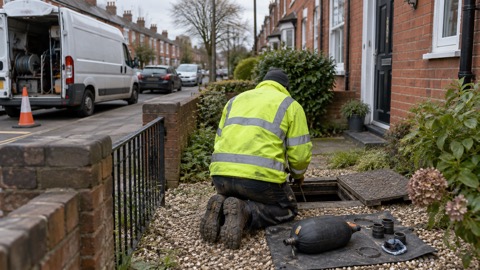 Non-Return Valves and Bungs
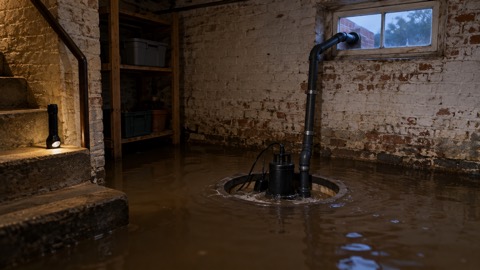 Sump and Submersible Pumps