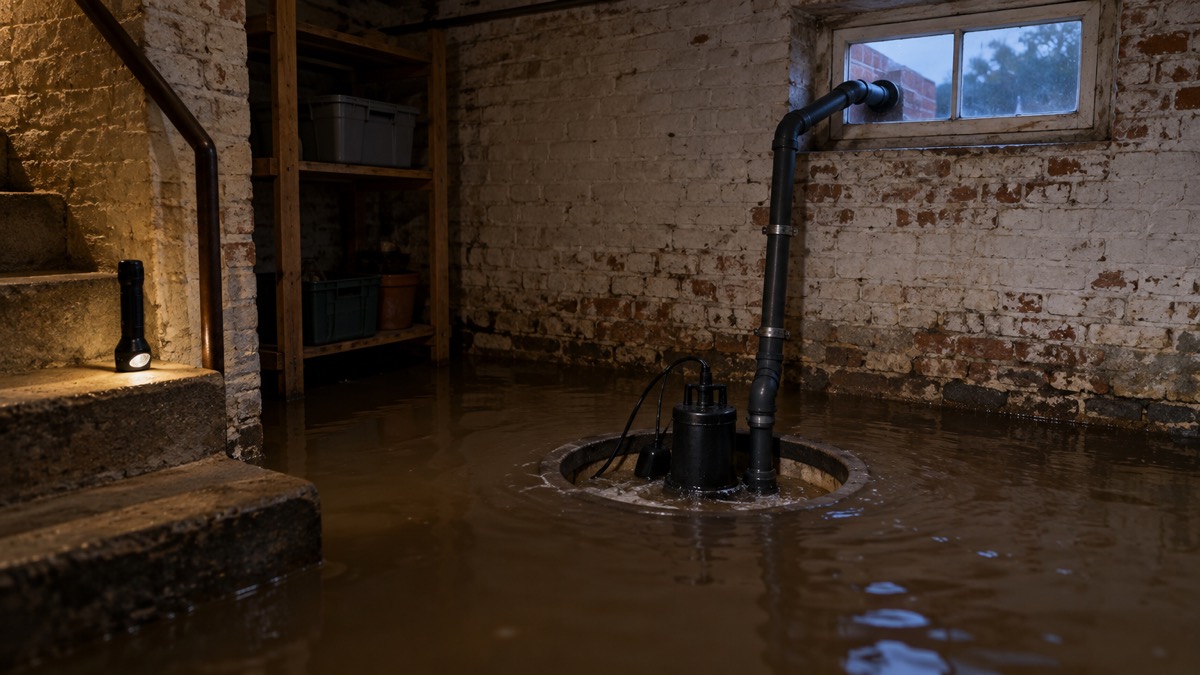
A pump is the one piece of flood kit that does not just keep water out, it moves it away. Two types matter to an ordinary household: a permanent sump pump system, which sits below floor level and switches itself on when water rises, and a portable surface water pump, sometimes called a "puddle sucker", which you put down on standing water and drain it to as little as 1mm1. A sump and pump system is rated by its maker at a high output of 333 litres per minute, and a surface water pump at up to 217 litres per minute1.
Which one you need depends on where the water is coming from. If it rises through the floor as groundwater, official guidance in Northern Ireland lists installing a sump and pump to remove water as one of the recognised measures, alongside fitting non-return valves to drains and water inlet pipes2. If it lies on the ground outside, in a yard, driveway or cellar step, a surface water pump placed on the ground during rising water drains it away from the premises1. Both are submersible: they sit in the water they are pumping, and both can be bought as automatic versions that run without you standing over them.
One rule comes before any of that. Do not pump water out of your home until the level outside is lower than the level inside. Suffolk's flood guidance puts it plainly: "DO NOT pump out water until levels outside your property are lower than inside. This reduces the risk of structural damage"3. Pumping a flooded room out while saturated ground still presses on the outside walls can damage the building's structure, so timing matters as much as equipment.
Sump pump or surface water pump: what each one does
These are two different tools for two different problems, and choosing between them starts with knowing how water reaches your home.
A sump and pump system is a submersible pump installed below ground in a bespoke sump, a chamber built into the floor so that water collecting there can be pumped out1. It is a permanent installation, part of the fabric of the building, and it addresses water that arrives from below: groundwater rising through a floor, or water that has already entered and needs a low point to collect in. Mid and West Wales Fire and Rescue Service describes the broader approach for householders, and official guidance in Northern Ireland names the sump and pump directly: "installing a sump/ pump to remove water and fitting non-return valves to all drains and water inlet pipes, which only let water flow one way"2.
A surface water pump is the opposite: portable, temporary and used outside or in shallow standing water. The maker describes them as "positioned outside on the ground surface during rising water to drain water away from the premises"1. You carry it to where water has collected, set it down, and it pumps the water away through a discharge hose.
The water these pumps deal with is surface water flooding, and it is worth understanding what that means because it shapes when a pump earns its keep. Natural Resources Wales defines it: "Surface water flooding happens when rainwater does not drain away through the normal drainage systems or soak into the ground but lies on or flows over the ground instead"4. Derbyshire County Council adds that it is caused by a build-up of storm water on surfaces, often where those surfaces are hard paved, or where there is too much rainfall for the soil to handle5. Wiltshire and Swindon Prepared note it is sometimes called pluvial flooding6, and Harborough's guidance for flood warders points out that it is much more difficult to predict and pinpoint than river or coastal flooding7. Suffolk's flood strategy calls it flooding caused by high intensity rainfall that generates flows over the ground and collects in low lying areas, also known as pluvial or flash flooding8.
That unpredictability is the argument for owning rather than hiring. River flooding gives warnings you can act on; surface water flooding can arrive with a heavy downpour, which is exactly when hire shops are busiest.
| Sump and pump system | Surface water pump | |
|---|---|---|
| Where it sits | Below ground, in a bespoke sump1 | On the ground surface, in standing water1 |
| Permanent or portable | Permanent installation1 | Portable, carried to the water1 |
| Typical use | Groundwater rising through floors, water entering the building1 | Water lying outside or in shallow areas, draining away from premises1 |
| Output | 333 litres per minute1 | Up to 217 litres per minute1 |
| Solids handling | Suitable for dirty water, solids up to 35mm1 | Designed for surface water and flood water drained to low levels1 |
| Drain-down | Collects water in the sump chamber1 | Down to as little as 1mm1 |
How a sump pump works: a float switch turns it on as water rises
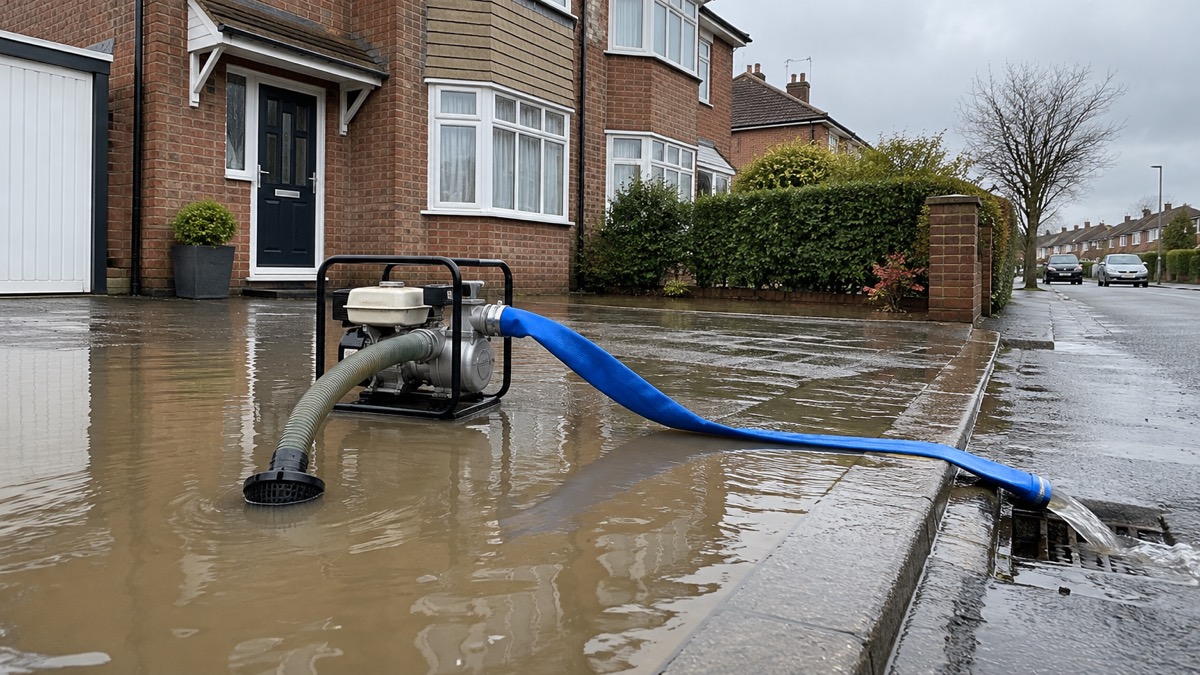
The part that makes a sump pump worth having is the float switch, because it means the pump works when you are not there to switch it on.
The maker describes the mechanism: "The pump has an integrated float switch which enables it to automatically switch itself on in the event of rising water"1. A float is a buoyant switch tethered to the pump. As water rises in the sump, the float lifts; at a set height it closes the circuit and the pump starts. When the level falls again, the float drops and the pump stops. Nobody has to be awake, at home, or wading through water to start it, which is the whole point during a flood that begins at three in the morning.
Surface water pumps can work the same way. The maker offers a compact design available with a built-in, adjustable float switch, and manual or automatic pump options1. The adjustable part matters: you set the height at which the pump starts, so a pump in a shallow yard can be set to trigger on a few centimetres of water rather than waiting for a depth that never comes.
Real households show how this works in practice. Derbyshire County Council's property flood resilience case studies describe a jewellery business in Hebden Bridge whose diesel generator is activated by a float switch, so that when water rises the generator starts itself and powers the pump, heat, light, phones and cleaning equipment until the mains supply is reconnected9. The same case studies describe a book shop with a powerful sump pump with an automatic float switch "to remove water as soon as it enters"9. In both cases the float switch is what turns a pile of equipment into a system that responds on its own.
A float switch also protects the pump. A pump running dry, with no water around it, can overheat and fail, and the switch stops it once the level has dropped. If you are choosing between a manual and an automatic pump, ask yourself one question: will someone always be there when the water comes? If the answer is no, automatic.
Pumping water from under the floor
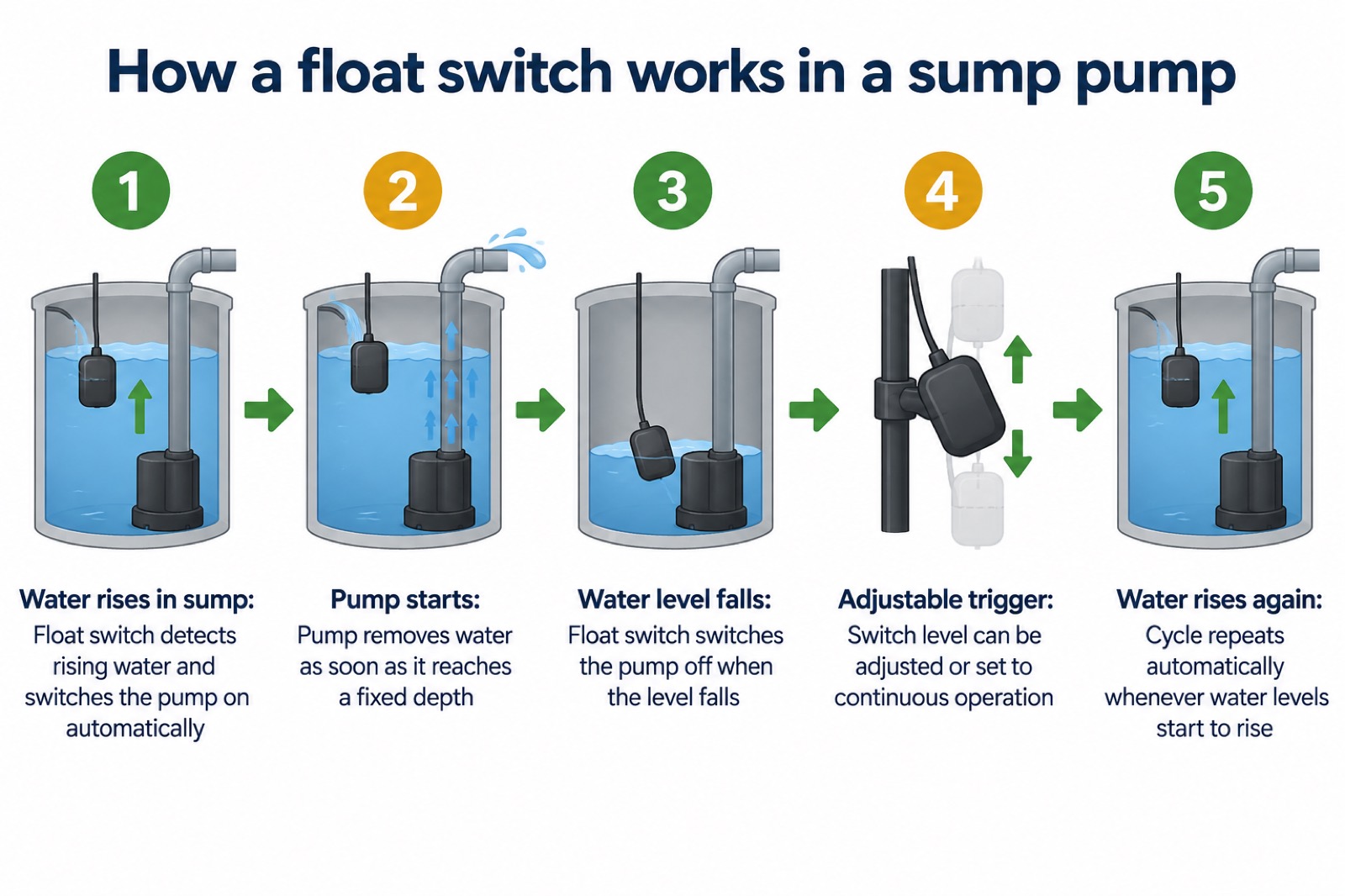
Water under a floor is the slow, stubborn part of a flood, and official guidance is consistent about what to do with it.
Surrey County Council is direct about the priority: "Before you can properly move into your home you need to make sure all standing water has been removed, particularly from the under floor area"10. The method it describes is a pump or buckets, followed by a wet/dry vacuum, then shovelling out mud and hosing out or using a garden sprayer10. For small areas of flooding, London Fire Brigade suggests a bucket may be enough; for larger areas it advises considering hiring a water pump run by a generator11. NI Direct, the Northern Ireland government service, adds that you can hire or buy a pump and generator from a DIY shop, and that you should begin getting rid of the water once levels are lower outside than inside your property12.
Nottinghamshire County Council points to water displacement pumps as the type to hire from local hire centres, and notes that for more serious flooding the Fire Service will deal with the situation if it is life threatening13. That is a line worth remembering: a pump is for protecting property, not for a situation where you or others are at risk.
The timing rule appears again and again across councils, and it deserves its own warning.
A sump system handles under-floor water continuously rather than as a one-off clean-up. Derbyshire's case studies describe the Wateredge Inn in Ambleside, whose emergency flood plan includes three pumps in the lower bar area, which is used as a sump, with water pumped out of the window from there, powered by a petrol generator on the flat roof9. The bar room becomes the lowest point, the water collects there, and the pumps move it out. The same case studies describe a ground floor flat in Berkshire with two sump pumps in the outhouse, one main and one back-up, funded by a government £5k grant, with the electrical supply well above flood height9. A main pump plus a back-up is a pattern worth copying if your flooding is regular: pumps fail, power fails, and the second pump is what saves the floor.
For more on the practical side of emptying a flooded home, see our guide to pumping water out of a home or cellar, and for the wider recovery, after a flood: returning home safely.
Surface water pumps drain down to as little as 1mm
The distinguishing specification of a surface water pump is how little water it leaves behind.
The maker states: "A Surface Water Flood Pump is designed for draining surface water and flood water down to very low levels, to as low as 1mm"1. Most general-purpose pumps stop when the water gets shallow, because their inlet sits a few centimetres above the base and the pump cannot draw what is below it. A pump that drains to 1mm can clear a yard, a cellar floor or a driveway almost to dry, which is the difference between a floor that dries and a floor that stays wet for days.
This matters most for surface water flooding, which collects in low lying areas after high intensity rainfall8. If your home sits at the bottom of a slope, or your garden and driveway drain towards the back door, the water that reaches you is this kind, and a pump that leaves two centimetres behind leaves you with the problem.
Surface water flooding is also mapped, so you can check whether this is your risk before buying anything. Somerset Council notes that surface water maps show areas that may be likely to have surface water flooding in a 1-in-200-year flood risk17. Natural Resources Wales explains the risk categories on its flood risk map, including that "Low means that each year, this area has a chance of flooding between 1 in 1000 (0.1%) and 1 in 100 (1%)"4. You can check your own address in our guide to checking your home's flood risk by postcode, and read more about the risk itself in types of flooding.
For a side-by-side look at which type suits which job, see our comparison of submersible or flat suction pumps for removing water.
Pump capacity: what the numbers mean
Two figures describe a pump's ability: how much water it moves per minute, and how high and far it can push it.
The maker rates its sump and pump system at a high output of 333 litres per minute, and its surface water pumps at outputs of up to 217 litres per minute1. To put that in household terms, Wessex Water's advice, reported by Wiltshire and Swindon Prepared, is that hosepipes and sprinklers can use between 500 and 1,000 litres of water an hour18. A sump system at 333 litres per minute moves more than that in two minutes, which is why even one pump can hold its own against water entering a building, provided the entry rate is not extreme.
Treat these figures as the maker's rated output under favourable conditions. Real flow depends on how far and how high the hose pushes the water, and every metre of lift or horizontal run reduces it. The maker's own wording, "up to 217 litres per minute", signals a best case1.
For scale, it helps to know what the emergency services bring. London Fire Brigade states it has 5 High Volume Pumps across London which can be used to pump large amounts of water during floodings19. Those are fire service assets for major incidents, not household tools, but they show the gap between a domestic pump and a serious flood: a pump protects a room or a floor, and if water is entering faster than hundreds of litres a minute across a whole building, the priority is safety and evacuation, not pumping.
When comparing pumps, look at three specifications together:
- Output in litres per minute, and whether the figure is a rated maximum1
- Solids handling, if the water may carry grit or debris: the sump system takes solids up to 35mm1
- Drain-down level, how shallow the water can get before the pump stops: as low as 1mm for surface water pumps1
Emergency flood pump kits and what they contain
If you want one purchase that covers pumping and protection together, a kit is the practical route.
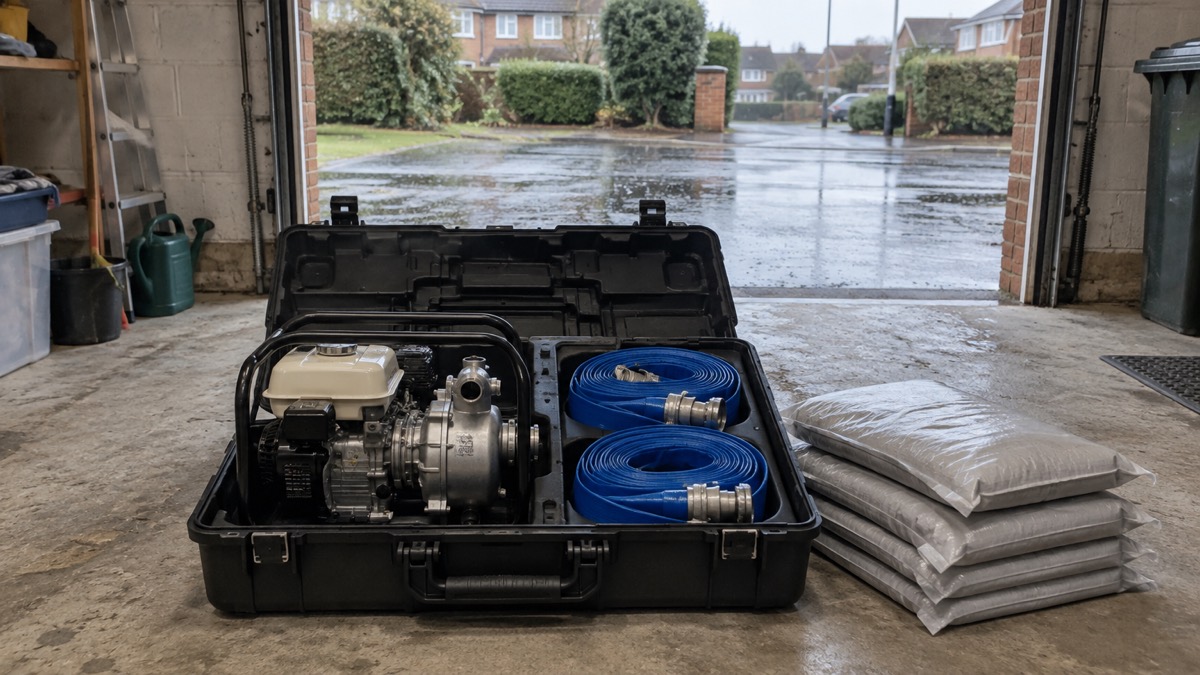
The maker's Emergency Flood Pump Kits comprise a Surface Water "Puddle Sucker" Pump with a range of hoses and self-inflating flood sacks1. The discharge hoses are light, easy to position and have quick connections to enable fast deployment, and the whole kit is supplied in a sturdy easy-carry case1. The combination is deliberate: the flood sacks slow water at the door, and the pump removes what gets past or rises from below. West Yorkshire Prepared lists flood gates and flood sacks among the options to protect your property against flooding20, so the kit pairs two recognised measures in one case.
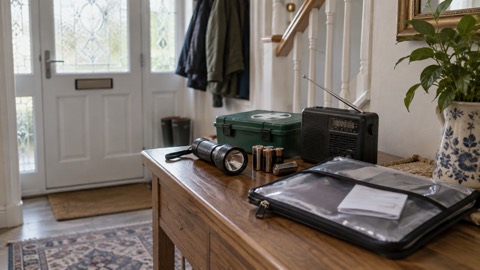
A pump kit is not the same as a flood kit, and you need both. Official guidance is consistent about what a household flood kit contains. SEPA, Scotland's environment agency, lists: torch and spare batteries, first aid kit, prescription medicines, warm waterproof shoes and clothes, rubber gloves, bottled water and snacks, essential pet and children's supplies, insurance documents, passports, a portable wind-up or battery powered radio with spare batteries, and a list of important phone numbers21. NI Direct includes essential medicines22, Lincolnshire Resilience Forum includes water for drinking and sanitation23, and Wiltshire and Swindon Prepared relay Environment Agency advice that a flood kit should contain key items such as batteries, chargers, paracetamols and plasters to help you if you need to leave your home quickly in a flood24.
A pump is for the building; the flood kit is for the people. Keep them stored together where you can reach both without wading.
Electricity, water and generators: running a pump safely
Water and mains electricity together are a danger to life, and the safety instructions here come from official sources.
If your home is flooded, Cumberland Council advises: switch off your electricity supply at the fuse box and turn off your water and gas supply at the mains, if it is safe to do so25. West Yorkshire Prepared gives the same instruction: turn off gas, electricity and water, only if safe to do so20. A submersible pump running on mains power in a flooded room is only safe if the supply is protected and the socket and cable are well above the water, which is why the Berkshire case study in Derbyshire's report specifically notes the electrical supply for the sump pumps was positioned well above flood height9.
After the flood, do not rush to restore power. Nottinghamshire County Council's advice is blunt: "Do not switch on any utilities until you have checked with an expert that is safe to do so"13. Our guide to is it safe to turn the electricity back on? covers this step in detail.
When the mains is off, a generator is the usual way to run a pump, and London Fire Brigade explicitly suggests hiring a water pump run by a generator for larger areas of flooding11. Wiltshire and Swindon Prepared's generator guidance sets the basic conditions: the generator will need to be secure with good airflow26. Never run a generator indoors or in a doorway where exhaust can enter the building; carbon monoxide kills without warning. The Wateredge Inn case study places its petrol generator on the flat roof, and the Hebden Bridge business houses its diesel generator in its own housing at the rear of the premises9, both deliberately separated from occupied space.
Check your equipment before you rely on it. Always use your pump with an RCB safety switch, and beware that water and electricity are dangerous12. Inspect the pump, its cable and its hose for damage before each use, and do not rely on equipment that has been sitting in flood water without checking it first.
For planning power beyond the flood, see our guide to backup power at home.
Hoses and where the water goes
A pump is only as good as its hose and its outlet, and where you send the water is not just a practical question, it is a matter of who is responsible for what.
Surface water pumps come with a power cable and a 10m lay-flat discharge hose, and the maker states longer lengths are available upon request1. Lay-flat hose packs small, deploys fast and is light enough to reposition, which suits an emergency. But a longer hose means more friction and less flow at the end of it, so keep the run short and straight where you can, and never let the hose run somewhere the water will simply flow back.
Where the water goes matters legally as well as practically. GOV.UK guidance on help during a flood sets out who to check with first27:
| Where you want to pump the water | Who to check with first |
|---|---|
| Public sewers | Your water company27 |
| Rivers, ditches or watercourses, for example a brook or mill stream | Your local Environment Agency office27 |
| Street drains, highways or highway ditches | The local highways authority or National Highways27 |
The reason is capacity. A street drain already overwhelmed by the same storm will not take your pumped water, and pushing floodwater into a watercourse can cause problems downstream. Derbyshire County Council also notes that water companies are responsible for managing flooding from sewers and water mains, so contact your water company if you experience that kind of flooding28. Our guide to who manages flood risk explains the full picture.
While you are setting up, take the other precautions official guidance recommends during a flood. Mid and West Wales Fire and Rescue Service advises placing plugs into sinks and basins and weighing them down to prevent surcharge into the sink29, and keeping a small stock of empty sandbags and sand, available from builders' merchants and hardware shops, to protect doorways and air vents29. If you have a septic tank, the government's flooding and health guidance advises not to use the tank at all if possible if it becomes covered with water, to avoid contact with standing water that may contain sewage, and to flush toilets as little as possible while a flood is in progress30. See also our pages on non-return valves and toilet bungs and sewer flooding.
Pairing a pump with other flood protection
A pump works best as part of a set of measures, and the case studies show what a complete set-up looks like.
The Berkshire flat in Derbyshire's case studies combined its two sump pumps with a flood barrier on the back door left permanently in place, a flood resilient front door, ceramic tiles bonded with waterproof adhesive, sacrificial carpet in the bedrooms, non-return valves on all pipe work and toilet bungs for each bathroom9. The pumps are the last line; the barriers, valves and resilient finishes reduce how much water gets that far. Our guides to protecting your home, door flood barriers and flood doors and windows cover those measures.
The same logic applies to the kit approach: flood sacks at the door, pump behind them. West Yorkshire Prepared lists flood gates and flood sacks alongside specialist doors and seals for airbricks as property protection options20, and the emergency flood pump kits combine both in one case1. For the disposable alternative, see sandbags and sandless alternatives.
If a sump and pump system is beyond what you can arrange yourself, professional help exists. Our guides to property resilience surveys and professional installation and property flood resilience grants explain how surveyors and funding work; the Berkshire case study's two sump pumps were funded by a government £5k grant9.
Finally, plan for the aftermath. Lancashire County Council warns that flood water could be contaminated, so always wear protective clothing, boots and rubber gloves when cleaning up and watch out for hidden or sharp objects15. The government's flooding and health guidance adds that pressure hosing should only be carried out in outdoor environments, with pressure hoses connected to a clean water supply, wearing gloves, a disposable plastic apron, a face mask and rubber boots30. Our guides to cleaning up safely after floodwater and floodwater and your health take those steps in order.
Sources (30)
- Sewage Defence: sump and pump systems and surface water pumps, Lakeside Flood Solutions, 2026
- How to protect your home from flooding, NI Direct, 2025
- Before, during and after a flood booklet, Suffolk County Council, May 2021
- Different types of flood risk, Natural Resources Wales, 2026
- Identify flood risk, Derbyshire County Council, 2026
- Flooding risks, Wiltshire and Swindon Prepared, 2026
- Be Flood Ready: guidance for flood wardens, Harborough District Council
- Suffolk Local Flood Risk Management Strategy, Suffolk County Council, February 2023
- Property flood resilience case studies, Derbyshire County Council, 2024
- Flooding: after, Surrey County Council, 2026
- After a flood: flooding advice, London Fire Brigade, 2026
- After a flood: clearing up, NI Direct, 2026
- After a flood: further support, Nottinghamshire County Council, 2026
- Preparing your home for flooding, Cotswold District Council, 2020
- Flooding support, Lancashire County Council, 2026
- Staying safe in a flood, Herefordshire Council, 2026
- Preparing for flooding, Somerset Council, 2026
- Wessex Water advice on saving every drop, Wiltshire and Swindon Prepared, 2026
- Flood response: techniques and procedures, London Fire Brigade, 2026
- Flooding, West Yorkshire Prepared, 2026
- Before, during and after a flood, Scottish Environment Protection Agency, 2026
- Preparing for a flood, NI Direct, 2025
- Get help and advice in an emergency, Lincolnshire Resilience Forum, 2026
- Winter hacks this winter, Wiltshire and Swindon Prepared, 2026
- Preparing for flooding, Cumberland Council, 2026
- Generators, Wiltshire and Swindon Prepared, 2026
- Help during a flood, GOV.UK, 2026
- Flooding responsibilities, Derbyshire County Council, 2026
- Flooding advice, Mid and West Wales Fire and Rescue Service, 2026
- How to recover from flooding, GOV.UK, 19 December 2023
 Flood Warning Checklist
 First Steps After a Flood
 Insurance Claim Records
 Checking Flood Risk by Postcode
 Types of Flooding
 Flood Alerts and Flood Warnings
 Flood Guidance Statement
 Wales Flood Warnings and Maps
 Making a Household Flood Plan
 Protecting Your Home
 Door Flood Barriers
 Sandbags and Alternatives
 Flood Doors and Windows
 Airbrick Covers
 Non-Return Valves and Bungs