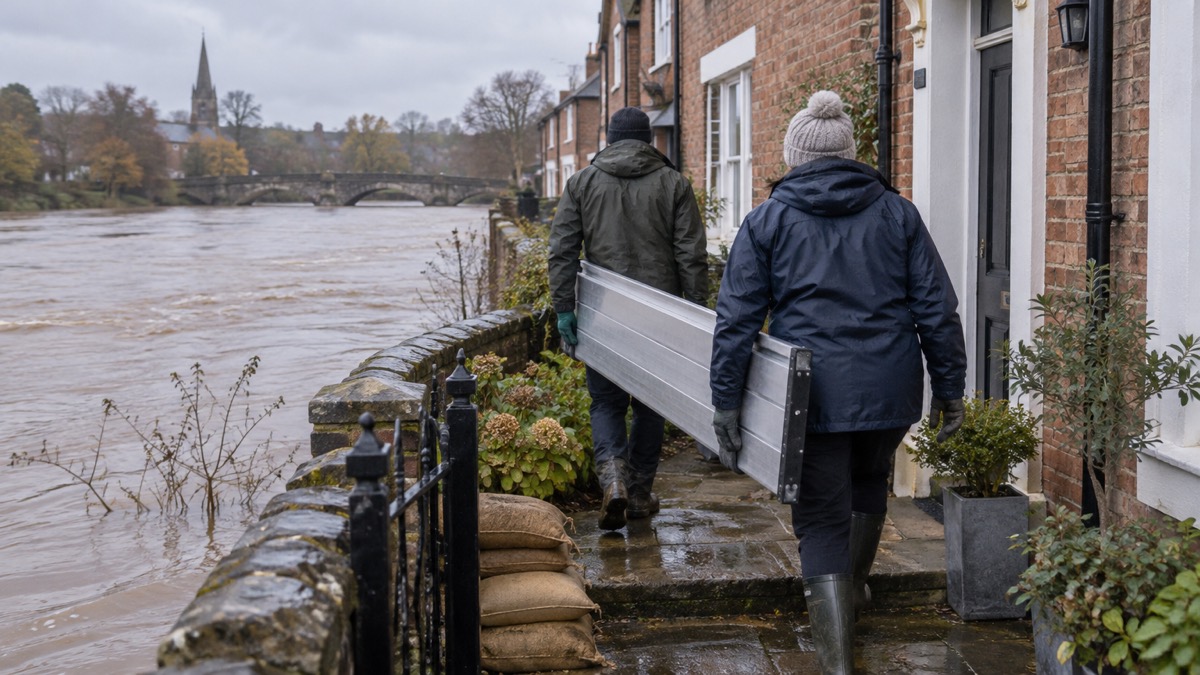
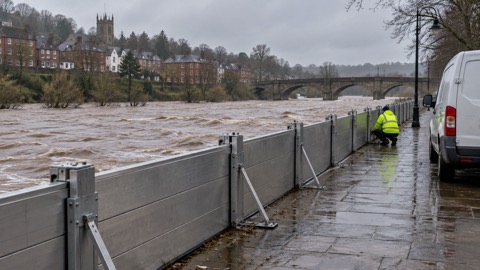
A door flood barrier is a panel or set of panels you fit across a doorway to stop floodwater getting in, and it is one of the most common pieces of flood protection a UK household buys. Flood resistance measures, as official guidance puts it, "try to prevent water entering your property through doorways, air bricks, drains, gaps in the floor and any other routes into your property"1, and a barrier at the door is usually the first and most visible part of that. Purpose-made products range from simple floodboards that fix to the frame, through demountable aluminium panels that clamp into permanent side posts, to expanding barriers that need no frame at all and self-deploying barriers that rise with the water2.
Which type suits your home depends on three things: how deep the water gets, how wide the opening is, and who will be there to fit it when a flood warning arrives. This page sets out each type of barrier, what it does, the specifications that decide it, how to measure a doorway, how to store the barrier, and where a barrier on its own is not enough. If you are new to flood preparation, start with checking your home's flood risk and making a household flood plan, because a barrier only works if someone is ready to put it in place in time.
The ways to keep floodwater out of a doorway
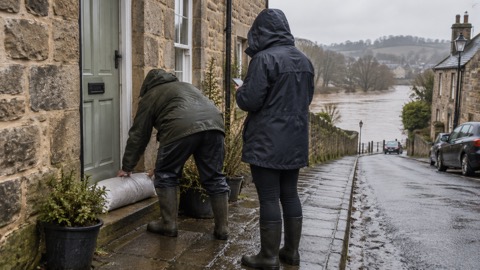
There are four broad approaches, and most households end up using more than one. The most basic is a barrier held flat against the wall or frame: official guidance describes "a strong wooden or metal barrier secured flat against the wall or frame surrounding a door or window, with the pressure of floodwater itself helping to seal the barrier"6. Next come purpose-made products: floodboards that fix to frames, demountable barriers that clamp into posts, and expanding barriers that wedge themselves into the opening3. Then there are permanent fittings, such as a watertight flood door that is always in place7. Finally there are improvised measures for households caught out: sandbag walls on doorways8, pillowcases or plastic bags filled with soil9, and even duct tape around the exterior of a door, which the fire and rescue service notes "can prevent water from getting between the door and the frame"10.
| Approach | What it is | Who it suits |
|---|---|---|
| Basic board | Wooden or metal barrier secured flat against the wall or frame6 | Low-cost, occasional shallow flooding |
| Floodboard | Purpose-made board fixed to the door or window frame11 | Regular risk, wants a reusable product |
| Demountable barrier | Aluminium panels clamped into permanent side posts2 | Regular risk, wants quick deployment |
| Expanding barrier | One barrier adjusted to fit different openings, no frame3 | Several openings, or renting |
| Flood door | Permanent watertight door7 | No one at home to fit a barrier |
| Sandbags and improvised bags | Filled bags stacked at the doorway8 | Emergency use, no fitted products |
The choice between these is what the rest of this page covers. What matters at the outset is that a doorway barrier is a resistance measure: it tries to stop water entering at all. That works for shallow, short floods. Once water is deep or sustained, official guidance shifts towards resilience as well, meaning repairs and fittings that let a home dry out and recover quickly, which is covered on protecting your home.
Floodboards: boards that fix to frames around doors and windows
A floodboard is the simplest purpose-made product. The Met Office describes them plainly: "Floodboards, can be fixed to your doors and windows"11. The mid and west Wales fire and rescue service adds that you "may want to consider buying purpose-made flood boards which slot into door frames and air bricks to seal them tightly"12. The board is stored somewhere dry and dry-fitted in advance, and when a warning comes it is slotted or fixed into place across the opening.
Their great advantage is reuse. Environment Agency guidance notes that floodboards "fix to frames around windows and doors. They can be washed, stored and used again"1, and that they "should always be removed once the flood water has gone to help the property dry out"1. That last point matters more than it sounds: a board left in place traps moisture in the wall and frame behind it, slowing the drying the house needs. The same guidance applies to airbrick covers, which should come off once the flood has passed because "ventilation is essential to dry wall cavities"6.
Floodboards suit households with a modest, known risk and someone at home to fit them. Their limits are height and width: a single board is only so tall before it needs serious fixings to resist the pressure of standing water, and very wide openings such as garage doors need something sectional instead. If your risk is greater than a board can handle, the next step up is a demountable system.
Demountable aluminium barriers: posts, panels and a water-tight seal
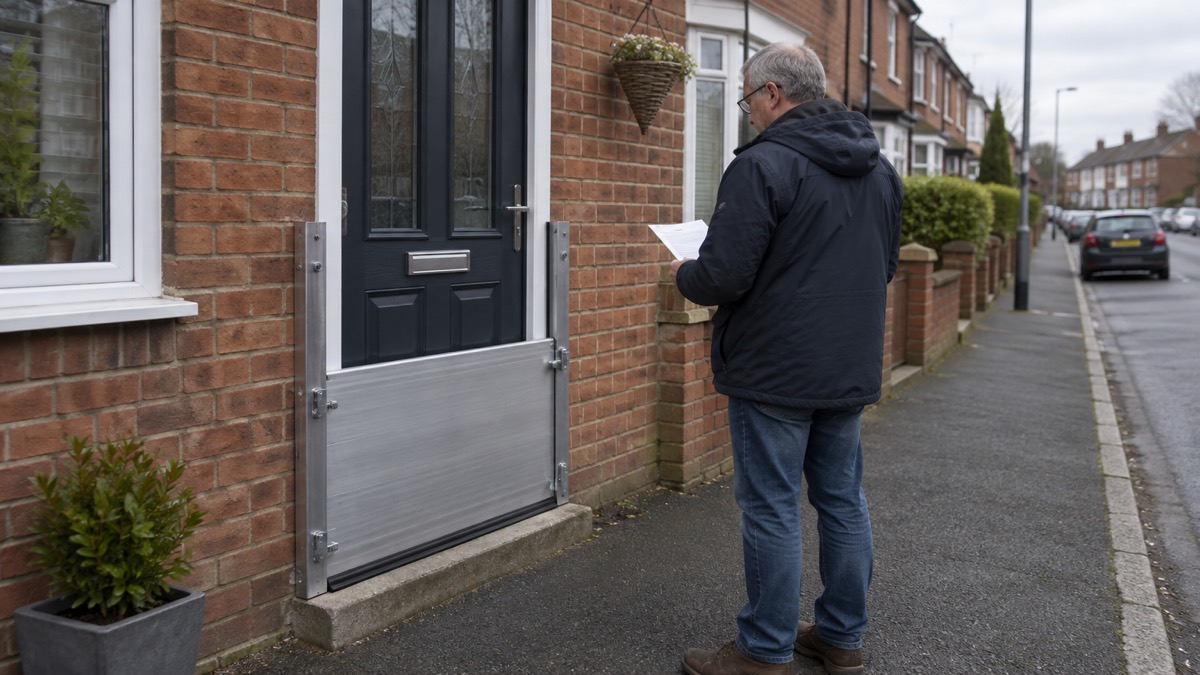
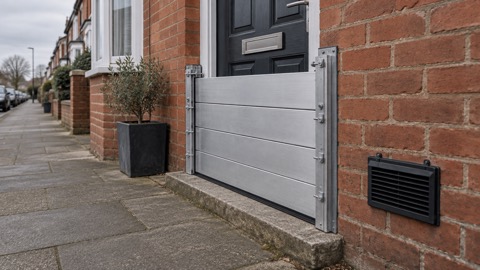
A demountable barrier is the workhorse of door flood protection. The Greater London Authority lists "demountable flood barriers and flood boards" among the products households can fit to prepare for flash flooding2, and Argyll and Bute Council's guidance on property flood resilience explains the distinction: "some features will be demountable such as barriers for doors and windows or others may be permeant e.g. a watertight PVC flood door"7. Demountable means the barrier comes out and is stored between floods, while the fixings stay on the building.
The system has three parts. Side posts or a frame are fixed permanently to the property, usually either within the door reveal or on the wall face either side of the opening. Aluminium panels, often one per opening but sometimes stacked, drop or slide into those posts. And a seal, typically a rubber gasket running along the bottom and sides, compresses as the panels are clamped in, forming a water-tight joint. The Scottish Flood Forum's protection guide describes one design in which "a preinstalled frame is attached to the property, this provides a secure and water tight fitting to which the flood door is attached. The barrier is curved to cope with the pressure of flood water"3. That curve is worth noting when you compare products: standing water pushes hard against a flat panel, and a curved or profiled panel resists that pressure better.
Real households bear this out. Derbyshire County Council's published case studies include homes fitted with "flood barriers to both doors" alongside self-closing airbricks and non-return valves13, a basement door and window protected by a flood barrier13, and a shop doorway where "a 1.2m flood barrier fits into doorway, to deal with low level floods, or buy time for moving contents in more severe events"13. That last example is the honest framing of what a tall barrier does: it holds back shallow water and buys time in deeper floods, rather than keeping a home dry in the worst case.
Demountable barriers suit households with a regular, known flood risk who want a product that deploys in minutes and can be checked and reused each time. The trade-offs are the permanent fixings on the building, the need to store the panels somewhere accessible, and the weight of larger panels. Guidance on flood protection home improvements suggests you "create an easy access store for flood barriers and blocks"14, and one case study business built "dedicated storage area on mezzanine" above flood level for exactly this reason13.
Expanding door barriers: one barrier, different openings, no frame
An expanding barrier does away with the frame altogether. The Scottish Flood Forum guide describes it as having "No frames, just a simple expansion system which allows one flood barrier to fit a number of different size openings"3. The barrier is wound out until it wedges tightly across the doorway, and the pressure of the water against it pushes it harder into the opening, improving the seal.
This type suits two situations well. The first is a household with several openings of different widths, or an awkward doorway where fixing a frame is impractical, because one adjustable barrier can serve them all. The second is a rented home, where drilling permanent posts into the fabric of the building may not be allowed; an expanding barrier leaves no fixings behind. It is also the type most likely to be already in the cupboard when an unexpected flood warning arrives, because nothing has to have been installed in advance.
The guidance is candid about the drawback: "A very effective system but product can be a little heavy if used by the elderly"3. If the person who will fit the barrier when the warning comes would struggle to carry and wind it, that is a reason to choose a lighter demountable panel, a permanent flood door, or a self-deploying barrier instead. Practise the fitting before you need it, and if weight is a problem, build help from a neighbour into your household flood plan.
Sectional barriers for garages and wider openings
Wide openings are the hard case. The Scottish Flood Forum guide is blunt: "Garages or wider opening are always more difficult to prevent flood water entering property"3. A single panel spanning a garage door has to resist much greater water pressure over a much wider span, so wide openings use sectional systems instead. In the design the guide describes, "This type of product consists of 4 long panels (can be more) stacked on top of each other, each one interlocking into the other, and forming an effective barrier"3.
Stacking brings a second advantage besides strength: height. The guide notes of this type that "It is not limited to a fixed height of 600 mm as some barriers are, but seek advice first"3. That 600 mm figure is the practical ceiling of many single-panel door barriers, and it is the single most important specification to check before buying, because it should match the depth of water you realistically expect. If your flood history or flood risk map suggests water deeper than that, a sectional system, or a barrier plus a plan to move contents, is the honest answer.
Sectional barriers suit garages, driveways, patio doors and commercial-style openings. They take longer to deploy than a single demountable panel, because each section has to be carried out and locked into the one below, so factor that time into your flood plan. Before a storm rather than a flood, official advice is also to "Lock doors and windows, especially large doors such as those on garages"15, since wind and debris can breach a large door before the water ever reaches it.
Automatic and self-deploying barriers: how they rise with the water
Every barrier described so far depends on someone being at home, able, and in time. Automatic barriers remove that dependency. The Scottish Flood Forum guide describes two designs. The first is a self-deploying water weight barrier: "It uses the weight of the water to hold the water back. The water lifts the top of the barrier and weighs the base down, forming a seal"3. The second is a water activated hydraulic barrier, which the guide says rises as the flood arrives, and "when raised the barrier reaches to the top of the wall, about 1m"3.
The principle is the same in both: the flood itself triggers and powers the defence. Nobody has to carry a panel out in the rain, and the protection works whether the household is asleep, at work or away. That makes automatic barriers worth considering for second homes, businesses, and households where the people who would fit a manual barrier are not always able to.
The same thinking applies to the smaller fittings around a doorway. An automatic barrier rises using the approaching floodwater itself, so the water that would come under the door is what brings the defence up13. An automatic barrier at the door pairs naturally with self-closing airbricks at the vents and a non-return valve on the drains, so that the whole ground floor defends itself. The trade-offs are cost, the need for professional installation, and the fact that a mechanism should be checked periodically, which is covered in storing and checking flood barriers.
Measuring a doorway: reveal fixing or wall-face fixing
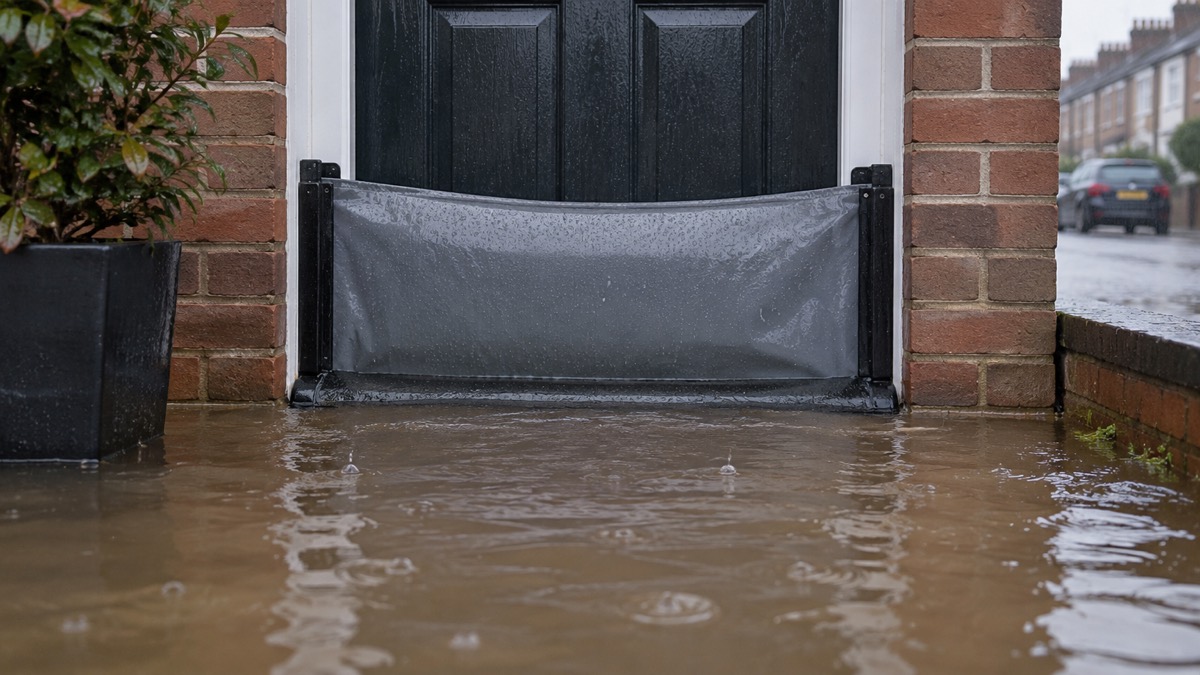
Before you buy any barrier that needs fixings, you need to know where those fixings can go. There are two standard positions. A reveal fixing sits inside the door opening itself: the posts or frame attach to the inner faces of the reveal, the sides of the opening, and the barrier sits flush within the doorway. A wall-face fixing attaches to the flat wall either side of the opening, which suits doorways with a narrow or awkward reveal, and allows a wider, taller barrier than the opening alone could hold. The basic board method described in official guidance works either way: the barrier is "secured flat against the wall or frame surrounding a door or window"6.
Measure the clear width of the opening at the point the barrier will sit, and the height you need, and check both against the maker's stated size range. For an expanding barrier, note the width of every opening you want it to fit, since one barrier serves a range of sizes3. For a demountable system, ask the supplier whether the posts fix in the reveal or on the wall face, because that determines both the maximum panel height and how visible the fixings are between floods.
Two further points from official guidance bear on the doorway itself. The condition of the door and its frame matters as much as the barrier fitted to them: a barrier can only hold back water at the point where it is fitted, so the surrounding wall and frame need to be sound. And if the risk is deeper than a barrier can hold, there is a more advanced option: enclosing the lower walls of the whole property, described as "an advanced method of reducing the effects of floodwater by enclosing the bottom 600-900mm of a property in plastic sheeting"6. That is a job for specialists, and it is one of the things a property resilience survey will assess.
Choosing a tested barrier and getting help with the cost
Two checks separate a serious product from a hopeful one. The first is certification. Natural Resources Wales advises households to "Choose BSI kitemark certified flood protection products that meet the British standard for quality and safety"4. The Kitemark scheme for flood products is explained in more detail on Kitemarked flood products and PAS 1188. The second is independent listing: Derbyshire County Council points households to the National Flood Forum's "directory of kite-marked flood resilience products - Blue Pages"16, where products can be checked before buying.
Costs can sometimes be offset. One case study household used a government grant to buy "2 Kitemarked flood doors"13, and grants for property flood resilience are covered on property flood resilience grants. Another household lowered her costs through a local flood action group, which "had arranged for a bulk purchase discount, so Debbie paid for and installed measures h"13 herself; a community group can do the same for barriers. If you are comparing a barrier with a permanent flood door, the trade-offs are set out on door barriers or flood doors, and the sandbag comparison is on sandbags or door barriers.
Putting a barrier in place when a flood warning comes
A barrier only works if it goes up in time, so the deployment step belongs in your flood plan as a numbered action. The sequence below is drawn from official advice across England, Wales, Scotland and Northern Ireland.
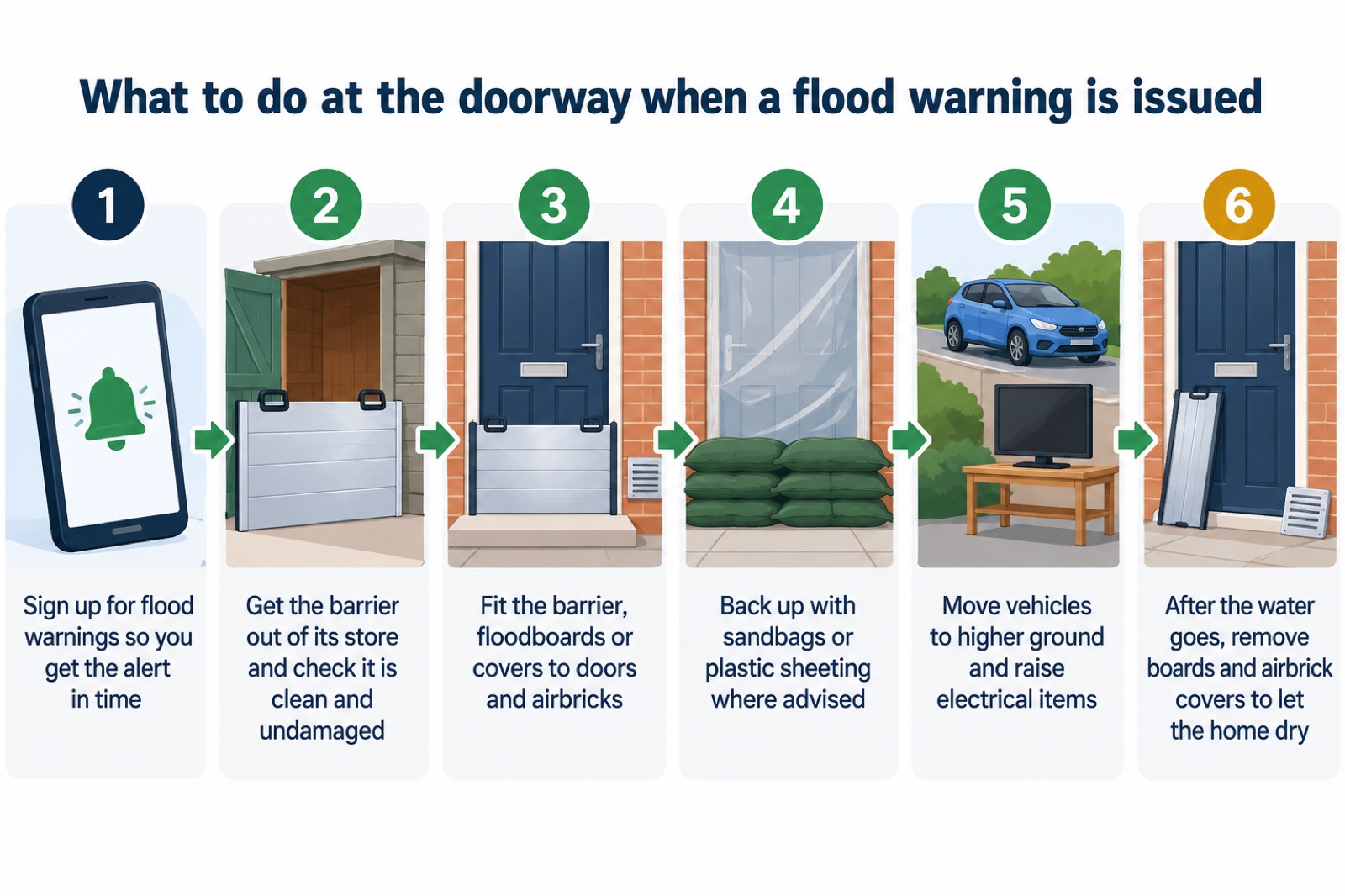
The official instruction is consistent everywhere. Gov.uk tells households to "use flood protection products if you have them, for example flood barriers or air brick covers"18. The mid and west Wales fire and rescue service says to "Block doors (with floodboards if available) and airvents with plastic sheeting and sandbags"12. Northern Ireland's guidance is to "have some sandbags, floodboards, or plastic covers prepared to block doorways and airbricks"20. Surrey's guidance asks households to "Decide what type of barriers and protection you need to reduce flood water coming into your home, including airbricks, doors and windows"21 well before any warning, which is the point of planning rather than shopping during the event.
Practise the fitting in dry weather at least once. Time yourself. If two people are needed, name them in the plan. And keep the barrier where you can reach it: the guidance on home improvements is to "create an easy access store for flood barriers and blocks"14, not a loft above a flight of stairs at the far end of a flooded street.
When a door barrier is not enough
The most important fact on this page is the limit. Suffolk County Council states it plainly: "Sandbags do not provide enough protection during a flood. Water can get into properties through many routes, not just doorways"5. The same logic applies to any barrier at the door. A barrier only defends the opening it covers, so a property that relies on one alone is still open to water arriving by the other routes the council describes.
So a door barrier should be one part of a set. The standard pairing, repeated across official guidance, is barriers on doors and windows plus non-return valves on drains and automatically closing airbricks22. Beyond that, resilience measures reduce what the water that does get in can destroy: raise plug sockets, boilers and service meters higher up walls24, raise fridges, freezers and washing machines on bricks12, and choose water resistant door and window frames sealed with silicone sealant24. Northern Ireland's guidance adds measures such as permeable paving on driveways, white goods on raised plinths, and "install a flood resistant front door and replace wooden window frames and doors with man-made ones like UPVC"14.
Finally, know when to stop defending and start moving. If water is coming through routes a barrier cannot cover, or the depth is beyond what the product is built for, the priority shifts to turning off utilities, moving people, pets and valuables upstairs, and following the steps on what to do during a flood and after a flood. A barrier buys time; it does not buy certainty.
Sources (24)
- What to do in a flood, Environment Agency leaflet, Nottinghamshire County Council, 2010-11
- How to prepare for flash flooding, Greater London Authority, 2026-10-25
- Flood Protection Guide, Scottish Flood Forum, 2023-02
- Preparing for a flood, Natural Resources Wales, 2026-10-29
- Flood management in Suffolk, Suffolk County Council, 2026-10-29
- Damage limitation guide, Dover District Council, 2001-09
- Property flood resilience questions and answers, Argyll and Bute Council, 2026
- Personal flood resilience, Derbyshire County Council, 2026-10-29
- What to do in a flood, Natural Resources Wales, 2026-10-29
- Safety in severe weather conditions, Devon and Somerset Fire and Rescue Service, 2026
- Protecting your property from flooding, Met Office, 2026-10-25
- Flooding advice, Mid and West Wales Fire and Rescue Service, 2026-10-29
- Property flood resilience case studies, Derbyshire County Council, 2024
- How to protect your home from flooding, nidirect, 2025-12-18
- Storms, heavy rain and high winds, Essex Prepared, 2026-10-29
- Resilience and sandbags, Derbyshire County Council, 2026-10-29
- Thunderstorms weather warning advice, nidirect, 2026-08-30
- Help during a flood, GOV.UK, 2026-10-25
- Flooding advice: preparing for a flood, London Fire Brigade, 2026-10-25
- What to do if a flood happens, nidirect, 2025-10-24
- Preparing for flooding, Surrey County Council, 2026-10-28
- Homeowner flood protection responsibilities and prevention tips, Central Bedfordshire Council, 2026
- Flooding guide for communities, Scottish Environment Protection Agency, 2026-10-29
- Getting back into your home following flooding, Surrey County Council, 2026-10-28
 Flood Warning Checklist
 First Steps After a Flood
 Insurance Claim Records
 Checking Flood Risk by Postcode
 Types of Flooding
 Flood Alerts and Flood Warnings
 Flood Guidance Statement
 Wales Flood Warnings and Maps
 Making a Household Flood Plan
 Protecting Your Home
 Sandbags and Alternatives
 Flood Doors and Windows
 Airbrick Covers
 Non-Return Valves and Bungs
 Sump and Submersible Pumps