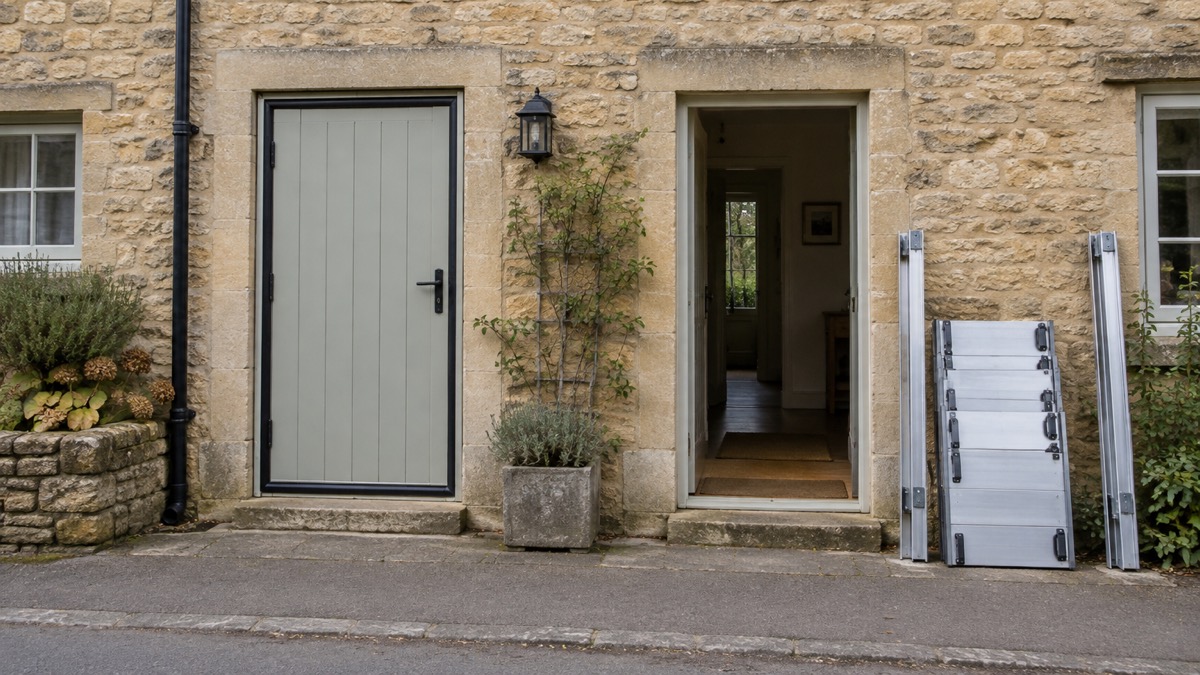
If flood water could reach your door, you have two broad choices. You can fit a barrier that goes up when a warning comes and comes down again afterwards, or you can change the doorway itself with a flood door or a raised threshold. Both keep water out of the opening; they differ in what they ask of you, what they cost you in effort, and what they can and cannot do.
The first thing to understand is that a doorway is only one way in. Water can enter a property via doorways, windows, air bricks or as groundwater through floors1. A barrier across the front door that leaves the airbricks open, or a flood door with a gap under the sill, will not keep a flood out. Official guidance is to decide what type of barriers and protection you need to reduce flood water coming into your home, including airbricks, doors and windows2.
The second is that nothing is absolute. Flood defences reduce, but do not completely stop the chance of flooding as they can be overtopped or fail3. A door barrier buys you protection up to its height and buys you time. Plan on that basis: protect the openings, have a plan for when water gets past them, and know where to get help.
| Flood door | Removable barrier | |
|---|---|---|
| When it protects | Whenever the door is closed7 | Only once you have fitted it6 |
| Effort at a warning | None | You must fit it, in the wet and the dark if the warning is late |
| Storage | None | Must be washed, dried and stored8 |
| Best suited to | A main entrance you are prepared to change | A doorway you cannot or will not alter, or a rented home |
Flood door or flood barrier: how each one protects a doorway
A flood door is a permanent change to the building. It is designed and manufactured with a special seal between the frame and the door which prevents water entering, and the flood protection is immediately effective when the door is closed7. There is nothing to fit, nothing to store and nothing to remember at 2am when a warning arrives. The door is designed to blend in with the property and there is nothing which would identify it as being an effective flood door7. That matters if you care how the front of the house looks, and it matters if you might forget to deploy a barrier.
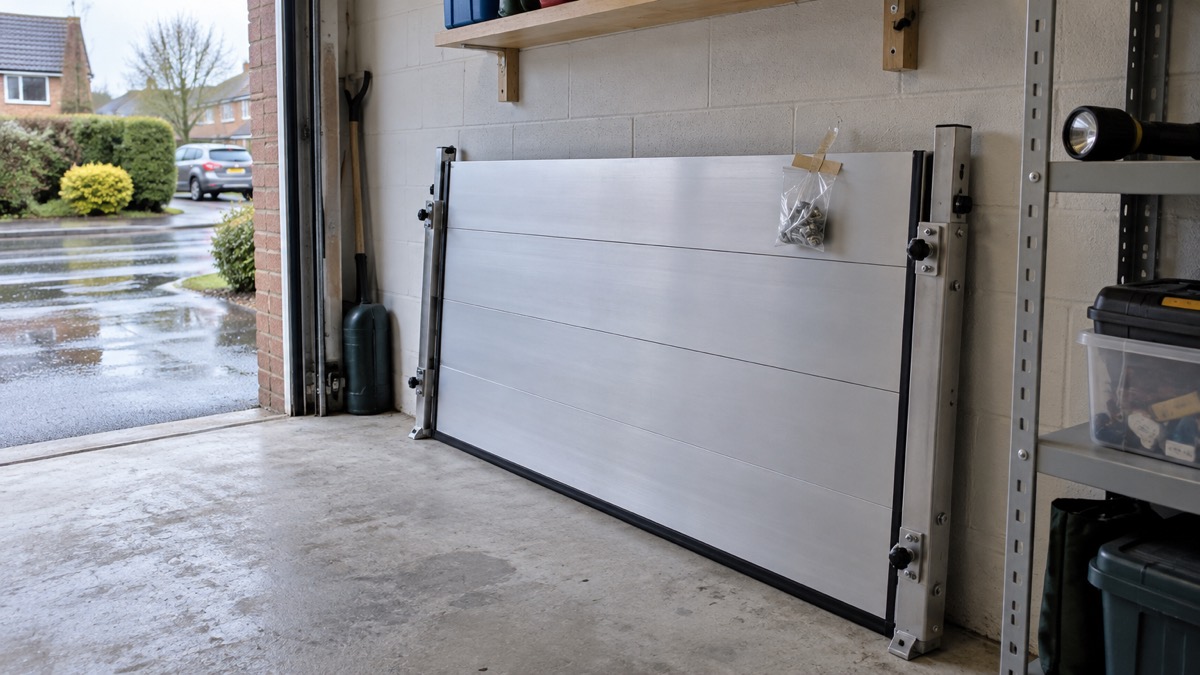
A barrier is a separate piece of equipment. The simplest forms are fixed to the frame around the opening and rely on the pressure of the floodwater itself to help seal them. Others come with a preinstalled frame attached to the property providing a secure and water tight fitting, and the barrier is curved to cope with the pressure of flood water7. A third type, the expanding barrier, has no frames, just a simple expansion system which allows one flood barrier to fit a number of different size openings7. That last type suits an awkward doorway, a rented property where you cannot fix a frame, or a household that wants one barrier to cover more than one opening.
The practical difference comes down to three things:
Whichever you choose, the doorway is one part of a set. Official guidance lists resistance measures that can be installed to keep the water out as flood doors, barriers, gates and walls4. Treat the door as the first line and the rest of the openings as part of the same job.
Temporary barriers you fit to a door when a flood warning comes
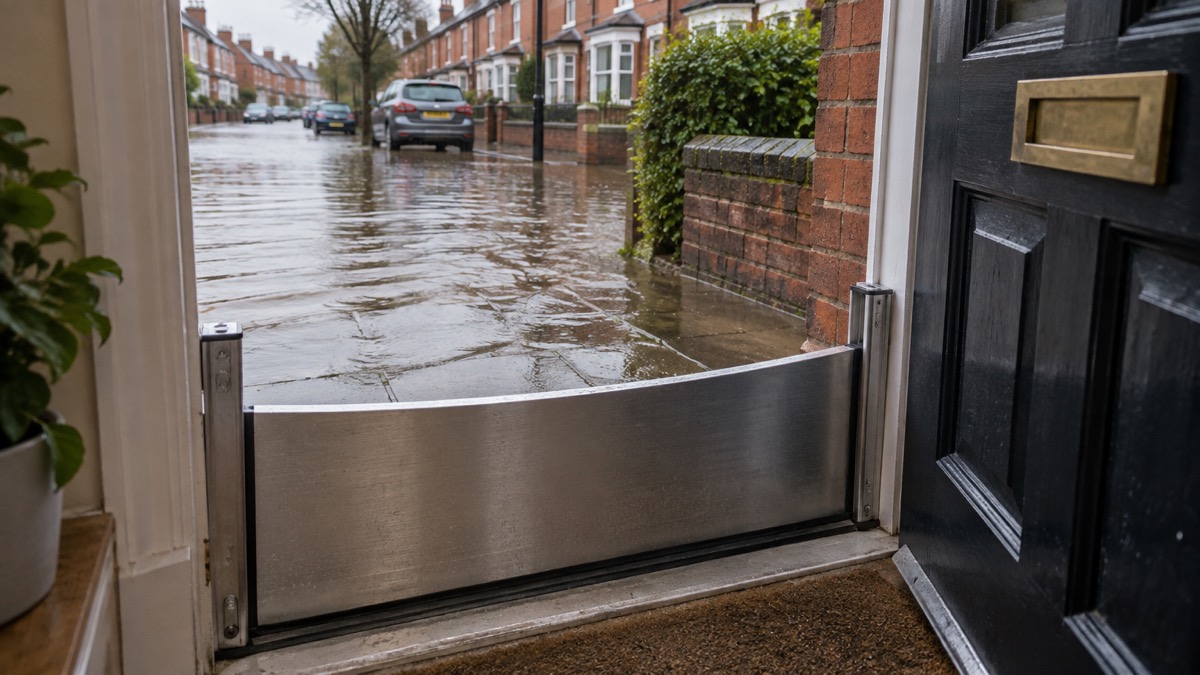
A temporary barrier is the option most households start with, because it needs no building work and can be bought online or from a local hardware store9. The principle is simple: use flood barriers to divert the water away from your home and to prevent it entering9. You are not trying to hold back a river, you are trying to keep the water that reaches your threshold out of the opening.
Timing is everything. Put temporary flood protection measures in place as soon as you get a flood warning, or before if you are not likely to be home at the time, and always remove them once the flood water has gone to help the property dry out6. A barrier left in a cupboard until the water is at the kerb is a barrier that will not be fitted properly. If you are out at work when warnings are issued, fit it before you leave when flooding is forecast.
Official advice is to use flood protection products if you have them, for example flood barriers or air brick covers10. Note the phrasing: if you have them. The single most useful thing you can do before the next flood season is to buy the barrier, check it fits, and learn how it goes in, so that fitting it under pressure is a five minute job rather than a first attempt.
For flash flooding, the same advice holds: use flood barriers if possible, to divert water away from your home12. Flash floods give the least notice, which is exactly when a barrier you have already practised with earns its keep.
Flood boards: a strong barrier fixed flat against the door frame
Flood boards are the traditional form of door protection and still the most widely recommended. The most basic method is to construct a strong wooden or metal barrier that is secured flat against the wall or frame surrounding a door or window, with the pressure of floodwater itself helping to seal the barrier8. The water pushes the board against its seal, so the harder the flood presses, the tighter the fit.
Modern purpose-made boards are neater than the homemade version. They fix to frames around windows and doors, can be washed, stored and used again, and should always be removed once the flood water has gone to help the property dry out6. You may want to consider buying purpose-made flood boards which slot into door frames and air bricks to seal them tightly13. Boards can be fixed to your doors and windows14, so the same product family covers more than the front door.
A board is only as good as its frame. The board seals against the frame, so a rotting or uneven frame will leak. If you are buying boards, check the frame they will sit against, and follow the maker's instructions for fitting and for any seal maintenance. Store the boards flat, clean and dry, with their fixings, so they go back on the same way next time.
Flood resistant front doors and raised thresholds
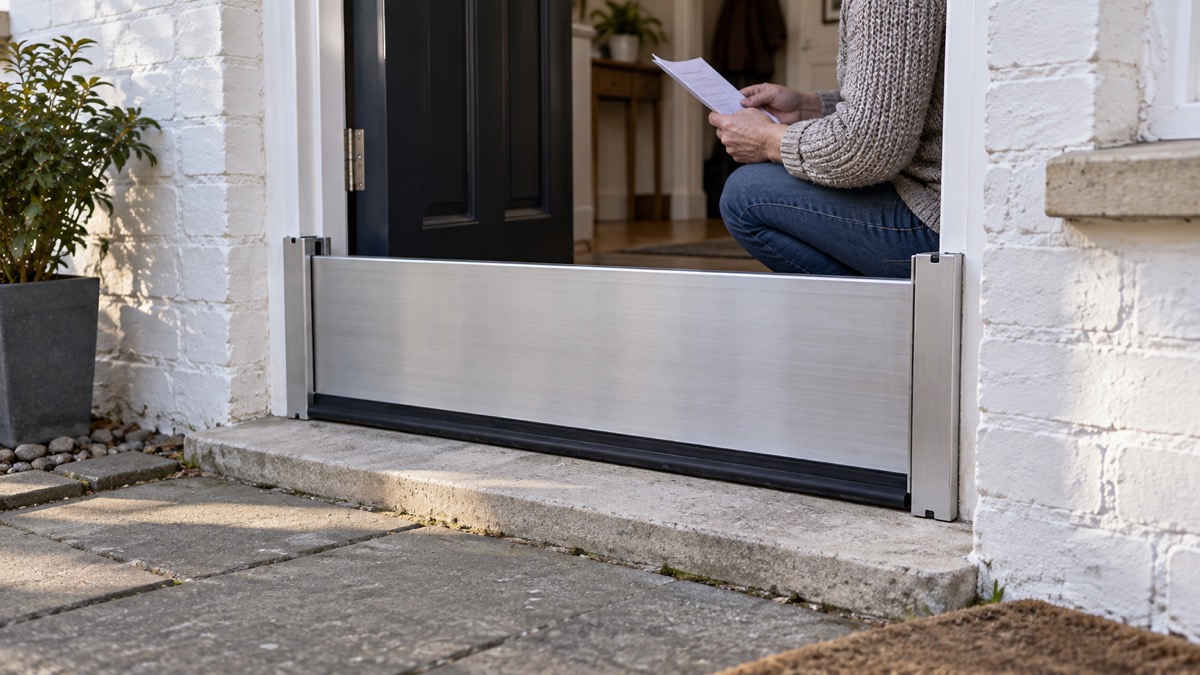
If you are replacing a front door anyway, or you want protection that needs no action at a warning, a flood resistant door is the permanent route. Official guidance for external doors is to put in a flood resistant front door, buy temporary removable flood barriers for your doors, or raise the threshold of your doors1. Those are the three options in the order a household usually considers them.
A watertight PVC flood door is one example of a permanent measure, alongside demountable barriers for doors and windows14. The distinction official guidance draws is between features that are demountable, such as barriers for doors and windows, and others that may be permanent, such as a watertight PVC flood door14. A raised threshold does the same job more simply: it lifts the bottom of the opening above the level the water is likely to reach, so there is less to keep out in the first place.
A door on its own is not the whole job. Choose water resistant door and window frames and use silicone sealant15. Fit plug sockets, boilers and service meters higher up on walls15. These are the measures that stop a small amount of water that gets past the door from becoming an expensive repair.
If you are in a high-risk area, consider investing in property-level flood protection products such as flood gates or barriers16. For a permanent door, that means a proper survey and a competent installer rather than a general builder learning on the job. See Property Resilience Surveys and Professional Installation for what a survey should cover.
Sandbags and homemade alternatives for doors and airbricks
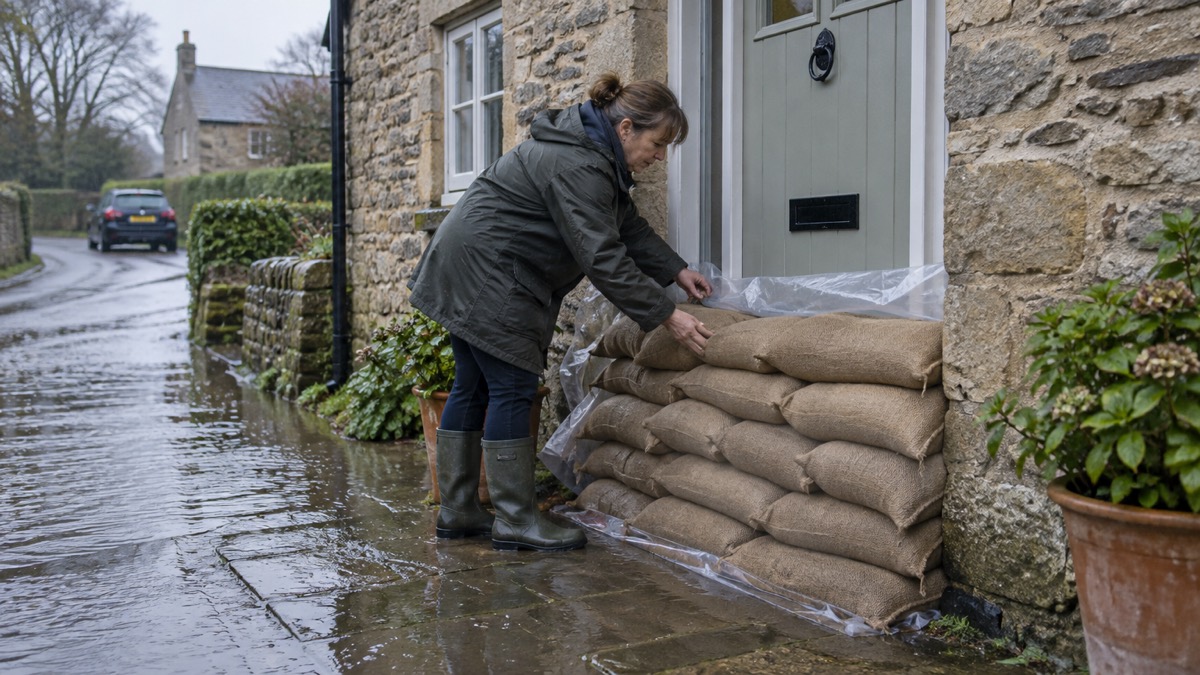
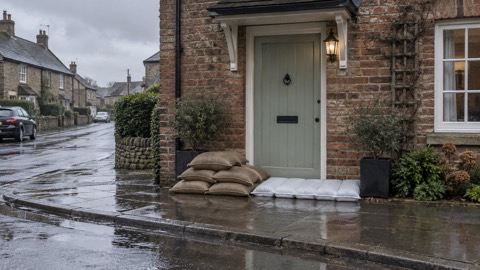
Sandbags are the measure everyone reaches for and the one most often misunderstood. Official guidance is blunt: sandbags do not provide protection during flooding; water can get into houses through many routes, not just doorways, and sandbags can become contaminated with sewage where sewer flooding occurs6. They are a stopgap, not a solution.
Used as a stopgap, they still have a place. If your property is at risk of flooding, have some sandbags or floodboards or plastic covers prepared to block doorways and airbricks17. On a flood warning, block doors (with floodboards if available) and airvents with plastic sheeting and sandbags13. Keep some sandbags to block doorways and some short wooden boards to nail over airbricks18. You can prevent the entry of water by making sandbag walls on doorways, or use other products that may be more effective19.
Where to get them: contact your local authority, who may have some available during a flood; if they do not supply sandbags, you can buy your own from DIY stores and builder's merchants5. Get sandbags to block doors and airbricks from a builders' merchant or your local council, or make your own using old pillow cases or carrier bags filled with sand or earth20. In Northern Ireland, the advice is to get a stock of sandbags from your local DIY store and keep them in a dry place21.
If you have left it too late, pillowcases or plastic bags filled with soil or heavy objects can be used to block water entering through doors and windows17. Treat that as an emergency measure only. For the longer term, implement property-level protection measures that go beyond sandbags, such as flood barriers, water-activated flood bags, and other modern flood defence products22.
Blocking airbricks, windows and the other ways in
A doorway barrier is wasted if the airbricks beside it are open. Water can enter a property via doorways, windows, air bricks or as groundwater through floors1, so the openings have to be dealt with together.
For airbricks you have two permanent options and one temporary one. You can replace air bricks with self-closing air bricks, which close automatically during flooding to stop water entering, or buy watertight covers to put over air bricks1. A self-closing air brick replaces the existing air brick and uses a floating ball arrangement which seals the ventilation hole when flood water reaches the air brick; some manufacturers use a flap valve instead7. A snorkel cover is permanently fixed to the wall over the air brick with vents above flood water height, allowing the property to breathe yet preventing ingress of flood water7. Simpler airbrick covers can stop flood water coming in through your airbricks6, and plastic covers do the same job8.
Whatever you fit, remember the other half of the job: remove any coverings on airbricks once the flood has passed, as ventilation is essential to dry wall cavities8. A cover left on for weeks traps damp in the wall.
Windows matter too. Floodboards can be fixed to your doors and windows13, and property flood resilience measures include installing flood barriers on doors and windows, using non-return valves on drains, and elevating electrical sockets22. If water can come up through the drains, a door barrier will not stop it; see Non-Return Valves and Toilet Bungs for that route.
Kitemarked barriers: what the mark tells you
When you buy a barrier, look for the Kitemark23. Choose BSI Kitemark certified flood protection products that meet the British standard for quality and safety5. The mark is the simplest way for a household to tell that a product has been tested to a recognised standard rather than simply described as waterproof.
The mark is not a guarantee that your doorway will stay dry. It tells you the product has been assessed to a standard; it does not tell you that your frame is sound, that the barrier is the right height for your flood risk, or that you have fitted it correctly. Those are your job, or your installer's.
Kitemarked products are what public funding is designed to buy. One household used a government £5k grant to buy 2 Kitemarked flood doors24. The Property Flood Resilience funding scheme lists flood doors and gates, temporary demountable barriers, pumps, airbrick covers and water resilient flooring among the measures it covers25. If you are applying for a grant, the standard of the product will be part of the assessment. See Kitemarked Flood Products and PAS 1188 Explained and Property Flood Resilience Grants.
Timber flood gates for driveways and pedestrian entrances
Not every opening is a front door. Driveways, side gates and pedestrian entrances let water into the curtilage of the house, and from there to the door. Official guidance lists flood doors, barriers, gates and walls as resistance measures that can be installed to keep the water out4, and advises that if you are in a high-risk area you should consider property-level flood protection products such as flood gates or barriers16.
A gate or a low wall across a driveway works on the same principle as a door board: a barrier across the opening, sealed against a frame or wall, with the water pressure helping to hold it. It needs the same things a door barrier needs: a sound surface to seal against, a height matched to your risk, and someone who knows how to put it in place. Options include flood gates or flood sacks, specialist doors and seals for airbricks26.
For a shared driveway or a terrace of houses, a gate at the entrance can protect several households at once, which makes it a natural thing to agree with neighbours. See Community Resilience for how to raise it locally.
Rented homes, flats and properties that are hard to protect
If you rent, the permanent measures are not yours to fit. If you are a renter, speak to your landlord or housing association about how they can better protect you from flooding27. Do that in the quiet months, not during a warning, and put it in writing.
For a rented home, a removable barrier that needs no fixings is the practical route. An expanding barrier with no frames, just a simple expansion system which allows one flood barrier to fit a number of different size openings7, can be fitted and removed without altering the property, and taken with you if you move. Check with your landlord before fitting anything to the frame.
For flats, the doorway is often the only opening you control, and the water may arrive through a shared stair or a drain rather than the street. Decide what type of barriers and protection you need to reduce flood water coming into your home, including airbricks, doors and windows2, and raise the shared parts with the building owner or managing agent.
Looking after a barrier so it works when you need it
A barrier that has been stored damp, lost its fixings or warped in a shed will not seal. Floodboards can be washed, stored and used again6, and should always be removed once the flood water has gone to help the property dry out6. Build a small routine around that:
- After any use, wash the barrier, dry it fully and check the seals.
- Store it flat, dry and easy to reach, with its fixings and instructions.
- Check it before each flood season, and test-fit it once so you know it goes in.
- Put it in place as soon as a flood warning comes, or before you leave if you will not be home6.
- Remove it once the water has gone, and remove any airbrick coverings too8.
Some households leave demountable barriers in place for the whole flood season rather than fitting them at each warning. One hotel puts its barriers in place every November alongside the beer garden and leaves them for the winter24. That is a judgement for a business with staff; for a home, the official advice remains to fit when warned and remove afterwards.
Where to get help and what to do next
Start with your own risk. Check whether your home is likely to flood and from which direction, using Checking Your Home's Flood Risk by Postcode, and read Types of Flooding so you know whether you are dealing with a river, the sea, surface water or groundwater. Groundwater, in particular, comes up through floors and will not be stopped by a door barrier.
Then decide your route. If you want protection that needs no action at a warning, look at a flood door or a raised threshold. If you want something you can fit yourself and take with you, look at a removable barrier or flood boards. Either way, deal with the airbricks and the drains at the same time. Door Flood Barriers: Types and How to Choose sets the types side by side, and Sandbags or Door Barriers: Which Protects a Home Better? compares the stopgap with the proper measure.
Sign up for warnings so you know when to fit the barrier. How to Sign Up for Free Flood Warnings explains the service, and Flood Alerts, Flood Warnings and Severe Flood Warnings explains what each level means. When a warning comes, Checklist When a Flood Warning Is Issued takes you through the steps in order.
If you need financial help with the work, Property Flood Resilience Grants explains the schemes. If you are uninsured or under-insured, Recovery Grants and Help If You Are Not Insured covers the support available. And if water does get in, What to Do During a Flood at Home and After a Flood: Returning Home Safely take you through it.
Sources (26)
- Adapting your home or business to the risk of flooding, GOV.UK, 2009-10-01
- Preparing for flooding, Surrey County Council, 2026-10-28
- Different types of flood risk, Natural Resources Wales, 2026-10-29
- How to prepare for flooding, GOV.UK, 2023-12-19
- Preparing for a flood, Natural Resources Wales, 2026-10-29
- Before, during and after a flood, Suffolk County Council, 2021-05
- Flood Protection Guide, Scottish Flood Forum, 2016
- Damage limitation guide, Dover District Council, 2001-09
- My street is flooding, London Fire Brigade, 2026-10-25
- Help during a flood, GOV.UK, 2026-10-25
- Preparing for a flood, Natural Resources Wales, 2026-10-29
- Extreme weather summer guide, London Fire Brigade, 2024-05
- Protecting your property from flooding, Met Office, 2026-10-25
- Property flood resilience questions and answers, Argyll and Bute Council, 2026
- Getting back into your home following flooding, Surrey County Council, 2026-10-28
- Prepare for potential flooding, Wiltshire and Swindon Prepared, 2026-10-25
- Preparing for flood, nidirect, 2025-09-11
- Flooding advice, Belfast City Council, 2026-10-29
- Personal flood resilience, Derbyshire County Council, 2026-10-29
- What to do if a flood happens, nidirect, 2025-10-24
- Homeowner flood protection responsibilities and prevention tips, Central Bedfordshire Council, 2026
- Flood preparedness, Southend-on-Sea City Council, 2026-10-29
- Property flood resilience case studies, Derbyshire County Council, 2024
- Property flood resilience funding, Devon County Council, 2023-07
- Flooding, West Yorkshire Prepared, 2026-10-29
- How to prepare for flash flooding, Greater London Authority, 2026-10-25
 Sandbags or Door Barriers
 Sandbags or Absorbent Bags
 Submersible vs Suction Pumps