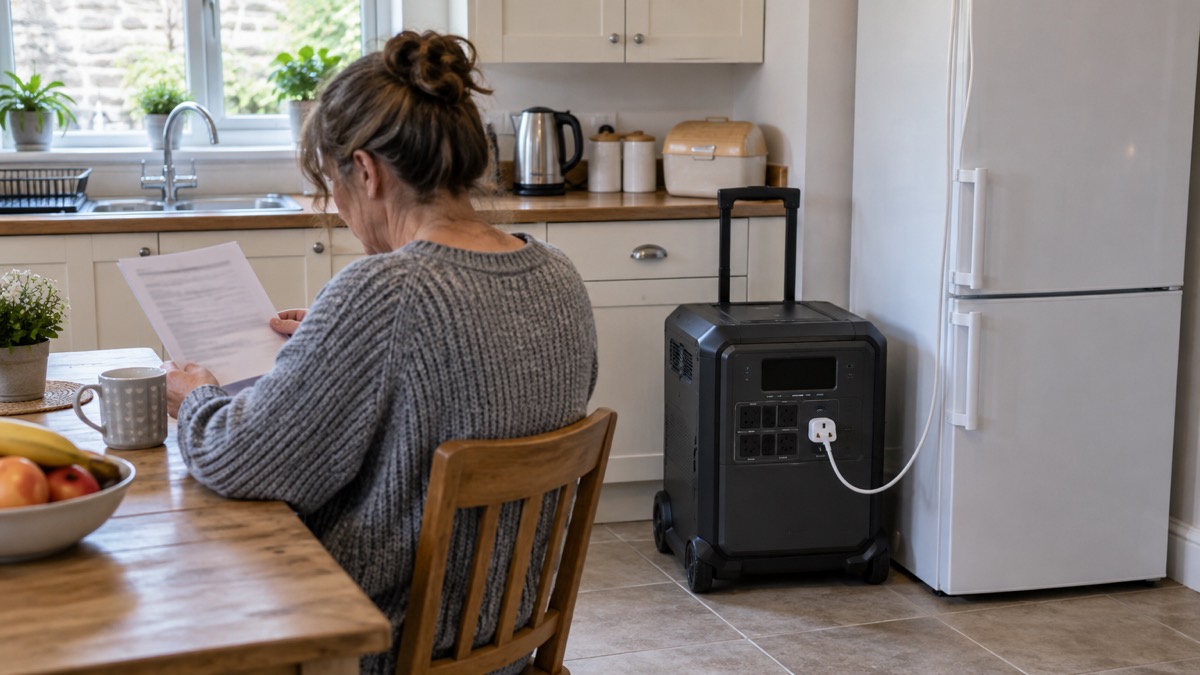
The Anker SOLIX F3000 is a large portable power station: a 3,072Wh lithium iron phosphate (LFP) battery with a 3,600W output, built into a wheeled case that Anker calls the EasyTow suitcase design1. In plain terms it is a big battery you charge from the mains or from solar panels, then plug ordinary appliances into during a power cut. Anker states one F3000 can power a 190W fridge for 42 hours3.
It is not a generator. There is no fuel, no exhaust and no carbon monoxide, which is why it can sit indoors beside the fridge. What it can and cannot do comes down to two numbers: how much energy it stores (3,072Wh) and how much power it can deliver at once (3,600W). Everything else, from run times to solar charging, follows from those.
This page sets out what the F3000 is, what it will run and for how long, how to recharge it, how to add capacity, and the temperature and weight limits Anker gives for safe use. It is a description of one product, not a recommendation over any other.
What the Anker SOLIX F3000 is
The F3000 is a single unit with a 51.2V, 60Ah, 3,072Wh LFP cell pack and a 3,600W AC output1. LFP chemistry is the reason Anker can quote a 4,000-cycle life and a 10-year lifespan with InfiniPower2. In household terms, a long cycle life matters because a power station that is charged and discharged regularly will hold its capacity for years rather than months.
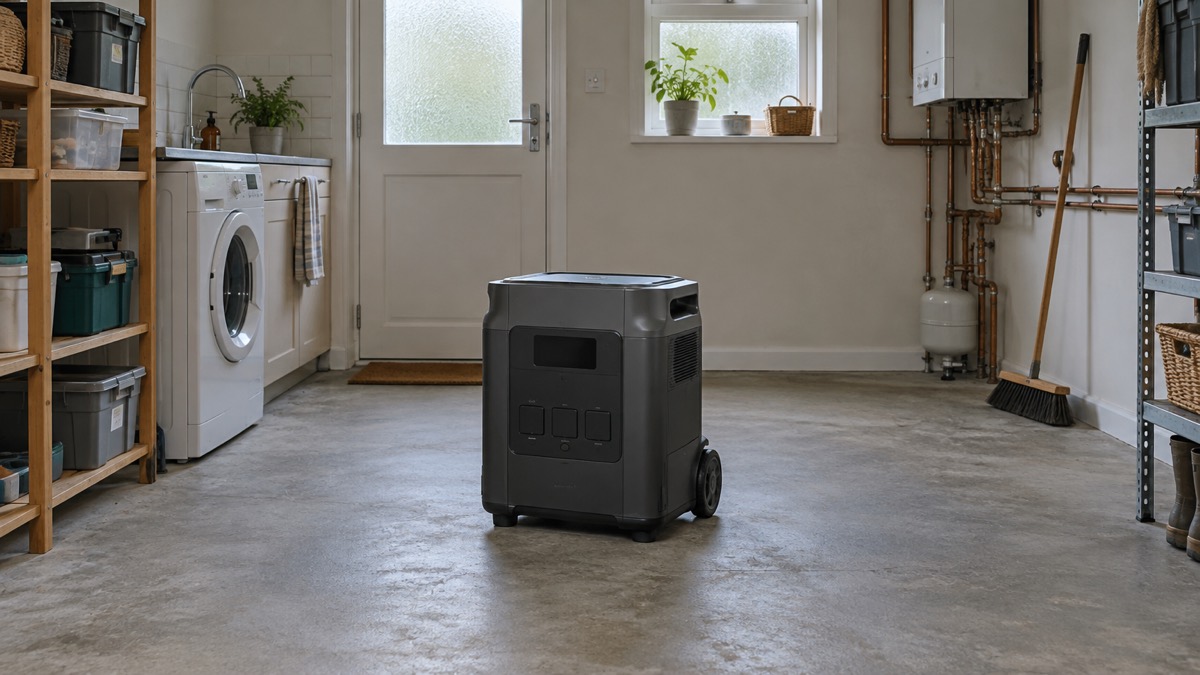
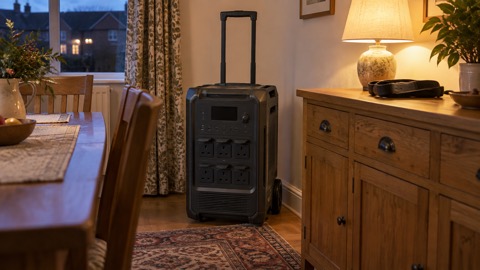
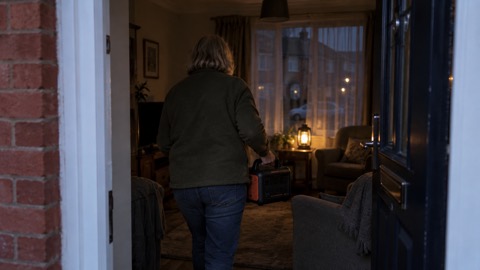
It is a heavy piece of kit. Anker gives the net weight as 41.5 kg and the dimensions as 651 × 300 × 377 mm3. That is why it has wheels and a pull handle: the EasyTow design is there so you can move it from the cupboard to the kitchen without lifting it2. Plan where it will live before it arrives, because carrying 41.5 kg up a flight of stairs is not something to do in the dark during an outage.
The front panel carries the sockets and controls: AC output ports, USB-C and USB-A outputs, a car socket, an Anderson DC output, the AC input, the expansion battery port, and separate high-PV and low-PV solar inputs2. Anker lists the USB-C output at up to 100W per port and the USB-A output at 12W max per port3. There is also an LCD screen showing the state of charge and a 20 ms switchover that Anker describes as keeping critical data backups secure and essential appliances running through an outage3.
What it will run, and for how long
Anker publishes run times for common household loads, and they are the most useful guide to what the F3000 can do. The headline figure is 42 hours for a 190W fridge3. Anker's own run time table also gives 42 hours for a 90W fridge, 3.25 hours for an 800W microwave, 1.8 hours for a 1,500W electric grill and 1.2 hours for a 2,200W kettle4. For smaller devices, Anker quotes 49.2 charges of a 49.9Wh laptop, 61.4 charges of a 40Wh drone and 183.4 charges of a 13.4Wh camera4.
| Load | Power | Run time stated by Anker |
|---|---|---|
| Fridge | 190W | 42 hours3 |
| Fridge | 90W | 42 hours4 |
| Microwave | 800W | 3.25 hours4 |
| Electric grill | 1,500W | 1.8 hours4 |
| Kettle | 2,200W | 1.2 hours4 |
| Drill | 600W | 4.5 hours4 |
| Chainsaw | 1,400W | 2 hours4 |
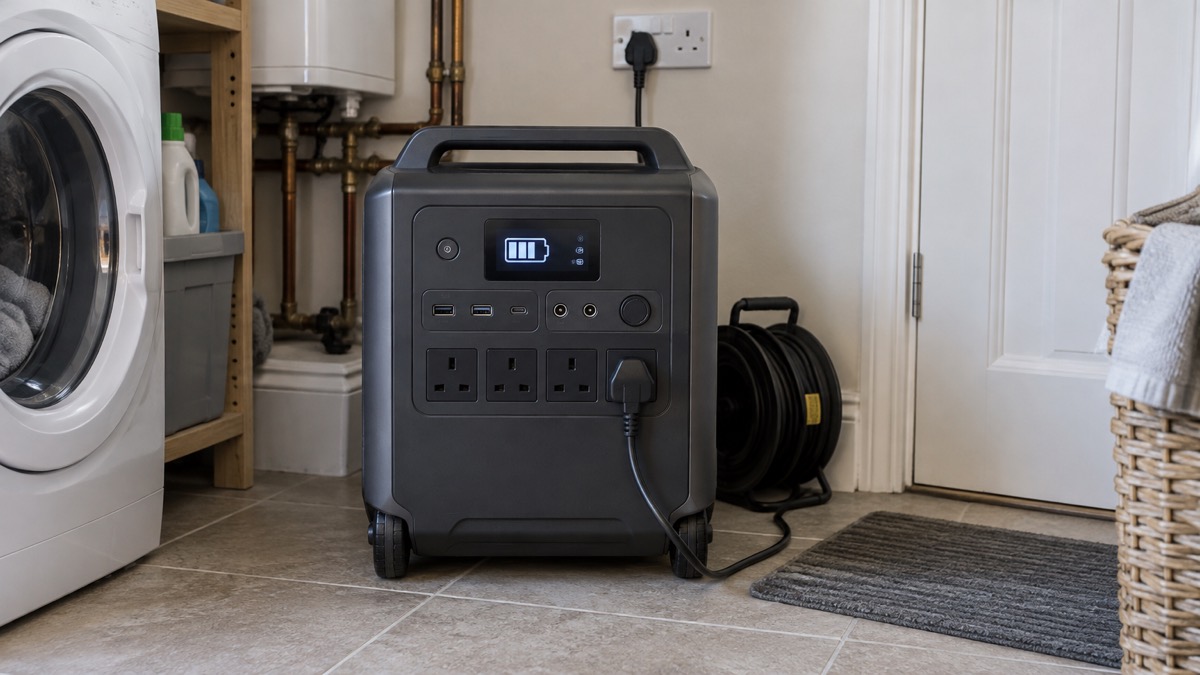
Two things follow from that table. First, the F3000 is at its best on steady, modest loads: a fridge, a boiler pump, lights, phones and a router. Second, high-power appliances work but eat the battery quickly. A kettle is a short burst, so 1.2 hours of kettle time is many cups, but a microwave or grill used carelessly will flatten the pack in an evening.
The 3,600W output is the ceiling for anything you plug in at once1. If you are working out whether a particular appliance will run, the watts and watt-hours guide explains how to read a label and allow for surge at start-up. For a fuller method, see what capacity power station you need.
Charging it: mains, solar and the car
From the mains, Anker gives the AC input as 230V~ 18A Max, 3,600W Max, 50Hz4. That is a high input for a domestic socket, so check the circuit you use and avoid sharing it with other heavy loads; the extension leads and overloading guide covers why. Anker also states the F3000 can be charged from the grid and from solar panels at the same time, with solar power prioritised and any remaining capacity supplied by the grid3.
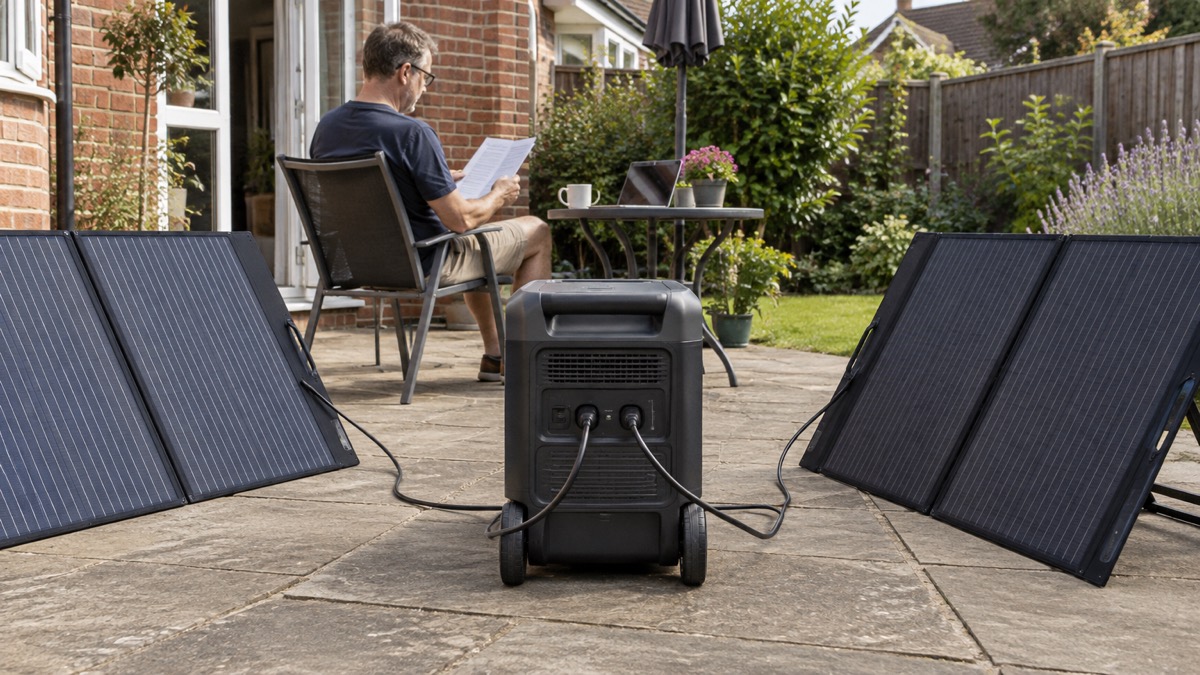
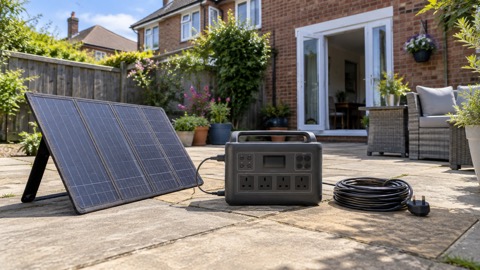
Solar is where the F3000 is unusually capable. Anker states it has two PV inputs supporting up to 2,400W in total5, and describes flexible dual-voltage inputs of 60V and 165V delivering up to 2,400W4. The two inputs are not the same:
- High-PV input: 1,600W max at 165V. Anker states it supports panels between 11 and 165V, and that you can connect up to four 400W solar panels in series for 1,600W5.
- Low-PV input: 800W max at 60V. Anker states it supports panels between 11 and 60V, and that you can connect two 400W solar panels in parallel for 800W5.
Anker quotes a full solar recharge in 1.5 hours4. That is the maker's best case with ample panel wattage and good sun, not a typical British winter day. If you are sizing panels, the solar panel sizing guide and how long solar charging takes in the UK set out what to expect. The F3000 can also be charged from an EV charger through an Anker SOLIX EV Charging Adapter at up to 3,600W (230V~18A)1. That is the station drawing power from a charger, not the station charging a car.
Expanding capacity from 3kWh to 12kWh
The F3000 starts at 3kWh and Anker states it is expandable from 3 to 12kWh3. Expansion batteries connect through the dedicated expansion battery port on the unit2. Anker sells an F3000 expansion battery and a BP3000 expansion battery for the F3000, and describes the F3000 as having a 3kWh capacity with low power consumption5.
Adding capacity does not raise the 3,600W output; it lengthens the time you can run the same loads. That suits a household that wants to cover a longer outage, or to run a fridge and a boiler for days rather than hours. Anker also lists a bundle pairing the F3000 with an expansion battery at 6,144Wh capacity1.
| Configuration | Capacity | What it changes |
|---|---|---|
| F3000 alone | 3,072Wh1 | Base capacity, 3,600W output |
| F3000 with expansion battery | 6,144Wh1 | Roughly double the run time at the same load |
| Maximum expansion | 12kWh3 | Longest coverage Anker states |
If you are weighing up whether to add batteries or buy a second station, the portable power stations guide explains the trade-offs. For the wider question of what to keep running first, see deciding what to keep running when the mains fails.
Safe charging, use and storage
Anker gives clear temperature limits, and they matter in a British winter. The charging temperature is 0°C to 40°C and the discharging temperature is -20°C to 40°C1. In practice that means you should not charge the F3000 in a freezing garage or shed: below 0°C the maker's charging range is exceeded. Discharging down to -20°C is permitted, but a cold battery holds less usable energy, so a unit kept in an unheated outbuilding will not give the run times in the table above.
Anker states the F3000 stays on standby for up to 5 days3. That is a figure for an idle unit, not a storage life, so for longer periods charge it, switch it off and store it within the temperature range. The power station storage guide covers this in more detail, and what temperature batteries should be stored at explains why a cool, dry cupboard beats a shed.
On noise, Anker describes whisper-quiet performance at just 35 dB under 1,800W3. That is quiet enough to sit in a kitchen or hallway without dominating the room. Anker also lists Smart Temperature Control among its solar generator features6, which is the kind of thermal management that keeps a unit within its limits under load.
Monitoring, time-of-use mode and what comes in the box
Anker states that with a stable Bluetooth connection you can access key information such as battery life, charging time and customised power usage4. That is useful during an outage: you can see how much charge is left without reading the screen from across the room. It is a short-range Bluetooth link, so it works within the house rather than remotely.
Anker advises enabling TOU mode to charge when prices are low and power when prices are high5. It is a scheduling feature for households on a time-varying tariff. It does not change capacity or output; it changes when the battery tops up.
Anker lists the box contents as the F3000 Portable Power Station, an AC charging cable, a high-voltage solar charging cable, a user manual, a warning notice and a warranty card1. The bundle with the PS400 solar panel adds an Anker SOLIX PS400 Solar Panel (400W)3. Read the warning notice before first use and keep the manual with the unit.
On support, Anker lists a 5-year warranty on the AC charging cable1 and states a 10-year lifespan with InfiniPower and 4,000-cycle LFP batteries2. Warranty terms for the station itself are set by Anker, so keep your proof of purchase and check the paperwork. Anker is the maker behind a range of backup power products; the Anker brand page covers the wider range.
Where the F3000 fits in a household plan
The F3000 suits a household that wants to keep a fridge, a boiler, lights and devices running through a multi-hour or multi-day outage, and that has somewhere dry and frost-free to keep a 41.5 kg wheeled unit3. It is less suited to someone who needs to carry a battery up stairs or into a loft, or who wants to charge it in a cold garage in winter.
Before an outage, charge it fully, test it with the appliances you plan to run, and note the run times from the table above against your own kit. During an outage, run the biggest loads briefly and the steady loads continuously. After an outage, recharge it, switch it off and store it within the maker's temperature range. The backup power at home guide and the power cut backup power checklist set this out step by step, and using generators and power stations during an outage covers the practical routine.
Sources (6)
- Anker SOLIX F3000 product page, Anker, 2026-10-25
- Anker SOLIX F3000 expansion battery, Anker, 2026-10-25
- Anker SOLIX F3000, Anker, 2026-10-25
- Anker SOLIX F3000 with PS400 bifacial portable solar panel, Anker, 2026-10-25
- Anker SOLIX BP3000 expansion battery for F3000, Anker, 2026-10-25
- Anker SOLIX solar generators, Anker, 2024

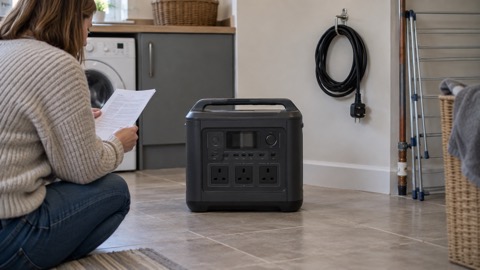 BLUETTI Apex 300 Power Station
 BLUETTI Elite 100 V2
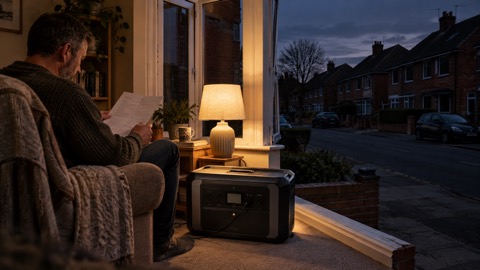 Anker SOLIX C2000 Gen 2
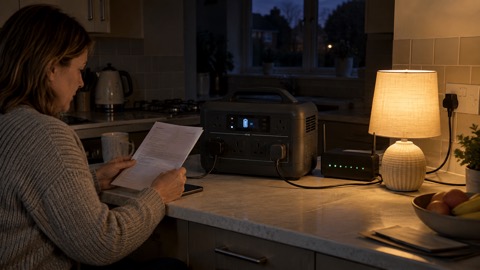 Anker SOLIX C1000 Power Station
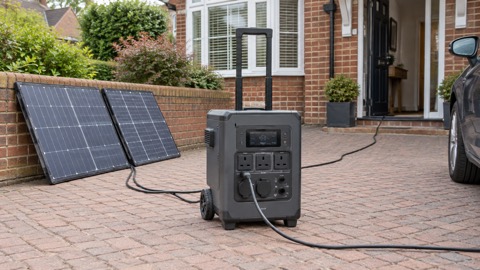 EcoFlow DELTA Pro
 BLUETTI Elite 400
 Anker SOLIX C300 Power Station
 EcoFlow DELTA 3
 EcoFlow DELTA 2 and DELTA 2 Max
 EcoFlow DELTA and DELTA Max
 EcoFlow RIVER 3 and RIVER 3 Plus
 EcoFlow RIVER 2 and RIVER 2 Max