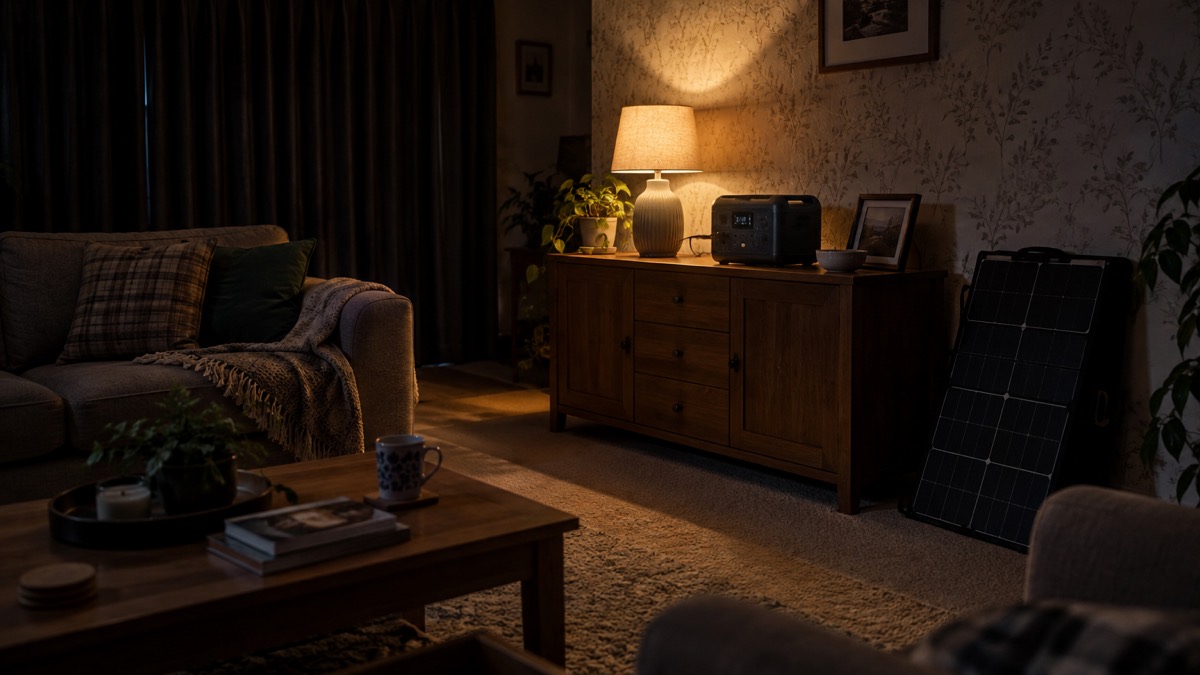
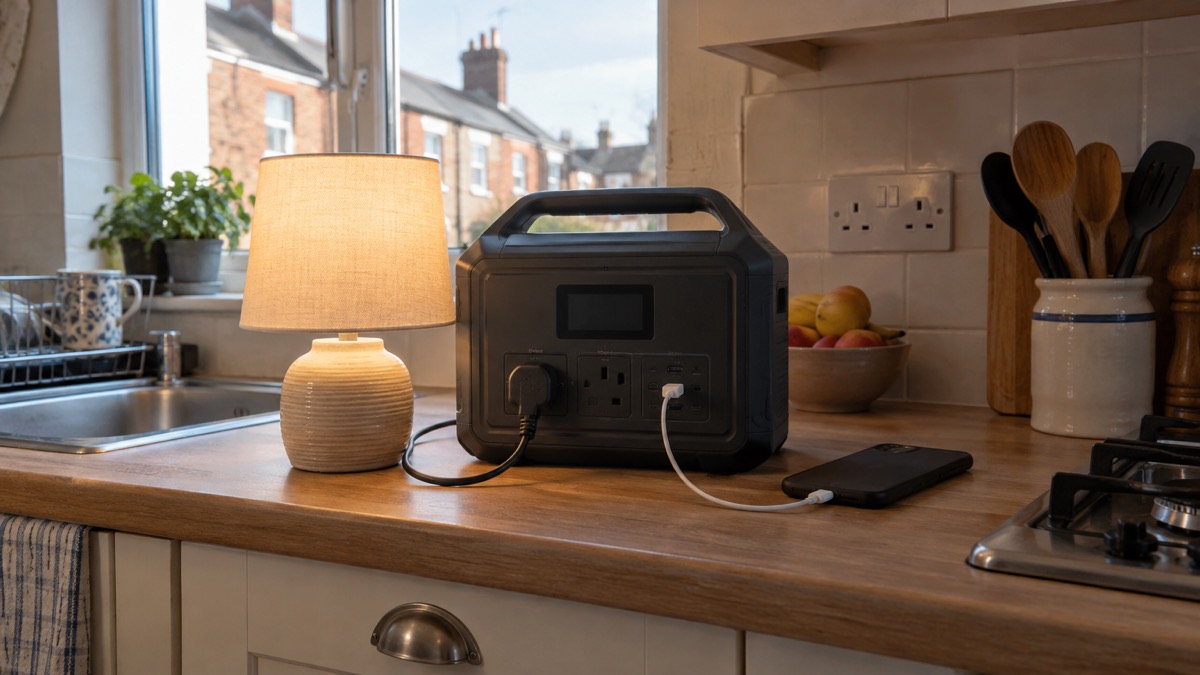
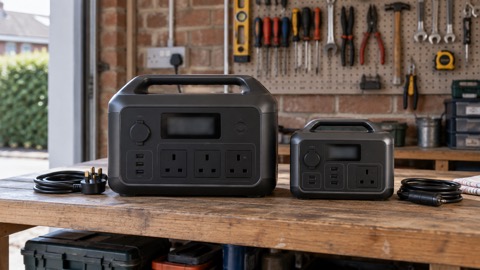
A solar generator is not a generator in the engine sense at all. It is a large battery, usually built into a box with mains sockets and USB ports, that you charge from one or more folding solar panels. The panels turn sunlight into electricity, the battery stores it, and you plug your appliances into the battery when you need them. One maker describes it as a portable power station that, combined with solar panels, makes its own electricity by recharging itself from solar energy1. An independent guide puts it more bluntly: these are smaller and more portable than generators that use a fuel tank, but are only really useful if you have low power demand2.
That last point is the one to hold on to. A solar generator will keep phones, a router, lights, a laptop and perhaps a fridge going through a power cut. It will not run an electric shower, an oven or a whole house. What it does give you is quiet, fume-free power indoors, and a way to recharge without queuing for petrol.
How a solar generator turns sunlight into stored power
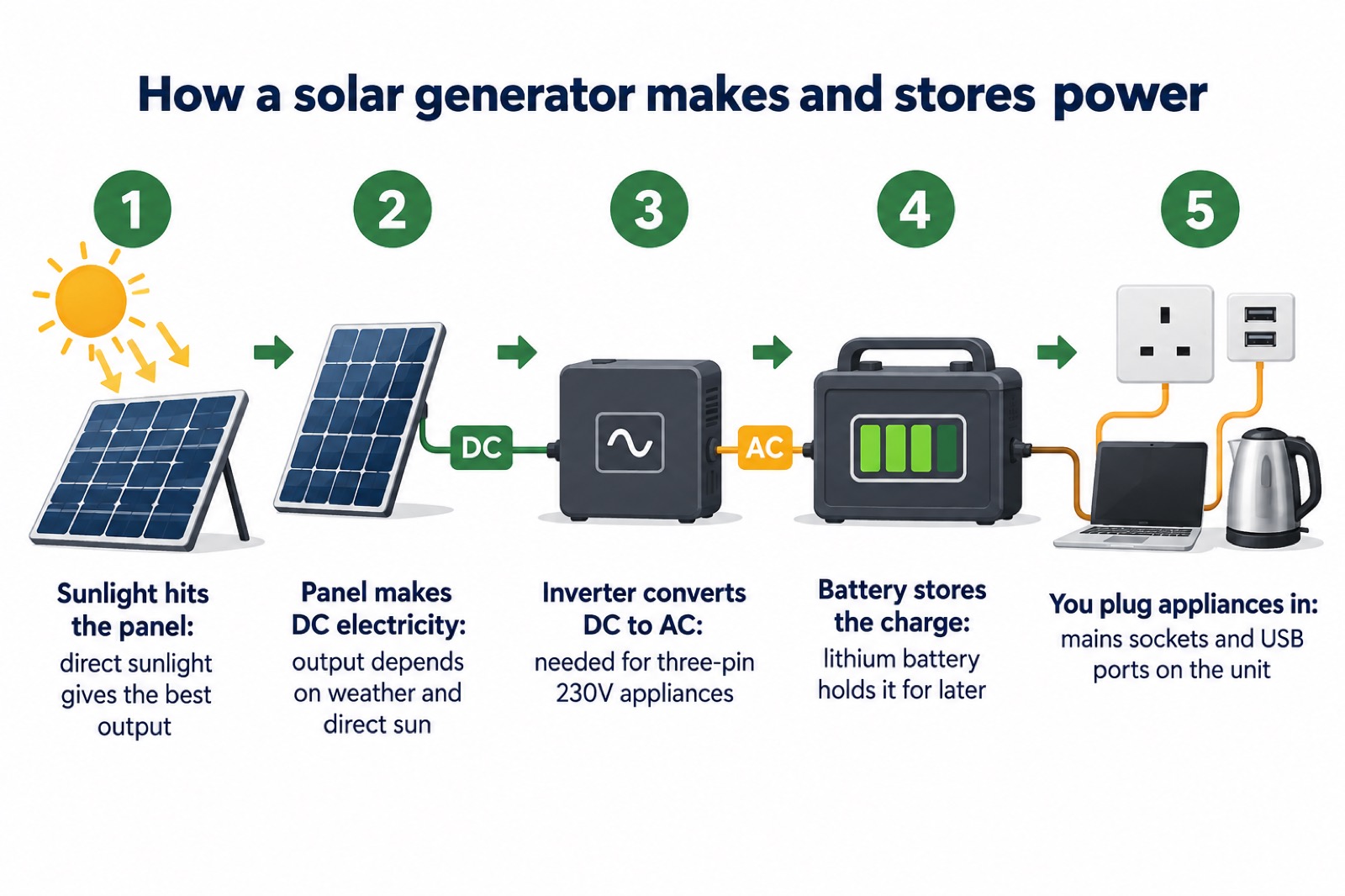
The chain is simple, and understanding it tells you why the weather matters so much. Solar generators collect solar energy from direct sunlight and store the power in a lithium battery7. The panel is the collector, the battery is the store, and an inverter inside the unit turns the battery's direct current into the alternating current that a three-pin plug expects. That inverter step is the same one any solar set-up needs: to use the electricity generated by solar panels, you need an inverter to convert the direct current (DC) into alternating current (AC)8.
A solar generator bundles all of this into one box. You do not wire anything into the house, you do not need an electrician, and you do not need the sun to be shining at the moment you want power. You charge when the sun is out and draw on the battery later. That is the whole appeal: it separates when you collect energy from when you use it.
This is also why a solar generator is not the same thing as home solar. Rooftop or balcony solar that feeds into the grid does not give you power in a blackout: a maker states plainly that solar energy generated by a balcony power plant is fed into the power grid, and this does not allow for energy storage to act as an emergency supply10. If you want solar energy during a power outage, the answer is a battery you charge from panels and then plug appliances into directly11. That is exactly what a solar generator is.
Solar generator or fuel generator: how each one behaves
The two behave completely differently, and the choice usually comes down to what you need to run and for how long. A fuel generator is a mechanical device that converts fuel, usually petrol or diesel, into electrical power12. A solar generator is a battery that stores electricity made by panels. Neither is better in the abstract; they suit different jobs.
| Solar generator | Petrol or diesel generator | |
|---|---|---|
| What it is | Battery plus solar panels2 | Engine converting fuel to electricity12 |
| Fuel | Sunlight7 | Petrol or diesel, kept on hand12 |
| Fumes | None; safe indoors per maker3 | Must be sited outside with good airflow13 |
| Noise | 30dB to 45dB depending on model4 | Petrol is quieter than diesel, but both are audible2 |
| Maintenance | No moving parts, no liquid fuel14 | Requires regular maintenance2 |
| What it suits | Low power demand2 | Heavier loads and long running times2 |
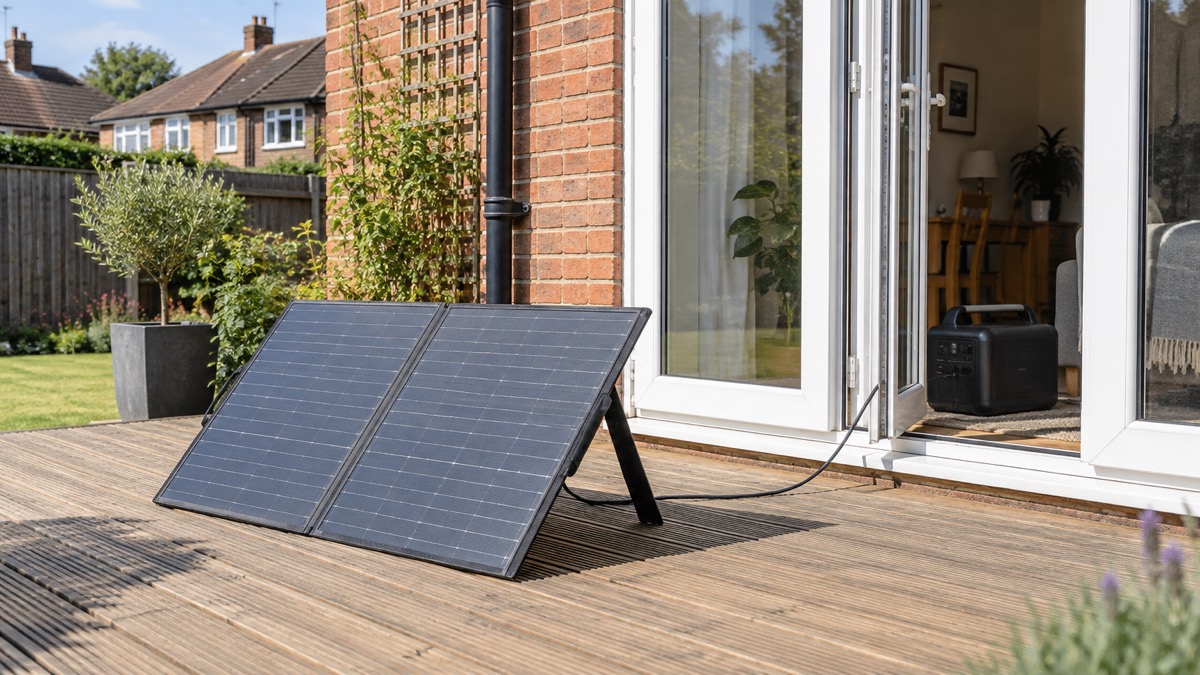
The noise difference is real but not absolute. Makers quote figures such as under 40 dB for a small unit, 30dB for a larger one and 45dB for a compact model4. One maker describes its units as consuming 30dB of noise, which it says makes them ideal for indoor use15. For comparison, a petrol generator has an engine running continuously; an inverter generator, which electronically controls and conditions the power it produces, is generally quieter and more compact than an open-frame machine, and is popular for caravans, camping, laptops and televisions16.
If you are weighing the two, our comparison of a portable power station or petrol generator for a power cut sets them side by side, and the portable generators guide explains the petrol, diesel and inverter types in more detail.
Where a solar generator falls short
A solar generator is honest about its limits once you understand the numbers. The first is capacity. A maker advises choosing a unit with a capacity that exceeds your minimum requirements, and says that for heavy-duty tools with a bigger wattage you should consider a larger battery4. In other words, the small units are for small loads. A 600Wh-class unit is quoted at 10 charges of a 10W tablet or 5 charges of an 80W laptop5; that is a phone-and-laptop device, not a fridge-and-freezer device.
The second is honesty about real-world capacity. Customer reviews of one model raise concerns that the actual usable capacity is lower than advertised, along with closely spaced outlets17. Treat the headline watt-hour figure as a ceiling, not a promise, and leave headroom.
The third is availability and kit completeness. Some models are simply sold out in the UK18, and what comes in the box varies: one bundle includes two SolarSaga 100W Mini panels19, while others are sold as the battery alone. Check what you are actually getting.
The fourth limit is what it cannot do at all. It will not back up your whole house, and it will not run high-draw appliances like heaters for long. A maker's claim that solar generators can run demanding devices like heaters and fridges21 should be read against the capacity of the specific unit: a small battery will run a heater for minutes, not hours. Match the battery to the load, using our guide to watts, watt-hours and surge.
Output depends on the sun and the sky
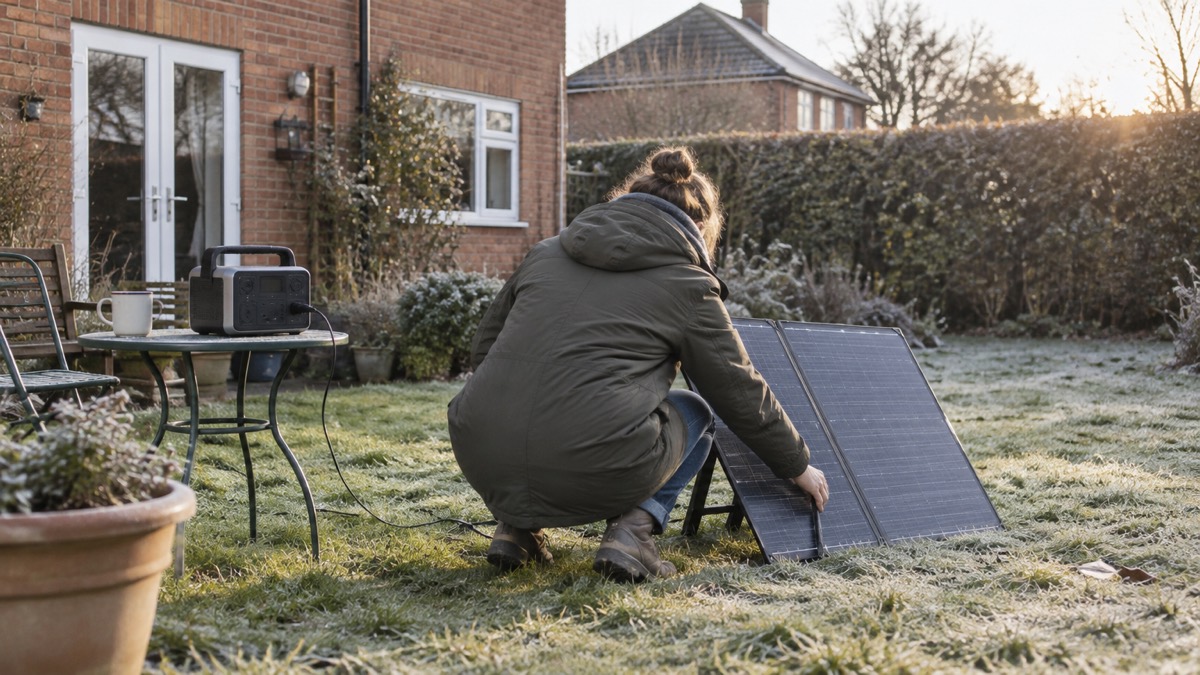
This is the section that decides whether a solar generator works for you in a British winter. Output is not fixed. A maker states that actual output, energy generation and savings depend on local regulations, weather, installation conditions and usage scenarios, and that figures are theoretical calculations22. Another advises that output power depends not only on the weather but also on the area of direct sunlight, and that you should adjust the position and angle of the panel for maximum sun9.
What that means in practice:
- Direct sun is best. Panels always need direct sunlight to charge, though charging works on cloudy days at a slower rate, and the higher the UV index the faster the charge6.
- Angle matters. Adjust the position and angle of the solar charger for maximum sunlight and larger output9.
- Real output varies. One 100W panel is quoted at 100 to 109W on sunny days23.
- Temperature has limits. One unit is quoted as delivering steady power from , 4°F to 113°F, indoors or out17.
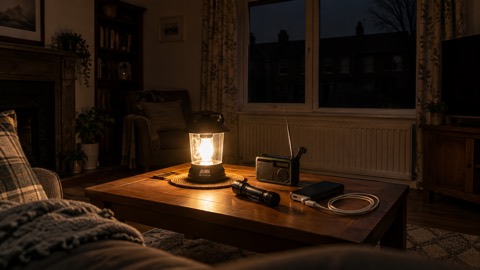
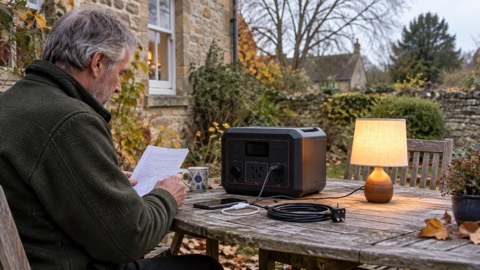
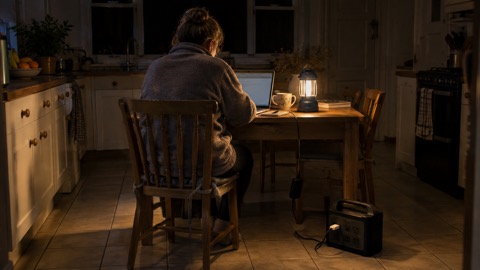
The practical routine in a long outage is to charge during daylight and use the battery after dark. A maker advises that when an outage runs over several days, you keep your generator topped up by charging it during the daylight hours24. Larger units charge faster with bigger panels: one model is quoted at 4 hours on a 400W solar input17, and another offers 1H emergency supercharging4. For more on matching panels to a battery, see portable solar panels for charging in a power cut and what size solar panel do I need.
Plug-in solar panels are a different thing
People often ask whether they can just plug a solar panel into a wall socket and run the house. The answer today is no, and the distinction matters. Plug-in solar panels work by light from the sun hitting the panels and generating energy, which flows into the electrical circuit for the home25. They are placed in sunny outdoor spots such as a terrace, shed roof or balcony, and plugged into a three-prong wall socket25.
But Electrical Safety First cautions that at present plug-in solar systems supply power to household circuits in a way not permitted by regulations, even though the Government announced plans in March 2026 to make them more widely available26. A solar generator sidesteps the issue entirely: the panels plug into the battery, not the house, and the battery feeds appliances through its own sockets. If you want to understand the plug-in question properly, read plug-in solar panels: are they safe to connect.
Running costs, noise and upkeep in ordinary use
Running costs are low because the fuel is free. There is no petrol or diesel to buy, and no fuel to store safely. A fuel generator, by contrast, runs on petrol or diesel, so you will need to keep fuel on hand12. Petrol is cheaper than diesel and quieter than diesel generators, but petrol generators require regular maintenance2, and diesel units generally last longer with long running times but cost more to buy and can be noisier2.
Maintenance on a solar generator is close to nil. One maker describes its units as more environmentally friendly and durable than conventional generators and requiring virtually no maintenance, and suitable as an emergency power supply1. Another says solar generators have no moving parts and do not use liquid fuel, allowing hassle-free maintenance14. The jobs that remain are simple: keep panels clean, keep them unshaded, and store the battery within its temperature range.
Noise is the other everyday difference. Makers quote 30dB to 45dB across their ranges4, and one describes its units as safe to use indoors with noise- and pollution-free power generation3. That is why a solar generator can sit in a hallway or kitchen during a cut, while a petrol generator must stay outside.
Where to get help and what to do next
Start by working out what you actually need to keep running. Our guide to deciding what to keep running when the mains fails walks through that, and the power cut backup power checklist turns it into a list. If you are comparing battery options, portable power stations: what they do and how to choose covers the wider category, and portable solar panels covers the charging side.
For safety, the rules are simple and firm. A solar generator has no carbon monoxide risk, but any fuel generator does, and official advice is that a generator needs to be secure with good airflow13. Never run a fuel generator indoors. Our guides to generator safety and carbon monoxide from generators explain why.
If you rely on powered medical equipment, plan for that separately: see powering CPAP, oxygen and other medical devices from a battery. And if you are thinking about a permanent battery rather than a portable one, home battery storage: does it keep the lights on explains the difference.
Sources (26)
- Anker SOLIX solar generators (EU), Anker SOLIX, 2026-10-25
- How to buy the best generator, Which?, 2026-01-20
- Anker SOLIX Flex portable power stations, Anker SOLIX, 2026-10-25
- Small solar generators, Jackery, 2026-10-25
- Jackery Solar Generator 600 v2, Jackery, 2026-10-25
- BioLite Site Lights, BioLite, 2026-10-25
- How to prepare for a long-term power outage, Jackery, 2026-08-14
- Solar panels safety advice, Electrical Safety First, 2026-10-26
- Anker SOLIX PS200 portable solar panel, Anker SOLIX, 2026-10-25
- Balcony solar system, EcoFlow, 2026-10-25
- How to use solar panels during a power outage, Jackery, 2026-09-28
- Portable power stations vs generators, Machine Mart, 2026-10-25
- Generators, Wiltshire and Swindon Prepared, 2026-10-25
- BLUETTI AC300 and B300K, BLUETTI, 2026-10-25
- How to build an emergency power supply for your home, Jackery, 2026-09-28
- Generators, Clarke International, 2026-10-25
- Jackery Solar Generator 1500 v2, Jackery, 2026-10-25
- Jackery Solar Generator 100 Plus, Jackery, 2026-10-25
- Jackery Solar Generator 2000 v2 (100 Mini), Jackery, 2026-10-25
- After a flood, London Fire Brigade, 2026-10-25
- Solar powered generators, EcoFlow, 2026-10-25
- Anker SOLIX Solarbank 4 E5000 Pro, Anker SOLIX, 2026-10-25
- Jackery SolarSaga 100 Air, Jackery, 2026-10-25
- EcoFlow portable solar panels, EcoFlow, 2026-10-25
- Plug-in solar panels, London Fire Brigade, 2026-10-25
- Solar panels safety advice (green energy), Electrical Safety First, 2026-03
 Power Cut Backup Power Checklist
 Backup Power Before Winter
 Safe Battery Charging at Home
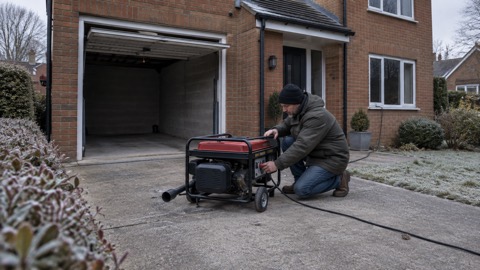 Running a Generator Indoors
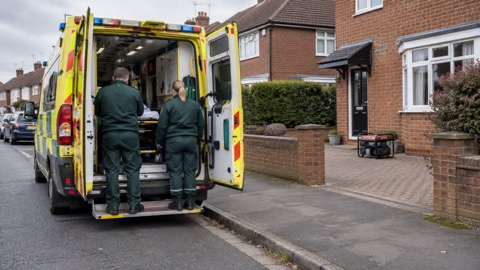 Carbon Monoxide from Generators
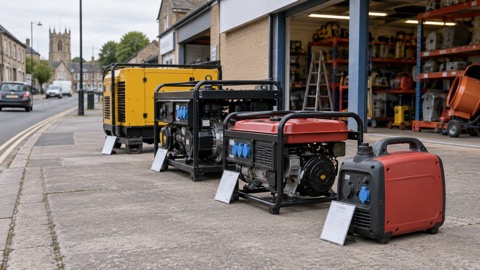 Generator Sizing for a Power Cut
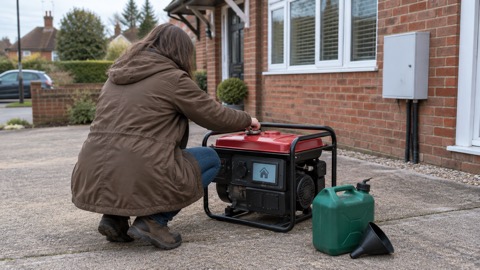 Generator Run Time on a Tank
 Storing Petrol at Home
 Diesel Storage at Home
 Storing a Generator
 Generators in Cold Weather
 Generator Noise and Neighbours
 Power Station Capacity Sizing
 Power Station Run Time
 Power Station for a Gas Boiler