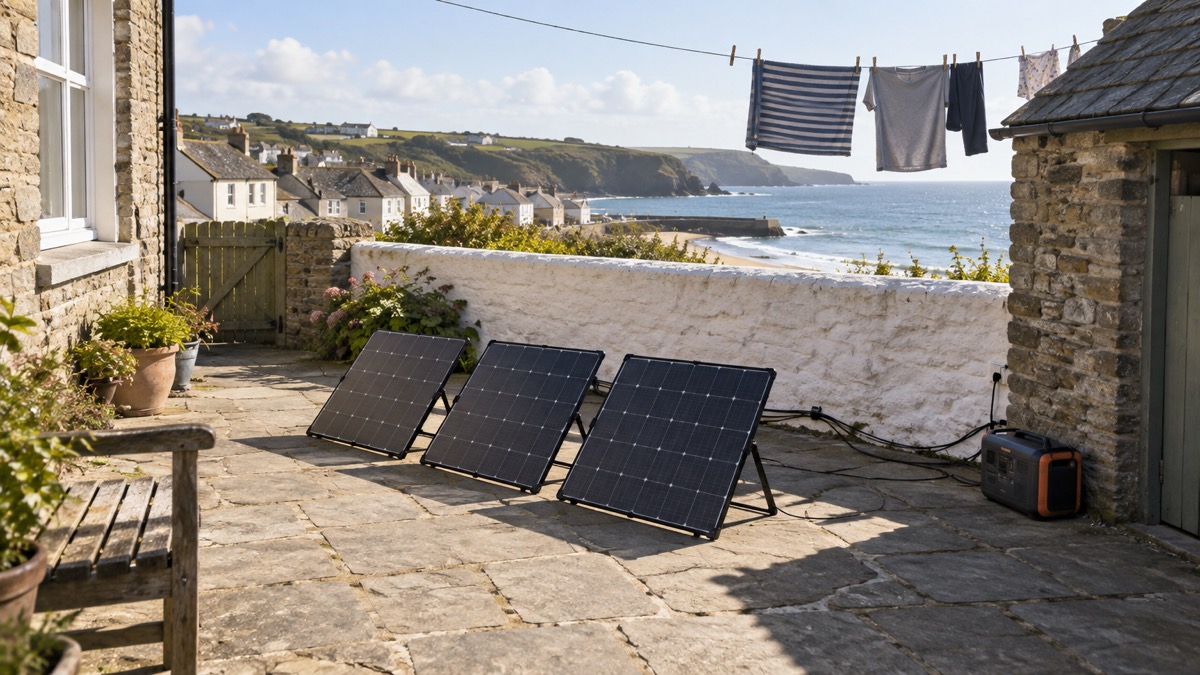
A Jackery SolarSaga panel is a folding solar panel that charges a Jackery portable power station, not your home's wiring. In a power cut it gives a household a way to top up a battery from daylight instead of relying on a wall socket or a car. The SolarSaga 200W is rated at 200W peak power, quoted as 200W plus or minus 5% at standard test conditions, and Jackery states 25% energy conversion thanks to dual-sided IBC technology1.
What it will not do is run your fridge directly, or work after dark. Jackery states that solar panels do not generate electricity at night, and that panels output DC power which typically does not match the voltage and power requirements of household appliances3. The panel's job is to refill a power station; the power station runs the appliances.
For a household preparing for outages, the practical questions are how much sun the panel needs, where to stand it, how to keep rain out of the connectors, and how to store it so it still works in two years' time. This page sets out what Jackery publishes about the SolarSaga range, what it means in an emergency, and where the maker's own figures disagree.
SolarSaga versions and how they differ
Jackery sells the SolarSaga panels as accessories to its power stations, and the range is not one product. The two that matter most for a household are the rigid folding 200W panel and the flexible 100 Light.
The SolarSaga 200W is a bifacial panel, meaning it is built to collect light on both faces, and Jackery quotes 200W at standard test conditions rising to 225W plus or minus 5% under its bifacial rating1. It uses TOPCON cells on one page and dual-sided IBC technology on another, both quoted at 25% conversion efficiency2. The SolarSaga 100 Light is a different proposition: a flexible panel that Jackery says bends to fit suitable curved surfaces, weighs 2.05 kg, which it describes as 56% lighter than rigid panels, and can be bent up to 221 degrees9. Jackery rates it at 100W with 25% bifacial efficiency10.
| Panel | Type | Rated output | Weight | Best suited to |
|---|---|---|---|---|
| SolarSaga 200W | Rigid folding, bifacial | 200W peak1 | 6.2kg with an integrated handle2 | A garden, driveway or balcony with a fixed sunny spot and somewhere to store a folding panel |
| SolarSaga 100 Light | Flexible, bendable | 100W10 | 2.05 kg10 | Balcony railings, a marine deck or a vehicle, where a flat panel will not sit12 |
Jackery recommends using the same panel model across a set for a simpler setup, and asks owners mixing models to send the panel model numbers and Explorer model so it can confirm the right connection9. If you already own one panel and are adding another, that advice matters more than the headline wattage.
SolarSaga 200W specifications
The headline figures decide whether the panel suits your household: how much it weighs to carry, how much space it takes folded and unfolded, and what it puts out. Jackery publishes these on its product pages, and they are the numbers to check against your storage space and your power station's input limits.
| Specification | Jackery figure |
|---|---|
| Peak power | 200W plus or minus 5% at standard test conditions (1000W/㎡, 25℃, AM 1.5)1 |
| Bifacial peak power | 225W plus or minus 5% under the bifacial rating7 |
| Conversion efficiency | 25%2 |
| Power voltage | 18V plus or minus 5%1 |
| Power current | 11.5A plus or minus 5%1 |
| Open circuit voltage | 22V plus or minus 5%1 |
| Maximum system voltage | 60V4 |
| USB-C output | 5V 3A3 |
| USB-A output | 5V 2.4A3 |
| Protection class | Class II against electric shock3 |
| Waterproof rating | IP68 on the product pages; IP67 on a support article3 |
| Operating temperature | -20°C to 65°C on one page; -10°C to 65°C on another2 |
| Folded size | 600 x 597 x 40 mm (23.62 x 23.50 x 1.57 in)1 |
| Unfolded size | 2279 x 597 x 25 mm (89.76 x 23.50 x 0.98 in)1 |
| Weight | 6.2kg with integrated handle on one page; 17.5 plus or minus 0.5 lbs on another; 14.33lb on a third2 |
Two of those rows need a caveat. The weight is not consistent across Jackery's own pages: 6.2kg, 17.5 plus or minus 0.5 lbs and 14.33lb all appear, and the figures disagree. Check the figure on the page you order from. The operating temperature is also given two ways, -20°C to 65°C and -10°C to 65°C, so treat the colder end as uncertain2.
The unfolded length is the figure most likely to catch a household out. At 2279 mm it is a long strip, so measure the sunny run of ground, balcony or wall you have before you commit. Folded, it is roughly the size of a large suitcase and stores flat.
Setting up a panel in direct sun
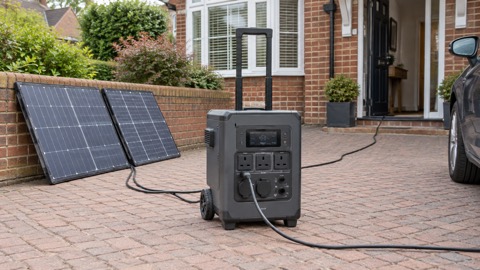
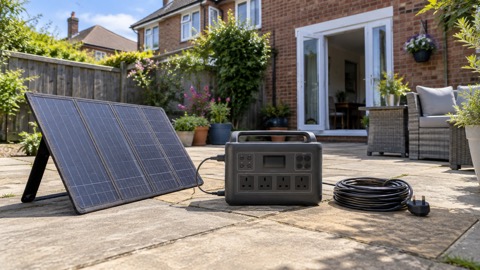
Jackery's own instructions are short. Position the panel in direct sunlight and use the built-in kickstand to angle it for maximum sun exposure, then connect the panel's power cord to the input port of your Jackery portable power station and turn on the power station's output11. The 200W has 3 built-in kickstands and a Sun Angle Indicator to help you angle it towards the sun2.
- Unfold the panel on firm, dry ground or a stable surface, clear of anything that could fall on it.
- Angle it towards the sun using the kickstands and the Sun Angle Indicator2.
- Connect the panel's output cable to the input port on the power station and make sure the connection is secure15.
- Switch on the power station and check it is charging.
- Bring the panel in before rain, and before dusk.
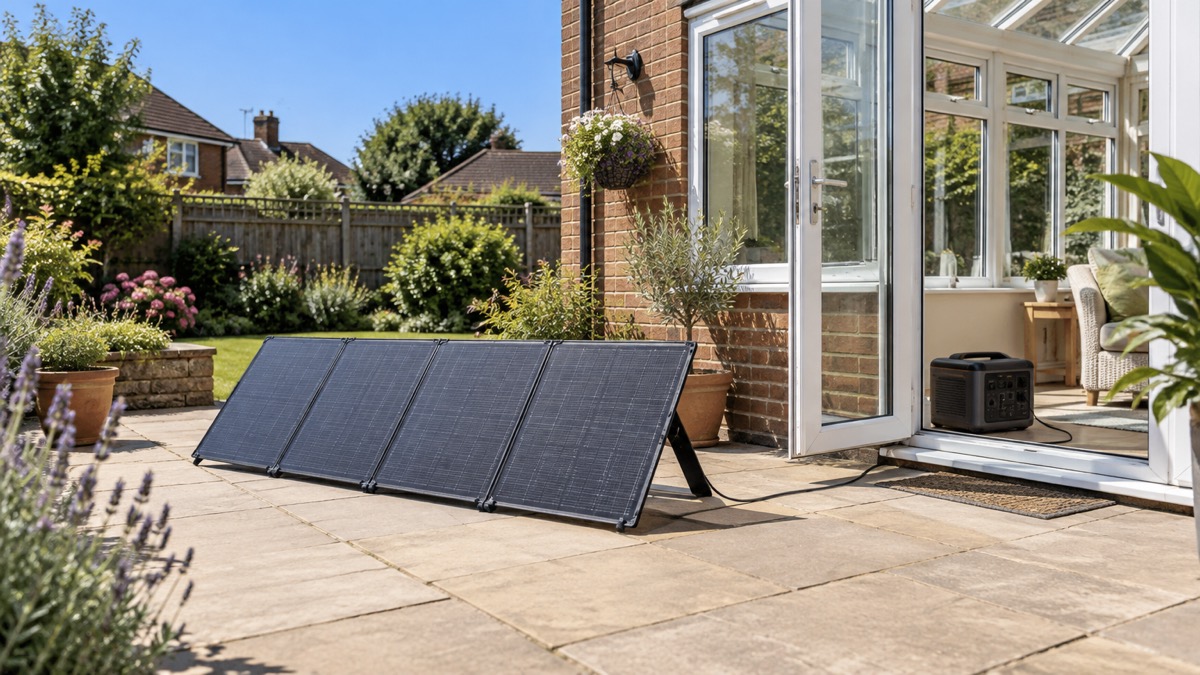
Jackery quotes set-up times of 30 seconds to unfold and under a minute to be fully operational for the 200W, and 60 seconds for the range as a whole2. Those are the maker's figures for a calm day with nothing to untangle.
A panel left out is a panel that can blow over. Jackery's own customer reviews mention fragile stands that struggle in wind, so weight the frame or choose a sheltered spot on gusty days1. The panel is not a permanent fixture: Jackery says it does not recommend leaving portable foldable panels outside permanently, and advises packing them away after use and bringing them in during severe weather9.
Low light, heat and cold: what affects output
A 200W panel rarely delivers 200W in a British garden. Jackery itself says many factors may stop the panels producing a full 200 watts, including altitude above sea level, the sun's altitude above the horizon, humidity and smoke from fires1. Customer reviews on the same page report panels delivering lower than rated wattage, around 135W, and charging slowly1. That is not a fault; it is what a panel does when the sun is low or the sky is hazy.
Temperature matters too. Jackery quotes a power temperature coefficient of minus 0.33 plus or minus 0.02% per degree C, meaning output falls as the panel heats up3. A hot panel in strong summer sun can therefore produce less than a cool one at the same brightness. Cold is less of a problem for output but more of a problem for handling: Jackery gives operating ranges of -20°C to 65°C on one page and -10°C to 65°C on another, and the figures disagree on the colder limit2.
For a UK household the practical response is to manage expectations and to move the panel. Jackery says the panels provide solar energy even on cloudy British days, and one page claims strong performance even in low light, but neither claim comes with a wattage17. Treat a cloudy day as a top-up day, not a full recharge day, and check the panel through the day, turning it as the sun moves.
Rain and water: why you should bring the panels in
This is the point where Jackery's pages disagree most, and where the safe answer is the cautious one. The product pages rate the 200W as IP68 waterproof, and one blog says the IP68 rating allows the panels to withstand wet and harsh weather3. But Jackery's own support article says the solar panels are not recommended to use in rain, as water will cause damage to the connection ports, and asks owners to retrieve the panels when it is raining6. A support article also lists IPX67 rather than IP686.
A waterproof rating describes the panel surface, not the connectors, and it is the connectors that Jackery warns about. Bring the panel in when rain starts, keep the cable ends dry, and do not leave it out overnight in wet weather. Jackery's own customer reviews include a user wishing the panels were water resistant so a rain shower would not be a worry, which tells you the practical experience matches the warning1.
Cleaning and storing your panels
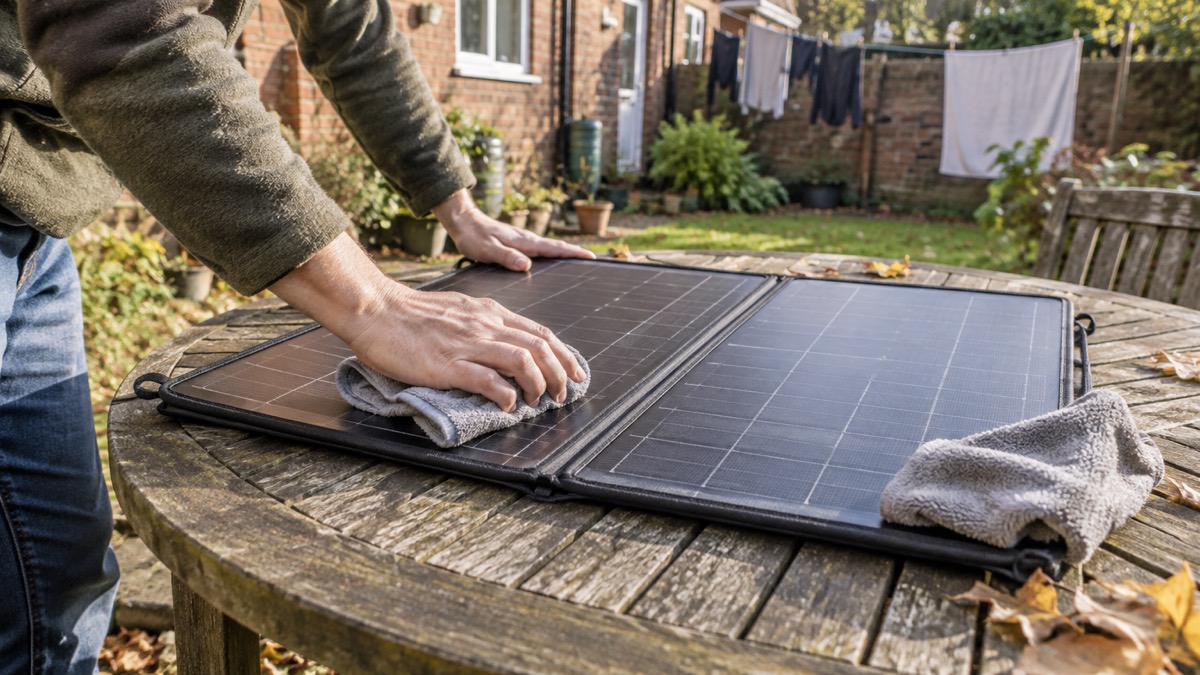
Jackery says the panels need no solar panel maintenance, and refers owners to the user manual for specific cleaning questions14. For routine cleaning, its instructions are simple: remove dust and dirt with a soft cloth or soft brush, then wipe the surface with a damp cloth to take off what remains18. Any guano or other adhesive should be removed as soon as possible, because leaving it reduces performance2.
Storage is where a panel earns its keep between emergencies. Jackery advises storing it in a dry, safe place with humidity no more than 60%, away from corrosive substances, heat sources and fire, and not alongside sharp objects12. Fold it flat, keep the cable coiled without sharp bends, and store it where you will find it in the dark.
- Clean before storing: use a soft cloth to remove the dust and dirt on the surface, then a damp cloth to wipe the solar module, and remove any guano or other adhesive as soon as possible to avoid a reduction in performance18.
- Keep it dry: humidity no more than 60%12.
- Keep it away from heat and flame: Jackery lists fire and heat sources as things to avoid2.
- Keep it away from sharp objects and corrosives: both are named in the maker's storage advice2.
- Check it each season: unfold it in daylight and confirm the power station accepts a charge before winter.
For the wider routine of keeping backup power ready, see the backup power checks before winter and the power cut backup power checklist. If you are still deciding between panel types, the guide to portable solar panels for charging in a power cut sets the options side by side.
Warranty, returns and support
Jackery advertises a 3 year warranty on the SolarSaga 200W with an extra 2 year extended warranty, applied automatically when you buy from its official website, and a 30 day money back return2. The collection page summarises this as 3+2 years9. One Jackery page lists the warranty as 36 months instead, so the figures disagree on how the extended period is described, though both point to five years in total for an official-website purchase19.
| Support item | What Jackery states |
|---|---|
| Standard warranty | 3 years2 |
| Extended warranty | Extra 2 years, applied automatically when bought from the official website2 |
| Return window | 30 day money back1 |
| Shipping | 2 to 5 business days, free shipping1 |
| User manuals | Available through Jackery's user guides page6 |
Keep your order confirmation. The extended warranty depends on where you bought the panel, so a purchase from a third-party retailer may not carry it. Jackery states that its SolarSaga panels need no solar panel maintenance, and refers you to the user manual for specific maintenance and cleaning questions6.
On certification, Jackery states that the SolarSaga 200W is certified by 17 rigorous IEC standards and by TUV to IEC TS 63163, meeting globally recognised benchmarks for safety and reliability2. It also holds Carbon Footprint Verification from TUV SUD covering its SolarSaga 80W, 100W and 200W panels20. Certification is evidence of independent testing; it does not change what the panel will deliver on a grey January afternoon.
Where the panel fits a household plan
A SolarSaga panel is a daylight top-up for a battery, not a substitute for one. In a power cut it lets you refill a power station without a wall socket, which matters most in a long outage when the mains is off for days and your car may be needed elsewhere. Jackery says its power stations can be charged from SolarSaga panels, wall outlets or car ports, so the panel is one of three ways in, not the only one5.
Plan around its limits. It cannot charge at night3. It cannot run appliances directly4. It will not deliver its rated wattage in low sun, heat or haze1. And it should come in when it rains6. Used within those limits, it turns a sunny afternoon into stored power you can draw on after dark.
For the wider picture, the Jackery brand page covers the power stations the panels charge, and Backup Power at Home sets out how panels, batteries and generators fit together. If you are working out how much panel you need for your power station, the guide to what size solar panel you need and how long solar charging takes in the UK will help you size it before you buy.
Sources (20)
- Jackery SolarSaga 200W Solar Panel, Jackery, 2026-10-25
- SolarSaga 200W Solar Panel (UK), Jackery, 2026-10-29
- SolarSaga 200W Solar Panel, Jackery, 2026-10-25
- Solar Generator 1000 v2 (UK), Jackery, 2026-10-29
- Jackery Buying Guide, Jackery, 2026-10-25
- User Guides, Jackery, 2026-10-25
- Solar Generator 2000 Plus with 200W Solar Panel (UK), Jackery, 2026-10-29
- Explorer 3000 v2 with Accessories (UK), Jackery, 2026-10-29
- Solar Panels collection, Jackery, 2026-11-02
- Jackery SolarSaga 100 Light, Jackery, 2026-10-25
- How to Use Solar Panels During a Power Outage, Jackery, 2026-09-28
- Jackery Solar Panels Complete Guide, Jackery, 2026-09-28
- Solar Generator 2000 v2 (UK), Jackery, 2026-10-29
- Solar Panels (UK), Jackery, 2026-10-29
- Power Outage (UK), Jackery, 2026-10-29
- Solar Generator (UK), Jackery, 2026-10-29
- Unveil the Journey in Off-Grid Green Energy with Robin (UK), Jackery, 2026-10-29
- Jackery Explorer 1500 Ultra Portable Power Station, Jackery, 2026-10-25
- Solar Generator 2000 Pro, Jackery, 2026-10-29
- Explorer 300 Plus Portable Power Station (UK), Jackery, 2026-10-29

 BLUETTI Apex 300 Power Station
 BLUETTI Elite 100 V2
 Anker SOLIX C2000 Gen 2
 Anker SOLIX C1000 Power Station
 EcoFlow DELTA Pro
 BLUETTI Elite 400
 Anker SOLIX C300 Power Station
 EcoFlow DELTA 3
 EcoFlow DELTA 2 and DELTA 2 Max
 EcoFlow DELTA and DELTA Max
 EcoFlow RIVER 3 and RIVER 3 Plus
 EcoFlow RIVER 2 and RIVER 2 Max