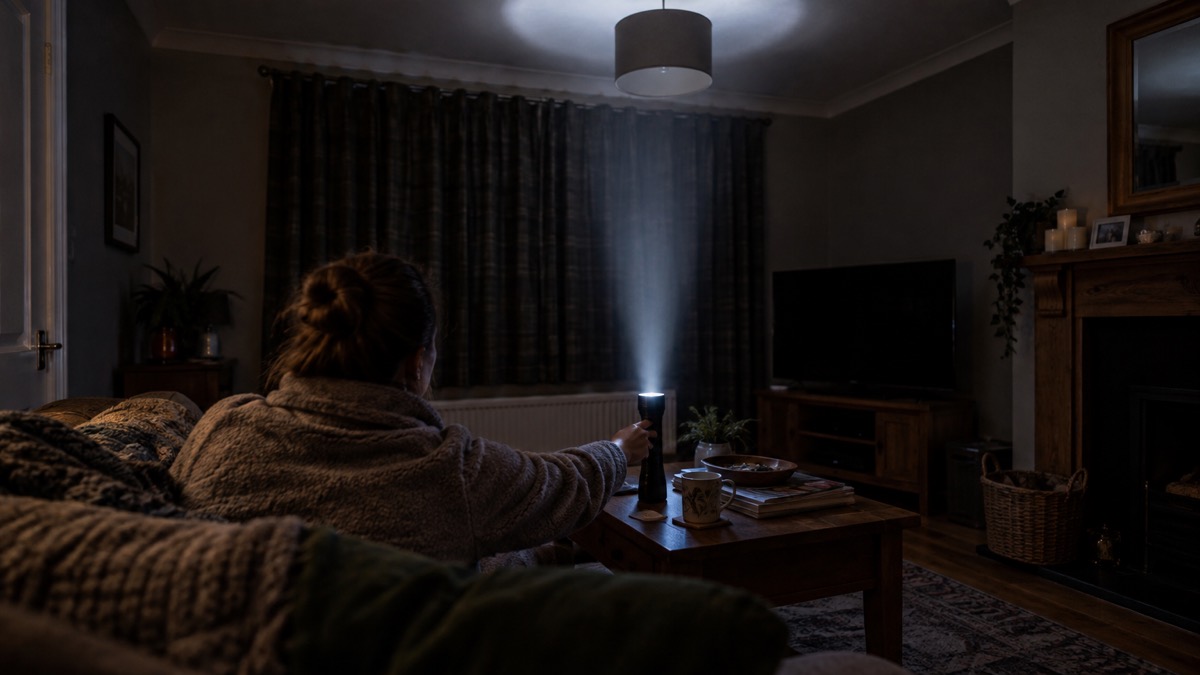
A rechargeable torch is one of the first things a household reaches for when the power goes, and the Ledlenser P7R SE is a full-size handheld torch built for exactly that moment. The maker lists it as a Special Edition 2022 model with a maximum output of 1,100 lumens on boost and a beam that reaches 220 metres1. On its lowest setting it runs for up to 40 hours, which is the figure that matters most in a long outage1.
It is rechargeable through a wall-mounted cradle rather than disposable batteries, so keeping it ready is a matter of putting it back on its mount after use. The maker states that a genuine 18650 3,000mAh replacement battery is available separately as item 501001, so the torch is not a sealed unit that has to be thrown away when the cell ages1.
This page sets out what the torch does for a household in an emergency, how long it lasts on each setting, how the Special Edition differs from other versions, how to charge and store it safely, and what the maker's warranty covers. It is written for someone deciding whether this torch belongs in their emergency kit, or working out how to get the best from one they already own.
What the P7R SE is, and what it does for a household in an emergency
The P7R SE is a rechargeable handheld torch in the Ledlenser P7R family. The maker describes every P7R as rechargeable, focusing from a wide flood to a tight spot with one hand, and sharing the same full-size shape, Advanced Focus System and magnetic charging2. The Special Edition 2022 version is listed at 1,100 lumens3.
For an emergency kit, the useful qualities are different from those of a torch you carry for a walk. You want a light that will still work after weeks in a drawer, that can light a whole room when the mains fail, that can be pointed down a garden or along a street after a storm, and that does not depend on a shop having the right batteries in stock. The P7R SE answers these by being rechargeable, by having a very low setting that sips power, and by having a very high setting for the moments you need to see a long way.
It is also a full-size torch rather than a pocket light. The maker gives the weight as 210g with the battery fitted, the length as 158mm defocused and 166mm focused, the head diameter as 37mm and the tube diameter as 30mm1. That size is what allows the long beam and the large battery, but it means the torch wants a proper home: a shelf by the door, a hook in the hall, or the charging cradle on a wall.
Run time: up to 40 hours on Low power
The headline figure for emergency planning is the 40-hour runtime on Low power. The maker gives that setting as 20 lumens with a 40-metre beam1. Twenty lumens is not enough to flood a room, but it is ample for finding your way around a dark house, reading a meter, checking a fuse box or moving safely at night without waking the household.
The other settings trade run time for brightness, and the maker's figures show the trade clearly.
| Mode | Brightness | Beam | Run time |
|---|---|---|---|
| Low power | 20 lumens | 40m | 40 hours1 |
| Mid power | 250 lumens | 150m | 5 hours1 |
| Power | 600 lumens | 190m | 2 hours1 |
| Boost | 1,100 lumens | 220m | not stated by the maker1 |
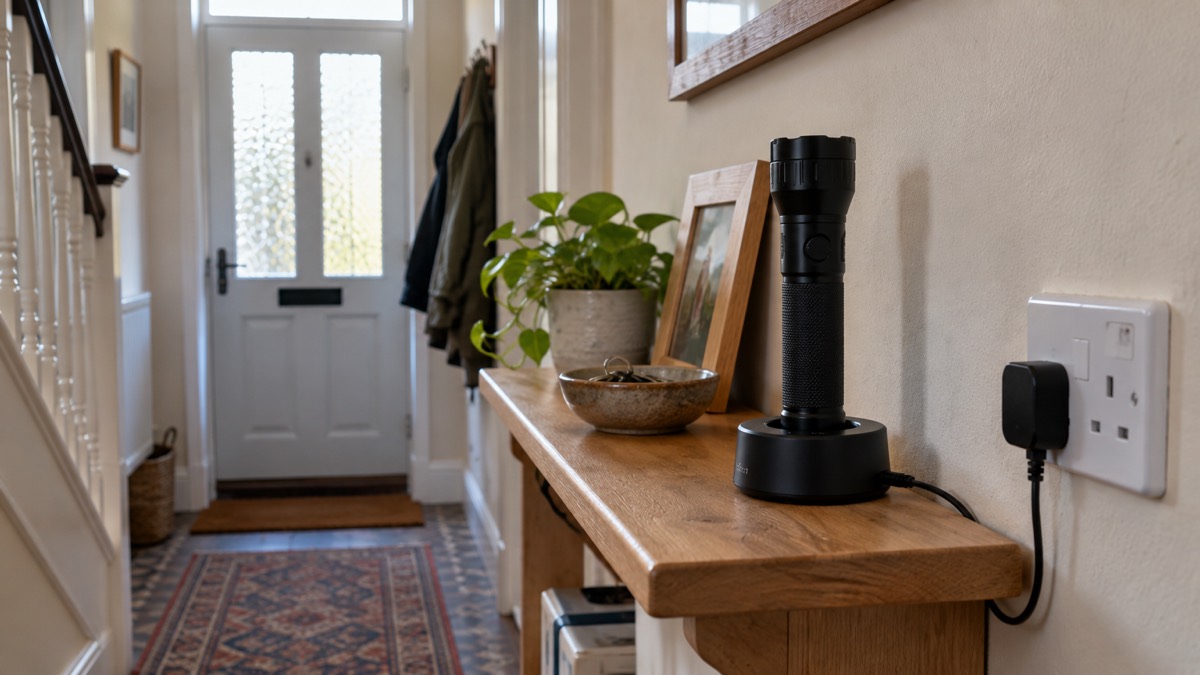
The practical lesson is to default to Low power in an outage and save the brighter settings for short bursts: checking outside after a storm, signalling, or lighting a room briefly while you do a job. A torch left on Mid power will be flat in five hours, which may be before the power returns.
The maker does not give a run time for Boost, so treat it as a short burst setting rather than something to plan around. If you need light for a whole evening, Low power is the setting that gets you there.
Brightness and beam: 1,100 lumens and 220 metres at boost
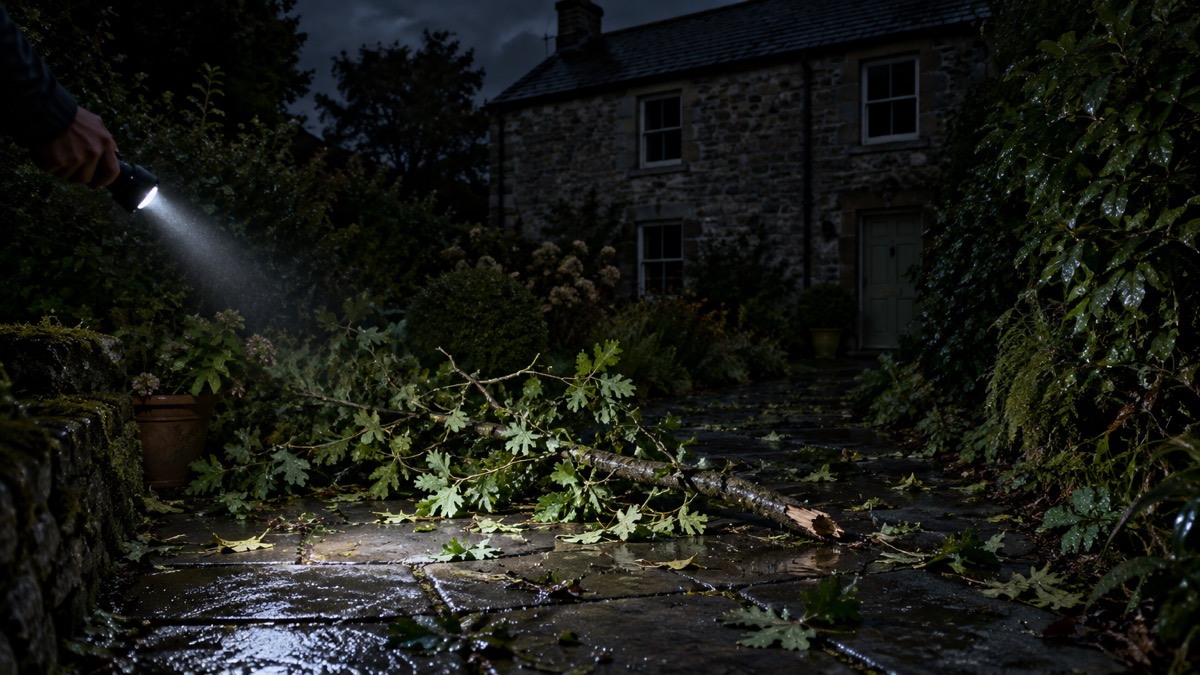
The P7R SE's maximum output is 1,100 lumens on boost, with a maximum beam distance of 220 metres1. That is a serious amount of light for a household torch. It is the setting for looking down a garden after a storm has brought a fence down, checking a road before you step onto it in a blackout, or picking out a route across a field.
The maker also gives the middle settings, which are the ones most households will use most of the time. Mid power is 250 lumens with a 150-metre beam and a 5-hour runtime, and Power is 600 lumens with a 190-metre beam and a 2-hour runtime1. Between them they cover most indoor and close outdoor work without draining the battery in an evening.
The maker describes the P7R SE as having more than double the output of the P7 SE4. That comparison is useful if you are weighing the rechargeable Special Edition against the battery-operated version, but the choice should follow your circumstances rather than the number alone: a rechargeable torch needs a socket and a habit of putting it back on the cradle, while a battery torch needs a stock of cells.
P7R SE and P7 Special Edition: how the versions differ
The P7R SE is one of two special editions in the P7R range. The maker states that the P7R 25th Anniversary Edition and the P7R SE are special editions2. The Special Edition additions over the standard P7R are a robust pocket clip, an enhanced grippy housing surface and Focus Lock1.
The P7 Special Edition is a different torch in a different family. It is battery operated rather than rechargeable, and the maker describes the P7R as offering higher output than the standard P73. That is the same headline run time as the P7R SE on Low power, but reached with disposable batteries rather than a rechargeable cell.
The standard P7 is a third option. The maker gives its Low Power setting as 40 lumens, 85 metres for 30 hours, and lists it with three light modes controlled by an end cap switch5. It is lighter than the P7R SE at 175g5, against 210g for the P7R SE1.
| Torch | Power source | Low power run time | Weight |
|---|---|---|---|
| P7R SE | Rechargeable 18650 Li-ion1 | 40 hours at 20 lumens1 | 210g1 |
| P7 Special Edition | Battery operated6 | 40 hours at 20 lumens6 | 210g6 |
| P7 | Battery operated5 | 30 hours at 40 lumens5 | 175g5 |
Which suits a household depends on how you plan to keep it ready. A rechargeable torch suits a home with a reliable routine of returning it to its cradle. A battery torch suits a household that would rather keep a stock of cells and not depend on a socket. Neither is better in the abstract; the question is which one you will actually keep charged or stocked.
Rapid Focus, Focus Lock and programmable light modes
The P7R SE uses the maker's Advanced Focus System with Rapid Focus and Focus Lock. The maker describes it as one-handed beam adjustment from a close-range flood to a focused 220-metre spot1. In practice, you can widen the beam to light a whole room or a table, then twist to a tight spot to pick out detail at the end of a garden, all with the same hand that is holding the torch.
Focus Lock is one of the Special Edition additions over the standard P7R1. It holds the beam at the setting you have chosen, so the focus does not drift while the torch is in a bag or being passed between people. For an emergency kit that may sit unused for months, that is a small but useful safeguard: the torch is set up as you left it when you pick it up in the dark.
The torch also has Smart Light Technology, which the maker describes as enabling programmable light profiles and customisable mode sequences1. The maker lists the light modes as Boost, Power, Mid power, Low power and Strobe, with Strobe described as emergency signalling1. A flashing light is much easier to spot than a steady one, so it is the setting for attracting attention, not for general lighting.
"Strobe, emergency signalling"
There is also a Transport Lock, which the maker states prevents accidental activation during storage and carry1. That matters for a torch kept in a bag or a drawer: a light that switches itself on in storage will be flat when you need it.
Toughness and limits: IP54, 1 metre drop test, -20°C to +40°C
The P7R SE is built to take the knocks of emergency use. The maker gives it an IP54 rating, a 1-metre drop test and an operating temperature range of -20°C to +40°C1. The maker's description of the IP54 rating on the related P7 torch is protection against dust and heavy rain5, which is the sensible reading for a torch used outdoors in bad weather.
Those limits are worth knowing rather than assuming. IP54 is not waterproof: it will cope with rain and dust, but it is not designed to be submerged. If a flood is the emergency, keep the torch out of the water and use it from dry ground. The drop test is to 1 metre, so a fall from a shelf or a hand should be survivable, but a fall down a stairwell is not what it was tested for.
The temperature range matters in a cold snap. A torch left in an unheated garage or a car boot in a hard frost is outside its stated operating range at the lower end, so bring it indoors if you want it to work when you reach for it. The maker gives the materials as aluminium alloy1, which is a robust housing for a torch that may be knocked about.
Charging, storing and keeping it ready
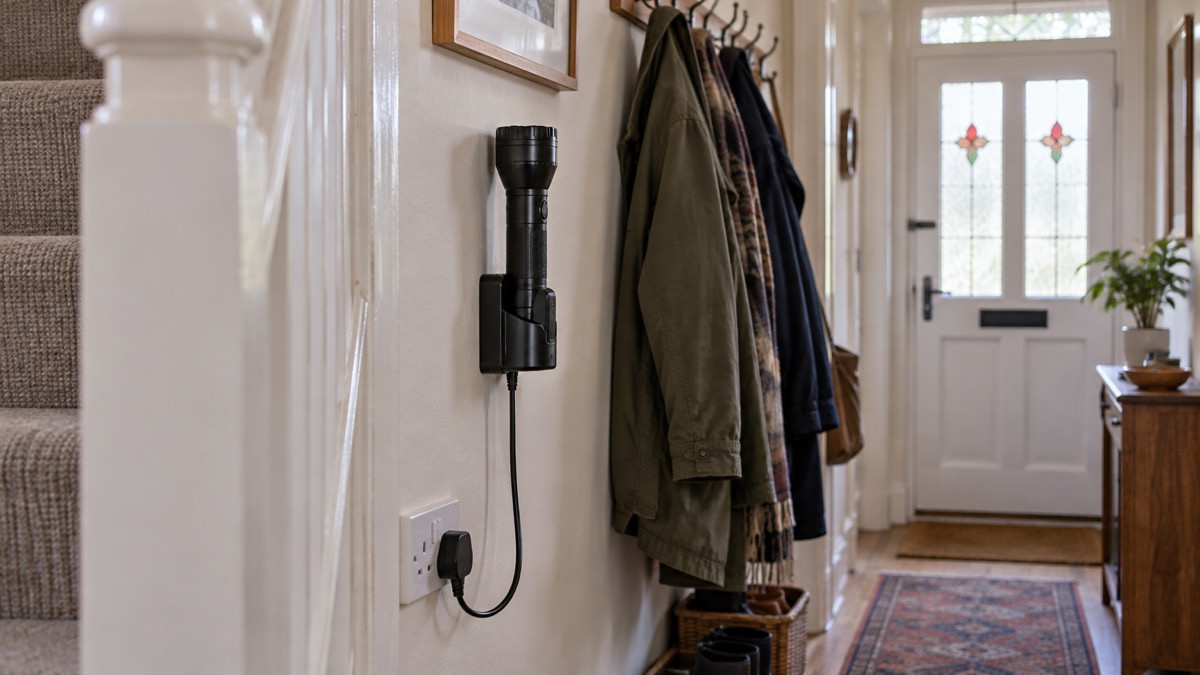
The P7R SE charges through the maker's Floating Charge System, a wall-mounted charging cradle that the maker states installs with the included 3M tape without tools1. The box contains the torch with a 18650 Li-ion rechargeable battery of 2,500mAh, the cradle, a pocket clip and the 3M wall-mount tape in two shapes, A for the front and B for the back1.
The maker's own instruction is that the cradle fixes to the wall with the tape, without tools1. Choose a spot near a socket where the torch is easy to reach in the dark, clean and dry the surface before applying the tape, and let it bond before hanging the torch. A cradle by the door or in the hall turns charging into a habit rather than a chore.
The charge time is 300 minutes1, so a flat torch needs a good part of a day on the cradle. Build that into your routine: put it back after every use, and top it up when a storm or a cold snap is forecast. The backup power checks before winter checklist is a sensible place to record that habit alongside your other kit.
For battery care, the maker's specification is a 18650 Li-ion cell, and a genuine 3,000mAh replacement is available separately as item 5010011. Lithium-ion cells are safe when used as the maker intends, but they should not be charged or stored in extreme heat, and a cell that is damaged or swelling should be taken out of service. The guidance on lithium-ion battery safety at home and on what to do if a battery starts swelling applies to any rechargeable torch, this one included.
Support and warranty
The P7R SE carries a 7-year warranty with registration, according to the maker1. The maker's P7R range page repeats that the P7R comes with a 7-year warranty when you register it2. Registration is what secures the seven-year term, so do it when the torch arrives and keep the proof of purchase with the details.
The item number is 5024191. Quote it when you contact the maker about warranty, order a replacement battery or check you have the right model. The standard P7 is listed under a different product number, 5031025, so the two are not interchangeable on paperwork.
The maker's product page is the place to check the current registration steps and support arrangements1. If you are building a household kit around this torch, the emergency lighting guide sets out how a torch fits alongside lanterns and other lights, and the power cut kit checklist helps you keep the whole set ready together.
Sources (6)
- P7R SE Torch Special Edition, Ledlenser, 2026-10-26
- P7R Collection, Ledlenser, 2026-11-02
- SE Special Edition Models, Ledlenser, 2026-11-02
- Ledelenser P7 SE Special Edition Torch | AAA Battery Operated | Up to 500 Lumens, ledlenser.co.uk
- P7 Torch 650 Lumens, Ledlenser, 2025
- P7 SE Torch and H7 SE Head Torch Special Edition Bundle, Ledlenser, 2026-10-25

 BLUETTI Apex 300 Power Station
 BLUETTI Elite 100 V2
 Anker SOLIX C2000 Gen 2
 Anker SOLIX C1000 Power Station
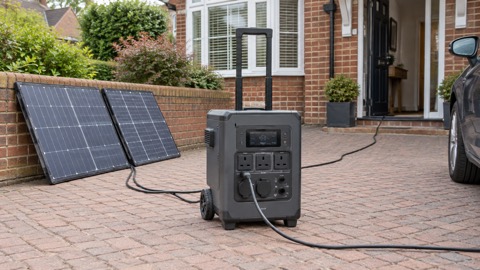 EcoFlow DELTA Pro
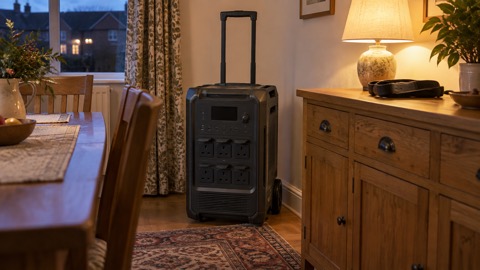 BLUETTI Elite 400
 Anker SOLIX C300 Power Station
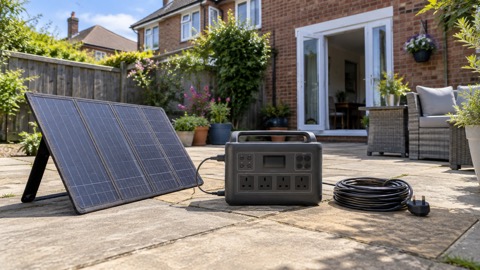 EcoFlow DELTA 3
 EcoFlow DELTA 2 and DELTA 2 Max
 EcoFlow DELTA and DELTA Max
 EcoFlow RIVER 3 and RIVER 3 Plus
 EcoFlow RIVER 2 and RIVER 2 Max