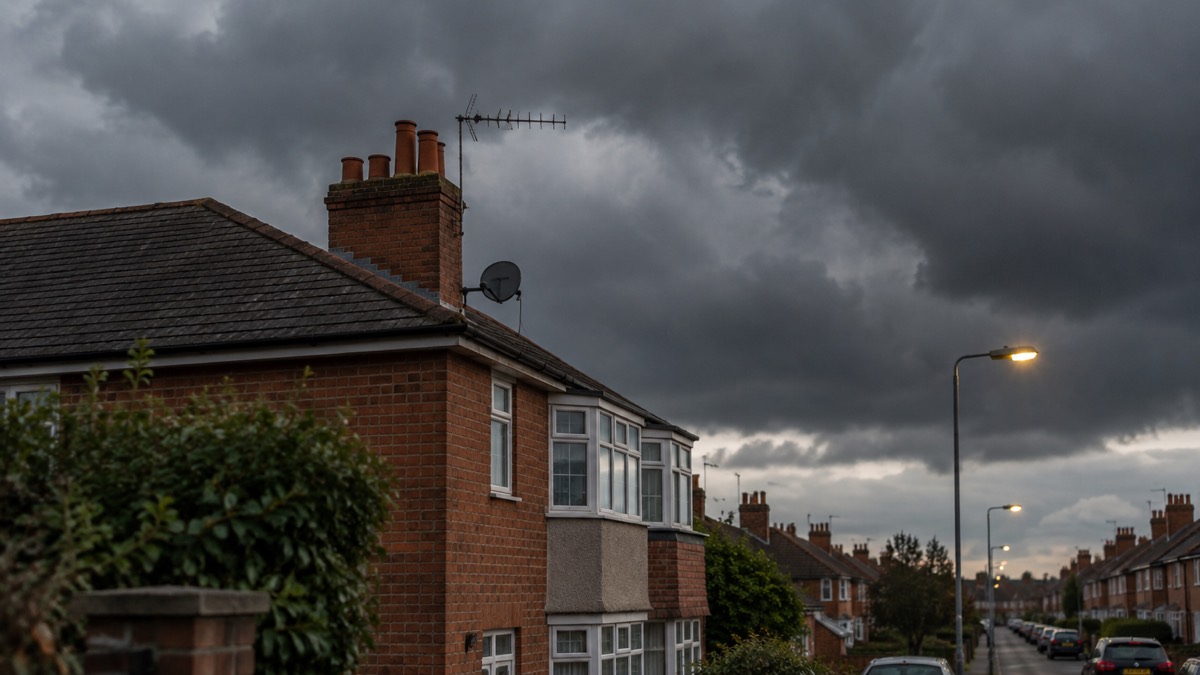
When the TV picture breaks up or the radio goes quiet during a storm, the cause is almost always one of two things: something has happened at your end, such as a shifted or damaged aerial, or something has happened upstream, such as a transmitter or mobile mast losing its power supply. Either way, the practical response starts the same way: work out whether it is just you or your whole area, and keep a battery, wind-up or solar radio ready so you can still receive news and warnings.
There is a second, much rarer cause of signal trouble that has nothing to do with wind or rain: space weather. Events from the sun, such as solar flares and mass ejections, can disrupt satellites, radios, power and telecommunication systems and GPS1. The Government lists severe space weather as one of the highest priority natural hazards in the UK National Risk Register2, but severe events are rare, low level events happen regularly and pass quickly, and the direct risk to people is very low.
Why storms knock out TV and radio reception
A storm can break the chain between a transmitter and your screen or speaker at several points, and understanding the chain tells you where to look. The signal travels from a transmitter to the aerial on your roof or the cable into your home, and the transmitter itself needs electricity to broadcast. Storms and high winds can bring down trees, damage buildings, roads, bridges and railways, cause severe flooding inland and in coastal areas, create large waves and dangerous sea conditions, and make travel dangerous9. Any of these can damage the network that carries both power and signals.
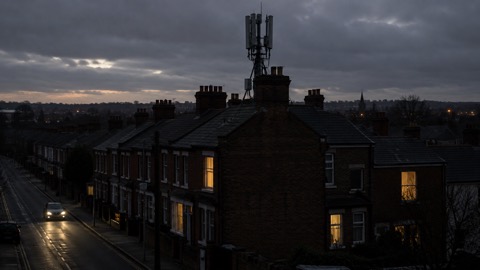
The single biggest cause of storm damage to the power network is wind. Ofgem's report into Storm Arwen found that the majority of network faults were caused by strong winds or trees and branches falling onto power lines10, and an earlier storm review found that wind speed, both gusts and sustained periods of high winds, is the primary cause of damage to electricity distribution networks11. When those power lines feed a TV or radio transmitter or a mobile mast, the broadcast signal can go down even though the transmitter itself is undamaged.
Damage to the wider networks takes other forms too. Severe weather damages telephone masts and fibre-optic cables12, and extreme heat and floods can damage mobile masts and broadband networks, with undersea internet and phone cables also at risk13. Winter weather has a particular ability to knock out heat, power and communications services, sometimes for days at a time14. Lightning from thunderstorms can cause power cuts and disrupt other utilities and services8. For the household, the result is the same: no signal, no picture, and sometimes no way to find out what is happening except by radio.
Is it your aerial or the transmitter?
Work through the possibilities in order, starting with the checks you can do yourself before moving to the ones that need help. The aim is to establish whether the fault is at your home or somewhere in the network, because that determines who fixes it and how quickly.
- Ask your neighbours. If homes around you, served by the same transmitter, have also lost signal, the fault is almost certainly upstream rather than at your aerial.
- Check other channels and other devices. If some channels still work, or FM and DAB radio are fine while TV is not, the problem may be a single multiplex or your aerial pointing slightly off.
- Look at the aerial, from the ground only. High winds can shift an aerial, its pole or the downlead cable. Inspect from ground level with binoculars if you can; do not go onto the roof.
- Never touch fallen or hanging cables. The nidirect advice for strong winds is to "be careful not to touch any electrical/ telephone cables that have been blown down or are still hanging"4. Report them instead.
- Check your provider's service status. Phone and broadband disruption can occur from severe weather, power cuts or a provider outage3, and providers publish fault information online, which you can reach on a mobile connection if your broadband is down.
- Consider a power cut at the transmitter. If your street lights or neighbours' homes are also without power, the transmitter or mast may have lost supply, and the signal may return with the electricity.
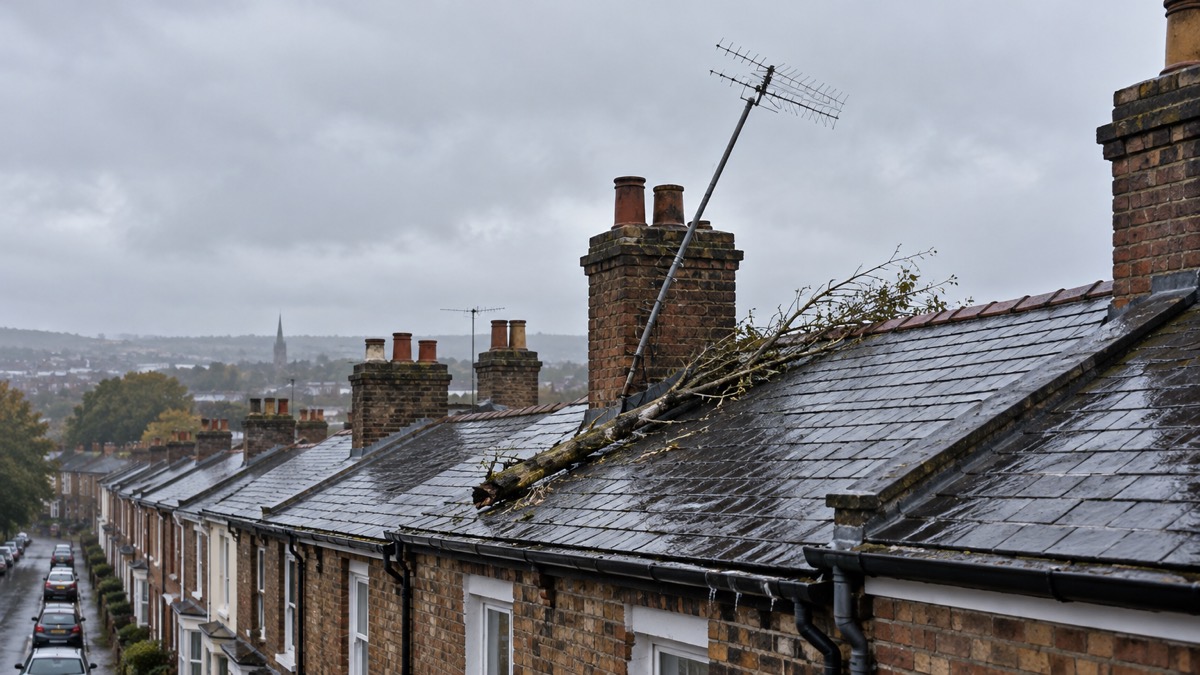
Where you live changes how likely you are to be affected. Ofcom notes that the impact of severe weather on phone and broadband services can be different depending on where you live, with rural areas more likely to be affected13. Rural homes are also more likely to rely on a single transmitter or a long line from it, so a single fault can cut off a wide area. If you depend on your landline or broadband, Ofcom advises that AM, FM and DAB radios working on batteries, wind-up or solar will help you receive weather warnings, news updates and information from your local authority or the UK Government13. Our guide to emergency radios covers what to choose, and what to do when phones and the internet go down covers the wider picture.
Storm seasons can bring several named storms in a row
One storm is manageable; a run of them is what strains households and networks. The Met Office names storms on the basis of the impacts expected from strong winds, though the impacts of other weather types such as rain leading to flooding or snow are also considered15. You should pay extra attention to advice and warnings when a storm is named by the Met Office, as named storms are more likely to bring the biggest impacts16.
The naming record shows how much the season varies. The 2023/24 season brought 12 named storms, the most in a season, while 2022/23 brought just 2, the least17. The practical lesson is to restock and recheck your preparations between storms rather than assuming the first one was the last.
During the storm itself, the advice from local resilience forums is consistent: during a storm, listen to the local radio or television for weather reports and emergency information18, and stay informed by looking at the weather forecast and checking the Met Office for weather warnings and details of risk in your area19. Flood and weather forecasts, and school closure information, will be on local radio and TV20. Storms can often be accompanied by heavy rainfall and have the potential to cause widespread disruption and even danger to life in severe conditions19, so treat each named storm seriously even if the last one passed you by. Our storms, snow and ice guide covers the wider preparations.
Space weather: what it is and why it can disrupt communications
Space weather is a separate problem from storms, and it behaves differently. It means events caused by elements emitted from the sun, such as solar flares and mass ejections; unusually strong events can disrupt satellites, radios, power and telecommunication systems and GPS1. Unlike a storm, you will not see it coming in the clouds, and it does not damage your aerial. It disturbs the signal path itself and the electronics at either end of it.
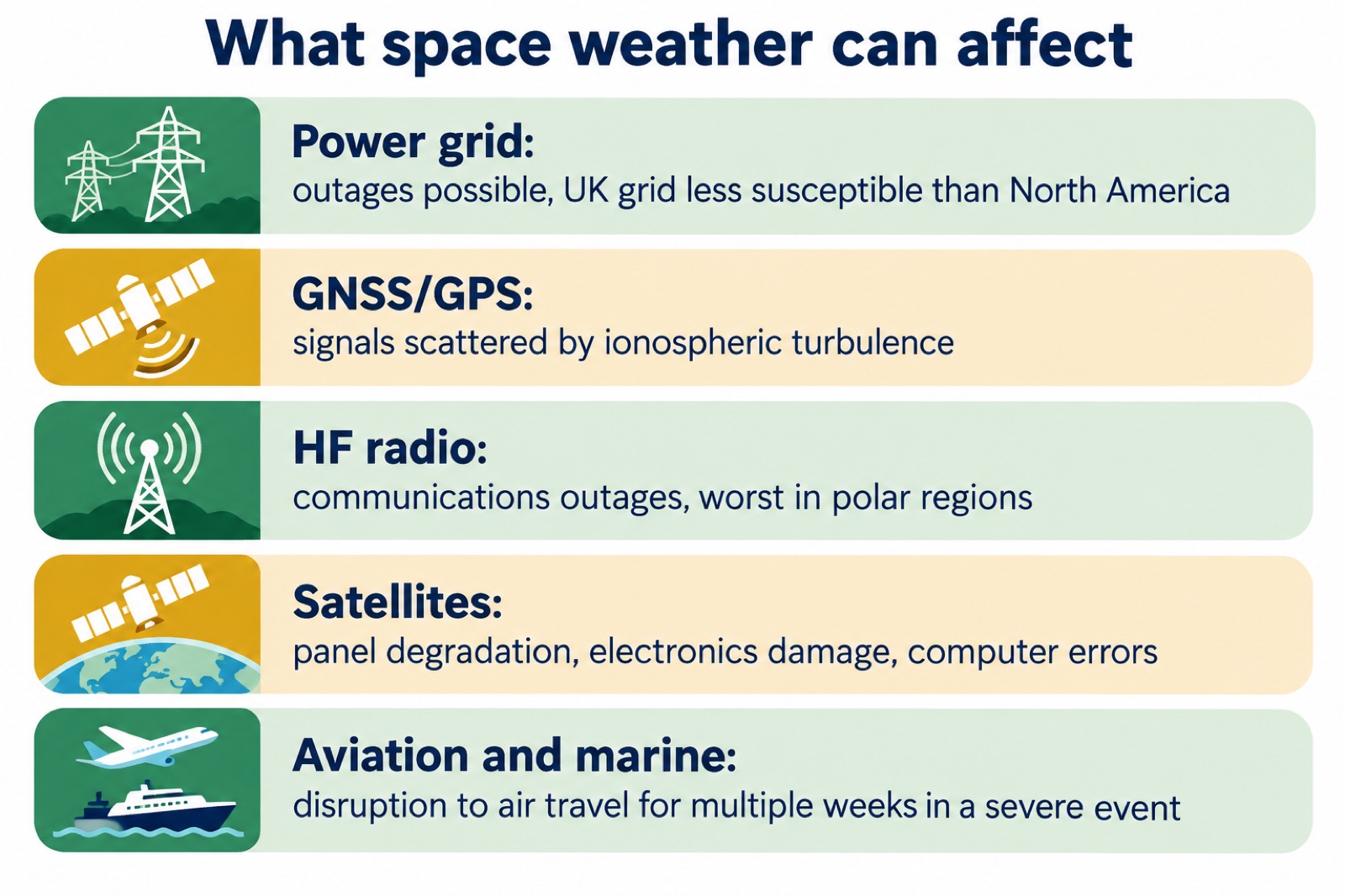
The mechanism is well understood. During a solar flare, the increase in radiation from the Sun causes the ionosphere, the layer of the atmosphere that radio signals bounce off, to absorb rather than reflect signals, disrupting communications on the sun-lit side of the Earth. Ionospheric turbulence can also scatter electromagnetic waves, disrupting GNSS/GPS and radio bands up to GHz frequencies2. In other words, the same event can degrade satellite navigation and radio reception at the same time, over a wide area, without any wind having blown.
Space weather comes in forms that are measured on separate scales: radio blackouts on the R scale, geomagnetic storms on the G scale and solar radiation storms on the S scale2. Each behaves differently. Geomagnetic storms can be felt for a number of days2. Solar radiation storms, consisting of very high energy protons, primarily impact polar regions, mainly degrading HF communications in those regions2, which matters most to aviation and marine users rather than to a household radio in Britain.
What space weather can take out: power, GPS, HF radio and satellites
The Met Office lists the main impacts of space weather as power grid outages, disruption to GNSS/GPS, HF radio communications outages, satellite damage, and increased radiation levels at high altitude2. Geomagnetic storms can affect power systems, spacecraft operations and communications systems such as GNSS/GPS or HF comms2. For satellites, solar panels can be degraded, reducing the life expectancy of the satellite, surface charging can damage the electronics, and radiation can cause errors in computer systems2.
The sectors that plan for this are listed by the Met Office as energy, satellite, communications, aviation, marine, road transport and rail transport2. A report by the National Audit Office on the UK's resilience to severe space weather sets out what a severe event could mean in practice: widespread disruption of air travel for multiple weeks, localised power outages in the UK, and disruption to satellite services such as satellite navigation and timing services used by many sectors7.
For a household, the effects would arrive indirectly. If GPS is degraded, phone mapping, some in-car navigation and delivery tracking may falter; the fire service advice during storms is simply to listen out for travel updates on your car radio or sat nav17. If power outages occur locally, the familiar storm problems follow: loss of heating, lighting and refrigeration for homes and businesses12. The National Audit Office report notes that the UK power grid has an advantage: the Met Office explains that the UK grid has much shorter and more highly connected transmission lines than those in North America, so it is less susceptible to space weather2.
Severe space weather is rare, and the direct risk to people is very low
It is worth being clear about scale. Low level space weather events occur on a regular basis; severe events are rare2. In 2025, the Government considered the likelihood of a severe space weather event occurring within the next five years to be between 5 and 25 per cent7. The London Risk Register rates severe space weather as a very high risk, with an impact score of 4 and a likelihood score of 4, covering solar flares, solar radiation storms and radio bursts21. It also rates the simultaneous loss of all fixed and mobile forms of communication as a high risk21. These ratings are about the effect on infrastructure and services, not about harm to individuals.
The direct risk to people from space weather itself is very low. The hazard is to systems: power, communications, navigation and transport. The same registers show how risk ratings work across hazards: in London, a major fire is rated medium, a radiation exposure from transported, stolen or lost goods is rated low, and a civil nuclear accident is rated high21. Severe space weather sits at the top of such lists because of how many services it could touch at once, not because anyone is endangered by the sun's output itself at ground level.
So the sensible household response is modest: the same preparations that see you through a storm also see you through a severe space weather event. Keep a battery, wind-up or solar radio for news and warnings13, keep a torch and a way to charge your phone, and know how to contact your network operator. Our staying informed guide brings those steps together, and where to get official warnings and news lists the sources to trust.
Unplug appliances to protect them from a surge when power returns
Whether the outage was caused by a storm or by space weather, the advice on your electrical items is the same. Turn off items such as irons, ovens, electric fires and fryers. Unplug your TV and computer, as they can be damaged if there is a surge when power goes back on22. A parish council preparation guide makes the same point for the two items most households care about: "It's also a good idea to unplug your TV and PC, to avoid damage to them in case of a surge when power returns"5.
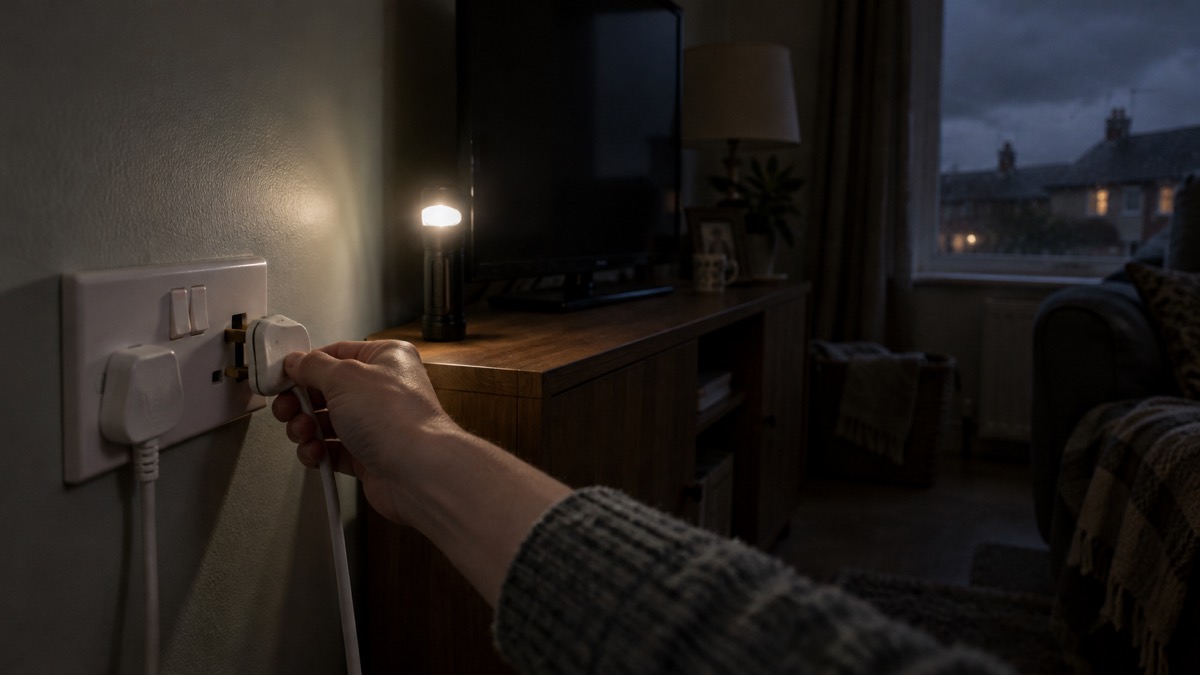
The same logic applies during thunderstorms, when the trigger is lightning rather than restoration. The Scottish Government's storms and wind advice is to unplug all unnecessary electrical items, as lightning can cause power surges9. And the Sussex resilience forum's preparation advice extends it to space weather events: turn off electrical appliances at the plug to avoid possible damage from a power surge when the power is restored1.
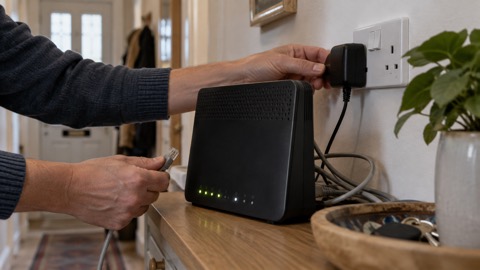
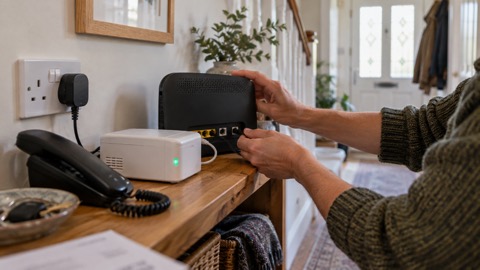
Do this as soon as the power goes off, not just before you expect it back, because restoration times are often uncertain. Our power cuts guide covers what to expect and how long outages typically last, and keeping your router and hub running in a power cut covers broadband equipment specifically.
Keep the fridge and freezer shut: food can last up to 8 hours
A signal outage caused by a power cut puts your food at risk, and the rules are simple. Your fridge should keep your food at a safe temperature for up to four hours during a power cut, provided you keep the door closed as much as possible23. The Food Standards Agency's guidance states that a power outage of less than 4 hours is unlikely to impact the safety of food in chilled or frozen storage6. Some food can last up to 8 hours if the fridge and freezer are kept closed1.
The four hour figure is the one to act on. If the temperature in your fridge rises to 8°C or more, you should eat food that normally needs refrigeration within four hours23. So the sequence is: keep the doors shut, wait, and if the outage stretches on, plan to use chilled food rather than lose it. Our emergency food guide covers what to keep in the store cupboard so a power cut does not leave you without a meal.
| Storage | How long food stays safe | Condition |
|---|---|---|
| Fridge | up to 4 hours23 | door kept closed as much as possible |
| Fridge and freezer | some food up to 8 hours1 | kept closed |
| Chilled food after 8°C | eat within 4 hours23 | if fridge temperature has risen |
Met Office space weather alerts and weather warnings
The Met Office is the UK's official weather service and is responsible for issuing weather warnings, which warn of impacts caused by severe weather24. Warnings are issued up to seven days ahead for rain, thunderstorm, wind, snow, lightning, ice, extreme heat and fog8, and the possible impacts include damage to property, travel delays and cancellations, loss of water supplies, power cuts and, in the most severe cases, a danger to life25. You can receive warnings through the Met Office app and website, social media, TV and radio24, and Surrey's emergency planning team advises getting severe weather warnings and signing up to Met Office alerts, and getting the Met Office App including alerts to your smartphone26.
The email alert service covers warning regions across all four nations: Orkney & Shetland; Highlands & Eilean Siar; Grampian; Strathclyde; Central, Tayside & Fife; SW Scotland, Lothian Borders; Northern Ireland; Wales; North West England; North East England; Yorkshire & Humber; West Midlands; East Midlands; East of England; South West England; and London & South East England27. During an active spell of severe weather, you may receive a number of alerts on a daily basis27, which is worth knowing so the volume does not put you off signing up.
For space weather specifically, the Met Office provides sector specific forecasts for authorities and organisations that prepare for and respond to risks such as space weather, and access can be requested2. The Sussex resilience forum's advice for households is that to receive automated space weather alerts and warnings you can request a specialist space weather account from the Met Office1. For most households, ordinary weather warnings plus a battery radio will be enough, but the specialist route exists if you want it.
One point on how warnings work: the Met Office does not send out warnings for days assessed as having only minor impact, but there could still be some impacts, expected to be short-lived or fairly localised28. So a day with no warning in force is not a day with no risk at all, and reception problems can still occur on unremarkable days. Our free alert services checklist lists what to sign up for before anything happens.
Getting help and getting repairs done
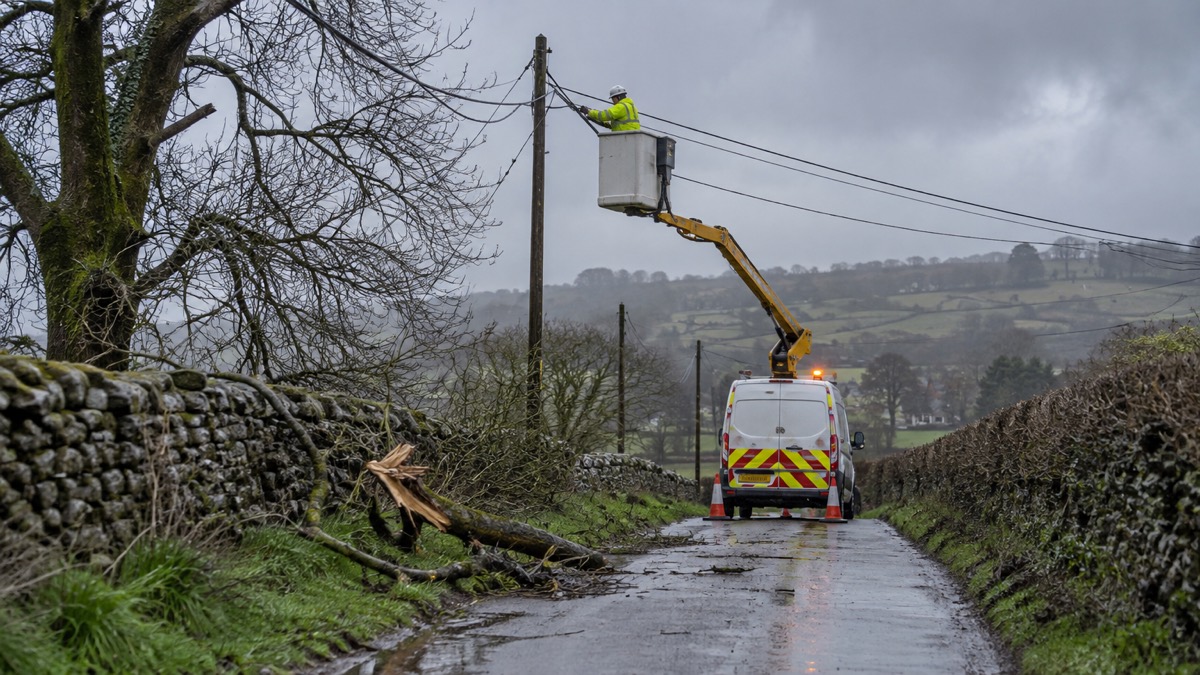
If the outage outlasts the storm, several routes lead to help. For phone and broadband, check your provider's fault status and report the problem; Ofcom's guidance on staying connected in severe weather is aimed particularly at people who rely on their line, and extra help is available from providers for those who need it, which our provider help page explains. If you or someone in your household depends on the phone line for a personal alarm or medical equipment, read our telecare guide before the next storm.
Repairs to the network take time, and the severity of the weather shapes how long they take. The experience of Storm Darragh shows what responders themselves face: field communication was challenging, as many areas with 4G masts off supply left Airwave devices limited and satellite phones working intermittently, delaying contact with the control room and slowing restoration29. If the engineers' own communications are struggling, expect repairs to take longer than the headline targets.
Finally, if you are without any signal at all and need emergency help, our guides on calling 999 when your mobile network is down and emergencySMS set out the options, and how phone and broadband networks respond to storms explains what happens behind the scenes and why restoration sometimes takes as long as it does.
Sources (29)
- Preparing for an emergency: be ready, stay safe, act now, Sussex Police, 2025-10
- Space weather impacts, Met Office
- Phone and broadband outages, prepare.campaign.gov.uk
- Strong winds weather warning information and advice, nidirect, 2026-10-24
- 12 tips to prepare for a power cut, Horsted Keynes Parish Council, 2026
- Food safety in a power cut: advice for consumers, GOV.UK, 2023-07-26
- The UK's resilience to severe space weather, National Audit Office, 2025
- Community resilience leaflet, Met Office, 2024
- Storms and wind, ready.campaign.gov.scot, 2026-03-24
- Storm Arwen report, Ofgem, 2022-06-09
- Storm review report, stage 2, Ofgem, 2014-07
- Utility failure: ongoing risks, Essex Prepared, 2026-10-29
- Stay connected in severe weather, Ofcom, 2026-10-13
- Adverse weather events: snow, Llangattock Community Council, 2023-10-12
- UK Storm Centre, Met Office
- Storms, prepare.campaign.gov.uk
- Amber warning in place as Storm Debi hits North Yorkshire, North Yorkshire Fire and Rescue Service, 2023-11-13
- Extreme weather, Flintshire County Council, 2026-10-29
- Storms and gales, Lancashire Prepared, 2026-10-29
- Flooding during a flood: easy read, Nottinghamshire County Council, 2025-11-02
- London Risk Register, version 14, Greater London Authority, 2025-01
- Loss of essential services, Greater Manchester Combined Authority, 2026-10-29
- Food safety in the kitchen: power cuts, Food Standards Scotland, 2026-10-25
- Weather warnings, Met Office, 2026-10-25
- National Severe Weather Warning Service, Met Office, 2026-10-25
- Sign up to warnings and alerts, Surrey County Council, 2026-09-28
- Subscribe to email alerts, Met Office, 2026-10-29
- Severe weather advice, Met Office, 2026-10-25
- ScottishPower Energy Networks paper, ScottishPower Energy Networks, 2025
 Free Alert Services
 Emergency Apps
 Digital Switchover Checklist
 When Phones and Internet Fail
 Official Warnings and News
 Emergency Radios
 Telecare on Digital Phone Lines
 Mobile Networks in Power Cuts
 Broadband Outages
 Router and Hub Power Cuts
 Wi-Fi Calling
 Satellite Messaging and SOS
 Satellite Messengers
 Calling 999 and 112
 Non-Emergency Numbers