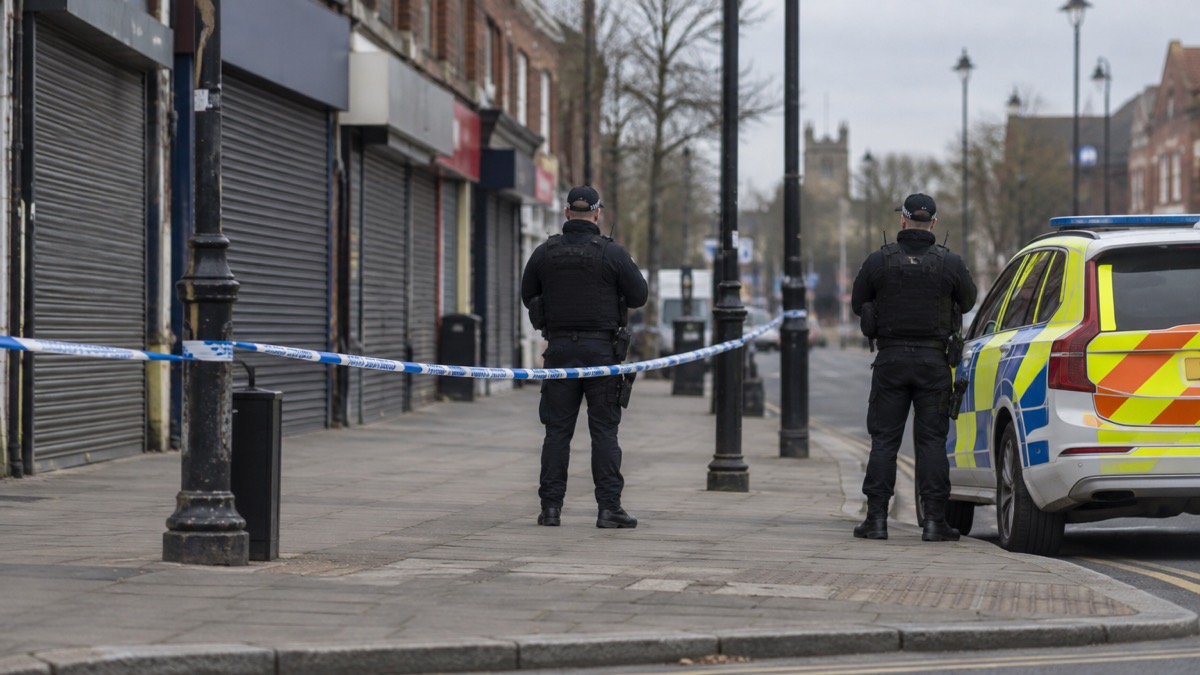
If armed police arrive while you are caught up in an attack, the single most important thing is to do exactly what they tell you, straight away. Keep your hands where officers can see them, stay calm and avoid sudden movements that could be taken for a threat1. They may shout, and they may treat you as a possible danger until they are sure you are not one. That is normal, and it is not personal.
This is the last stage of the Run, Hide, Tell advice. You run if you can, you hide if you cannot, and when it is safe you tell the police on 9992. Armed officers arriving is the point where Tell meets the people who will deal with the attacker, and where your behaviour in the first few seconds decides how quickly they can get on with that job.
The rest of this page sets out what to do in those seconds, why officers behave as they do, and how to give the police the information they need once the danger has passed. If you have not yet read the core guidance, start with Run, Hide, Tell: What to Do in a Terror Attack.
Follow armed officers' instructions immediately
The core instruction is short. Follow police officers' instructions, remain calm, avoid sudden movements that may be considered a threat and keep your hands in view1. Every other piece of advice on this page is a detail of that one sentence.
Officers arriving at a live incident are working at speed and under pressure. They need to identify the attacker, and they need to be certain that the people around them are not part of the attack. A person who does not respond to a shouted instruction, or who moves unexpectedly, creates doubt at the worst possible moment. Doing as you are told removes that doubt and lets the officers move on.
The same principle runs through official emergency advice in all four nations. Belfast City Council tells residents to follow the advice of the emergency services4, and North Devon Council says to follow the advice in any official warning or emergency alert you receive5. In a terrorist incident specifically, the North West Ambulance Service says that when the emergency services arrive you should follow their instructions if they tell you to leave the area3.
A few practical points follow from this:
- Listen for the instruction, not the tone. Officers may shout. The words are what matter.
- Do one thing at a time. If you are told to stop, stop. If you are told to move, move. Do not try to explain yourself until you are asked.
- Do not argue, and do not reach for anything. Not a phone, not a bag, not a door handle, unless you are told to.
- If you cannot hear, say so clearly and keep still. Do not turn and walk away.
If you are with other people, pass the instruction on quietly and make sure everyone with you is doing the same thing. A group that moves together and keeps its hands visible is easier for officers to read than a group doing different things.
Keep your hands visible and avoid sudden movements
Hands are the part of your body officers watch most closely, because they need to see at a glance that you pose no threat. That is why the guidance puts them at the centre: keep your hands in view1. If you are asked to raise them, raise them. If you are asked to put them on your head, do it and keep them there. The exact position matters less than the fact that officers can see them and that you do not move them without being told.
"Keep your hands in view"
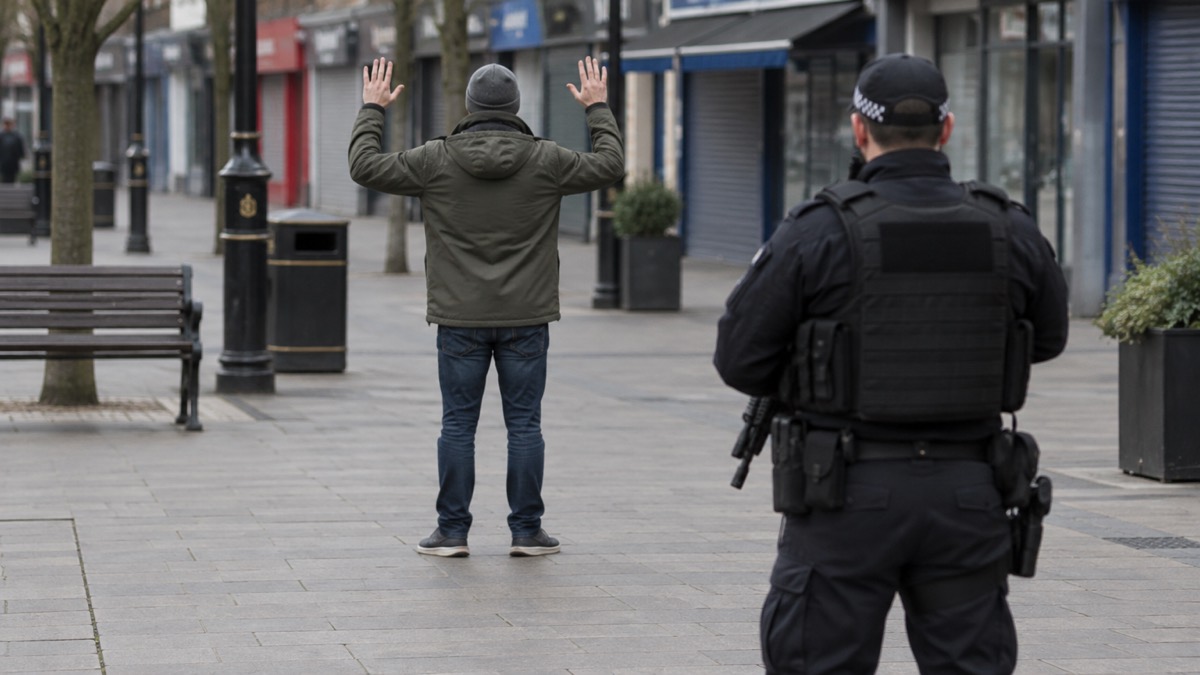
The same logic explains the advice about sudden movements. Reaching into a pocket, pulling a phone from a bag, turning quickly or running when you have been told to stop can all look, for a moment, like something else. The guidance is not asking you to be still for its own sake. It is asking you not to create a moment of doubt.
If you are helping someone who is injured, tell the officers what you are doing before you do it, and keep your hands visible as you do it. Police advice is to follow officers' instructions, remain calm, avoid sudden movements that may be considered a threat and keep your hands in view3. If an officer tells you to stop helping and move away, do that. The ambulance service will take over when it reaches you.
Why officers may treat you as a possible threat at first
It helps to understand what the officers are doing. They have arrived at an incident where someone has been, or is being, attacked. They do not yet know who the attacker is, whether there is more than one, or whether anyone in the crowd is involved. Until they know, everyone is a possible threat. That is why the guidance is framed the way it is: remain calm, avoid sudden movements that may be considered a threat, keep your hands in view1.
This is not suspicion of you as a person. It is the only safe starting point officers have. The faster you show them you are not a threat, the faster they can concentrate on the person who is.
The same caution applies after the immediate danger has passed. Official advice on returning home after an emergency warns people to be wary of anyone who knocks on the door offering to carry out building or repair work, and to check their credentials first6. In the confusion after an attack, people who mean you no good can take advantage of the disruption. Deal with officials who can identify themselves, and with nobody else.
If you have information about the incident, there are two routes. If officers are with you, tell them directly. If you are away from the scene and it is safe, call 9992. You can also report a possible terrorist threat online through the police7. For the wider picture of how the threat is assessed in the UK, see UK Terrorism Threat Levels and What They Mean for You.
Where armed police fit in Run, Hide, Tell
Run, Hide, Tell is the national advice for a firearms or weapons attack, and it can be used in many situations and places8. It has three steps, and armed police belong to the third.
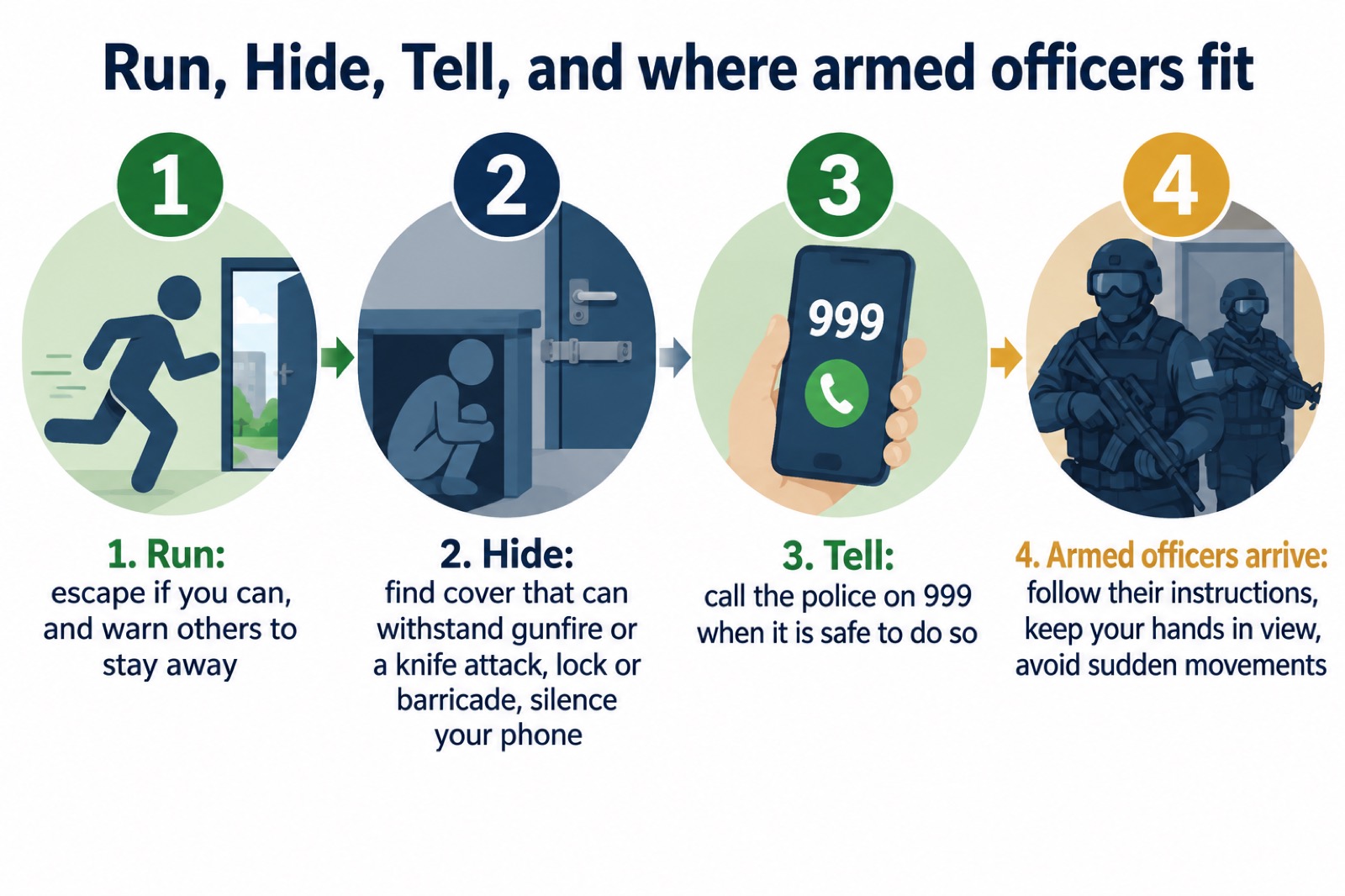
The Hide step is worth knowing because it decides what state officers find you in. Find cover that can withstand threats such as a knife attack or gunfire, and remember that cover from view does not mean you are safe. Hide even behind a locked door, be aware of your exits, try not to get trapped, lock and barricade, move away from the door, and be quiet: silence your phone and turn off vibrate2. A phone that rings while officers are clearing a building creates exactly the kind of uncertainty they are trying to eliminate.
When officers reach you, the Hide step is over. Do not stay barricaded if you are told to come out. Do not ask them to wait while you gather belongings. Come out with your hands visible and follow instructions1.
If you are caught up with family, the same rules apply to everyone with you, including children. The page on Caught Up in an Attack With Your Family: What to Do covers that in more detail, and Where to Hide During a Gun or Knife Attack explains how to choose cover before officers arrive.
Staying calm when officers are shouting at you
Staying calm is easier said than done, but it is the behaviour that makes everything else possible. Official guidance for emergencies returns to it again and again. The ambulance service says simply: stay calm9. The Scottish ambulance service advises monitoring a casualty until help arrives and staying as calm as possible to reduce their stress10. The Northern Ireland Ambulance Service says the most important thing you can do before help arrives is to stay calm, because you may need to help with treatment until the response gets to you11. The fire service gives the same instruction when you call 999: try to stay calm and give the control operator the exact address12.
None of this is a criticism of anyone who freezes or struggles to take it in. It is practical. A calm person can hear an instruction, follow it and give useful information. A person who is overwhelmed cannot do any of those things quickly, and may do something that looks like a threat.
A few things help:
- Breathe out slowly, then listen. You are not trying to feel calm. You are trying to hear the next instruction.
- Fix your eyes on the officer giving the instruction. It gives you something to concentrate on.
- Give yourself one job at a time. Hands visible. Stay still. Wait for the next instruction.
- If you have to speak, keep it short and factual. "I have a child with me." "I am injured." "There is someone hurt behind the counter."
If you are injured or unwell, say so clearly and wait for instructions. Do not try to treat yourself while officers are giving you directions.
Telling the police what you saw
Once it is safe, the police need information, and you may be the only person who saw what happened. The Tell step is to call the police on 9992. When you get through, be ready to give the details the guidance asks for: the nature of the incident, the location, the suspects, the direction of the last sighting, and descriptions of the attacker including numbers, features, clothing and weapons. Add anything else useful, such as casualties, type of injury, building information, entrances, exits and hostages2.
| What to tell the police | Why it matters |
|---|---|
| Nature of the incident | Tells the control room what response is needed2 |
| Location | Gets officers and ambulances to the right place2 |
| Suspects and direction of last sighting | Helps officers find the attacker2 |
| Descriptions: numbers, features, clothing, weapons | Lets officers identify the right person2 |
| Casualties, injuries, entrances, exits, hostages | Helps the ambulance and fire services plan2 |
If you can, stop other people from entering the building, but only if it is safe to do so2. Do not put yourself back in danger to do it.
If you cannot speak safely, the Silent Solution system exists for exactly that. When you call 999 and cannot speak, the police call handler will attempt to communicate with you by asking simple yes or no questions, so listen carefully to the questions and instructions so they can assess your call and arrange help13. The page on How to Report Suspicious Activity or Terrorism Concerns covers the reporting routes in more detail, and The Terrorism Threat in the UK: Attack Types and What Households Should Know explains the kinds of incident you might be reporting.
Children, bags and phones: the practical questions
Children with you. Keep them close, keep them quiet and make sure their hands are visible too. Tell them in advance, calmly, that police may shout and that they should do as they are told. The government's Be Ready campaign suggests talking to children about what to do in an emergency, including how and when to call the emergency services, and helping them learn their home address and, if possible, a parent or guardian's mobile phone number, practising these regularly14. That preparation pays off in any emergency, not only an attack. If you are separated from a child, tell the nearest officer immediately.
Phones and bags. Keep your hands in view and do not reach into a bag or pocket unless you are told to1. If you are asked to put a bag down, put it down slowly and step away from it. A phone is worth keeping close if you can, because you may need it to call 999 once it is safe2, but never at the cost of obeying an instruction. Keeping a phone or alert device nearby is sensible preparation for any emergency15, and having access to a phone before bed is standard advice for winter safety16. The same habit serves you here.
Being searched or held. Expect to be treated as a possible threat until officers are satisfied you are not one1. That can mean being asked to keep your hands visible, being moved on, or being held in a safe area while the incident is dealt with. Do as you are told, keep calm and explain anything relevant, such as an injury or a child with you. Once the emergency services arrive, follow their instructions, including if they tell you to leave the area3.
After the incident: where to get help
When the immediate danger has passed, the ordinary emergency services take over. If someone is badly hurt, call 999 as soon as you can and listen very carefully to what you are told to do while you wait for an ambulance to arrive17. If you are at home or at work, check that your house number or name is clearly visible from the roadside, get someone to open the doors or stand outside to signal the ambulance when it arrives, write down the patient's GP details if you know them, collect any medication they may need, and lock away any family pets9.
If you are asked to meet an ambulance, have something visible so the crew can locate you, such as car lights, a torch, waving with your arms and clothing, or a jacket or coat18. If someone is unresponsive, the advice for a child is to tap their feet or stroke their neck and shout, and if you get no response, call 999 and start CPR straight away19. The page on First Aid at Home: A Household Guide covers the basics, and Support for Victims and Families After a Terror Attack explains what help is available afterwards.
For the wider picture of how the UK prepares for incidents like this, see Major Incidents: A Household Guide to Terror Attacks, Chemical and Radiation Emergencies and How the UK Prepares for Emergencies: A Household Guide.
Sources (19)
- Physical threats: armed police response, ProtectUK, 2022-10-06
- Run, Hide, Tell, ProtectUK, 2026-05-21
- Staying safe from a terrorist incident, East of England Ambulance Service, 2026-10-29
- Emergency advice, Belfast City Council, 2026-10-29
- Be prepared for emergencies, North Devon Council, 2026-10-29
- Are You Ready booklet, Culham Parish Council, 2025-09
- Contact the police, GOV.UK, 2026-10-29
- Run Hide Tell, Counter Terrorism Policing, 2026-04-23
- Using 999, East of England Ambulance Service, 2026-10-28
- Heart attack first aid, NHS Inform Scotland, 2026-07-24
- What to do before help arrives, Northern Ireland Ambulance Service, 2026-10-29
- Get out, stay out and call 999, North Wales Fire and Rescue Service, 2026-10-26
- Silent Solution guide, Independent Office for Police Conduct, 2023
- Get prepared for emergencies, Prepare campaign, 2026-10-21
- Falls prevention, Staffordshire County Council, 2026
- Winter safety, Greater Manchester Fire and Rescue Service, 2026-10-29
- Heavy bleeding, North West Ambulance Service, 2025-03-13
- Calling 999, NHS 111 Wales, 2021
- What to do if your child has an accident, NHS, 2025-12-18
 Bomb Threat Calls
 Radiation Checklist First Hour
 Power Cut Kit Checklist
 Where to Hide in an Attack
 Young People in a Terror Attack
 Family Caught in an Attack
 Suspicious Letters and Parcels
 Reporting Terrorist Content
 Corrosive Attack First Aid
 Tap Water Safety
 Shelter or Evacuate
 Collecting Children at School
 Food After a Nuclear Accident
 Martyn's Law at Venues
 Sellafield Emergency Advice