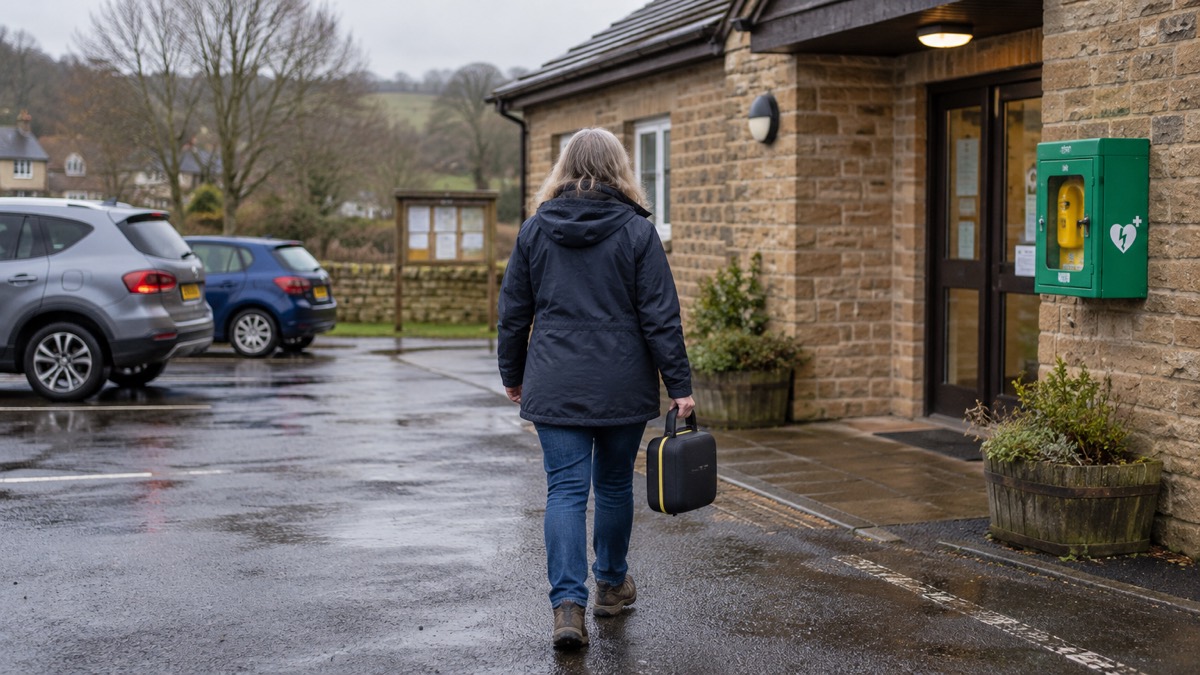
A fully automatic defibrillator is one that analyses the heart's rhythm and delivers a shock itself, without anyone pressing a button. The iPAD SP1, made by CU Medical Systems, is sold in the UK in both a fully automatic and a semi-automatic version, and the fully automatic one is built for people with no first aid training: it talks you through the rescue, tells you when to stand clear, and shocks the casualty on its own if a shock is needed1.
For a household, club or village thinking about a defibrillator, that changes what you have to get right. You still ring 999, start CPR when told and put the pads on, but the moment of decision is taken out of your hands. The device weighs 2.4kg with its battery and pads fitted, carries an IP55 rating and is designed to withstand a one-metre drop, so it can live in a hall, a workshop or a vehicle rather than only in a clean office1.
This page sets out what the fully automatic SP1 does, how it differs from the semi-automatic version, how adult and child modes work on the same pads, what the specifications mean in practice, and how to keep it tested, stored and ready for the day it is needed.
What the iPAD SP1 Fully Automatic AED is
The iPAD SP1 is an automated external defibrillator: a portable machine that analyses a casualty's heart rhythm and, if it finds one that can be corrected by a shock, delivers that shock to restart the heart. The fully automatic version does the last step itself. The maker describes it as developed with unqualified users in mind, with features that help with interpretation, and as designed specifically for untrained public use1.
That framing matters for a household plan. A defibrillator is not a substitute for CPR or for calling 999; it is the piece of equipment that buys time while the ambulance comes. The maker's own description of the rescue is that the device gives clear voice prompts and visual instructions to guide responders step by step, including guidance on performing CPR5. The machine tells you what to do next, in order, so nobody has to read a manual over a casualty.
The SP1 is also sold as a semi-automatic model, and the two share most of their design. Both are made by CU Medical Systems, both are supplied with a pair of dual adult and child electrode pads, a battery, an AED starter kit and a carry case, and both carry the same 7-year warranty, upgraded free to 10 years on registration1. The difference is confined to the moment of the shock, which is covered below.
Where it sits in a wider plan is worth thinking through before you buy. A defibrillator is one of the few pieces of emergency kit that is useless unless somebody can find it and knows, roughly, what will happen when it starts talking. The page on defibrillators and how to use one covers the general sequence; this page covers what is particular to this model.
How the shock is delivered: stand clear when the countdown starts
On the fully automatic SP1, once the pads are correctly placed and the device detects the relevant irregular heartbeat, it delivers the shock automatically1. Before it does, it gives a verbal countdown so that everyone steps back from the casualty6. That countdown is the single most important thing to understand about this version: when you hear it, stop what you are doing, take your hands off the casualty and make sure nobody else is touching them.
The sequence in practice runs like this:
- Call 999 and put the phone on speaker.
- Switch the device on and follow its spoken and visual prompts.
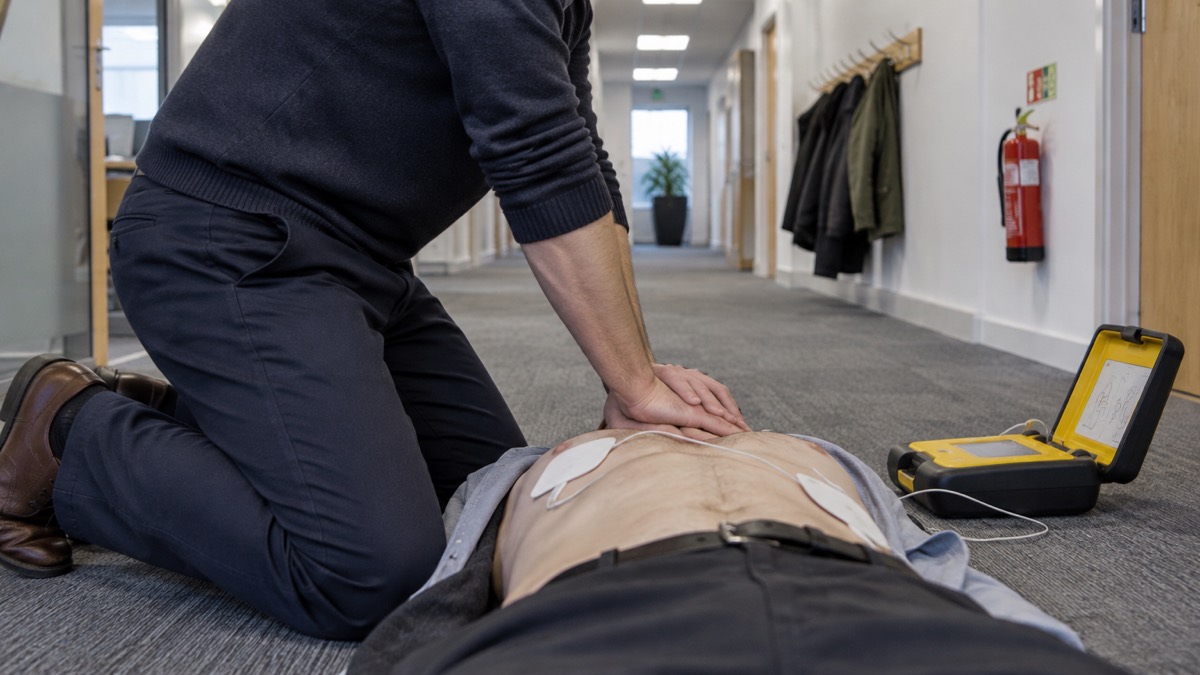
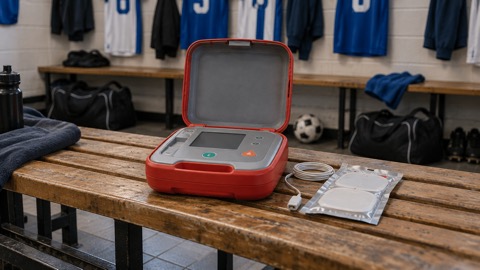
- Attach the pads as shown, one on the upper right side of the chest below the collarbone and the other on the lower left side below the armpit7.
- Stop CPR when told, and keep everyone clear when the countdown begins6.
- Resume CPR as instructed once the shock has been delivered.
The machine will only shock when it has determined a shock is necessary, which is why the pads must be positioned correctly and the casualty must be still during analysis. The maker states that the device informs users when the pads are in the correct position and delivers a shock only when it is determined necessary9.
After the ambulance crew arrives, hand the device over. It provides detailed information to paramedics, including usage time and the number of shocks delivered on arrival1. That record is part of the handover, so do not pack it away.
SP1, fully automatic or semi-automatic: how the versions differ
The two versions of the SP1 do the same job up to the point of the shock. The semi-automatic model prompts the user to press a button which delivers the shock2. The fully automatic model delivers it without requiring manual intervention from the responder once the rhythm has been analysed and a shock is required10. The distributor's summary is the same: the semi-automatic SP1 prompts the responder to press the shock button after performing an ECG analysis, while the fully automatic version shocks on its own5.
The practical difference is a few seconds and a decision. The maker notes that delivering a shock on a fully automatic unit can take a few seconds longer than on a semi-automatic one, because of the verbal countdown before the shock6. On a semi-automatic unit, the operator can press the shock button as soon as they are clear, which can shave a few seconds off the process6. Against that, the fully automatic version removes the possibility of hesitation or of pressing at the wrong moment, which the maker says can reduce the chance of human error for untrained users6.
| Feature | Fully automatic SP1 | Semi-automatic SP1 |
|---|---|---|
| Who presses the shock button | Nobody; the device shocks itself1 | The responder, when prompted2 |
| Warning before the shock | Verbal countdown to stand clear6 | Voice prompt to press the button and stand clear10 |
| Time to shock | A few seconds longer, because of the countdown6 | A few seconds shorter, as the operator can press as soon as clear6 |
| Suits | Public places where staff may have no medical training6 | Responders confident making the decision to press6 |
Which suits a household, club or village hall is a question of who is likely to be there when someone collapses. The maker suggests a fully automatic unit may be a better choice in public areas such as offices, pubs and schools, where staff may not have medical training6. The comparison page on semi-automatic or fully automatic defibrillators sets the two types against each other in more detail.
Using it on a child: adult and child mode on the same pads
The SP1 handles adults and children on one set of pads. The maker describes a quick switch between adult and child mode, with pre-connected dual electrodes that can be switched back and forth easily and swiftly1. The switch sits under a safety cover that prevents accidental switching1. The distributor calls it a built-in paediatric switch, allowing responders to switch between adult and child modes5.
Child mode reduces the energy delivered. The maker states that the SP1 can be switched to a child mode which reduces the intensity of the electrical current11. The pads themselves are dual use: the twin pack of iPAD SP1 adult and child electrode pads is listed for use with either the semi-automatic or the fully automatic SP1, and can be used on both adult and child patients by way of the paediatric switch12.
For a household with young children or grandchildren, this is the feature that decides the purchase. You do not need a second machine or a separate set of pads for a child; you need to know where the switch is and to have checked that the cover is intact. The page on using a defibrillator on a child or baby covers the wider question of when a paediatric mode is appropriate.
Specifications: 2.4kg, IP55 and a one-metre drop
The SP1's physical specifications are what decide where it can live and how it survives there. The maker gives a weight of 2.4kg including battery and pads, and dimensions of 26cm x 25.6cm x 6.95cm1. A retailer lists the same 2.40kg and a height of 260mm8. The maker gives an IP55 rating, meaning dust resistant and protected against low-pressure water jets1. The maker states the device can withstand a drop of one metre and is water resistant, so it is well suited to outdoor environments3; a retailer lists the drop test at 1.2 metres8. Where the two differ, the maker's one-metre figure is the one to plan around.
| Specification | Maker's figure | Retailer's figure |
|---|---|---|
| Weight | 2.4kg including battery and pads1 | 2.40kg8 |
| Dimensions | 26cm x 25.6cm x 6.95cm1 | Height 260mm8 |
| IP rating | IP55, dust resistant and protected against low-pressure water jets1 | IP558 |
| Drop resistance | One metre3 | 1.2 metres8 |
| Battery capacity | Not stated by maker | 200 shocks8 |
| Body material | Not stated by maker | ABS plastic8 |
| Connectivity | Not stated by maker | None8 |
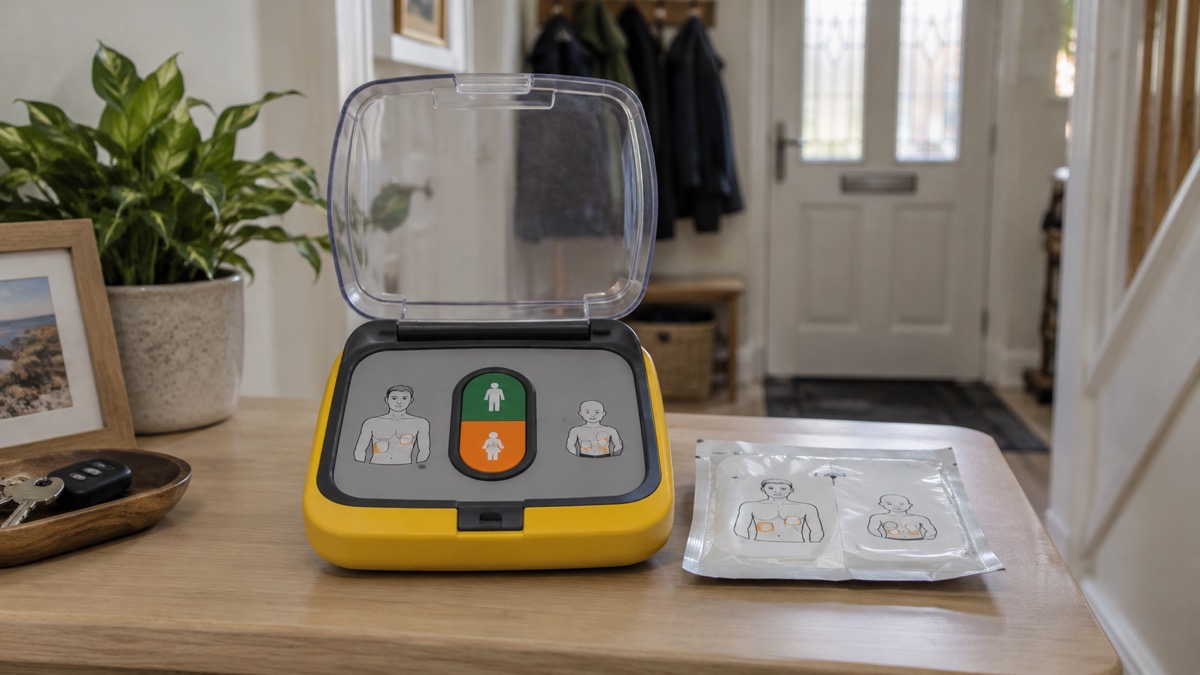
What those numbers mean for a household is straightforward. At 2.4kg it is light enough to carry to a casualty in another room, a neighbouring house or across a playing field, and small enough to sit on a shelf or in a bracket without dominating a wall. The IP55 rating and the drop resistance mean it does not need a heated, dust-free office: a garage, a workshop, a village hall or a boat club is within its design. It is not, however, an outdoor cabinet device on its own; if it is going outside, it needs a proper cabinet, which the page on indoor or outdoor defibrillator cabinets explains.
The battery and pads have their own lives. The maker's figures, as summarised in NHS ambulance service guidance, are a battery shelf life of 5 years and a pad shelf life of 3 years4. The replacement battery is estimated to have the capacity for a minimum of 200 shocks at 150 joules11. The page on how long defibrillator batteries and pads last covers replacement timing in general.
CPR support: audio prompts and a built-in metronome
A defibrillator is used in the middle of CPR, and the SP1 is built to keep the compressions going at the right rate while it works. The maker states that the smart 'i' button allows the user to calibrate the device to deliver a rhythmic CPR metronome, and that the button can also be used to check for errors and calibrate the compression rate, number of breaths and cycles1. The maker's own summary is that the in-built metronome ensures chest compressions are given at the correct rate3.
The voice prompts adjust themselves to the room. The maker states that voice prompts automatically volume-adjust thanks to ambient noise detectors1. In a noisy hall, a workshop or at the side of a road, that means the instructions should stay audible without anyone turning a dial. The device also gives visual instructions alongside the voice prompts, so a responder can follow the steps on screen if hearing is difficult5.
The maker's wider point is that audio instructions mean you do not have to read instructions while performing the shocks9. For an untrained household, that is the whole design idea: the machine carries the sequence, and you carry the hands.
Keeping it ready: self-tests, carry case and wall bracket
A defibrillator that has sat untested in a cupboard for three years is not ready. The SP1 is designed to look after itself between emergencies: the distributor states that it regularly checks for faults or expired parts, ensuring it is always ready for an emergency5, and the maker states that the unit self-tests to ensure it is always ready for use3. The maker also notes that the device performs a self-test whenever new batteries are installed and then turns off after the test is complete11.
That self-test is not something to run on a whim. The maker states that a test performed by removing and reinstalling the battery takes around 20 minutes and should never be performed before using the device on someone in cardiac arrest11. Treat the routine self-test as the machine's job, and your job as the visual check: pads in date, battery in date, indicator showing ready, mode switch on adult, cover intact.
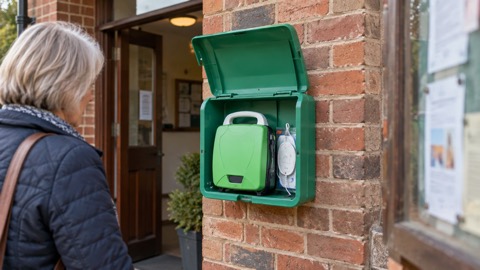
Where it lives matters as much as how it is tested. The maker's advice is to install the device on a wall bracket so that it does not end up stored in a cupboard or drawer where no one can find it, and states that its bracket is specially designed for the SP1 so the device can be grabbed quickly10. The bracket is listed for both the semi-automatic and fully automatic versions and is for indoor installation5. The maker also supplies a bright orange carry case with hands-free portability, reinforced protection and easy equipment access5, and states that the SP1 comes with a free carry case as well3.
For a community group, the Resuscitation Council UK's guidance for communities is the place to start on siting, signage and guardianship11, and the defibrillator guardian checklist turns that into a routine. The general principles for placement are that a defibrillator should be centrally located within high-risk areas, highly visible, near a phone for calling 999, easily accessible and clearly signed13.
Support, warranty and where it fits a household plan
The SP1's warranty is 7 years as standard, with a free upgrade to 10 years when you register the device1. The replacement battery is covered by a four-year warranty11. One maker guidance page gives the device warranty as five years11, which conflicts with the product page's 7-year figure; the product page is the newer statement and the one to rely on, but check the paperwork that comes with your own unit. Registration is the step that turns the standard cover into the longer one, so do it on the day the device arrives.
What the fully automatic SP1 does for a household in an emergency is narrow and specific: it lets someone with no training deliver a defibrillation shock without having to decide when to press a button, while the machine talks them through CPR and keeps the compression rate steady. It does not replace calling 999, and it does not replace learning CPR. The page on learning CPR free online covers the free options, and the first aid at home guide sets the device in the wider kit a household should hold.
For a home, the case for one rests on who lives there and how far the nearest public access defibrillator is. For a club, village hall, pub or school, the maker's own suggestion is that a fully automatic unit may be the better choice where staff may not have medical training6. The page on choosing a defibrillator for a home, club or village works through that decision, and the iPAD brand page lists the rest of the range.
Sources (13)
- iPAD SP1 Fully Automatic AED Defibrillator, Steroplast, 2026
- iPAD SP1 Semi-Automatic AED Defibrillator, Steroplast, 2026
- Defibrillators: which model would be best for you and your needs, Steroplast, 2023
- PAD Information Pack, South Central Ambulance Service NHS Foundation Trust, 2026
- Fully automatic vs semi-automatic AEDs, CU Medical Systems, 2025
- How to use an AED, NHS Inform Scotland, 2026
- How to use a defibrillator, St John Ambulance, 2026
- iPAD SP1 Fully Automatic Defibrillator with Indoor Cabinet, Safelincs, 2026
- How to use an AED: steps to follow, Steroplast, 2021
- Defibrillator position and placement, Steroplast, 2022
- Public access defibrillators: a guide for communities, Resuscitation Council UK, 2025
- iPAD SP1 Adult/Child Electrode Pads Twin Pack, Defibwarehouse, 2026
- Why defibrillators are crucial to have in the workplace, British Red Cross, 2025

 HeartSine samaritan PAD 350P
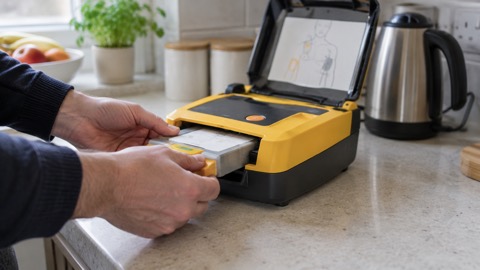 HeartSine Pad-Pak
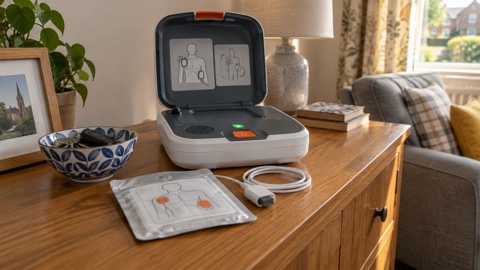 Stryker LIFEPAK CR2
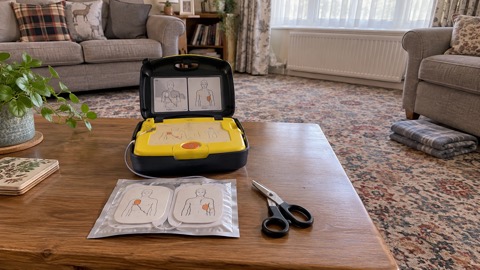 ZOLL AED 3 Defibrillator
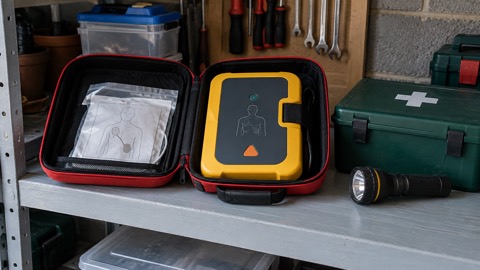 ZOLL AED Plus Defibrillator
 Cardiac Science Powerheart G5
 Philips HeartStart FRx AED
 LifeVac Anti-Choking Travel Kit
 Wallace Cameron Family Kit
 Burnshield Hydrogel Spray 125ml
 Burnshield Hydrogel Gel 50ml
 EpiPen Adrenaline Auto-Injector