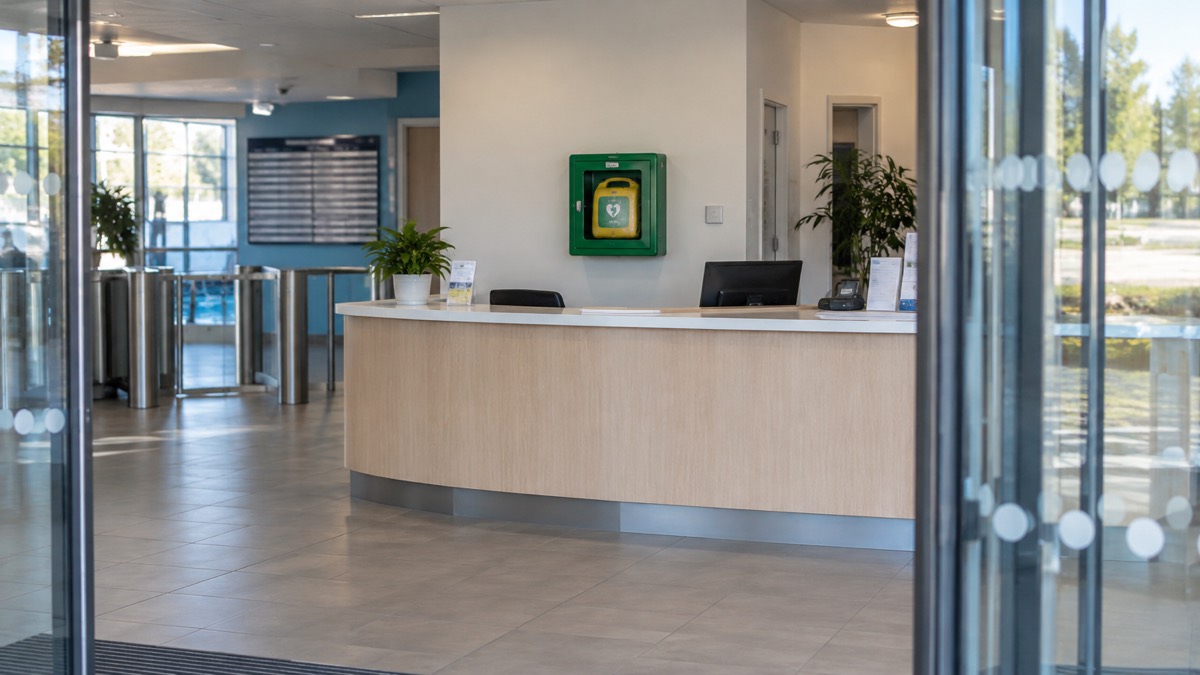
A defibrillator is the piece of kit that can restart a heart that has stopped, and the Mediana A16 semi-automatic AED is one of the models a household, club or village hall might consider keeping on hand. It is a semi-automatic unit: it analyses the heart rhythm, tells you through voice prompts what to do, and then waits for you to press a flashing button to deliver the shock. The maker, Mediana, sells the same A16 platform in both semi-automatic and fully automatic versions, so the choice between them is a real one rather than a fixed feature1.
For a household getting ready for emergencies, the point of an AED is the gap it fills before an ambulance arrives. It is not a substitute for calling 999 or for CPR; it is what you reach for when someone has collapsed and is not breathing normally. The A16 is built to be used by someone with no training: opening the lid starts voice instructions that talk the user through using the device, applying the pads and delivering a shock3. It is rated to IP55, weighs about 1.95kg including the battery but excluding the pads, and runs self-tests daily, weekly and monthly so you can see at a glance whether it is ready1.
This page sets out what the A16 does, how it differs from the fully automatic version, what its specifications mean for where you keep it, and how to store and check it so it works on the day. It does not tell you which defibrillator to buy; it tells you what this one can and cannot do.
A16 and A16 Core HeartOn: semi-automatic or fully automatic
The A16 family comes in two behaviours, and the difference matters most in the seconds after someone collapses. A semi-automatic AED prompts the user to press the shock button; a fully automatic AED uses a countdown or voice commands and delivers the shock without the user pressing a shock button4. The maker lists the A16 as available in both fully and semi-automatic options, and the fully automatic Core HeartOn version is sold with English, Welsh and Polish prompts2.
The trade-off is speed against hesitation. One maker's guidance notes that without the machine's countdown, the operator can press the shock button as soon as they are clear, which can shave a few seconds off the process; the same guidance says that with a fully automatic AED, delivering a shock can take a few seconds longer compared with a semi-automatic AED, because there is a verbal countdown before the shock6. Neither is wrong. A semi-automatic unit gives a calm bystander the chance to check that nobody is touching the casualty before the shock; a fully automatic unit removes the need for that final press, which can help where the person helping is anxious about doing the wrong thing.
For a household, the practical question is who is likely to use it. If the answer is "whoever is in the house, possibly a neighbour or a delivery driver", the semi-automatic A16's spoken prompts and flashing button are designed to carry an untrained person through. If the answer is a workplace where staff may freeze at the critical moment, the fully automatic version removes one decision. The site's comparison of semi-automatic and fully automatic defibrillators sets the two approaches side by side, and the wider guide to choosing a defibrillator for a home, club or village covers the questions to ask before you commit.
Whichever you choose, the A16 is described by the maker as ideal for workplaces, schools or public use, and one supplier lists it as suitable for low-risk workplaces at one kit per 1 to 25 employees, or high-risk workplaces at one kit per 1 to 5 employees2. Those ratios are a starting point for a site risk assessment, not a substitute for thinking about how long it takes to fetch the unit and bring it to the casualty.
Delivering a shock: ready in ten seconds or less
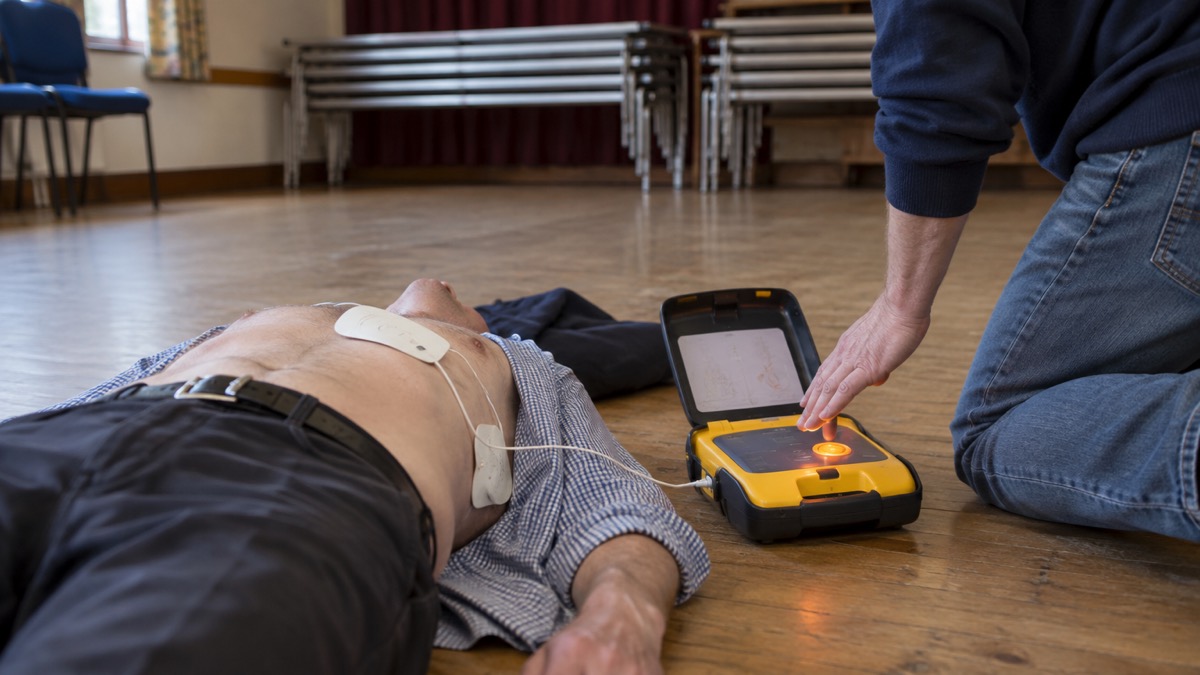
The A16's headline performance figure is that analysis to unit charged and ready takes ten seconds or less1. In a cardiac arrest, every minute without defibrillation reduces the chance of survival, so a short charge time is one of the few specifications that directly affects the outcome. The flashing button then indicates "ready for shock delivery", prompting the user to press the button and deliver shock1.
The sequence a bystander experiences is straightforward. Opening the lid starts the voice instructions, which talk the user through using the device, applying the pads and delivering a shock3. The unit analyses the rhythm, charges, and then either prompts for the button press (semi-automatic) or counts down and delivers (fully automatic). The A16 is also listed with fast shock delivery as a feature2.
Two things affect whether that ten seconds is real in your setting. The first is pad placement: pads must be on bare skin, and for infants or smaller children one pad goes in the middle of the chest and the second on their back, between the shoulder blades7. The second is whether anyone is touching the casualty when the shock is delivered. The machine will prompt, but the person pressing the button is responsible for the final check. Practise the sequence before you need it, using the unit's training mode or a training unit if you have one, and read Defibrillators (AEDs): What They Do and How to Use One for the full routine.
Adult and child mode: one button switches between them
The A16 can change from adult to child mode with one button, and the same one-button switch is described across the range1. That matters because the energy a defibrillator delivers to an adult is not the energy you want for a child, and in an emergency you do not want to be hunting through menus. The unit ships with a set of adult and paediatric pads, so the child setting and the child pads are both available from the box1.
The practical routine for a child is: switch to child mode, apply the paediatric pads as directed, and follow the voice prompts. For infants or smaller children, one pad goes in the middle of the chest and the second on their back, between the shoulder blades7. If you have only adult pads and a child needs help, do not delay: use what you have and follow the prompts, because a shock delivered with adult pads is better than no shock at all. The site's guide to using a defibrillator on a child or baby covers the pad placement in more detail, and Where Do Defibrillator Pads Go? explains the adult positions.
For a household with young children or grandchildren regularly in the house, the one-button switch is one of the A16's more useful features: it means a grandparent or babysitter can move between adult and child mode without training beyond the prompts. Check the pads in the kit at the same time as you check the battery, and replace them when they are out of date or have been opened.
Voice prompts in English, Welsh and Polish
The A16 has three pre-loaded languages: English, Welsh and Polish1. In Wales, that means a bystander who is more comfortable in Welsh can be guided in Welsh, and in communities with a Polish-speaking population, the same applies. The language is selected on the unit, so set it to the language most likely to be needed where it is kept, and note the setting so it can be checked at each inspection.
The voice prompts are backed by a voice prompt, an action icon (LED) indicator and a status LCD1. The A16 also has voice recording functionality, so the prompts and the sounds of the rescue are captured for later review1. That recording is one of the ways the unit supports a debrief after an incident, and it is also why the SD card and the optional event review software matter (see below).
Self-tests and the status display
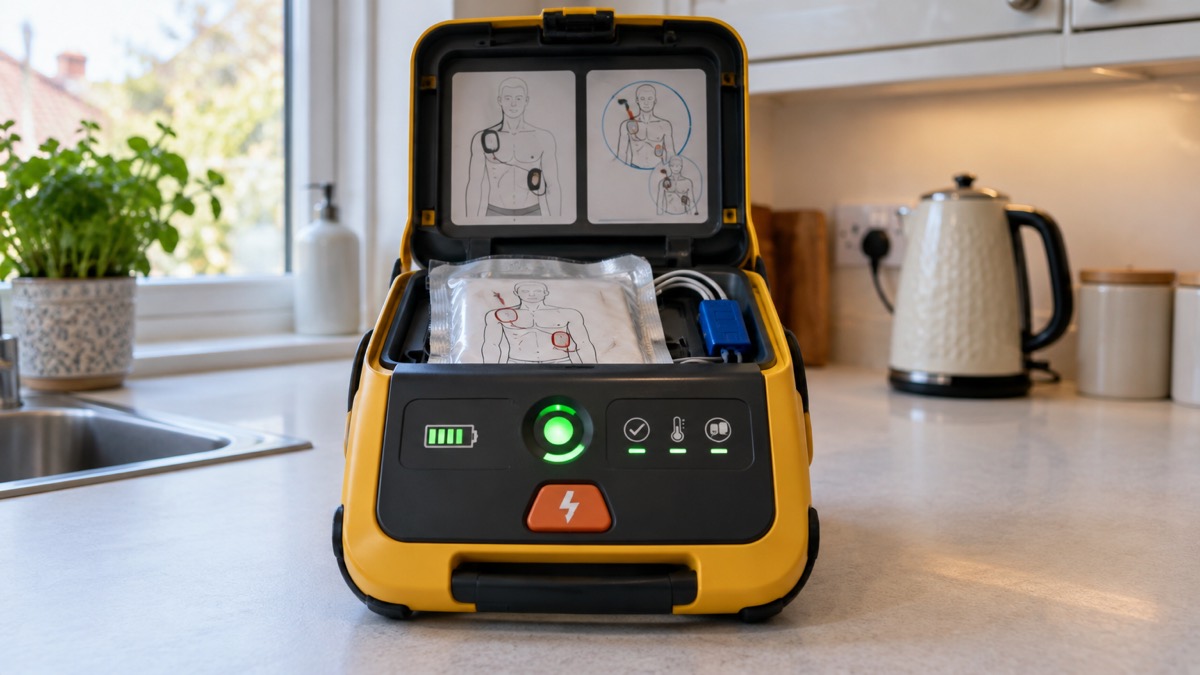
The A16 is designed to be checked at a glance. Its status indicator shows the battery level, self-test (pass or fail), temperature, condition and pads1. The self-test suite includes a power-on self-test, periodic tests (daily, weekly and monthly), a pad quality check and a battery insertion self-test1. The maker also lists a pads quality check as a feature5.
That combination is what makes the unit suitable for a household or a village hall where nobody is a trained technician. The daily routine is to look at the display: if it shows a pass and a healthy battery, the unit is ready. If it shows a fail, a low battery or a pad problem, act on it before the next emergency rather than assuming it will sort itself out. The site's Defibrillator Guardian Checklist sets out a simple schedule for whoever has taken on the checking role, and How Long Do Defibrillator Batteries and Pads Last? explains when replacements are likely to fall due.
The battery is listed as 3000mAh/15V, with a capacity of 200 shocks or six hours of monitoring1. Those figures describe what the battery can deliver, not a promise about how long it will sit unused; the status display is the reliable guide to the state of the battery in your unit. Record the installation date on the battery and on the pads, and diarise a check at the same time each month so it becomes routine.
Specifications: 1.95kg and rated IP55
The A16's physical specifications decide where it can live and how easily it can be carried to a casualty. The table below sets out the figures as listed by the supplier and the maker.
| Specification | Figure | What it means for a household |
|---|---|---|
| Weight | approx 1.95kg including battery, excluding pads1 | Light enough for one person to carry to a casualty |
| Dimensions | H 286.5mm x W 200mm x D 90cm1 | Check the cabinet or shelf size before you buy |
| IP rating | IP551 | Protected against dust and water jets, so suitable for a sheltered outdoor cabinet |
| Drop test | 0.75m on all six sides1 | Survives being knocked off a shelf or dropped at the roadside |
| Battery | 3000mAh/15V, 200 shocks or six hours of monitoring1 | Enough for a prolonged resuscitation attempt |
| Languages | English, Welsh and Polish1 | Set to the language most likely to be needed |
| Guidelines | Meets 2015 AHA / ERC guidelines1 | Check the current guidance when you review your kit |
The IP55 rating is the one to think about hardest. The maker rates the unit to IP551. It does not mean it can be left in a puddle or submerged, and it does not remove the need for a cabinet. The maker states that the unit has been drop tested to 0.75m on all six sides, proving its robustness1.
The dimensions in the supplier's listing are given as H 286.5mm x W 200mm x D 90cm1. If you are mounting the unit outdoors, the site's comparison of indoor and outdoor defibrillator cabinets covers the choice, and the guide to public access defibrillators explains how a publicly accessible unit is registered and found.
Where to keep it, and how to keep it ready
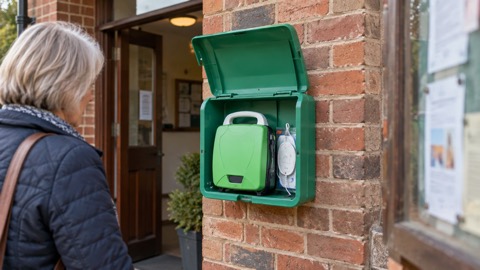
Where you keep the A16 decides whether it is used in time. The NHS ambulance service recommends placing AEDs in a high footfall location, on the outside of buildings in a protective cabinet, so they are accessible by the public on a 24/7 basis4. The Northern Ireland Ambulance Service makes the same point: AEDs stored in visible, secure cabinets are accessible 24/7 and protected from weather and vandalism8. For a household, that means a spot a helper can reach without a key hunt, and a cabinet that keeps the weather off.
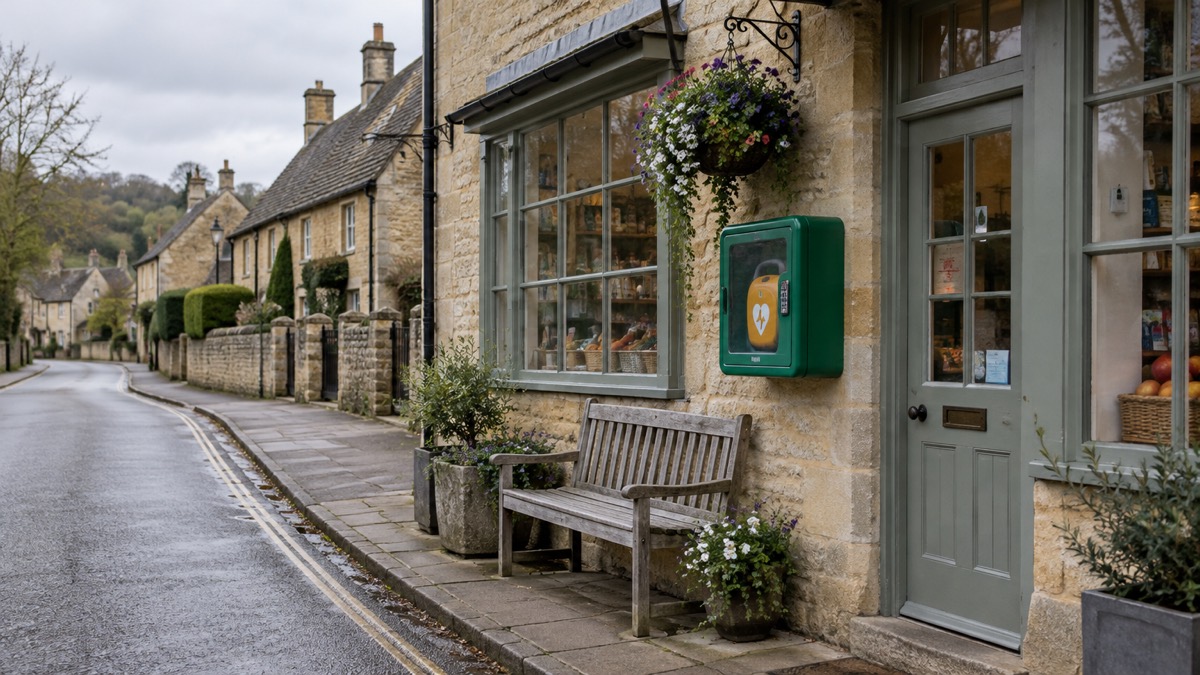
There is a tension in the guidance that is worth naming. Older official guidance says AEDs should be stored in locations that are immediately accessible to rescuers and should not be stored in locked cabinets, as this may delay deployment9. The ambulance service guidance recommends placing AEDs on the outside of buildings in a protective cabinet, accessible by the public on a 24/7 basis4. The resolution in practice is a cabinet whose code is registered with the ambulance service and displayed where a caller can get it, so the unit is both protected and reachable. The site's guide to getting the code for a locked defibrillator cabinet explains how that works.
A simple readiness routine for a household or small site:
- Check the status display at least monthly: battery level, self-test pass or fail, temperature, condition and pads.
- Record the dates on the battery and pads when you install them, and diarise the replacement.
- Set the language to the one most likely to be needed, and note it on the check sheet.
- Keep the manual and the pads with the unit, and check the pads are still sealed.
- Tell people where it is. A defibrillator nobody knows about is a defibrillator nobody fetches.
What comes in the box, ordering and support
The semi-automatic A16 kit is listed as one Mediana A16 semi-automatic AED, one operator's manual, one battery pack, one SD card and one set of adult and paediatric pads1. That is enough to put the unit into service: fit the battery, check the pads, run the self-test and mount it. The SD card is there for the voice recording and event data, and the unit has SD card and infrared communication support1.
One supplier lists the semi-automatic A16 as in stock, with an estimated delivery time of 7 working days from the point of order, shipped free by DX Express, and asks customers to call its contact centre on 0344 871 8000 to order1. If you are buying for a community event or a new season of activity, order with that lead time in mind. The maker's own product pages describe the A16 range as suited to workplaces, schools and public use, and the fully automatic Core HeartOn version is sold as a separate product2.
After a rescue, the A16's voice recording and SD card allow the event to be reviewed, and optional event review computer software is available1. Agree beforehand who will retrieve the card and who will look at the data, and handle it with the same care you would any other record of a medical emergency. The site's information to have ready for the ambulance crew is a useful companion: the crew will want to know what happened, when, and what the defibrillator did.
Using it safely, and where it fits a household plan
An AED is safe to use, but a few rules keep it that way. Do not touch the casualty while the unit is analysing the rhythm or delivering a shock. Do not use the unit on someone who is responsive or breathing normally; it is for a person who has collapsed and is not breathing normally. Do not delay CPR to fetch it. And do not treat the defibrillator as a substitute for calling 999: the ambulance service is still the thing that gets the person to hospital.
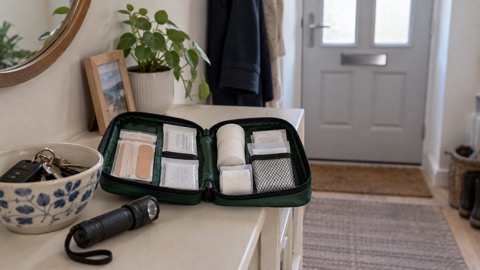
For a household, the A16 fits into the same plan as the rest of your emergency kit. It sits alongside your first aid supplies, your first aid at home arrangements and your emergency kit, and it is checked on the same schedule. If someone in the house has a heart condition, talk to their clinician about whether a home defibrillator is appropriate, and make sure everyone who might be present knows where it is and how to open it. The site's guide to CPR and the primary survey cover what to do in the first minute, before the defibrillator is even open.
The A16 is one option among several. If you are weighing it against other models, the site's product pages for the HeartSine samaritan PAD 350P, the LIFEPAK CR2, the ZOLL AED 3 and the Cardiac Science Powerheart G5 set out what each does, and the comparison of semi-automatic and fully automatic defibrillators helps you decide which behaviour suits your household. What matters most is not the badge on the case but whether the unit is in date, in reach and known to the people who might need it.
Sources (9)
- Mediana A16 semi-automatic AED, Red Cross First Aid Training, 2026-10-29
- Mediana A16 Core HeartOn AED (English/Welsh/Polish) fully automatic, Reliance Medical, 2026-02-25
- AED FAQs, Reliance Medical, 2023
- PAD Information Pack, South Central Ambulance Service NHS Foundation Trust, 2026-08
- Mediana A16 HeartOn semi-automatic defibrillator bundle, Reliance Medical, 2025-03-12
- AED and CPR guidance, CU Europe, 2025-06-03
- How to use a defibrillator, St John Ambulance, 2026-10-28
- Defibrillators | NIAS, Northern Ireland Ambulance Service (NIAS)
- aed.pdf, Resuscitation Council (UK)

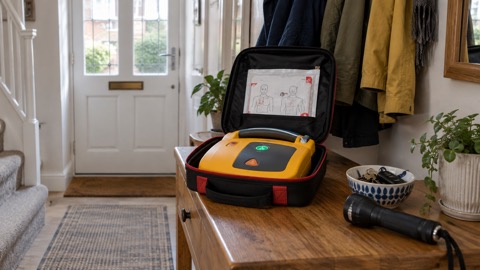 HeartSine samaritan PAD 350P
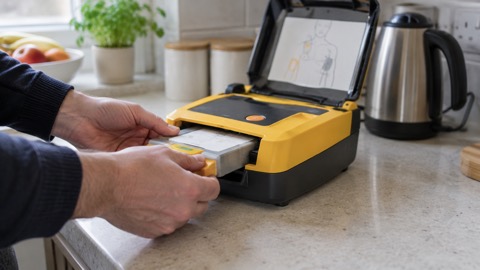 HeartSine Pad-Pak
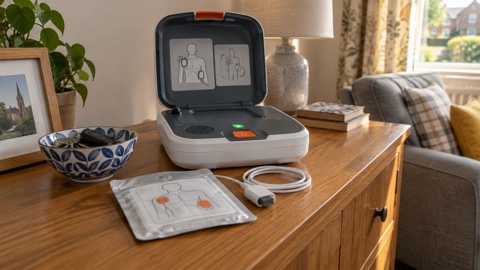 Stryker LIFEPAK CR2
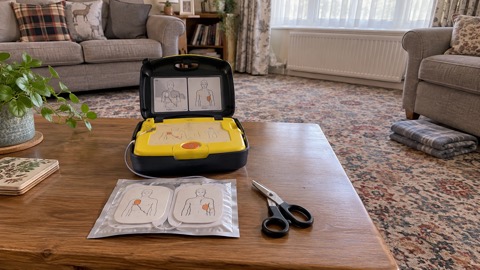 ZOLL AED 3 Defibrillator
 ZOLL AED Plus Defibrillator
 Cardiac Science Powerheart G5
 Philips HeartStart FRx AED
 LifeVac Anti-Choking Travel Kit
 Wallace Cameron Family Kit
 Burnshield Hydrogel Spray 125ml
 Burnshield Hydrogel Gel 50ml
 EpiPen Adrenaline Auto-Injector