Meaco is a British maker of household air treatment appliances: dehumidifiers, portable air conditioners, fans and air purifiers. For a UK household preparing for emergencies, its kit covers two of the situations you are most likely to face at home, a flood or leak that leaves the house damp, and a heatwave that leaves it too hot to sleep in. Its range runs from a 12 litre low energy dehumidifier that also purifies air1, through portable air conditioners that cool, fan, dry and heat a single room2, to a commercial building dryer designed for drying spaces out after a flood or fire3.
This page sets out what each type of Meaco kit does, what the maker's own figures say it can do, and how it fits into the practical steps official guidance gives for floods, heatwaves and power cuts. Where the advice comes from a council, fire and rescue service or the NHS, that is stated, because in an emergency the official instruction is the one to follow. Nothing here is a ranking of Meaco against other makers; it is what Meaco says about its own products, and what official UK guidance says about using that kind of kit.
What Meaco makes for UK households
Meaco's range falls into four groups, each of which has a place in household preparedness.
Dehumidifiers remove water from the air. The household models are the Meaco 12L Low Energy Dehumidifier and Air Purifier1 and the Meaco DD8L Pro4. For heavy drying work there is the Meaco 50Lm-v2 Building Dryer, a commercial dehumidifier designed for use in demanding applications, built in robust metal casing on wheels and castors, with removable handles and both a pushing handle and a lift handle3.
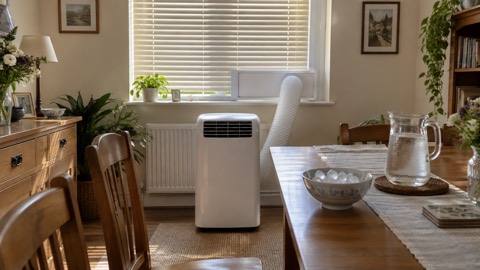
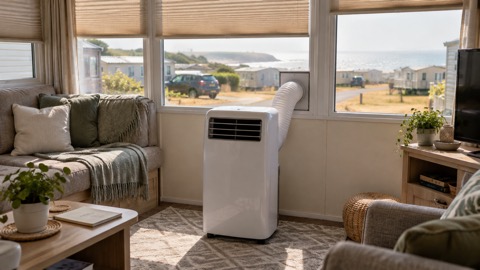
Portable air conditioners cool a single room. The MeacoCool MC Series Pro 10000 CH runs in Cool, Fan, Dry, Sleep and Heat modes with an A energy rating2; the same product page lists the MC Series Pro 9000 CH at 1005 watts2.
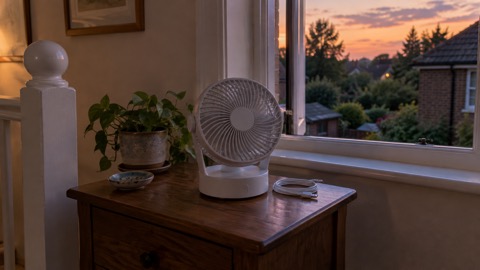
Fans move air around a room. Meaco does not list a standalone fan in the material here, but the MeacoCool air conditioners include a Fan mode among their settings2, and official heatwave guidance treats fans and air conditioning units together as cooling aids6.
Air purifiers clean the air of allergens and dust. Meaco builds purification into the 12L Low Energy model, which comes with a free HEPA filter to remove allergens1.
For a household putting together an emergency kit, the dehumidifier is the piece of Meaco kit most likely to earn its place, because flooding is one of the most common emergencies UK homes face, and drying out afterwards is where a dehumidifier does its work. The air conditioner matters most for heatwaves, particularly for bedrooms and for households with members who struggle in heat.
Dehumidifiers: drying out a damp home
A dehumidifier's job is to pull water out of the air and collect it in a tank, or down a hose if you use continuous drainage. Councils and resilience partnerships across the UK name dehumidifiers as a standard tool for drying a damp home: Wiltshire and Swindon Prepared advises that heating, dehumidifiers and good ventilation can help to dry out your home7, and Runnymede Borough Council says the same three are all very effective in drying out your home8.
The Meaco household dehumidifier in the material here is the 12L Low Energy Dehumidifier and Air Purifier. The maker states it uses just 157 watts of electricity1, which is the figure to bear in mind if you are weighing what it costs to run for long periods. How much water it removes depends entirely on the temperature and humidity of the room, and the maker gives figures for four conditions:
| Room condition | Water removed per day | Power used |
|---|---|---|
| 10 degrees C, 60% RH | 1.62 litres | 138 watts |
| 10 degrees C, 80% RH | 3.94 litres | 142 watts |
| 20 degrees C, 60% RH | 4.92 litres | 157 watts |
| 20 degrees C, 80% RH | 8 litres | 163 watts |
| 30 degrees C, 60% RH | 7.60 litres | 175 watts |
| 30 degrees C, 80% RH | 12 litres | 200 watts |
All figures are the maker's own, from the product page1. The pattern matters more than any single number: a cold room yields a fraction of the water a warm one does, so heating the room, which official guidance recommends alongside dehumidifying7, also makes the dehumidifier work better.
The 12L has a 2.5 litre tank, a continuous drainage option (hose not included), one fan speed with a maximum airflow of 90 m³/h on low speed, a manual louvre, a child lock facility, and a noise level from 41 dB1. It has won a Quiet Mark award, which the maker cites as proof of its quietness1. The Meaco DD8L Pro, a desiccant model with a DC motor and a dust filter, extracts 5.4 litres a day at 20°C and 60% relative humidity on fan speed 29.
Electrical Safety First, the independent electrical safety body, gives two pieces of care advice for dehumidifiers: empty the water tank after each use, where required, and before moving the unit10. For day to day damp, a household model like the 12L is the right scale of machine; for drying out after water gets into the house, read the next section.
Using a dehumidifier after a flood or leak
After a flood or a serious leak, a dehumidifier becomes a recovery tool, and official guidance is specific about how to use it.
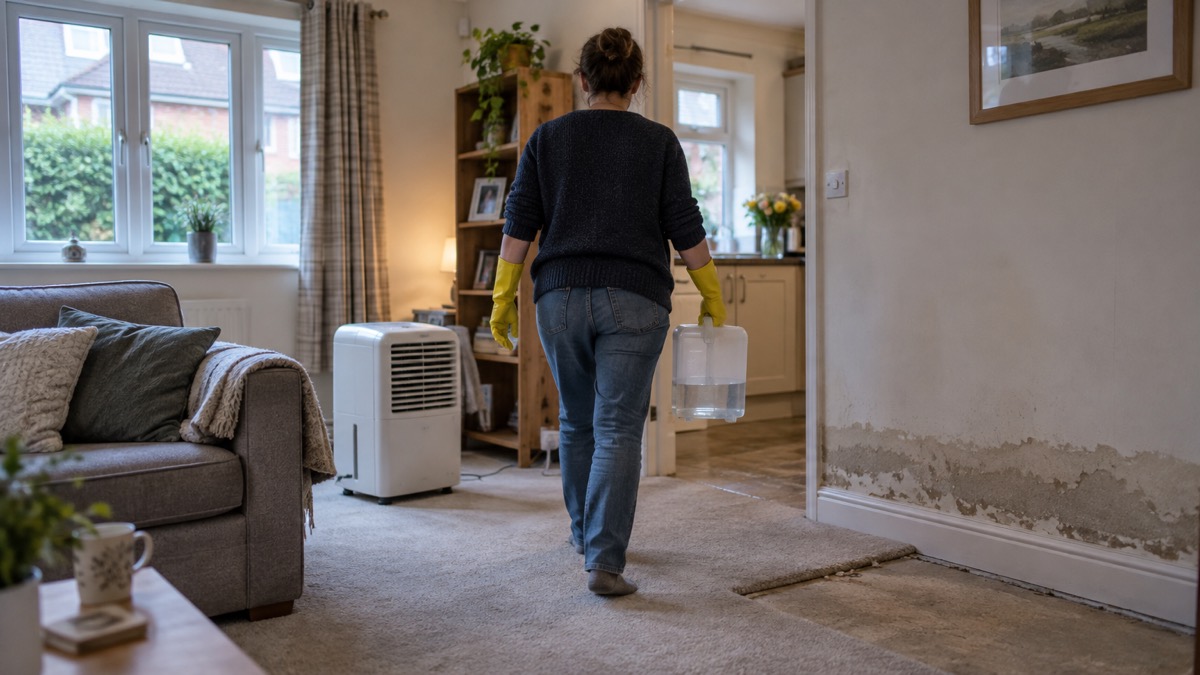
The first rule is about windows. Natural Resources Wales advises that you keep doors and windows open to dry out your property, or use a dehumidifier with the windows and doors closed11. nidirect, the Northern Ireland government service, puts it more firmly: if you use a dehumidifier to remove water from the air in your home, you need to keep external doors and windows shut4. The two approaches are alternatives, not a combination; an open window while the machine runs means you are drying the street.
Second, a dehumidifier dries the air, not the floodwater. Derbyshire County Council's flood clean-up guidance states that dehumidifiers can be used to collect moisture from the air and can aid in drying out a property but should not be used to remove floodwater12. Standing water has to go first, and Lancaster City Council's advice for people cleaning after flooding is to add small amounts of chlorine bleach to standing water, then remove it, along with all debris, soaked and dirty material including wet insulation, residual mud, furniture, appliances, clothing and bedding13.
Third, protect yourself while cleaning and emptying the tank. York Council advises wearing rubber boots, waterproof gloves and an apron14; nidirect adds a face mask, waterproof jacket and trousers and rubber gloves4; and Derbyshire advises wearing face masks and eye protection when emptying the dehumidifier tank, with the collected water disposed of down regular drains and sinks12.
For scale, this is where the Meaco 50Lm-v2 Building Dryer fits. The maker describes it as a commercial dehumidifier for use in demanding applications, including drying spaces out after a flood or fire, building restoration, product storage and commercial uses3. It uses a rotary compressor to increase efficiency, has hot gas defrost for low temperature use, and a washable filter3. Its extraction figures, again from the maker3:
| Room condition | Water removed per day | Power used |
|---|---|---|
| 10 degrees C, 60% RH | 10.2 litres | 394 watts |
| 10 degrees C, 80% RH | 13.5 litres | 401 watts |
| 20 degrees C, 60% RH | 16.6 litres | 472 watts |
| 25 degrees C, 80% RH | 30.7 litres | 570 watts |
| 30 degrees C, 80% RH | 49.6 litres | 655 watts |
Its tank is 5.5 litres with a water tank full indicator, and it has a continuous drainage option3. Note that even this machine extracts far less in a cold house than a warm one, which is why councils pair dehumidifiers with heating7.
A few practical points from official guidance round this out. Nottinghamshire City Council confirms it does not supply dehumidifiers after flooding and that you can obtain them from hire centres15, so hiring a building dryer rather than buying one is a normal route after a flood. Devon's flood recovery leaflet advises opening windows to aid ventilation and using dehumidifiers16, and Scottish Borders Council lists fans, air conditioning units and dehumidifiers as aids to the drying process17. North Yorkshire Fire and Rescue Service notes that after a fire you can hire dehumidifiers, which will remove water from the atmosphere, since firefighting leaves homes wet18. nidirect advises that a dehumidifier may be useful to help with drying out your home quickly when children are about19, and Warwickshire Council advises checking for signs of water damage, like dampness or mould, and consulting experts for mitigation and repair20.
Fans: keeping cool in hot weather
Official heat advice in the UK treats fans as one of the basic tools for keeping cool. NHS guidance from Guy's and St Thomas' says to use fans and air conditioning units if they are available for you6, and Derbyshire County Council advises ensuring adequate ventilation21. Oxford Health NHS Foundation Trust's weather safety guidance keeps it simple: try not to get too hot22.
Fans work by moving air over your skin rather than cooling the room, so where you point them and when you run them matters as much as the fan itself. The government's Beat the Heat checklist for keeping cool at home advises shading or covering windows if possible23, because a fan in a sunlit room is pushing hot air around. The same checklist advises checking that fridges, freezers and fans are working properly before hot weather arrives, for example by checking that your food is remaining cold or frozen23, which is a pre-heatwave check worth doing for every cooling appliance in the house, Meaco or not.
Meaco does not list a standalone fan in the material here. Its MeacoCool air conditioners include a Fan mode among their settings2, so one machine covers both needs: fan-only for ordinary warm days, full cooling when the heat builds. For the broader steps, see our heatwaves and drought guide.
Portable air conditioners: cooling a room in a heatwave
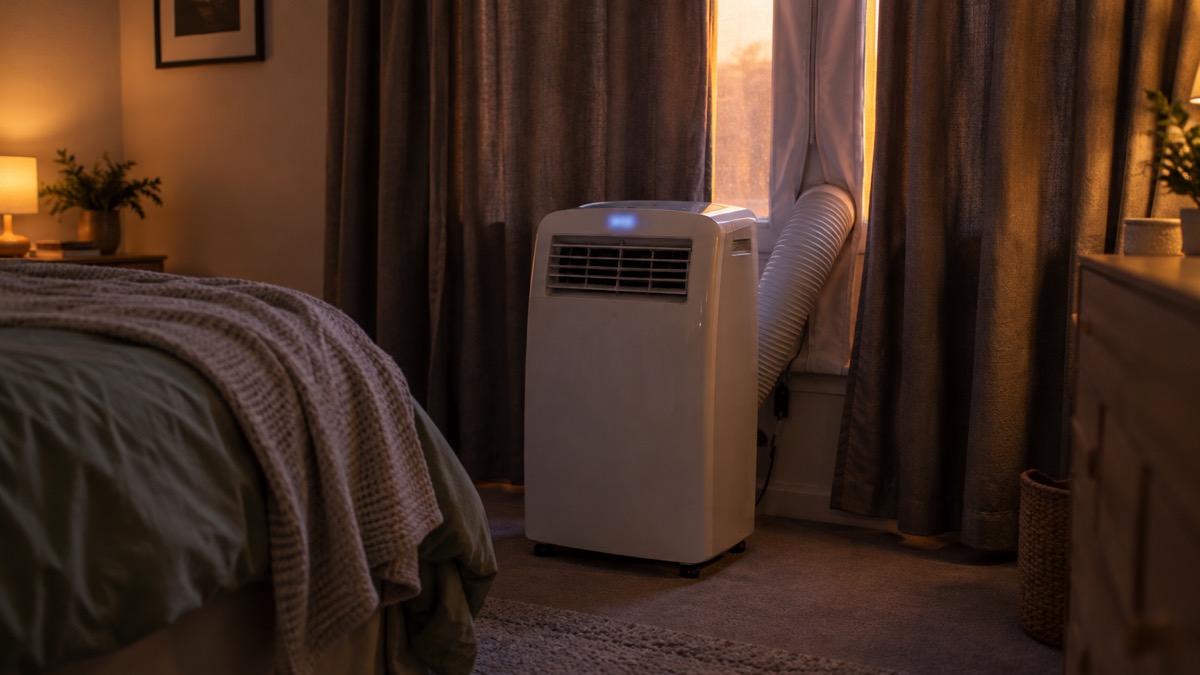
A portable air conditioner actually lowers the temperature of a room, rather than just moving air, and in a heatwave that difference matters most in the bedroom and for people whose health suffers in heat. NHS guidance from Guy's and St Thomas' advises using fans and air conditioning units if they are available for you6, and for heat exhaustion it advises moving to a cooler place such as a room with air conditioning or somewhere in the shade6. West Yorkshire Prepared advises keeping rooms cool by using shades or reflective material outside the windows, and if that is not possible, using light-coloured curtains and keeping them closed, noting that metallic blinds and dark curtains can make the room hotter24.
The MeacoCool MC Series Pro 10000 CH is the model detailed in the maker's material. It runs in Cool, Fan, Dry, Sleep and Heat modes, has an A energy rating, and draws 1120 watts in cooling, with heating power consumption of 999 watts2. The same page lists the MC Series Pro 9000 CH at 1005 watts2. The Dry mode means it can act as a dehumidifier as well as a cooler, which is useful in the muggy conditions that often accompany UK heatwaves.
The maker's own usage advice is to pre-cool rooms, such as your bedroom, so that the room is cool before you use it, using the timer or the Meaco App2. This is the practical way to use a portable unit: cool the room ahead of the hot part of the day or before bedtime, rather than trying to cool it once it has already heated through. Pair this with the official steps above, shading windows and closing light curtains24, so the machine is not fighting the sun.
*A portable air conditioner pre-cooling a bedroom before a hot night, with the window shaded.]
Power draw is the thing to plan around. At 1120 watts2, an air conditioner is a heavy load compared with a dehumidifier at 157 watts1, which matters if you are thinking about backup power for outages during a heatwave. For the health side of hot weather, see our heatwaves and drought guide.
Air purifiers: cleaner air indoors
Meaco's approach to air purification is to build it into a dehumidifier rather than sell it as a separate machine. The Meaco 12L Low Energy Dehumidifier and Air Purifier cleans the air with a free HEPA filter to remove allergens1. Its filter set is a washable dust filter with the option to include a HEPA filter, and it has no ioniser1. It offers Air purification, Continuous and Defrost modes1.
For a household, this means one machine doing two jobs: drying the air and filtering it. That is worth knowing during the situations this site covers, because the times a home's air is worst are often the times a dehumidifier is already running, such as after a flood, when dust and particles are stirred up by cleaning and drying work. Having the air cleaning and the water removal happening in the same unit at the same time means there is one less thing to set up and watch over when a household is already busy coping with the aftermath.
The 12L's other specifications carry over from the dehumidifier section: 41 dB noise from, one fan speed, 90 m³/h maximum airflow on low speed, a manual louvre and a child lock1. It is rated by the maker at 4.8 out of 5 stars based on 161 reviews1, a maker's own figure, not an independent test.
Running Meaco kit safely during an emergency
Meaco's appliances are mains-powered, so in any emergency the first question is whether you have power, and the second is whether the kit is safe where it stands.
Electrical safety comes first. The Scottish Fire and Rescue Service notes that you will typically need the model name or number, serial number and purchase date to register an appliance25. Cornwall Fire and Rescue Service points to the Register My Appliance website, which makes it easy to register all of your electrical products, and notes you will need the brand name, model, serial number and purchase date5.
If an emergency means leaving your home, your appliances are not the priority, but your grab bag is. Official guidance on emergency kits is consistent across England, Wales and Scotland: Lincolnshire advises including a first aid kit and pet care items if required, and sturdy leashes, harnesses or carriers so you can move your pets safely26; Neath Port Talbot Council advises keeping suitable clothes and baby and pet supplies at home in the event of an emergency27; and the Scottish Government's Ready Scotland kit advice includes a first aid kit and a spare walking stick or any mobility devices you need28. Our emergency kit guide sets these out in full, and households that need extra support should read our extra help guide.
For the appliances themselves during an emergency, the maker's own instructions govern: the 12L's child lock facility1 matters if small children are around during a flood clean-up, and the 50Lm-v2's wheels, castors and handles3 are how you move a heavy dryer between rooms without lifting it full of water. Electrical Safety First's rule of emptying the tank before moving the unit10 applies to every dehumidifier here.
What to do in a power cut
A power cut stops every Meaco appliance in the house at once, so it is worth knowing what to do before and during one.
West Yorkshire Prepared's power cut advice covers both. Beforehand: keep a mobile phone charged and write down important phone numbers, and if you get advance notice, fill a flask with hot water and make up a hot water bottle, back up work and important files, and switch off appliances that could pose a hazard29. During: if it is a localised power cut, stay with friends or relatives until your power is back on, leave a light on so you know when your power comes back on, and check on vulnerable neighbours or family29. Their kit list for power cuts is a torch and spare batteries, a wind up or battery-powered radio tuned into local news or a car radio, a power bank or solar charger, an analogue phone, warm clothes and blankets, and non-perishable food29.
For storms that may bring power cuts, West Yorkshire Prepared also advises having a battery powered radio and a torch with extra batteries to hand, keeping mobile phones and laptops charged, and knowing where your utility points are24.
After the power returns, Lancashire Prepared notes that you may need to reprogramme many of your electronic devices30. For Meaco kit that means checking the mode, timer and humidity or temperature settings before you assume the machine has carried on where it left off, particularly if you use a timer to pre-cool a bedroom2 or run a drying cycle overnight.
Because dehumidifiers and air conditioners draw anything from 157 watts1 to 1120 watts2, running them from backup power is a serious planning question rather than an afterthought; our backup power guide and power cuts guide cover what a household can realistically support.
Support and warranty
Meaco's warranty terms, from its own product pages, are consistent across the range. The Meaco 12L Low Energy Dehumidifier comes with a two year parts and labour warranty, with the option to extend it to five years1. All Meaco portable air conditioners come with a two year parts and labour warranty, with the option of extending it to five years2. The Meaco 50Lm-v2 Building Dryer comes with a two year parts and labour warranty3.
To make a claim or get support, you will need the same details registration needs: the model name or number, the serial number and the purchase date25. Keep the receipt with a note of those details, and registering the appliance5 means the maker can contact you directly if a fault emerges.
For consumables, the 50Lm-v2's filter is washable rather than replaceable3, and the 12L uses a washable dust filter with the option of a HEPA filter1. The Drinking Water Inspectorate's general guidance on equipment, in the context of private water supplies, is to replace filters, lamps and filter media according to the manufacturer's instructions31; the same principle applies here, so follow the replacement schedule in your Meaco handbook rather than a rule of thumb.
Safety notices and recalls
No Meaco recall appears in the material here, but the system for catching one is worth knowing, because it is how a fault in any appliance reaches you.
The Office for Product Safety and Standards issues recalls and alert notices on its website, as London Fire Brigade explains32. Cheshire Fire and Rescue Service advises checking for recalls or safety notices on the Electrical Safety First website33, and Electrical Safety First itself publishes dehumidifier safety advice, including the tank-emptying rule quoted above10. Registering your electrical items with the manufacturer means you can be informed of any safety recalls, so a registered appliance is one the maker can reach if a fault comes to light.
If a safety notice does affect a Meaco appliance you own, follow the notice's instructions, stop using the machine, and contact the maker with your model and serial number25. For the wider electrical safety picture in the home, see our home emergencies guide.
Sources (32)
- Meaco 12L Low Energy Dehumidifier and Air Purifier product page, Meaco, 2026-10-29
- MeacoCool MC Series Pro 10000 CH portable air conditioner product page, Meaco, 2026-10-29
- Meaco 50Lm-v2 Building Dryer product page, Meaco, 2026-10-29
- After a flood: clearing up, nidirect, 2026-05-06
- Register your appliance, Cornwall Fire and Rescue Service, 2026-10-29
- Heatwave advice, Guy's and St Thomas' NHS Foundation Trust, 2026-06
- Flooding and health: safely cleaning your home, Wiltshire and Swindon Prepared, 2026-10-25
- Flooding aftercare, Runnymede Borough Council, 2026-10-26
- Dehumidifier safety advice, Electrical Safety First, 2026-10-25
- What to do after a flood, Natural Resources Wales, 2026-10-29
- Cleaning up and returning home after flooding, Derbyshire County Council, 2026-10-29
- Be prepared: flooding advice, Lancaster City Council, 2026-10-26
- Flood advice, City of York Council, 2026-10-29
- After a flood: further support, Nottinghamshire City Council, 2026-10-29
- Flood recovery information leaflet, Devon County Council, 2026-01-29
- Flooding advice, Scottish Borders Council, 2026-10-29
- Steps after a fire, North Yorkshire Fire and Rescue Service, 2026-06-17
- Keeping children safe during a flood, nidirect, 2025-12-09
- Dealing with the aftermath of a fire, Warwickshire County Council, 2026-10-29
- Keeping cool, Derbyshire County Council, 2026-10-29
- Weather safety guidance, Oxford Health NHS Foundation Trust, 2026-09-18
- Beat the heat: keep cool at home checklist, UK Government, 2026-07-21
- Severe weather advice, West Yorkshire Prepared, 2026-10-29
- Electrical safety at home, Scottish Fire and Rescue Service, 2025-02-27
- Get help and advice in an emergency, Lincolnshire County Council, 2026-10-29
- NPT Prepared emergency kit checklist, Neath Port Talbot County Borough Council, 2026-10-29
- Emergency kit, Ready Scotland, 2026-10-22
- Power cuts, West Yorkshire Prepared, 2026-10-29
- Loss of essential services, Lancashire Prepared, 2026-10-29
- Protecting your private water supply, Drinking Water Inspectorate, 2026-10-28
- Electrical items in the home, London Fire Brigade, 2026-10-25
- Electrical fire safety: white goods, Cheshire Fire and Rescue Service, 2026-05-20
 MeacoFan Sefte 8" Portable Battery Air Circulator
 Meaco MC Series Pro 9000 CH Portable Air Conditioner
 Meaco MC Series Pro 10000 CH Portable Air Conditioner