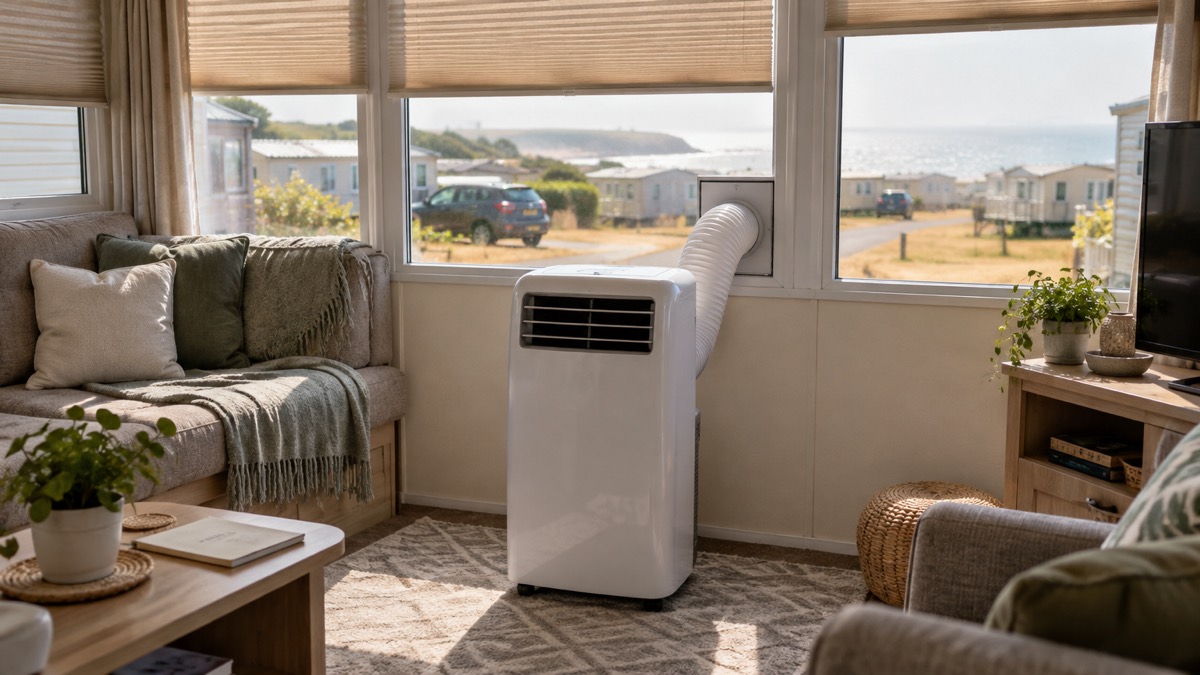
A portable air conditioner is not the first thing most households put in an emergency kit, but in a long heatwave it can be the difference between one cool room and none. The Meaco MC Series Pro 10000 CH is a freestanding unit from Meaco that needs no professional installation: you wheel it in, vent the warm air out of a window and plug it into an ordinary socket1. For a household preparing for hot weather, that makes it a piece of kit you can store, bring out when a heat-health alert is issued and put away again.
What it does is narrow and useful. It cools, dehumidifies and, on the CH models, heats, so the same unit has a role in winter if the central heating fails2. It draws on the ordinary 220-240V / 50Hz mains supply and carries an A energy rating2. It is not a whole-house solution and it will not run indefinitely on a battery, but it gives one room somewhere to retreat to.
This page sets out what the unit can and cannot do for a household getting through an emergency, the specifications that decide how you use it, how to set it up and vent it, how to run it safely, and what support and warranty you can expect. It does not cover price, and it does not rank the unit against others.
What the Meaco MC Series Pro 10000 CH does for a household
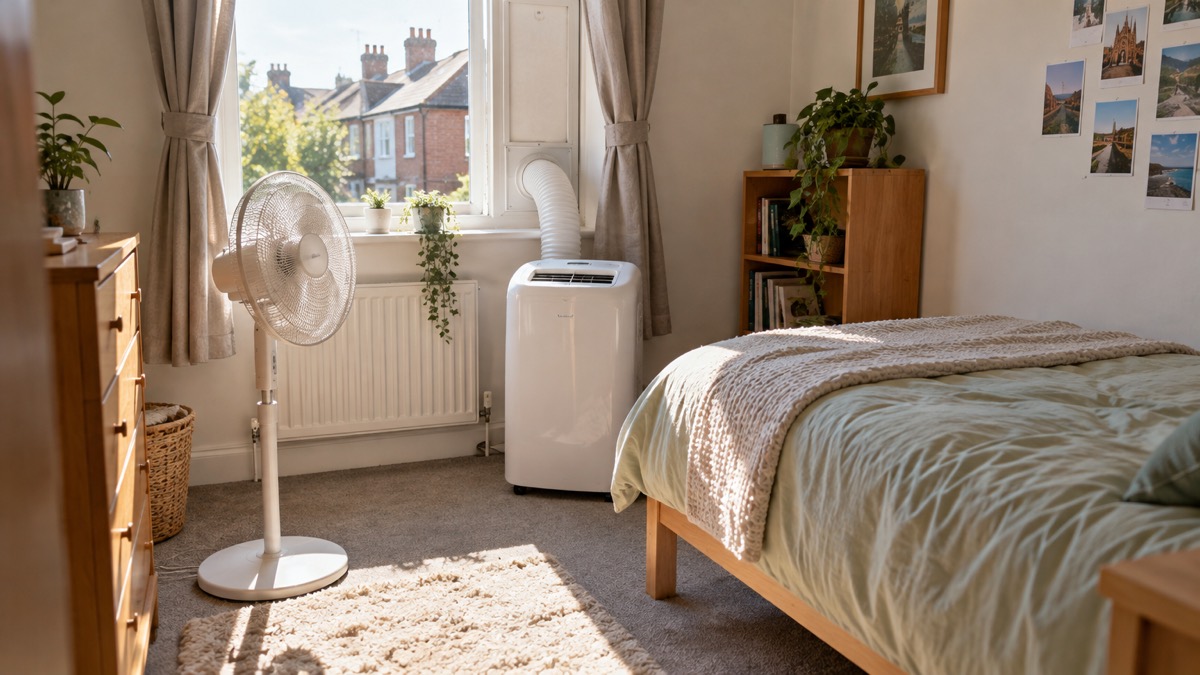
Think of the unit as a single-room resilience tool rather than a comfort appliance. In a heatwave, the rooms that matter are the ones where people sleep and where anyone frail spends the day. A portable air conditioner can cool or precool a room, and Meaco's own advice is that it works best alongside air movement: the maker recommends using a portable air conditioner and a MeacoFan Air Circulator together so cooler air is moved around more evenly on hot days3. If you already keep a fan for power cuts, the two are meant to be used as a pair.
The CH suffix matters for preparedness. The unit offers Cool, Dry, Fan and Heat modes, with Heat available only on the CH models, and Sleep Mode available through the remote control2. That means the same box that cools a bedroom in July can heat a room in a winter gas failure, and can act as a dehumidifier above 15°C when damp is the problem2. For a household that wants one piece of equipment covering more than one emergency, that spread of modes is the reason to choose it.
It is also genuinely plug-in-and-go. Meaco states that its portable air conditioners do not require professional installation and are freestanding units that you place where you need them1. There is no engineer visit to book, which matters in a heatwave when trades are busy, and no fixed plumbing to freeze or leak. All models include a remote control, so you can switch modes and fan speeds from across the room without moving the unit1.
What it will not do is cool a whole house, run for days from a battery, or replace the basic heat precautions that matter most. Use it as part of a plan that includes keeping your home cool, watching for heat illness and checking on people at risk, not as a substitute for them.
MC Series Pro 10000 CH specifications
The figures below are the maker's own, from the MC Series instruction manual and the Meaco product pages. Where the manual covers the MC Series as a whole, the figure applies to all models in the range.
| Specification | Detail |
|---|---|
| Power supply | 220-240V / 50Hz2 |
| Energy rating | A2 |
| Modes | Cool, Dry, Fan and Heat; Heat only on CH models2 |
| Cool Mode temperature range | 16°C to 32°C2 |
| Dehumidifier use | Above 15°C2 |
| Noise level (low fan speed) | 53dB2 |
| Exhaust duct length | 1.8m / 71″, cannot be extended2 |
| Minimum room size | Not smaller than 4m²2 |
| Clearance required | At least 50cm around the unit2 |
| Included accessories | Duct, duct machine adaptor, duct window adaptor, drainage hose, remote control, spare bung, 2 window kits, window kit screws2 |
| Warranty | Two years from date of purchase2 |
Two of these decide where the unit can live in your home. The 4m² minimum rules out box rooms, cupboards and small utility spaces, and the 50cm clearance means it cannot be pushed flush against a wall or into a corner. Measure the spot before a heatwave arrives, not during one.
The accessories list is worth reading as a checklist. The box includes the duct, both adaptors, the drainage hose, the remote, a spare bung, two window kits and the window kit screws2. Keep them together in one bag with the manual, because a missing window adaptor is the difference between a vented unit and a hot room. Our page on window kits for portable air conditioners explains how they seal the gap.
MC Series Pro 10000 CH and 10000 CH: how the names differ
The naming is where buyers most often get confused, so it is worth being precise about what the documents actually say. The manual covers the MeacoCool MC Series Portable Air Conditioner in 7000 and 10000 BTU versions, and states that Heat is only available on the CH models2. The CH suffix is therefore the marker for the heat function: a 10000 CH has heating, a plain 10000 does not.
The manual does not set out a full side-by-side naming table, and it does not list every model variant. What it does establish is the rule that matters for a household: if you want the unit to double as a winter heater when the gas or central heating fails, you need the CH version. If you only ever intend to use it for summer cooling, the heat function is not part of the specification you are relying on.
For a preparedness purchase, that is the decision. A cooling-only unit is a summer tool. A CH unit is a two-season tool, and the maker's manual confirms it can be used as a heater during the winter months if required2. Check the model name on the box and the receipt before you store it, so you know which one you own when an emergency arrives.
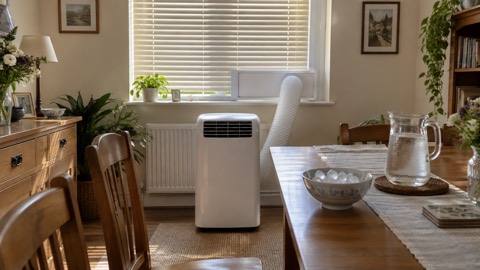
If you are weighing up the size of unit for your space, the 9000 CH model sits alongside this one in the range, and our guide to portable air conditioners explains how capacity and room size relate.
Cooling and heating: what it can handle
In Cool Mode the temperature can be set between 16°C and 32°C2. That range covers a British heatwave comfortably: you are unlikely to want a room colder than 16°C, and the upper end lets the unit run as a fan-assisted cooler when the room is hot but not extreme. Set it a few degrees below the room temperature rather than at the minimum, and let it work steadily.
The mode button scrolls through Cool, Dry, Fan and Heat, with Heat only on the CH models and Sleep Mode available only through the remote control2. In practice:
- Cool for hot days and stuffy bedrooms.
- Dry for humid, sticky weather, and for damp rooms above 15°C.
- Fan for air movement without cooling, useful when the compressor is not needed.
- Heat on CH models for a cold room in winter.
- Sleep via the remote for overnight use.
The maker's advice on pairing the unit with a fan is worth taking seriously. Meaco recommends using a portable air conditioner and a MeacoFan Air Circulator together for maximum comfort and relief in the heat, because the air circulator moves the cooler air around more evenly3. If you keep a battery fan for power cuts, as covered in our guide to the MeacoFan Sefte, the two complement each other: the fan keeps air moving when the power is off, and spreads the cooled air when it is on.
Power use during an outage or on backup power
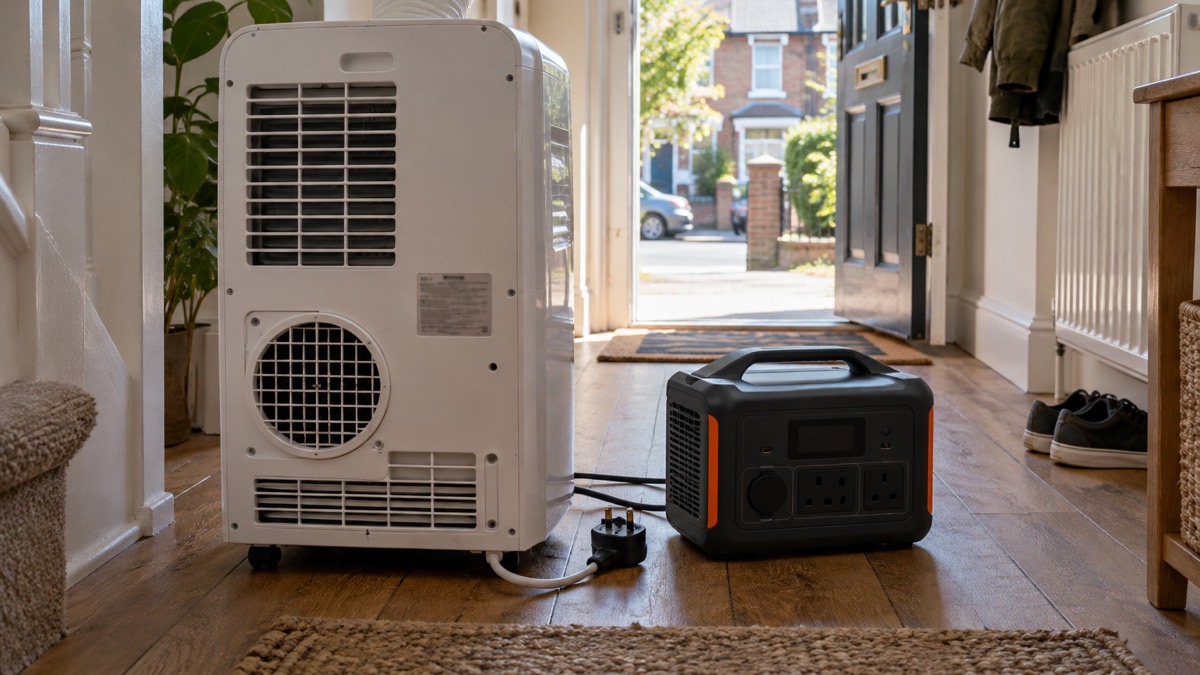
The unit runs on 220-240V / 50Hz mains electricity and carries an A energy rating2. That tells you it is designed for a standard domestic socket, but the manual does not give a running wattage, so you cannot calculate from these documents exactly how long a battery would last. What you can do is plan around the principle: a compressor-driven air conditioner is a high-draw appliance, and a portable power station sized for phones, lights and a fridge is unlikely to run it for long.
For most households the realistic plan is:
- Run the air conditioner on mains power while the supply is on, to precool the room you will use.
- Keep a battery fan charged for the hours when the power is off, as described in our guide to keeping cool during a power cut.
- Treat any battery supply for the air conditioner itself as short-term and check the appliance's rating plate against the battery's continuous output before relying on it.
The unit's memory function helps here. After a power cut it will continue to run on the same setting it was set to before the power cut occurred2, so when the supply returns it picks up where it left off without anyone resetting it. That is useful in an outage that ends overnight.
Setting up the exhaust hose and window vent
A portable air conditioner produces heat as well as cold, and the duct is how the heat leaves the room. Meaco supplies window kits with its portable air conditioners to help vent warm air outside and keep cooler air inside1. The box contains a duct, a duct machine adaptor, a duct window adaptor, two window kits and window kit screws2.
The duct is 1.8 metres long and cannot be extended2. That single figure dictates the layout: the unit must sit within 1.8 metres of the window, with at least 50cm of free space around it on a level surface2. Do not add extra ducting, and do not crush or kink the hose against furniture.
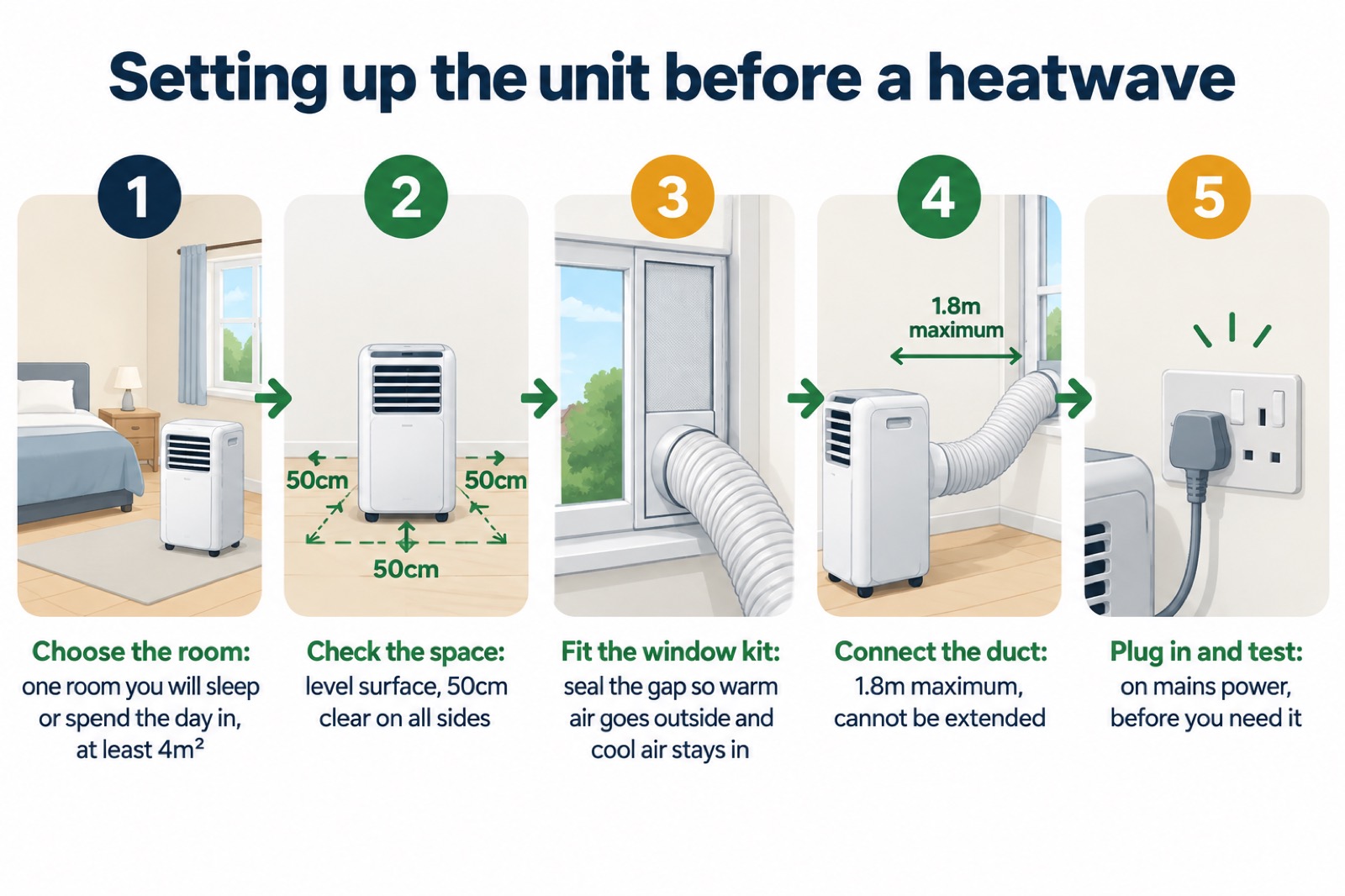
Test the whole set-up on a mild day before summer. Fit the window kit, run the unit in Fan mode, and check that the window still closes securely around the adaptor. Our guide to window kits covers the sealing details, and if you are deciding between this kind of unit and a fixed installation, portable or split air conditioner sets out the trade-offs.
Safe use, draining and storage
The maker's manual gives clear placement rules: a level surface, at least 50cm of free space around the unit for adequate airflow2. Keep curtains, bedding and paper away from the outlet, and do not block the air intake.
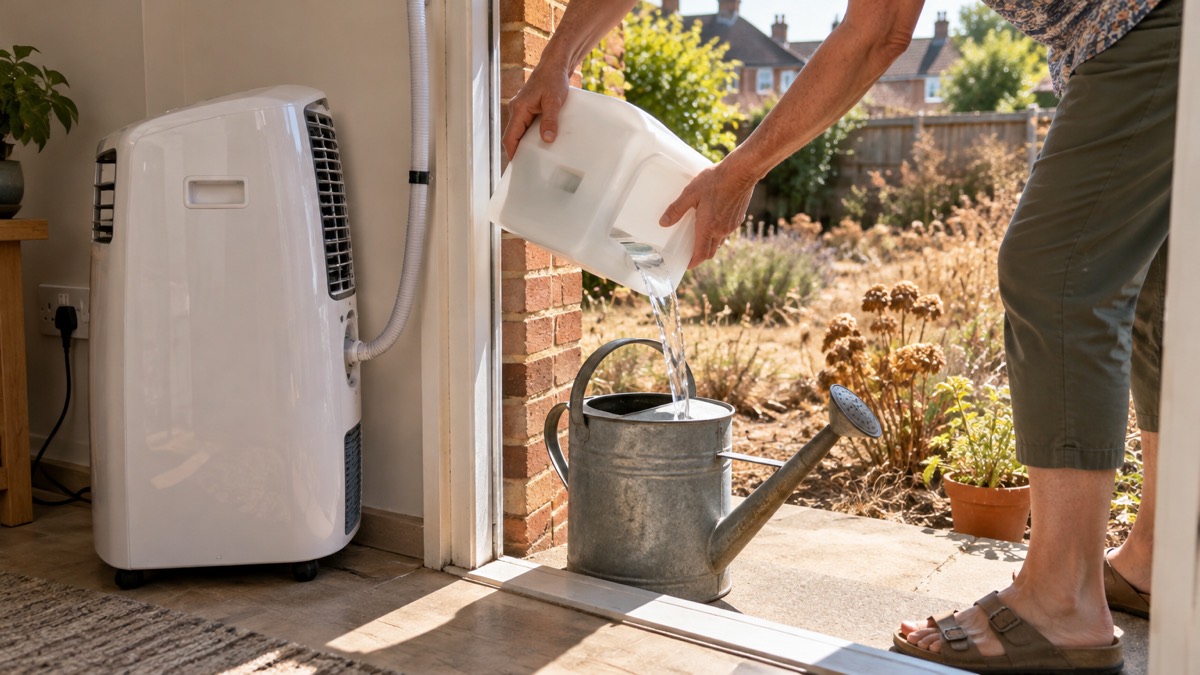
Draining depends on the mode. In Dry Mode or Heat Mode the drainage hose needs to be attached continuously; in Cool Mode it does not need to be attached continuously, but Ft (Full Tank) will appear on the display when the water tank needs draining2. In humid weather, expect to empty the tank more often, and fit the hose before switching to dry or heat.
If the display shows E0, the manual identifies it as a display board error and says to contact Meaco2. Do not keep running a unit that is showing a fault code.
For storage, the same 4m² rule applies to storing as to using2. Keep the unit, duct, adaptors, hose, remote and window kits together in a dry place, and check the maker's pages for any current safety notice before the season starts.
Support and warranty
The manual states that there is a two-year manufacturer's warranty on the portable air conditioner from the date of purchase2. Meaco's product pages describe a market-leading warranty on its portable air conditioners1; where the two differ in wording, the manual's two-year term is the specific figure to rely on.
The warranty has conditions worth knowing before you file the receipt away:
- It excludes damage to the unit's filter, duct, duct adaptors, drainage hose, remote control and window kit, which can be subject to wear and tear2.
- It is only valid on presentation of the original, unaltered and date-stamped purchase receipt2.
That second point is the one households most often trip over. Keep the receipt with the manual and the accessories, in the same bag, so that a claim in a future summer is straightforward. The excluded parts are exactly the ones you handle most, which is another reason to store them carefully.
For support, the manual directs owners to contact Meaco when the E0 display board error appears2. Meaco's own product pages are the place to check for current notices and documentation1. If you are building a wider plan for hot weather, our hot weather preparation checklist and the heatwaves and drought section put the unit in context alongside water, shade and health precautions.
Sources (3)
- Portable Air Conditioners, Meaco, 2026
- MeacoCool MC Series Portable Air Conditioner 7000-10000BTU Instruction Manual, Meaco, 2021
- Air Conditioners, Meaco, 2026

 Meaco MC Pro 9000 CH
 Meaco MeacoFan Sefte