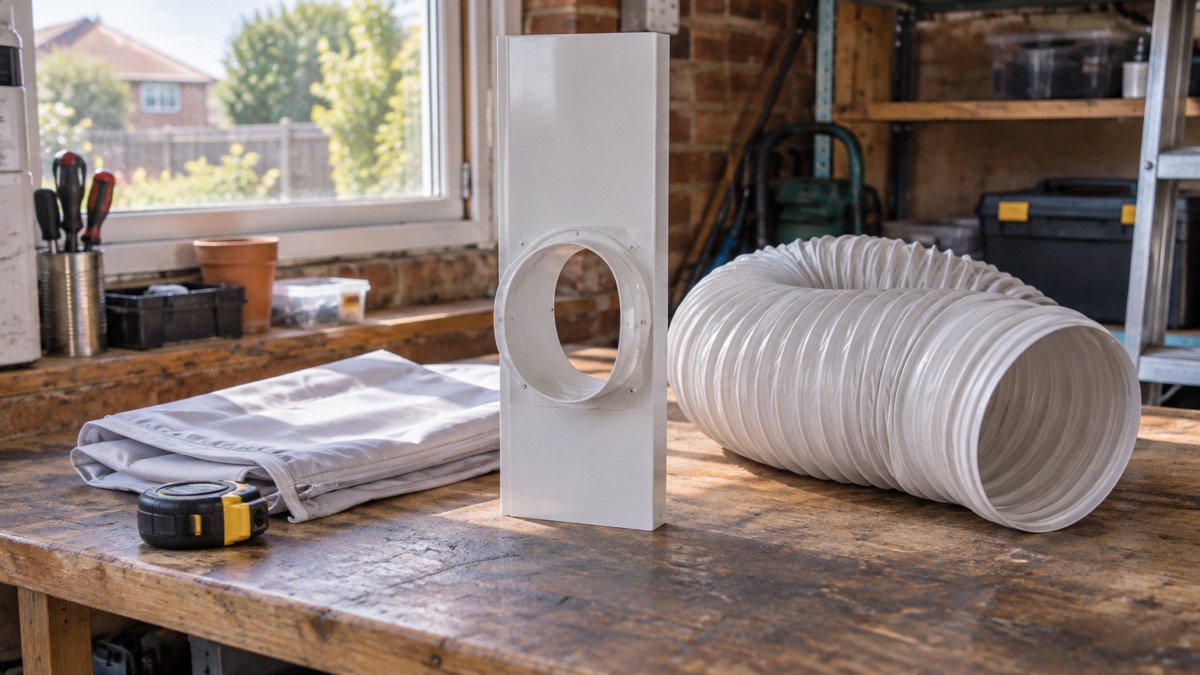
A portable air conditioner is not like a fan. It takes heat out of the room and has to put that heat somewhere, which is why it comes with an exhaust hose. If you simply hang the hose out of an open window, the warm air comes straight back in and much of the cooling is lost. Which? puts it plainly: portable units "need to be properly vented to the outside using a special fitting for the window. If the vent is just put through an open window, it will let heat back in"1. That fitting is the window kit.
A window kit is a panel or a fabric sleeve that fills the gap around the hose, so the window can stay closed against the frame while the hose passes through. The maker of the MeacoCool range states that "the use of a window kit prevents warm air from outside entering the room, making the cooling more efficient"2. Most portable units are sold with one or both types, and the choice comes down to your window.
There are two kinds. The standard kit is a set of rigid plates for sash windows, with a combined length of 170 cm3. The flexible kit is a fabric sleeve that suits all types of windows, up to 39 cm wide and 4 m long2. Measure your opening before you buy, fit the kit so the hose is held securely, and seal the edges. The rest of this page takes each step in turn.
Standard or flexible kit: which one fits your window
The two kits are not interchangeable in the way a plug is. Each is shaped for a different kind of opening, and the right one is decided by how your window opens, not by the size of the room or the power of the unit.
The standard kit is a set of rigid plates that slide into the channel of a sash window, the type that moves up and down. The maker describes it as suitable for sash windows2. The plates stack or overlap to fill the height of the opening, and the hose clips into a hole in one of them. Because the plates are rigid, the window can be closed down onto them, which holds the whole assembly in place and gives a reasonably tight seal.
The flexible kit is a fabric sleeve, usually with a zip or a panel for the hose, that fits into the opening and is held by the window closing onto it. The maker describes it as suitable for all types of windows2. That includes casement windows, which open outwards on a hinge and have no sash channel for a rigid plate. It also suits roof windows, tilt-and-turn windows and openings that are an odd shape or size.
| Kit type | Suits | Size limits | What it does |
|---|---|---|---|
| Standard | Sash windows2 | Plates of 65 cm, 65 cm and 51 cm, total 170 cm3 | Rigid plates fill the opening; window closes onto them |
| Flexible | All types of windows2 | Up to 39 cm wide, up to 4 m long2 | Fabric sleeve fills the opening around the hose |
Some units come with both. The MeacoCool MC Series Pro 9000 CH and the 10000 CH each include one standard and one flexible window kit2. If you are buying a unit, check what is in the box before ordering a kit separately, and check the kit's dimensions against your window rather than assuming it will fit.
Standard window kit: three plates up to 170 cm for sash windows
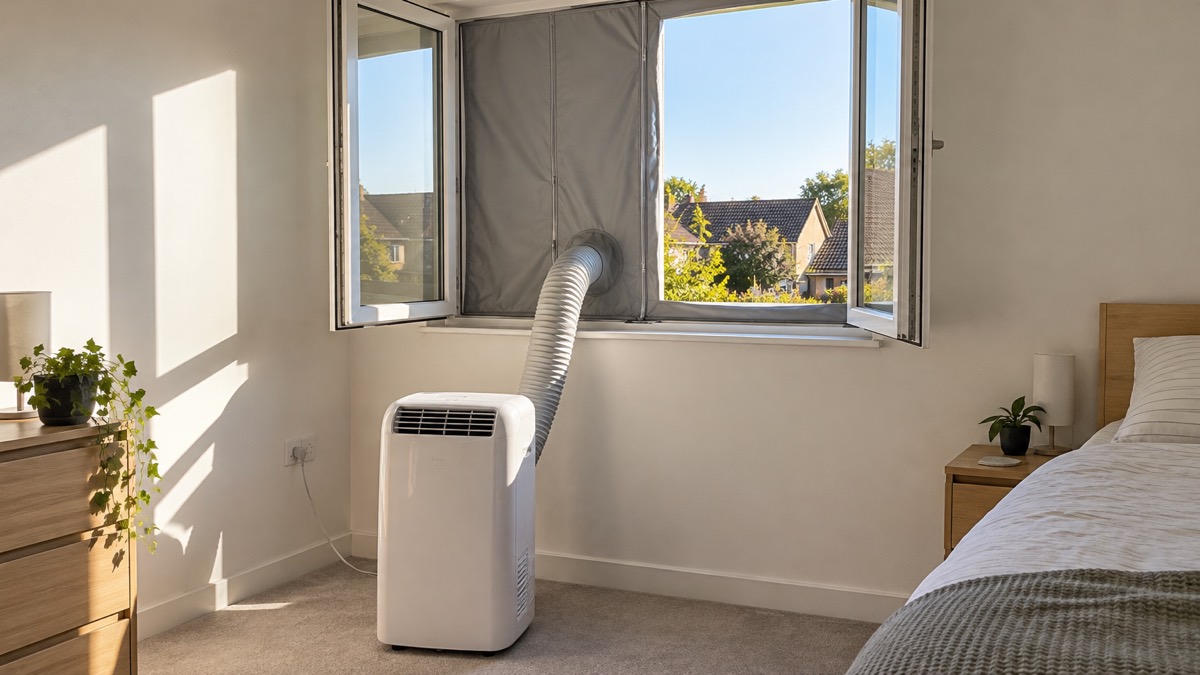
The standard kit is built around three plates. Plate A is 65 cm, plate B is 65 cm and plate C is 51 cm, giving a total combined length of 170 cm3. The plates are designed to overlap or stack so that you can make up the height of your window opening from the available sizes.
In practice you use the combination that comes closest to your opening without leaving a large gap. A tall sash window may take all three plates at full extension. A shorter opening may take two plates, or one plate plus part of another. Plate C, at 51 cm, is the shortest and is the one that gives you fine adjustment at the bottom of the range.
The kit is made for sash windows because the plates need a channel to sit in and a moving sash to clamp them. The lower sash comes down onto the top of the plates and holds them. That is also why the kit is less suited to a door: there is no sash to clamp against.
Before fitting, check the window opens and closes freely with the plates in place. A sash that will not close properly is a security and weather risk, and it also means the kit is not held firmly. If the window is stiff, deal with that first rather than forcing it onto the plates.
Flexible window kit: up to 39 cm wide and 4 m long for any window
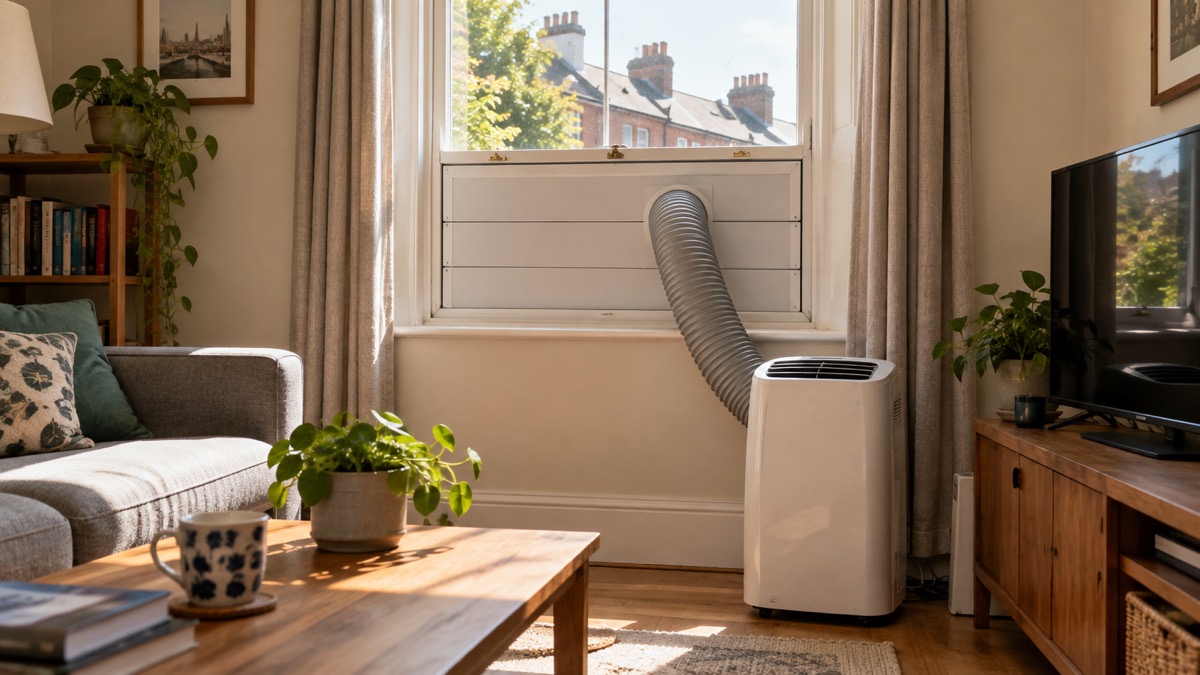
The flexible kit is the more adaptable of the two. The maker gives its dimensions as up to 39 cm in width and up to 4 m in length2. Those are maximums, so the kit can be used on a small opening as well as a large one, and the length allows it to reach across a wide window or a door.
The width figure is the one to watch. At up to 39 cm, the sleeve is designed to cover a relatively narrow band around the hose, not a whole wall of glass. If your opening is wider than that, the kit will cover the centre where the hose passes but leave the sides of the opening exposed. That is where sealing matters, and where a second panel or some careful draught proofing may be needed.
The length of up to 4 m is generous because the sleeve has to span the opening and may need to be gathered or folded. It does not mean the hose is 4 m long. The hose that comes with the unit is separate, and its length is set by the maker. The EcoAir Apollo 12K, for example, includes a 1.5 m exhaust hose in its installation kit6. A longer hose run than the maker supplies can affect performance, so use what comes with the unit unless the maker says otherwise.
Fitting the flexible kit is a matter of opening the window, placing the sleeve so the hose panel sits where you want it, and closing the window onto the sleeve to hold it. Check that the sleeve is not twisted and that the hose is not kinked. A kinked hose restricts the airflow the unit needs to get rid of heat.
Using a standard kit across a sliding door leaves a small gap at the top
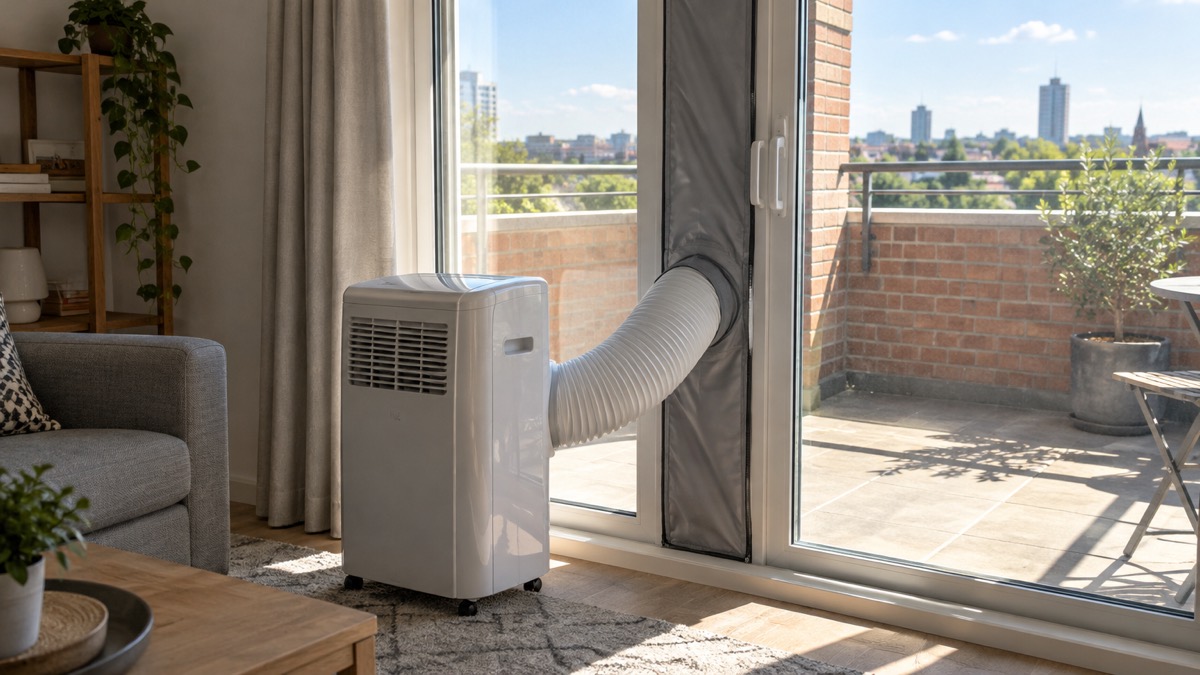
A sliding door is a tempting place to vent a portable unit, because it is large, easy to reach and often in the room you want to cool. The standard kit can be used across one, but the maker is clear that it is not a perfect fit: "if you're trying to cover a sliding door, there will be a small gap at the top (this will not massively affect the performance of the air conditioner)"3.
That is a useful, honest statement. The gap is real, and it will let some warm air in, but the maker's view is that it does not defeat the cooling. The important thing is that the gap is small and at the top, where warm air stratifies, rather than a large opening around the hose. If you use a standard kit on a sliding door, check the top edge and close the gap as far as the kit allows.
The flexible kit is listed as suitable for all types of windows, with a length of up to 4 m2. Either way, the principle is the same: the more of the opening you fill, the less warm air comes back in.
Measuring your window before you order
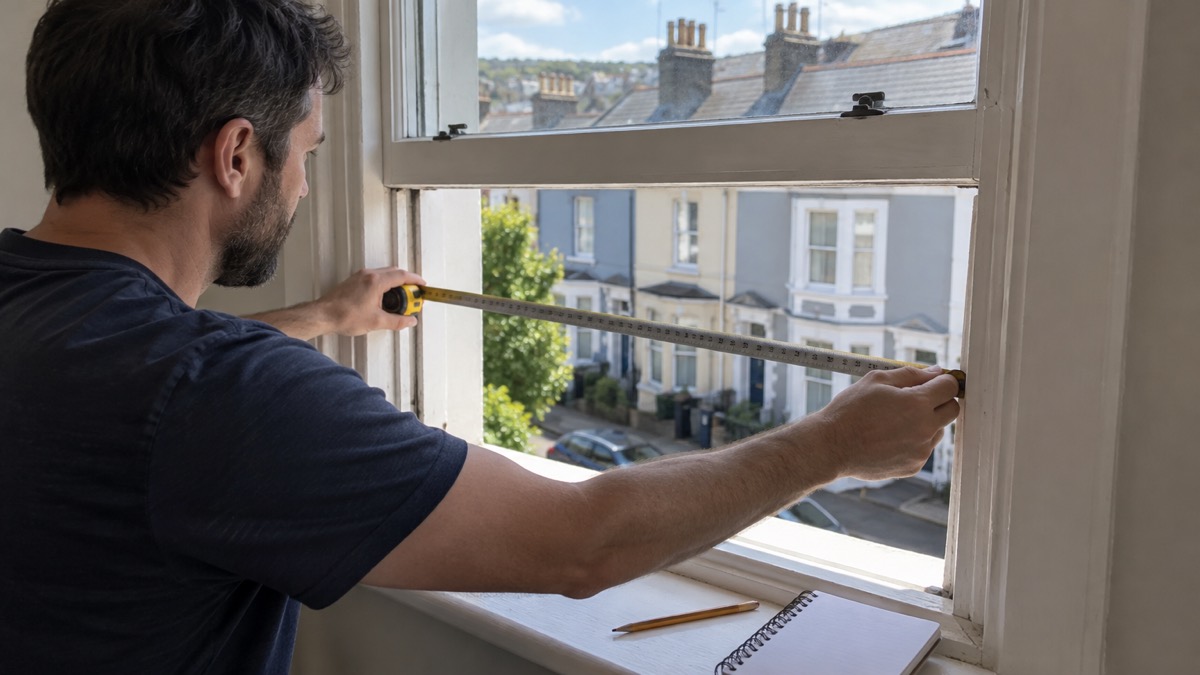
Measure the opening, not the glass, and measure it twice. For a sash window, measure the width of the gap between the sashes and the height you need to cover. For a casement or any other window, measure the widest point of the opening and the length you need the sleeve to span. Write both figures down.
Then compare them with the kit. The standard kit's plates give you 65 cm, 65 cm and 51 cm to work with, up to a total of 170 cm3. The flexible kit gives you up to 39 cm in width and up to 4 m in length2. If your opening is larger than either, the kit will not fill it on its own.
Also check the practical side. A portable air conditioner can draw up to 2000 watts, or up to 9.3 amps, according to Electrical Safety First5. That is a heavy load for a domestic circuit, so plug it directly into a wall socket rather than an extension lead, and do not run it on the same circuit as other high-power appliances. If the plug or socket feels warm, stop using it and have it checked.
Sealing the gaps around the plates
A window kit is only as good as its edges. The plates or sleeve cover the middle of the opening, but the sides, top and bottom can still leak. Which? suggests basic window repair jobs you may be able to do yourself, "such as using caulk or rubber-foam insulation to fix gaps or cracks"4. The same materials work around a kit.
Work around the kit in this order:
- Fit the kit and close the window onto it.
- Feel around the edges with your hand for draughts while the unit runs.
- Fill gaps with caulk or rubber-foam insulation, as Which? describes4.
- Check again, and adjust the kit if it is sitting crooked.
- Make sure you have not covered any ventilation point in the room7.
Do not use expanding foam around a window you may need to open in an emergency, and do not seal a window so tightly that you cannot get out. The NHS advises that windows can be fitted with locks or safety catches that restrict the opening to less than 6.5 cm, to stop babies climbing out8, and that advice still applies with a kit in place. A kit should not defeat a window's safety catch.
Casement windows and other awkward openings
A casement window opens outwards on a hinge. There is no sash channel, so the standard kit has nothing to sit in. The flexible kit is the one to use, because the maker describes it as suitable for all types of windows2. You open the window, place the sleeve so the hose panel sits in the opening, and close the window onto the sleeve as far as it will go.
The difficulty is that a casement window often will not close onto a sleeve in the same way a sash does. The hinge holds the window open at an angle, and the sleeve has to bridge the gap. In that case, the seal will be less tight, and you may need to accept a little leakage or find another window. Do not force a casement window against its hinge or prop it in a way that could let it swing shut.
The same applies to roof windows and tilt-and-turn windows. The flexible kit is the adaptable option, but the fit depends on the window. If the window cannot be held securely with the kit in place, use a different opening or accept that the unit will run less efficiently.
What gaps do to cooling, and how much it matters
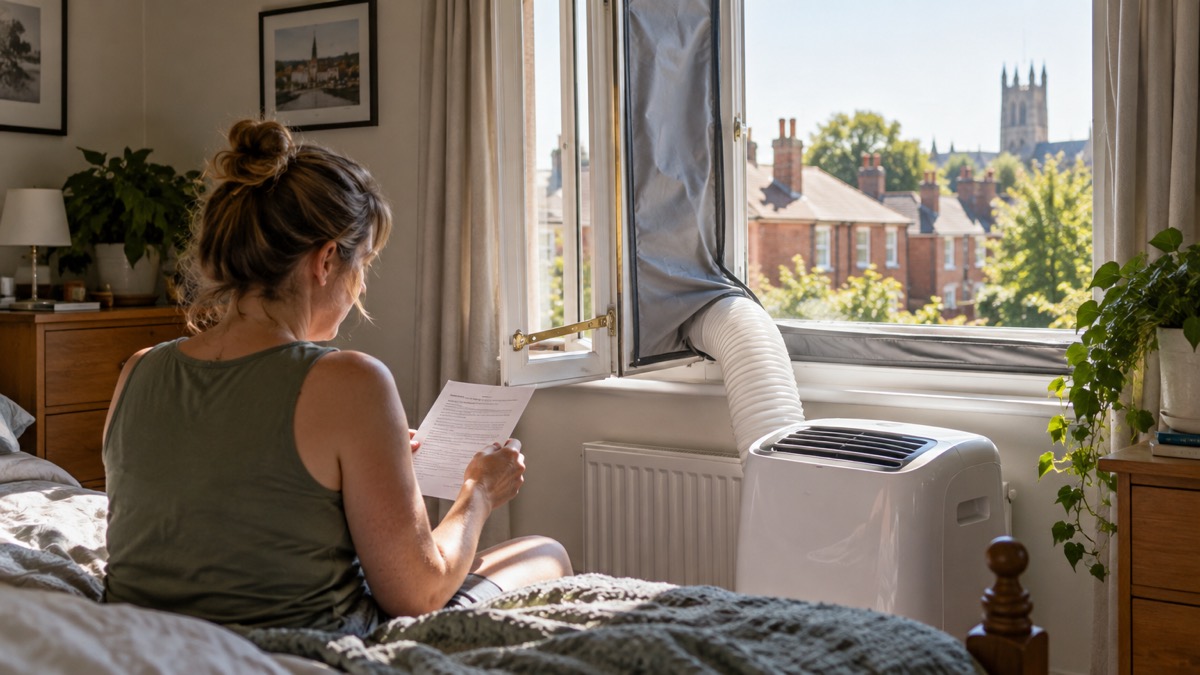
The whole point of the kit is to separate the air the unit is cooling from the air it is rejecting. The maker states that a window kit prevents warm air from outside entering the room, making cooling more efficient2. Which? is blunter: a vent through an open window "will let heat back in"1. A gap around the kit is a small version of the same problem.
How much it matters depends on the size of the gap and the weather. A small gap at the top of a sliding door, which the maker says will not massively affect performance3, is a different matter from an unsealed casement window with the hose hanging out. In hot weather, when the temperature difference between inside and outside is greatest, the penalty for a poor seal is largest.
The practical response is to seal what you can, accept what you cannot, and judge the result by how the room feels. If the unit runs continuously and the room never gets comfortable, the seal is one thing to check, along with the unit's size for the room and whether the hose is kinked. For more on choosing and running a unit, see Portable Air Conditioners: How They Work and How to Choose. If you are weighing a portable unit against a fixed one, Portable or Fixed Split Air Conditioner sets out the differences.
Safety around the unit and the window
A window kit is a simple piece of kit, but it sits between a powerful electrical appliance and the outside. A few rules keep it safe.
- Plug it in properly. A portable air conditioner can draw up to 2000 watts and up to 9.3 amps5. Use a wall socket, not an extension lead, and do not overload the circuit.
- Check for recalls. Electrical Safety First has issued a safety notice for the Pump House Portable Air Conditioning Unit PAC12 and PAH13, describing it as a portable air conditioning unit9. Check any second-hand or older unit against recall notices before use.
- Keep ventilation open. Do not block ventilation points to improve the seal7. A room with a gas appliance or fire needs a permanent air supply.
- Mind the window. Do not defeat window locks or safety catches8, and do not seal a window you might need to escape through.
- Watch the hose. A kinked or crushed hose restricts airflow and can overheat the unit. Keep the run as straight as the kit allows.
Where to get help and what to do next
If you are not sure which kit you need, start with the maker's instructions for your unit. The MeacoCool pages list what is in the box, including one standard and one flexible kit on the 9000 CH and 10000 CH models2, and the EcoAir Apollo 12K page lists its installation kit contents6. The maker's own instructions for your model are the authority on fitting.
For the wider picture, How to Keep Your Home Cool in Hot Weather covers shading, ventilation and the times of day to keep windows closed. How to Stop the Sun Heating Your Rooms Through the Windows deals with the glass itself. If you are still deciding whether an air conditioner is the right choice, Electric Fan or Portable Air Conditioner: Which Suits Your Home? compares the two.
Keep a note of your window measurements and your kit's limits somewhere you can find them. When a hot spell is forecast, you want to be fitting the kit in daylight, not hunting for the plates in a dark loft. A spare set of keys for your windows, kept with your emergency kit, is also worth having10.
Sources (10)
- How to keep your home cool in hot weather - Centre for Sustainable Energy, Centre for Sustainable Energy
- MeacoCool MC Series Pro 9000 CH, Meaco, 2026-10-29
- MeacoCool MC Series Pro 10000 CH, Meaco, 2026-10-29
- Storm damage: how to protect your home from a thunderstorm, Which?, 2026-10-21
- Ratings of electrical appliances, Electrical Safety First, 2026-10-25
- EcoAir Apollo 12K, EcoAir, 2026-10-29
- Cold weather, Public Health Wales, 2026-06-16
- Baby and toddler safety, NHS, 2026-02-19
- Pump House Portable Air Conditioning Unit PAC12 and PAH13, Electrical Safety First, 2026-10-29
- Planning for an emergency kit, Wiltshire Council, 2026-10-29
 Baby and Child Hot Weather
 Hot Weather Preparation
 Flood Warning Checklist
 Baby's Room Temperature
 Child Dehydration Signs
 Fans in Very Hot Weather
 Signing Up for Heat Alerts
 Heat Rash
 Calling 999 for Heat Illness
 How Much Water to Drink
 Keeping Cool in a Power Cut
 LPG Tank Safety in Hot Weather
 Medicines and Heat Risk
 New Build Overheating
 Checking On Older Neighbours