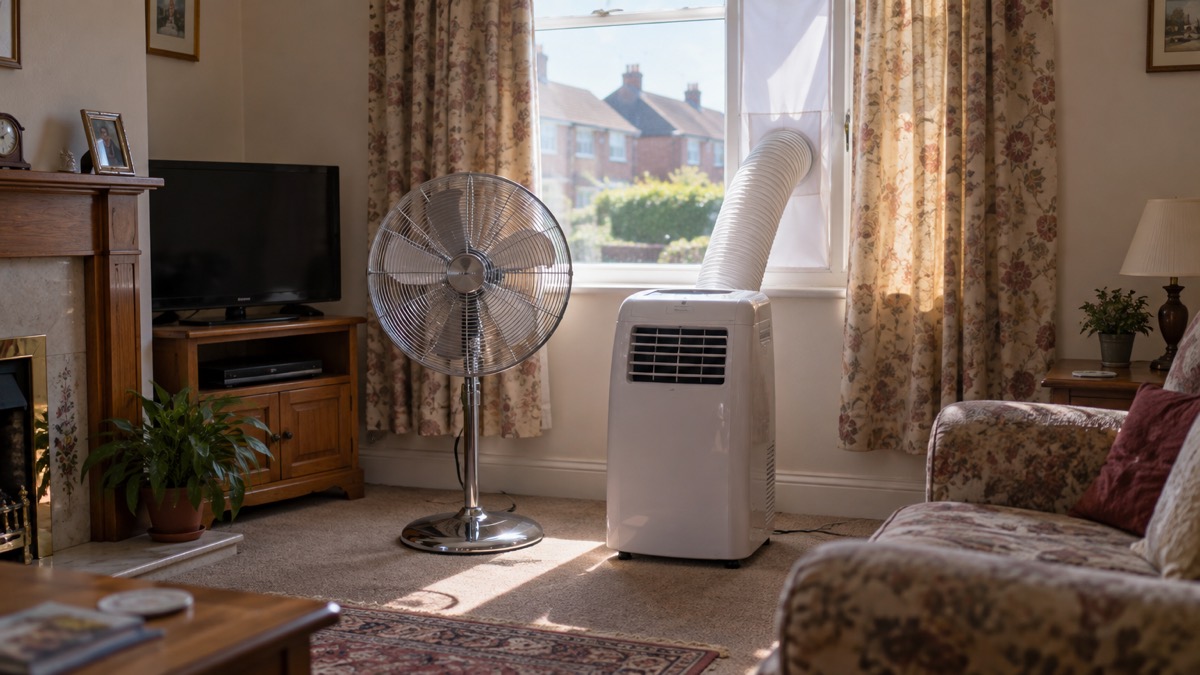
If you are weighing up a fan against a portable air conditioner before a hot spell, the single most useful fact is this: a fan helps while the room is below 35°C, and above that it is likely to heat you up rather than cool you down1. That threshold, repeated across official and NHS guidance, decides most of the choice. Below it, a fan is cheap to run, simple and effective. Above it, moving the air around does not remove heat from the room, and the airflow can dry you out.
A portable air conditioner does something a fan cannot: it takes heat out of the air. The trade-off is that portable units use 30 to 50% more electricity than fixed systems1, and they need somewhere for the waste heat to go. So the decision is not really about which machine is better. It is about which one suits your rooms, your budget for running costs, and how hot your home actually gets.
Start with the room, not the appliance. Shade the windows, open them when the outside air is cooler, and turn off what you do not need. Then decide whether a fan will carry you through, or whether your bedroom or living room regularly passes the point where a fan stops helping.
| Electric fan | Portable air conditioner | |
|---|---|---|
| What it does to the room | Moves air around; does not lower the temperature1 | Removes heat from the air and expels it through a hose |
| Works best when | Air temperature is below 35°C1 | The room is too hot for a fan, and the hose can reach outside |
| Running cost | Low; a ceiling fan in particular has low running costs1 | Higher: portable units use 30 to 50% more electricity than fixed systems1 |
| Installation | None; plug in and place | Needs venting to outside and space for the hose |
| Main safety point | Do not aim it at your body; keep drinks going3 | Follow the maker's instructions for venting and siting |
Above 35°C a fan is likely to heat you up rather than cool you down
The 35°C figure is the hinge on which this whole decision turns, and it appears in guidance from public health bodies, councils and the NHS alike. The Centre for Sustainable Energy states plainly that if the room temperature is above 35 degrees, a fan will likely heat you up rather than cool you down1. Oxfordshire County Council's heat guidance is equally direct: do not use fans if it is hotter than 35°C2. The UK Health Security Agency's guidance for social care managers says the same, adding the reason: do not use fans if it is hotter than 35°C, as they can raise body temperatures7.
The mechanism matters if you are going to act on it. A fan does not cool air. It moves it. Below 35°C that moving air helps your body shed heat and feels cooling. Above 35°C, when the air is already hotter than your skin, blowing more of it across you adds heat rather than removing it. Several councils put it in everyday terms: above 35 degrees you will just be moving hot air around8.
There is a second effect that applies at any temperature. Official guidance warns that fans can cause excess dehydration, and that you should not aim a fan directly at your body, because this can lead to dehydration3. The NHS in Liverpool puts the practical response alongside the warning: place the fan at a certain distance from people, not aiming it directly at the body, and have regular drinks, especially for sick people confined to bed3.
One set of official guidance says fans may not prevent heat-related illness above 35°C and can cause excess dehydration3; another says to use electric fans below 35°C but not to aim them at the body, which can lead to dehydration4. Both agree on the threshold and on keeping the airflow off your skin. Treat 35°C as the point to switch the fan off and rely on shading, ventilation and, if you have it, air conditioning.
Fan or portable air conditioner: how each one cools a room
The two appliances work in fundamentally different ways, and that difference explains everything about how you use them.
A fan circulates the air already in the room. It does not remove heat, it does not dry the air, and it does not change the temperature of the room at all. What it does is speed up the movement of air across your skin, which helps you feel cooler while the air is below 35°C1. That is why a fan is cheap, light and easy to move from room to room, and why it stops working once the room gets too hot.
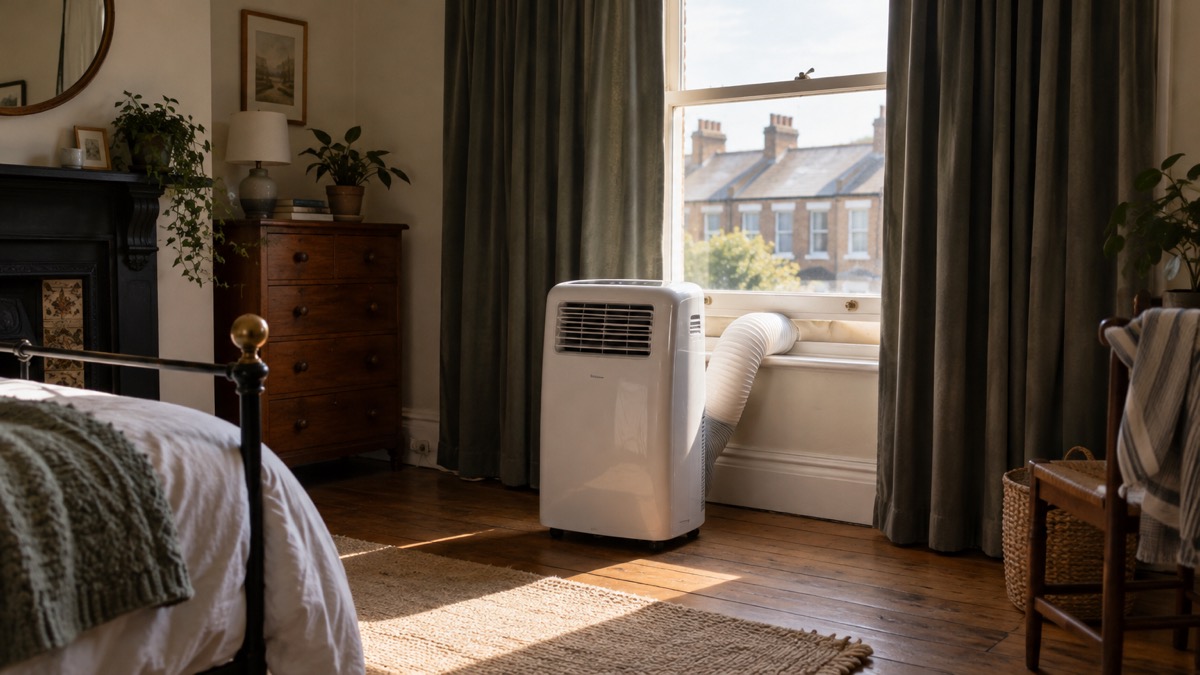
A portable air conditioner removes heat from the air and expels it. In a portable unit that waste heat leaves through a hose, which has to go somewhere: a window, a door or a purpose-made opening. The unit also has to be sited so the hose can reach outside without being kinked. This is the practical detail that catches people out, and it is worth planning before you buy rather than on the first hot night.
If you want to go further into either type, the guides to electric fans and to portable air conditioners set out the variants and what to look for. If you are choosing between a portable unit and a fixed split system, the comparison of portable or fixed split air conditioners covers the trade-offs, including the running-cost gap above.
When a fan is enough
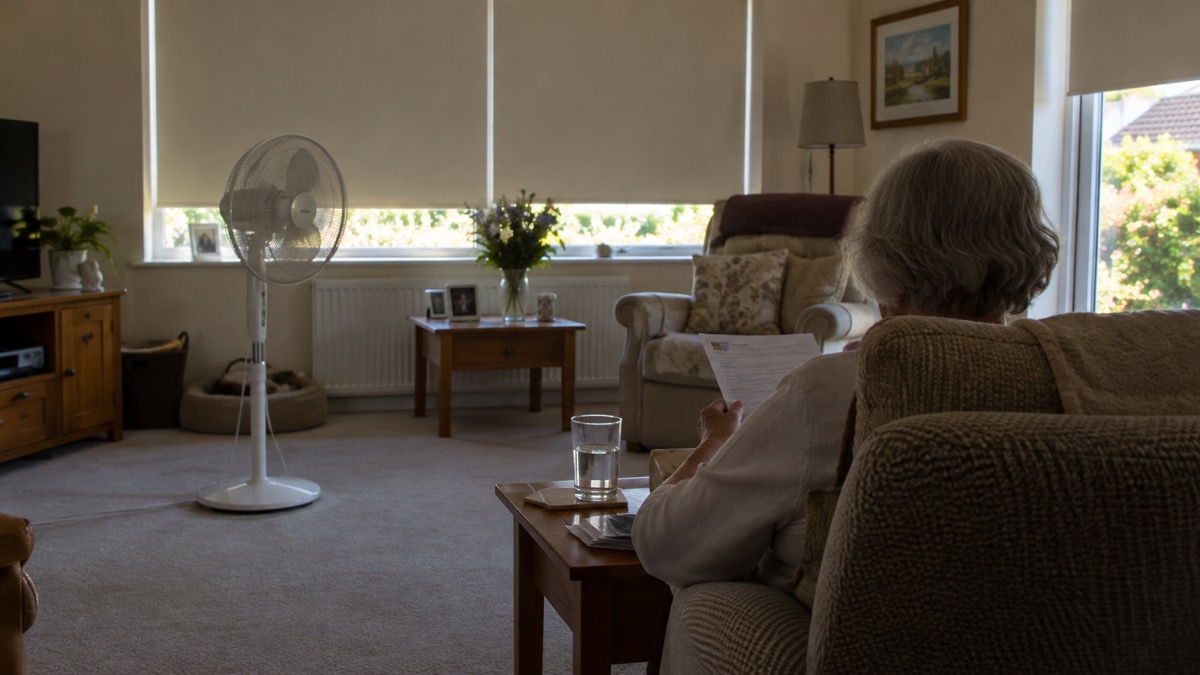
For most UK homes for most of the summer, a fan is enough, and the guidance says so. Electric fans can help if temperatures are below 35°C9, and they may provide some relief at those temperatures10. The NHS falls guidance is equally straightforward: use a fan if the temperature is below 35°C11.
A fan suits your home if the rooms you use stay below that threshold, if you can shade the windows and get a through draught, and if nobody in the household is at particular risk. It also suits anyone who wants something they can move from the bedroom to the living room, or run from a battery during a power cut. A ceiling fan is worth considering as a more permanent option: the Centre for Sustainable Energy notes that ceiling fans have low running costs and are very effective1.
There are ways to get more out of a fan. Oxfordshire's guidance suggests using portable electric fans with a bowl of ice, or installing a permanent ceiling fan or ventilation system2. Northern Ireland's guidance notes that electric fans may provide some relief, and adds two useful household measures: turn off non-essential lights and electrical equipment, because they generate heat, and keep indoor plants and bowls of water in the house, as these can cool the air12.
- Shade first. Use curtains, blinds or shutters on your windows to keep the sun out13.
- Ventilate at the right times. Open windows in the morning and evening, when the outside air is cooler13.
- Turn off what you do not need. Non-essential lights and electrical equipment generate heat12.
- Keep the airflow off your skin. Place the fan at a distance rather than aiming it at your body3.
- Keep drinks going. Regular drinks matter more when a fan is running, especially for anyone sick in bed3.
If your rooms regularly pass 35°C, or if the person sleeping there is older, unwell or a baby, a fan alone may not be enough on the hottest nights. That is when a portable air conditioner, or a cooler room elsewhere in the house, becomes worth considering.
When a portable air conditioner is worth having
A portable air conditioner earns its place when the room itself is the problem: when it stays above 35°C through the afternoon, when the bedroom does not cool down at night, or when someone in the household is at real risk from the heat and cannot simply move to a cooler room.
The case for one rests on what it does that a fan cannot. It removes heat rather than moving it, so it keeps working when the air is hotter than your skin. The case against is running cost and practicalities. Portable units use 30 to 50% more electricity than fixed systems1, so if you are choosing between a portable unit and a fixed system, the fixed one is the more efficient way to cool a room, provided you can have one installed. A portable unit is the option for a household that cannot or will not have a fixed system fitted.
Venting is the detail that decides whether a portable unit works in your home. The hose has to reach outside, and the unit has to sit somewhere it can do that without blocking a doorway or being knocked over. Window kits exist for exactly this, and the guide to window kits for portable air conditioners explains the options. Check the maker's own instructions for the venting kit and clearances before you buy, and follow them once you have it.
For a bedroom specifically, the aim is to cool the room before you sleep rather than to blast it with cold air all night. The guide to how to sleep and cool a bedroom on hot nights goes through the routine. If you are weighing a portable unit against a fixed split system, the portable or fixed split air conditioner comparison sets out the running-cost difference and what each suits.
Running either one safely in a heatwave
Both appliances are safe when used as intended, and both have failure modes worth knowing. The general heatwave advice is to use fans and air conditioning units if they are available for you6, and to check that fridges, freezers, fans and air conditioning work properly before the heat arrives5.
For fans, the safety points are about how you use them rather than the machine itself. Do not aim a fan directly at your body, because this can lead to dehydration4. Above 35°C, do not use fans at all, because they can raise body temperatures7. Keep drinks going, particularly for anyone sick and confined to bed3. And if you are using a fan in a bedroom, remember that ventilation matters: ensure adequate ventilation in the room, and keep the fan at a certain distance from people rather than aiming it directly at the body3.
For portable air conditioners, the safety points are about power and venting. Follow the maker's instructions for the hose and clearances. Do not block the vent or run the unit in a sealed room without the vent connected. If you are using an extension lead, make sure it is in good condition and can handle the appliance's power requirements14. And if the unit is a rechargeable device, do not leave it charging unattended or in standby for long periods: a product recall for a rechargeable radiator fan warned that if the product is charged or left unattended in standby mode, a fault may occur leading to thermal runaway and the product catching fire15.
Keeping cool if the power goes off
A power cut in a heatwave removes both your fan and your air conditioning at once, and it can happen at the worst moment. The practical answer is to have a plan that does not depend on either appliance.
Start with the building. If you do not have air conditioning, stay on the lowest floor away from the sunshine17. Cool the room down by opening windows and doors to let a draught flow, use curtains, blinds or shutters on your windows, and open windows in the morning and evening13. Turn off any appliances you do not need, because they generate heat13. Keep indoor plants and bowls of water in the house, as these can cool the air12.
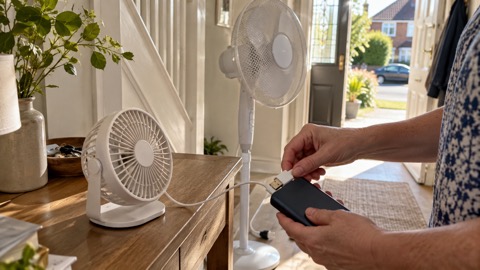
Then think about the people. Check that your fridge and freezer are working properly, for example by checking that your food is remaining cold or frozen13, and leave the fridge and freezer switched on with the door shut to maintain a low temperature18. If someone in the household is at particular risk, the extra help in an emergency guide covers what to arrange in advance, and the power cuts guide covers the wider household routine. A battery fan or a cordless rechargeable fan can bridge a short cut; the comparison of a cordless rechargeable fan or mains fan sets out what each can do.
If the cut is likely to be long, the keep cool during a power cut guide goes further, and the backup power section covers what can and cannot safely run a fan or a small appliance. The hot weather preparation checklist is the place to start before the heat arrives.
Where to get help in extreme heat
Most heat illness is managed at home, but knowing when to seek help matters. If you need medical help for a heat-related health problem, contact NHS 111; in an emergency, or when you think someone has heatstroke, call 9996. The same advice applies across the UK: NHS 111 in England, Scotland and Wales, and 999 for an emergency19.
The signs to act on are set out in the heat exhaustion and heatstroke guide. In short, move the person indoors or into the shade, remove extra clothing, give them water or another fluid, and spray or sponge them with cool water. They should start to cool down and feel better within 30 minutes; if there is no improvement or their symptoms worsen, get medical help20. Phone 999 or go to A&E if someone has symptoms of heatstroke, or still feels unwell after 30 minutes of resting in a cool place, being cooled down and drinking fluids19.
If you are concerned about someone who may need support, contact your local authority5. That is the route to adult social care and to services that can check on someone who lives alone. The older neighbours guide covers how to check on people nearby, and the people at risk guide explains who is most vulnerable.
Heat-health alerts are the system that warns services, and the public, that hot weather is coming. The heat-health alerts guide explains the colours, and the sign-up guide explains how to receive them. For a household, the response is the same whatever the alert level: check your kit, keep the home cool, drink regularly, and look out for anyone who needs help.
Sources (20)
- How to keep your home cool in hot weather, Centre for Sustainable Energy, 2026-07
- Beat the Heat, Oxfordshire County Council, 2026
- Heatwaves, Birmingham Women's and Children's NHS Foundation Trust, 2026-10-29
- Stay cool and safe in hot weather, Somerset Council, 2026-07-08
- Staying well in hot weather, Devon County Council, 2026-07-02
- Heatwave advice, Guy's and St Thomas' NHS Foundation Trust, 2026-06
- Supporting vulnerable people before and during hot weather: social care managers - GOV.UK, UK Health Security Agency (GOV.UK)
- Keeping cool in heat waves, Oxfordshire County Council, 2026
- Hot weather, Mersey and West Lancashire Teaching Hospitals NHS Trust, 2026-10-29
- How to keep cool this summer, Lancashire County Council, 2026
- Guidance at home, Oxford Health NHS Foundation Trust, 2026-09-15
- Heat exhaustion and heatstroke, nidirect, 2025-12-02
- Staying well in hot weather, Berkshire Healthcare NHS Foundation Trust, 2026-10-29
- Prevention - Fire Kills, Fire Kills (firekills.campaign.gov.uk)
- Product recall: Valiant Radiator Fan, Office for Product Safety and Standards, 2025-11-07
- Caravan, motorhome and campervan safety, Humberside Fire and Rescue Service, 2026-10-29
- Extreme weather, Flintshire County Council, 2026-10-29
- Loss of essential services - Greater Manchester Combined Authority, Greater Manchester Combined Authority
- Heatstroke and heat illness, NHS inform, 2026-07-15
- Keeping warm or cool in extreme weather, UK Chief Medical Officers, 2025-12-16
 Cordless vs Mains Fan
 Portable vs Split Air Con