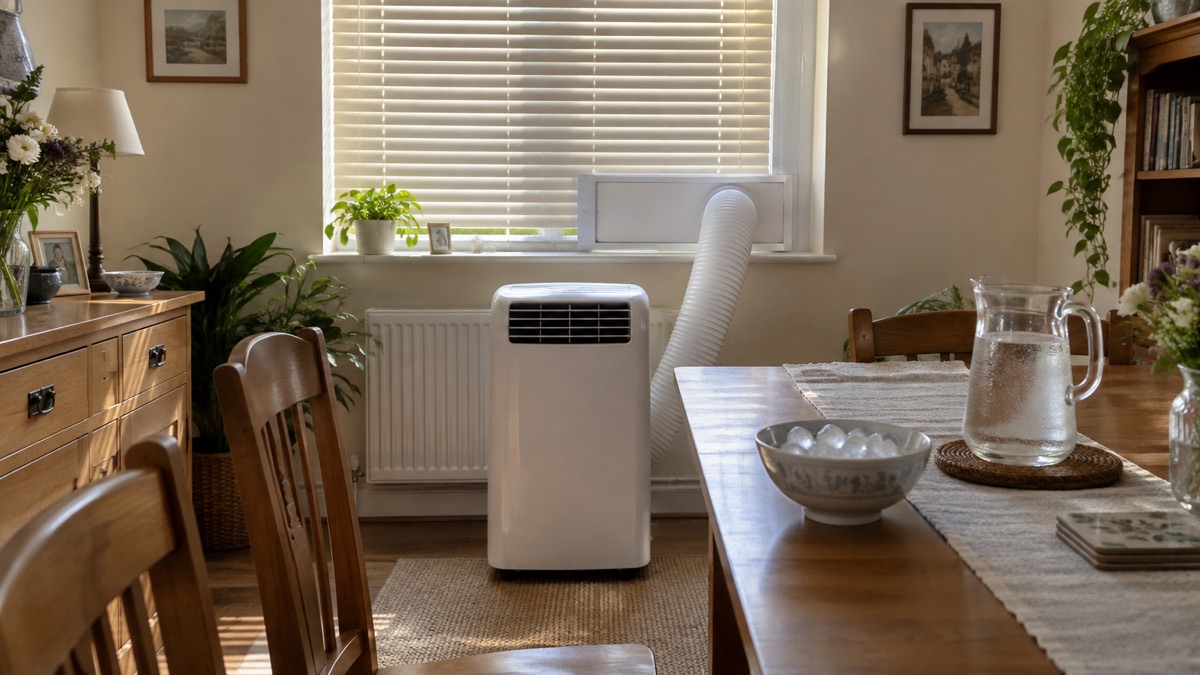
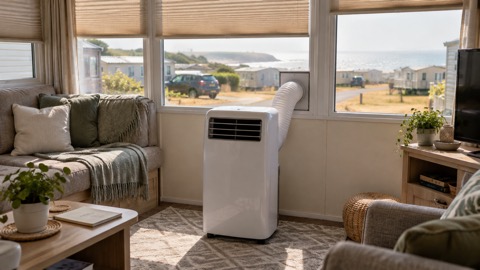
A portable air conditioner is not the first thing most households put in an emergency plan. It earns its place in one specific, recurring situation: a heatwave, when the bedroom or the living room becomes too hot to sleep or sit in, and when the people most at risk, older neighbours, babies, anyone with a heart or lung condition, are the ones who feel it first. The Meaco MC Series Pro 9000 CH is a freestanding unit from Meaco that cools, dehumidifies, circulates air and, on the CH models, heats1. It needs no professional installation and comes with a window kit to send warm air outside2.
For a prepping household the useful questions are narrower than for a shopper. Where does it fit, what does it draw, what happens when the power goes off, and how do you keep it ready and safe between the hot spells when you need it? The maker's manual for the MC Series answers most of these directly, and the independent safety guidance fills in the rest1.
What the Meaco MC Series Pro 9000 CH does for a household
The unit is a single freestanding box that does four jobs across the year. In Cool Mode it takes heat out of a room and vents it outside. In Dry Mode it works as a dehumidifier, which the maker notes is effective above 15°C. In Fan Mode it simply moves air. On the CH models, Heat Mode makes it a heater for the winter months as well1. That spread matters for preparedness: one appliance covers the hot spell and the cold snap, and the Dry Mode is useful after a flood or a leak when a room needs drying out.
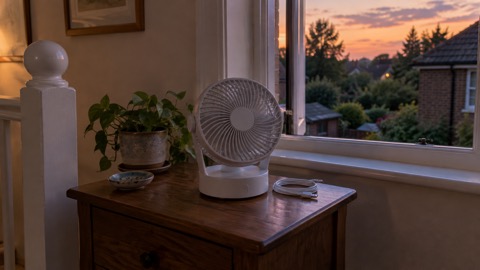
Meaco's own product pages describe the range as freestanding units that do not require professional installation, supplied with window kits to vent warm air outside and keep cooler air inside2. The range currently lists 8 products2. The maker also recommends pairing a portable air conditioner with a MeacoFan air circulator, on the basis that the air conditioner cools or pre-cools the room while the fan moves the cooler air around more evenly4. That is a comfort recommendation rather than a safety one, but it is worth knowing if you are deciding how to spend a limited budget on cooling.
Where it fits a household plan is as a room-level tool, not a whole-house solution. It cools the room it stands in, and only if the warm air it produces can leave. That single condition governs almost everything else on this page: placement, venting, and what you do when the power fails.
Specifications that decide where it fits
The manual gives a compact set of figures for the MC Series. They are the ones that decide whether the unit suits your room, your socket and your sleep.
| Specification | Figure | What it means at home |
|---|---|---|
| Modes | Cool, Dry, Fan, Heat (Heat on CH models only)1 | One unit for summer cooling, winter heating and drying a damp room |
| Sleep Mode | Remote control only1 | Keep the remote by the bed on hot nights |
| Noise level | 53dB on low fan speed1 | A steady background hum; site it away from the head of the bed |
| Power supply | 220-240V / 50Hz1 | Standard UK mains; no special supply |
| Energy Rating | A1 | The maker's rating for the range |
| Duct length | 1.8m / 71″, cannot be extended1 | The unit must stand within 1.8 metres of the window |
| Current draw | Up to 9.3 amps for portable air conditioners3 | A high-draw appliance; check leads and sockets |
| Included | Window kit2 | You do not need to buy a vent separately |
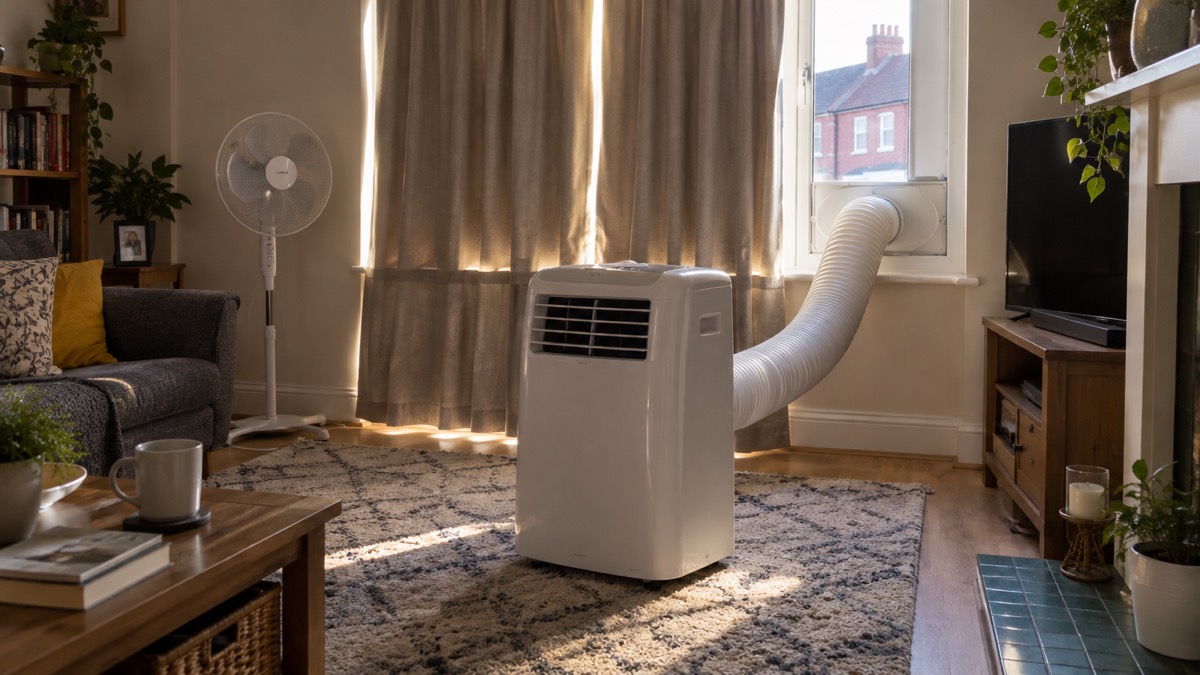
The duct length is the figure that most often catches people out. At 1.8 metres it fixes where the unit can stand, and the maker states plainly that it cannot be extended1. If your only suitable window is further from the socket than that, the unit will not vent properly where you want it. Measure before you commit to a position, and remember the socket needs to be within reach of the same spot.
The current draw is the other figure to hold in mind. Electrical Safety First, the independent electrical safety charity, gives the draw for portable air conditioners as up to 9.3 amps3. That is a substantial load, and it is the reason the guidance on extension leads below matters more than it would for a lamp or a phone charger.
Cooling and heating: what it can handle and for how long
The unit runs four modes, and the maker's manual sets out how each behaves1. Cool Mode is the summer workhorse. Dry Mode dehumidifies, and the manual notes it works above 15°C, so it is a warm-weather drying tool rather than a winter one. Fan Mode moves air without cooling. Heat Mode, on the CH models, turns the unit into a heater for the winter months1.
Two behaviours are worth knowing because they look like faults when they are not. First, in Cool or Dry Mode the unit defrosts: the compressor stops operating for ten minutes or until the coil temperature has reached 7°C1. If the cooling pauses and then resumes, that is the defrost cycle doing its job, not a breakdown. Second, the unit has a memory function, covered below, which means it returns to its previous setting after a power cut1.
How long it runs in practice depends on the room, the outside temperature and how well the room is sealed. The maker's advice is to keep all doors, windows and curtains or blinds closed before using the unit, in order to pre-cool the room1. That is the single biggest lever on how hard the unit has to work: a room with an open door to a hot hallway is a room the unit will never catch up with.
For the wider picture of cooling a home without relying on one appliance, the guide to keeping your home cool in hot weather sets out the shading, ventilation and timing measures that reduce the load on any cooler. Used together with those, a portable unit has less work to do and runs more comfortably.
Setting it up safely: window venting and placement
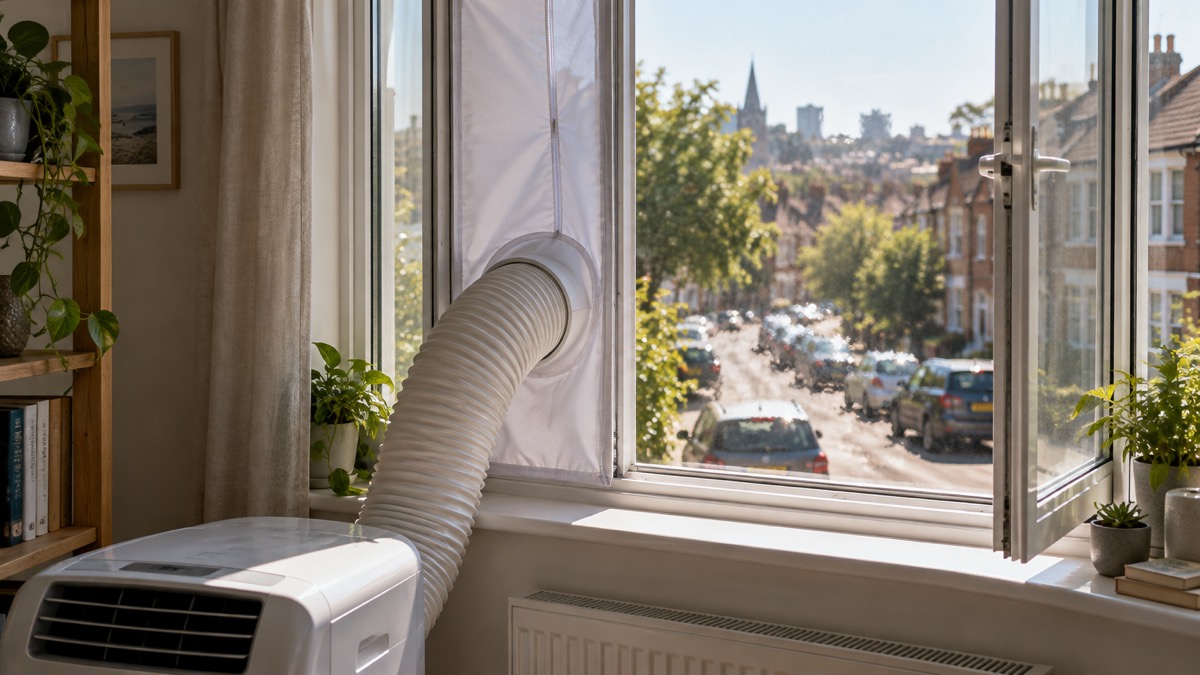
Venting is where a portable air conditioner succeeds or fails. The maker supplies window kits with its portable units to vent warm air outside and keep cooler air inside2. The independent Energy Saving Trust is blunt about why the kit matters: portable air-conditioning units need to be properly vented to the outside using a special fitting for the window, and if the vent is just put through an open window, it will let heat back in5. A hose hung out of an open window undoes most of the cooling the unit produces.
Set the unit up in this order:
- Choose a spot within 1.8 metres of the window, because the duct cannot be extended1.
- Fit the window kit rather than propping the window open around the hose5.
- Close all doors, windows and curtains or blinds before switching on, to pre-cool the room1.
- Keep the air intake and the vent clear of furniture and soft furnishings.
- Check the plug and lead for damage before the first run of the season.
Placement also decides how well the unit performs and how much you hear it. At 53dB on low fan speed1, it is not silent, so a corner away from the head of the bed and away from a desk where you take calls is sensible. Do not box it in: the unit needs to draw air in and push it out.
If you are weighing up whether a portable unit or a fixed split system suits your home, the comparison of portable or fixed split air conditioners sets out the trade-offs, and the guide to window kits for portable air conditioners covers fitting in more detail.
Safe use during hot weather
A portable air conditioner is one tool among several in a hot spell, and the maker is clear that it works best alongside air movement: Meaco recommends using a portable air conditioner and a MeacoFan air circulator together, with the air conditioner cooling or pre-cooling the room and the fan moving the cooler air around for additional comfort4. That is a comfort point, but it also means you are not relying on a single appliance to make a room bearable.
The safety points that matter most in hot weather are about the people, not the machine. Keep the room the unit serves as a cool space where the most vulnerable member of the household can sit. The guide to who is most at risk in hot weather explains why older people, babies and anyone with a long-term condition need a cool room first, and the heat exhaustion and heatstroke page sets out the signs that mean you stop cooling the room and start helping a person.
On the machine itself, three habits keep it safe:
- Check the plug, lead and socket for damage or scorching before each season's first use.
- Keep the vent and intake clear, and never drape anything over the unit.
- Switch off and unplug before draining the tank or cleaning the filter.
For the wider household routine in a hot spell, the hot weather preparation checklist gathers the jobs in one place, and how to sleep and cool a bedroom on hot nights covers the overnight case in more detail.
Running it on backup power in a power cut
This is where a portable air conditioner meets the rest of a preparedness plan. The maker's manual states that in the event of a power cut the unit has a memory function and will continue to run on the same setting it was set to before the power cut occurred1. In plain terms: when the power comes back, you do not have to reset it. That is a small but genuinely useful behaviour in a long outage, especially overnight.
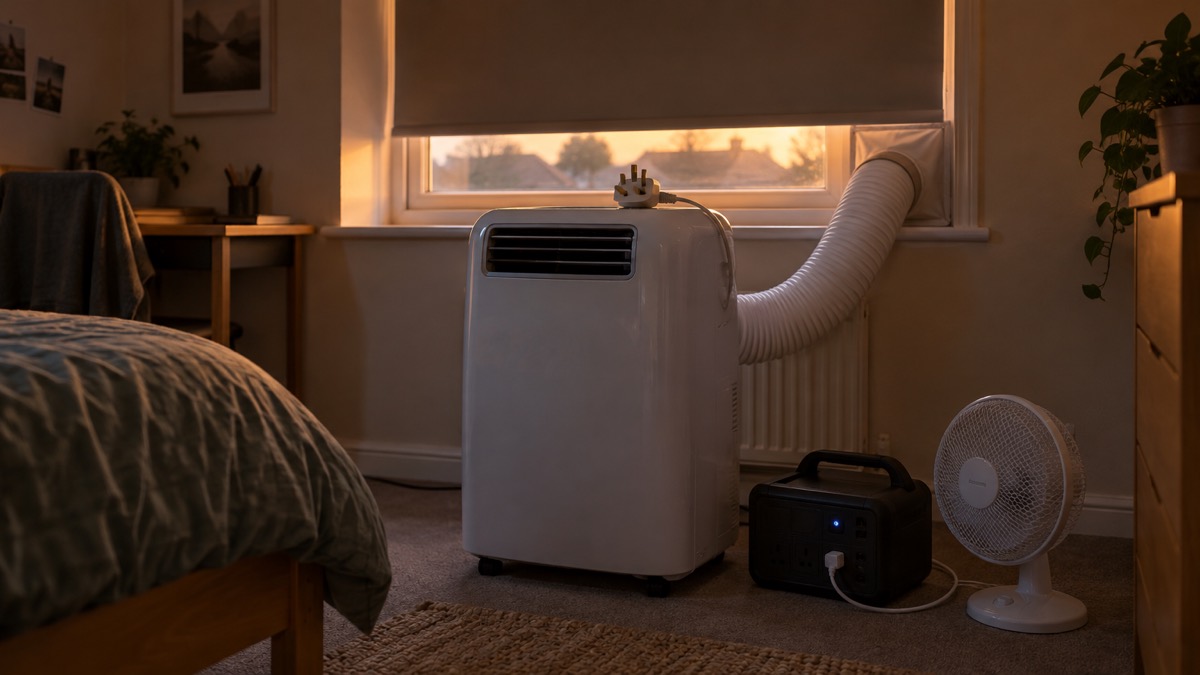
The harder question is whether you can run it from backup power at all. The unit's supply is 220-240V / 50Hz1, and Electrical Safety First gives the draw for portable air conditioners as up to 9.3 amps3. That is a large load for a domestic battery station or generator, and it is the figure to check against the capacity of whatever backup you have before you plan to run cooling from it. For most households the realistic plan is not to run the air conditioner through an outage but to have a lower-draw fallback: a fan, a cool room, and the measures in how to keep cool during a power cut in hot weather.
The principle of keeping backup power for the loads that matter is set out in the guide to backup power at home, and the wider case for planning around an outage is in power cuts: a household guide. Advice for tropical fish keepers is to keep a battery-operated air pump, heater or generator ready as backup power during a power cut6. That advice is written for one kind of load, but the principle, that some loads are worth backing up and others are not, applies to any household deciding what to run from a battery.
Cleaning, draining and storing it between seasons
Water is the part of ownership that catches people out, and the manual is specific. When the unit is used in Dry Mode or Heat Mode, the drainage hose needs to be attached continuously. In Cool Mode it does not need to be attached continuously, but Ft will appear on the display when the water tank needs draining1. So the routine differs by mode: continuous drainage in the drying and heating modes, and a manual empty when the display tells you to in cooling mode.
| Mode | Drainage arrangement | What you do |
|---|---|---|
| Cool | Hose not needed continuously; Ft shows when the tank is full1 | Switch off, drain the internal container, restart |
| Dry | Drainage hose attached continuously1 | Check the hose runs to a drain and is not kinked |
| Heat | Drainage hose attached continuously1 | Same as Dry Mode |
| Fan | No condensate to drain | Routine cleaning only |
Before the unit goes away for the season, drain it fully, clean the filter, and store it dry and covered. A unit stored with water in the tank is a unit that smells when you next switch it on. Keep the window kit and the duct with the unit, because the duct cannot be replaced with a longer one1 and a missing kit stops you venting properly next summer.
The maker's product pages note that selected models include Cooling, Dry, Fan and Heat Mode, giving more flexibility across the season2. That is the argument for keeping the unit rather than storing it away entirely: it has a winter job as a heater and a damp-room tool, so it earns its storage space.
Support, warranty and safety notices
The manual's fault codes tell you which problems are yours to fix and which are the maker's. E0 is a display board error and E1 a faulty temperature sensor, and for both the manual says to contact Meaco. E2 is a faulty evaporator coil sensor, and again the instruction is to contact Meaco. Ft is the internal water container being full, which you can clear yourself1.
| Code | Meaning | What to do |
|---|---|---|
| E0 | Display board error1 | Contact Meaco |
| E1 | Temperature sensor faulty1 | Contact Meaco |
| E2 | Evaporator coil sensor faulty1 | Contact Meaco |
| Ft | Internal water container full1 | Drain the tank and restart |
Keep the manual with the unit, and note the model and serial number somewhere you can find them without moving the appliance. If the unit is under warranty, contact the maker before attempting any repair yourself, and follow the maker's own instructions for your model rather than a general guide.
For the wider context of cooling choices, the section on heatwaves and drought gathers the household guidance, and the comparison of an electric fan or portable air conditioner helps if you are deciding which to buy first. The page on portable air conditioners: how they work and how to choose covers the technology across models, and the Meaco MC Series Pro 10000 CH page covers the larger unit in the same range.
Sources (6)
- MeacoCool MC Series Portable Air Conditioner 7000-10000BTU Instruction Manual, Meaco, 2021
- Portable Air Conditioners, Meaco, 2026
- Ratings of electrical appliances, Electrical Safety First, 2026
- Air Conditioners, Meaco, 2026
- How to keep your home cool in hot weather, Energy Saving Trust, 2026
- What about my tropical fish?, Northern Ireland Networks, 2026

 Meaco MC Pro 10000 CH
 Meaco MeacoFan Sefte