Your block letter is the single piece of information that tells you when your home would lose electricity during a national emergency rota. Every electricity meter in Great Britain is assigned one, and in a national energy shortage the letter decides which three-hour slots your street goes dark. You can find it in three ways: by entering your postcode at powercut105.com, on the top half of some electricity bills, or by ringing 105 and asking your local network operator1.
The good news is that you almost certainly will never need it. Emergency Power Cuts are very rare in Great Britain, would only be used as a last resort if there was a major national energy shortage that could not be dealt with by a range of other measures first, and no emergency power cuts are currently planned2. But finding your letter takes two minutes, and if a rota is ever announced you will want it to hand before the whole country logs on to look it up at once. Independent guidance for customers who depend on electricity for medical equipment is to find your block letter now and note it down in a safe place4.
Find your block letter by postcode or on your electricity bill
There are two quick ways to find your letter, and it is worth doing both so you can cross-check.
The first is the postcode lookup. Go to powercut105.com and enter your postcode: the site will tell you what company supplies your area, and you can find which load block letter you are in by entering your postcode there1. The same site, sometimes called Power Track, works for ordinary power cuts as well: you can enter your postcode and it will tell you what company supplies you6. Your block letter is static and will not change during an emergency, so the letter you find today is the letter that will be used if a rota is ever published5.
The second is your electricity bill. Your block letter should also be printed in the top half of your electricity bill, and some energy suppliers include it there2. Dig out a recent bill and check the upper portion of the page before you resort to anything else. If you keep paper bills in a drawer, this is often the fastest route of all.
If you rely on electricity for medical equipment, do not leave this to the last minute. Independent guidance is to find your block letter now and note it down in a safe place in case you ever need it, either from the top of your energy bill or from the operator lookup4. Write it next to your emergency numbers, tell the people you live with where it is, and include it in your household plan. Our page on relying on medical equipment that needs electricity goes through the fuller preparations, and the checklist for households using medical equipment is built around exactly this kind of note.
Can't find it? Call 105
If the postcode lookup does not help, or you cannot get online, ring 105. It is the national power cut number in England, Scotland and Wales, free of charge, and you can use it to report a problem and get updates on when your power will be restored7. Call 105 or use the online postcode checker to find out who your distribution network operator is, and they can tell you your block8.
In a declared national energy emergency using planned Emergency Power Cuts, the current 105 telephone number would also activate a special high-capacity service that would direct you to where you can find your block letter, heard or texted to your mobile4. The idea is that in a real emergency, when millions of people are trying to look up their letter at once, the phone line will not simply jam: 105 would activate an additional service so you can get your block letter over the phone if you do not have online access4.
Northern Ireland is different. There, the number to ring about power cuts is 03457 643643, not 1051. NIE Networks' Customer Helpline on 03457 643 643 is the contact for reporting a power cut or a damaged power line9, and the same number appears in official guidance for reporting damaged electricity equipment9. Our page on Northern Ireland: NIE Networks, reporting and help covers the arrangements there in full.
| Where you are | Number to ring | What it does |
|---|---|---|
| England, Scotland and Wales | 105 | Free national power cut line; in a declared emergency, directs you to your block letter4 |
| Northern Ireland | 03457 643643 | NIE Networks Customer Helpline for power cuts and damaged lines1 |
What your block letter means for a rota power cut
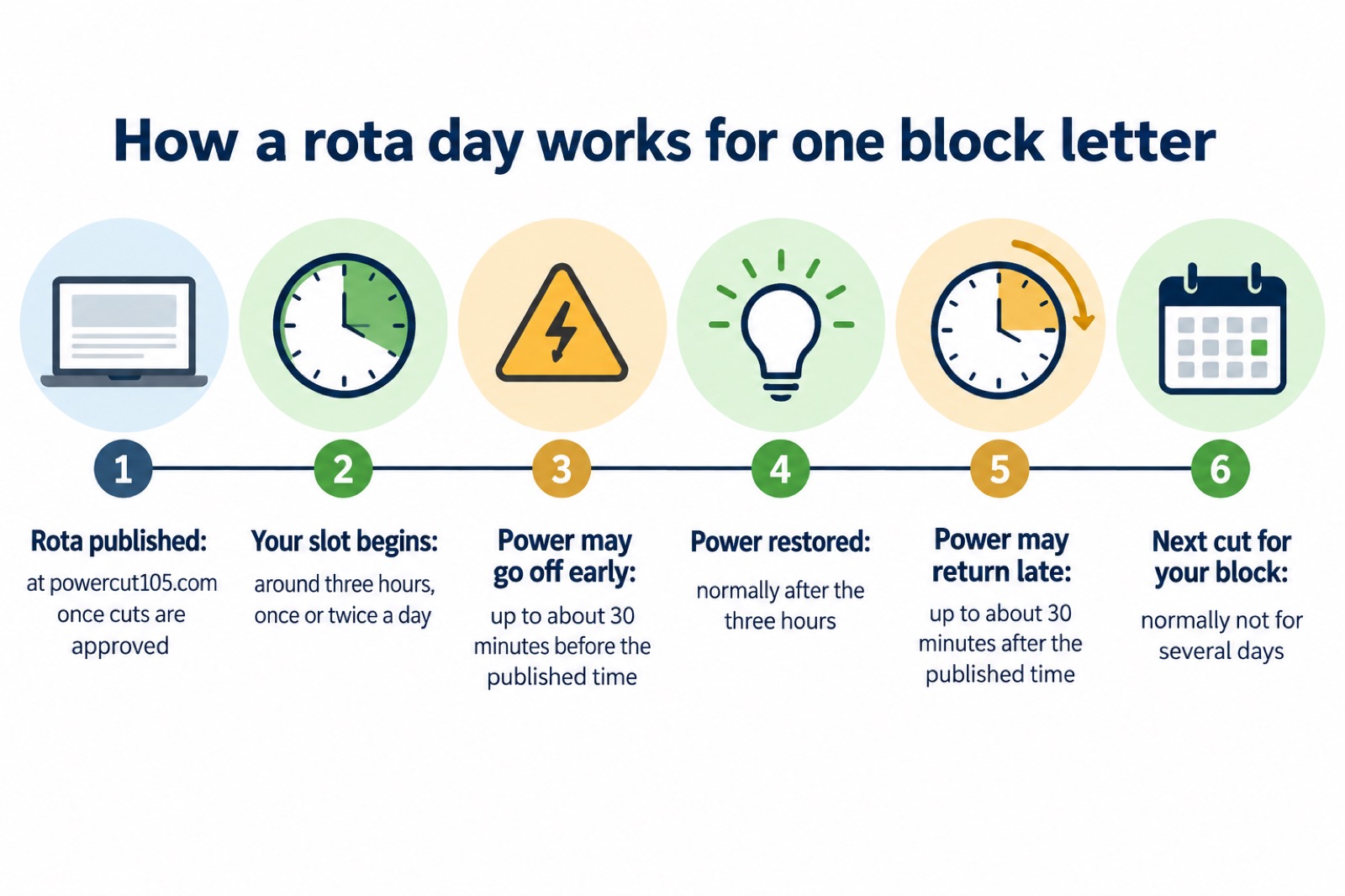
Each electricity meter is assigned a block letter between A and U, and the letters F, I and O are not used5. Each area in Great Britain is assigned a load block letter and would be scheduled to disconnect from the electricity grid for around three hours at a time in the unlikely event of a national energy shortage, when emergency power cuts could be scheduled on a rotating area-by-area basis3.
In practice, different block letters will be timetabled to be without power for around three hours once or twice a day5. Typically, you would be without power for at least three hours, once or twice a day4. The rota rotates so that no single group of homes carries the whole shortage: normally, customers who have been subject to a rota cut will not suffer a second one for several days2.
The rota itself is only published once emergency power cuts have been approved to take place. Customers will be able to find their rota and what it means for them at powercut105.com by entering their postcode10. Until an emergency is declared, there is nothing to look up beyond your letter itself: the timetable does not exist in advance, because it depends on how severe the shortage is and how long it is expected to last.
Treat the published times as a guide, not a guarantee. Your power might be switched off or reconnected around 30 minutes before or after the published time depending on electricity use at that time5. Power will normally be restored after the three hours, unless operational reasons prevent this2. So if your slot says 4pm to 7pm, be ready for the lights to go out from about half past three and to come back any time up to about half past seven.
Your block letter stays the same unless you move home
Your block letter is static and will not change during an emergency5. The letter is tied to your meter and your area, not to the state of the grid, so there is no need to re-check it every few months or worry that it has been reassigned since you last looked. Once you have noted it down, it stays valid.
What does change it is moving home. A new house means a new meter, and a new meter has its own block letter, which may well be different from your old one even if you have only moved across town. After any house move, look the new letter up at powercut105.com or check the first electricity bill at the new address, and update your notes.
The same principle applies to anyone whose circumstances change. Official guidance on personal emergency plans is to contact the relevant party if your mobility or health changes, you no longer need help, you move to a different home, or your contact details change11. In the power cut context, that means updating your details with your network operator, and if you are on the Priority Services Register, telling them about the move too. Our page on the Priority Services Register explains who can join and what it gives you.
When emergency power cuts would happen, and how likely they are
Emergency Power Cuts, known in the industry as rota load disconnection, would only be used as a last resort if there was ever a major national energy shortage that could not be dealt with by a range of other measures first4. Emergency Power Cuts are very rare in Great Britain4, and network operators state plainly that no emergency power cuts are currently planned and that these measures would only be used in emergencies2.
Before any rota is considered, a sequence of gentler measures comes first. These include encouraging additional generation to meet demand, asking heavy industrial users to limit demand at peak periods, asking or paying customers to change how and when they use appliances, and reducing voltage across the country by a small, indiscernible percentage2. A rota only appears if all of that is not enough.
If a shortage is likely to last a few days, an emergency power cut rota will be published. When you enter your postcode you will see when you will have a power cut the next day and a timetable of risk for days after, and official guidance is to keep checking the rota every evening, because it is updated daily as the situation develops12. The procedures are not improvised on the day: they are tested every year by the energy industry2.
The scale, if it ever happens, is large. Emergency power cuts mean switching power off to at least 5% of UK households at once: more than one million homes, at least 5% of households in Great Britain, will be without power at once2. In Northern Ireland, the blocks are pre-determined and are designed to represent approximately 5% of the NI Electricity System, with the areas affected by each block spread geographically across Northern Ireland5. Our page on rota disconnections covers the mechanics of the scheme in more depth.
How much notice you would get
The honest answer is: probably days, but possibly much less. It is likely that network operators and the public would be given a number of days' notice, although this could be implemented sooner if the situation demanded it, and network operators themselves may receive as little as 30 minutes' notice of an instruction2. A separate account says planned Emergency Power Cuts through a power-sharing rota would be notified up to 48 hours ahead4. Because the two figures differ, treat "at least a day or two, possibly more" as the working assumption and check official channels rather than relying on a fixed window.
How would you hear about it? The Electricity System Operator plans to hold a press conference and use social media to let people know a few days before, with the message carried by national and local news and official social media channels2. There will be no calls, texts or emails to every customer in advance2, so do not wait for your supplier to contact you personally.
The UK's Emergency Alerts system is a separate channel that can reach compatible mobile phones: after the alert is sent by the government or emergency services, the message will be received on a mobile phone within about 4 to 10 seconds13. Keep your phone charged and do not switch emergency alerts off. Our what to keep charged checklist is built around exactly this kind of dependency.
Who is affected: no opt-outs, including the Priority Services Register
This is the part many people find hardest to accept. Households and businesses can't opt out or be specially treated for emergency planned power cuts2. Being on the Priority Services Register does not exempt your home from the rota, and official guidance confirms you will not receive extra payments for being on a priority service register14. The register is still worth joining for ordinary outages, because it gets you advance notice of planned maintenance and extra support during faults, but it does not lift your home out of a national rota.
Network operators have no choice in the matter either. They are legally required to implement power cuts when instructed by National Grid ESO, with qualifying criteria set out by the Government in section 5 of the ESEC guidance2. The instruction comes from the top of the system, and the operator's job is to carry it out.
A very limited number of sites are protected from emergency power cuts. These are typically locations deemed critical national infrastructure, such as air traffic control centres and major hospital facilities with accident and emergency departments2. Ordinary homes, care homes without A&E departments on site, shops and schools are not on that list. Our page on which sites are protected from emergency disconnection explains the boundaries.
If you depend on mains power for medical equipment, plan on that basis. Find your block letter now and note it down in a safe place4, and read our guidance on keeping medicine cold and on medical equipment for the preparations that actually make a difference.
What else goes off during a rota cut
A rota cut does not just switch off your lights. It takes out everything in your area that runs on the same electricity supply. This includes streetlights, traffic lights, shops, petrol stations and public buildings2. Plan for dark streets, closed shops and pumps out of action during your slot, and fill the car and do the shopping before a scheduled cut rather than during it.
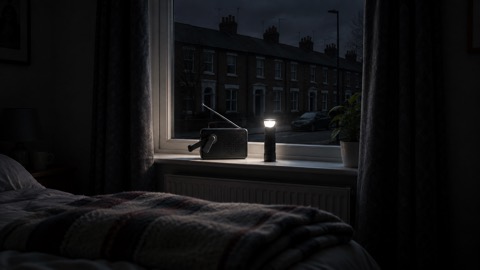
Communications are affected too. Mobile telephone transmitters and broadband connections are not protected and may be interrupted2. That means your mobile may lose signal or drop to a weak connection during a cut, and home broadband will go down with the router. Do not plan to "just stream updates" through your slot: keep a battery or wind-up radio in the house, and keep a power bank charged for the phone. Our power cut kit checklist lists what to have ready.
Even if your rota block is not confirmed for disconnection, there is a possibility that you may experience some short duration effects, lasting less than three minutes, such as dimming of lights or low power2. These are a side effect of the grid being run under strain, not a sign that your home is about to be cut off.
Getting through a cut: when to check for updates
Once a rota is running, the rhythm is simple. If the shortage is likely to last a few days, an emergency power cut rota will be published, and official guidance is to keep checking the rota every evening for the next day's schedule and the timetable of risk for days after12. The rota is updated daily, so yesterday's timetable is not today's.
To report a power cut and track updates, visit your local network operator's website, or call 105 if you are unable to report online1. Call 105 free of charge to report the problem and get updates on when your power will be restored7. In Wales, as elsewhere, the number to call is 10516. For ordinary planned maintenance outages, which are a completely separate thing from an emergency rota, you can visit your network operator's power cut map to track and register for updates on your planned power cut, 24 hours a day17; our page on planned interruptions explains those.
The practical routine for a rota period:
- Each evening, enter your postcode at powercut105.com and check whether your block letter appears in the next day's timetable12.
- If your block is scheduled, get ready the night before: charge phones and power banks, fill flasks, and read our page on what to do when the electricity goes off.
- During the cut, use the operator's website or 105 for updates rather than calling repeatedly1.
- When the power returns, follow the checks on our when the supply returns page before switching everything back on at once.
- Expect the reconnection to land within about 30 minutes either side of the published time5.
Two things are worth repeating because they worry people. First, you will only be charged for the amount of electricity you use, so a rota cut does not add anything to your bill2. Second, normally those customers who have been subject to a rota cut will not suffer a second one for several days2, so once your slot is over, you can reasonably expect a stretch of normal supply while other blocks take their turn.
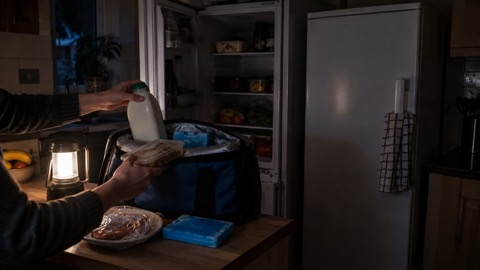
For everything else about living through the hours without power, our power cuts section has the full set: keeping warm without electricity, fridge and freezer food, staying safe in the dark and how long until the electricity comes back.
Sources (17)
- Power cuts: what to do, UK government Be Ready campaign, 2026
- Emergency power cuts, Electricity North West, 2026
- Power cuts: what to do, UK government Prepare campaign, 2026
- Emergency power cuts, Northern Powergrid, 2026
- Emergency power cuts, NIE Networks, 2026
- Power Track: what is it?, Wiltshire and Swindon Prepared, 2026
- Storms and wind, Ready Scotland, 2026
- EMERGENCY POWER CUTS - FAQ_0.pdf, Northern Powergrid
- Strong winds and heavy rain warning: information and advice, nidirect, 2026
- How planned emergency power cuts would work, Energy Networks Association, 2022
- Residential Personal Emergency Evacuation Plan: a guide, London Fire Brigade, 2026
- What are electricity rota loads?, Wiltshire and Swindon Prepared, 2026
- Emergency alerts, Denbighshire County Council, 2026
- Plan for a power cut, Ofgem, 2026
- Electrical items in the home, London Fire Brigade, 2026
- Adverse weather events, Llangattock Community Council, 2026
- Your planned power cut explained: network maintenance and inspection, SSEN, 2026
 Power Cut Kit Checklist
 What to Keep Charged
 Household Emergency Plan
 Reporting a Power Cut
 What to Do in a Power Cut
 Getting Ready for a Power Cut
 Fridge and Freezer Food
 Keeping Warm Without Electricity
 Central Heating Without Power
 Cold Homes and Health
 Carbon Monoxide Risks
 Staying Safe in the Dark
 Smoke and Carbon Monoxide Alarms
 How Long Until Power Returns
 When the Power Comes Back