A national power outage is defined in official planning as the loss of power affecting the whole country for a prolonged period, and it would far exceed the few hours a normal power cut lasts1. It is classed as an extremely unusual occurrence, but it is planned for: the Department for Energy Security and Net Zero (DESNZ) is the lead government department for this risk, working with the National Energy System Operator2. Widespread and longer outages, with regional or, although unlikely, national impacts, could potentially last several days3.
For your household, the practical difference between a normal power cut and a national one is duration and scale. A power outage disrupts communications, water and transportation, and closes retail businesses, grocery stores, petrol stations, cash machines, banks and other services; it can cause food spoilage and water contamination1. The government's own resilience planning states plainly that in widespread power and water outages, urgent support may not reach everyone who needs it in the first few hours or days2. So the household that has torches, a charged power bank, water and a plan will get through the first day far better than one that has not.
This page explains how Britain would respond: who leads, how power would be restored, how you would be warned, and what to do at each stage. For the practical household side, start with what to do when the electricity goes off and the power cut kit checklist.
What happens in the first hours of a national power cut
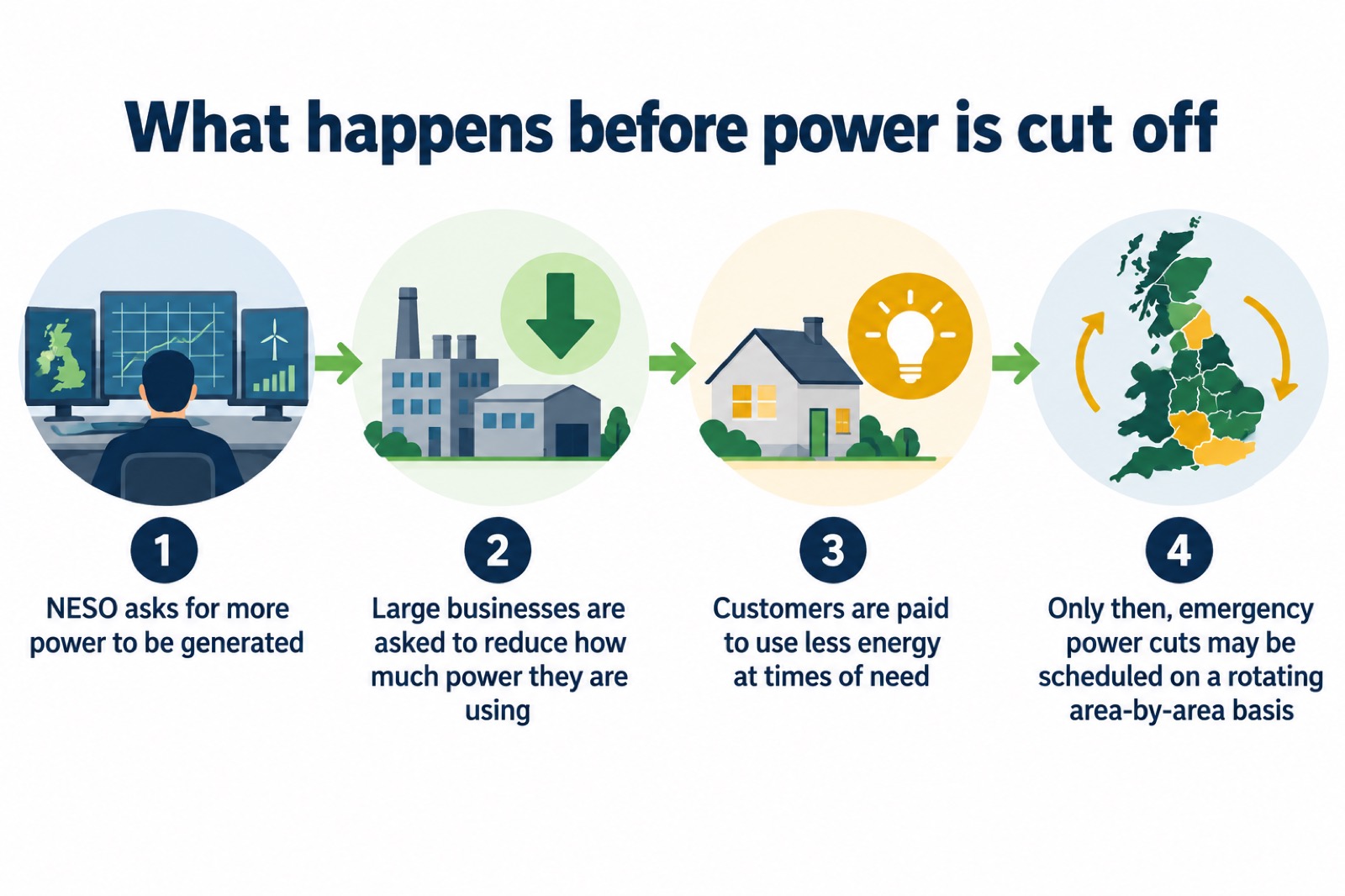
In the first minutes, the response is automatic and does not depend on anyone reaching a phone. Before power is cut off at all, the system operator will ask for more power to be generated, ask large businesses to reduce how much power they are using, and pay customers to use less energy at times of need6. Those steps come first, and they are the reason most shortages never reach households. Only if those measures are not enough do planned emergency power cuts begin, on a rotating area-by-area basis4.
The effects you would notice first are the ones official planning lists: communications, water and transportation disrupted; shops, petrol stations and cash machines closed; food spoilage and water contamination as time goes on1. Schools and colleges must close when the electricity goes off, because heating and water stop with it7. If the outage is national rather than local, help will be stretched: the UK Government Resilience Action Plan states that in widespread power and water outages the authorities may not be able to reach everyone who needs urgent support in the first few hours or days2.
What to do in those first hours is the same as for any power cut, only planned for longer:
- Check whether it is just your home: look at your trip switches and see if your neighbours have power too.
- Report the cut: visit your local network operator's website to report it and track updates, or call 105 free in England, Wales and Scotland, or 03457 643643 in Northern Ireland4.
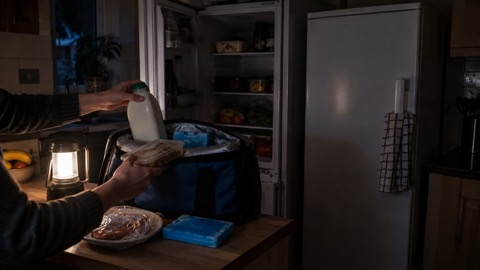
- Keep fridge and freezer doors shut, and follow the fridge and freezer guidance.
- Gather torches, not candles, and keep a charged power bank for your phone.
- Check on neighbours and relatives who may need help.
One point worth knowing in advance: you will not be paid compensation for blackouts caused by a national power shortage, for damage to electrical equipment or appliances, or for a low supply after a power cut8. Compensation for power cuts exists, but it does not cover a national shortage, so do not plan around a payment arriving.
NESO keeps supply matching demand, and its winter outlook warns of shortages ahead
The National Energy System Operator (NESO) runs the balance between electricity supply and demand across Great Britain, and that balance is the first line of defence against any national outage. When the cushion of spare capacity gets thin, NESO issues system notices to the market. An Electricity Margin Notice does not mean there is not enough electricity to meet demand; it means NESO would like a larger cushion of spare capacity and wants the market to provide it9. Those notices are an early warning to the industry, not a signal to households that the lights are about to go out.
The sequence of actions before any household is cut off is set out in official guidance6:
Each winter, NESO publishes a winter outlook that sets out how it expects supply and demand to match up. In its winter outlook report, the Electricity System Operator raised the possibility of emergency power cuts but said it was unlikely they would be needed, and its base case scenario does not expect any planned power disruption5. That is the honest position to hold in mind: the machinery for rota disconnections exists and is rehearsed, but the system operator's own expectation is that it will not be used.
For what this means for your household in a shortage, see rota disconnections and how Britain's electricity network is run.
Planned emergency power cuts can come with 30 minutes' notice or less
If a national energy shortage ever did require emergency power cuts, they would be scheduled on a rotating area-by-area basis. Each area in Great Britain is assigned a load block letter, and would be scheduled to disconnect from the electricity grid for around three hours at a time4. Power will normally be restored after the three hours, unless operational reasons prevent this, and your power might be switched off or reconnected around 30 minutes before or after the published time, depending on national electricity use5. You can find your own area's letter on the block letters page.
The notice you get depends on the type of cut. For planned emergency power cuts under a power-sharing rota, the guidance points to up to 48 hours' notice, and for planned power cuts generally, one source says 10 days' notice and another says at least 48 hours' notice, so treat days rather than hours as the realistic expectation for a rota. But for an emergency instruction, network operators may receive as little as 30 minutes' notice to implement a power cut, so it will not be possible to give advance notice as for a planned outage5.
How you would hear about it matters just as much as the timing. The Electricity System Operator plans to hold a press conference and use social media to let people know a few days before, with information then carried by national and local news and official social media channels. There will be no calls, texts or emails to every customer in advance5. That means your job before any shortage is simple: know where to find official information, and keep a battery or wind-up radio and a charged phone.
Your Local Resilience Forum warns, informs and advises the public
Behind every local response is a Local Resilience Forum (LRF). Each region across the country has one, made up of local authorities, the emergency services, the NHS and health bodies, and environment-related government agencies, set up to warn, inform and advise the public in the event of an emergency10. They are not a talking shop: each LRF brings together all the responder organisations that have a duty to assess risks and plan for emergencies under the Civil Contingencies Act 200411.
Their plans are specific and written down. Wiltshire and Swindon's Local Resilience Forum, for example, holds a Widespread Utilities Plan and a Local and National Power Outage Plan, with all LRF partners having their own local plans specific to their service or business7. During an outage, your LRF and your local utility providers are the places to look for what is happening: you will be able to search on your postcode on their websites and see if there is anything going on in your area7.
The Met Office plays a formal part in this system. It has a key role under the Civil Contingencies Act 2004 to provide information to Category 1 and 2 responders, and also to warn and inform the public around severe weather12. Its Civil Contingencies Advisors build relationships with responders, help assess weather-related risks and develop severe weather plans alongside other agencies in the local resilience forum, and support exercises by providing mock weather forecasts and warnings13. During severe weather, they communicate the forecast, the warnings issued and the potential impacts to emergency responders, and take part in multi-agency teleconferences13.
What this means for you is that local warning and information channels exist and are tested. Before an emergency, find your own LRF's website and your local network operator's site, and bookmark both. Know who your power provider is and how to contact them if you have a power outage14.
Who runs the response in England, Wales, Scotland and Northern Ireland
The lead government department for a national power outage is DESNZ, working with the National Energy System Operator2. Underneath that national lead, the machinery is local, and it differs between the four nations.
| Nation | Local resilience arrangements | Flood and environment lead |
|---|---|---|
| England | 38 Local Resilience Forums2 | Environment Agency15 |
| Wales | 4 regional Local Resilience Forums11, complementing the Wales Resilience Forum and Wales Resilience Partnership16 | Natural Resources Wales15 |
| Scotland | Local resilience forums, with emergency alerts able to be sent by the Scottish Government as well as the UK Government17 | Scottish Environment Protection Agency15 |
| Northern Ireland | NI Direct provides public emergency information15 | NI Direct15 |
The Environment Agency, NI Direct, the Scottish Environment Protection Agency (SEPA), Natural Resources Wales (NRW) and local authorities share responsibility for providing advice and information to the public during flood emergencies18, and the same bodies are the ones to check for flooding information for your part of the UK12. Power cuts cut across all of this, which is why the forums bring the utilities, the emergency services and councils together in one place.
Reporting a power cut also differs by nation. Call 105 for information, a free service for people in England, Scotland and Wales19; in Northern Ireland the number is 03457 6436433. Full details are on how to report a loss of electricity and the Northern Ireland page.
Emergency alerts can be sent by the UK Government, the Scottish Government or other public bodies that deal with emergencies, for example the police or your local council17. Keep your phone charged and do not disable emergency alerts.
London: over 170 organisations in the London Resilience Partnership
London's response is the largest single example of how this works, and it is worth understanding wherever you live, because it shows what "coordinated response" means in practice. The London Resilience Partnership brings together over 170 organisations who each have specific responsibilities for preparing for and responding to emergencies20. It acts on behalf of the Mayor of London, Greater London Authority, local authorities and London Fire Brigade to ensure London stays safe from the hazards and threats that could impact a city20.
The partnership's own definition of resilience is worth reading, because it describes what every LRF in the country is trying to do:
"an enabler which helps London to survive and prosper. It is the ability of institutions and communities to work together to prevent, handle then recover and learn from disruption, and adapt to change."
London plans for a national power failure specifically. The London Resilience Forum developed winter planning assumptions and held a strategic level pan-London workshop, plus a workshop for Borough Resilience Forums, for the risk of power failure during the winter of 2022/2321. In 2023 the London Resilience Partnership took part in a national power failure exercise, and continues to work with London partners and central government on implementing the recommendations arising from that exercise21. The London Risk Register, developed with partners, summarises the types of emergencies that may affect London, and the partnership advises starting there to find out what emergencies may affect you22.
The register takes the risk seriously. Failure of National Electricity is assessed as Very High risk, with a likelihood of 3 out of 5 and the highest impact rating7. The London Risk Register also records that failure of the national electricity transmission system would potentially affect millions of consumers23. That is the planning picture, not a prediction: it is why over 170 organisations rehearse together rather than wait for the day.
The partnership's reach goes beyond power. Following the summer flash floods, the Mayor called together senior leaders from the Environment Agency, Thames Water, the London Resilience Partnership, London Fire Brigade and London's boroughs, with further meetings led by the Deputy Mayors for Fire and Resilience and Environment and Energy24. Heat Ready London sets out where action is needed most from partners across six key sectors: the built environment; business and economy; emergency preparedness; resilience and response; health and care; and green space and nature, alongside infrastructure25.
How the energy industry plans to restore power and keep people informed
Restoration is the network operators' work, and it is planned for. Should there be a sudden loss of electricity, the network operator would be able to reconfigure their network to stabilise the grid and reconnect most customers11. Generators are used for faults by power companies where there is a failure of equipment that cannot be repaired immediately26, which is how areas can be kept supplied while permanent repairs are made. For households, battery power packs are a reliable source of power when the electricity goes off, letting you charge your phone and still use it at the same time27.
Keeping you informed is treated as a duty, not a favour. Communications providers should keep you informed during outages with clear, timely updates on what is happening, and where possible may offer temporary or alternative ways to stay connected; they often have a status page with updates on planned maintenance and significant incidents28. Your network operator's website is where you report a cut and track updates4.
What each part of the system does:
| Who | What they do in an outage |
|---|---|
| NESO | Balances supply and demand, issues system notices, and would schedule any emergency rota6 |
| DESNZ | Leads the government response as lead government department2 |
| Network operators | Reconfigure the network to stabilise the grid and reconnect most customers; use generators for unrepairable faults11 |
| Local resilience forums | Warn, inform and advise the public, under plans written in advance10 |
| Communications providers | Keep you informed with clear, timely updates, and may offer alternative ways to stay connected28 |
For how long restoration can take and what affects it, see how long until the electricity comes back?, and for what to check when the supply returns, when the supply returns.
Landlines after the digital switchover: why your phone may not work in a blackout
The way Britain's phone network works is changing, and it changes what a blackout means for your ability to call for help. Digital landlines need mains electricity and will not work in a power cut unless there is a battery back-up29. The old copper network is being retired: BT plans to retire its old landline network by 31 January 2027, by which time consumers on the network should have been moved to a digital landline or another equivalent phone service29.
There are protections, and you should know them now rather than during a cut:
- If you depend on your landline, your provider must make sure you can contact the emergency services during a power cut29.
- If your landline will not work during a power cut, your landline provider might offer you a free solution, such as a back-up battery unit, for a minimum of one hour, that would enable you to call the emergency services if you needed to4.
- For vulnerable customers, the guidance is stronger: your communication provider must provide a free back-up battery unit, meaning the landline would work for at least an hour during a power cut, and many batteries now last much longer28.
Contact your landline provider to check whether your phone will work during a power cut, especially if it is your only way of making emergency calls or you have a telecare kit connected3. If your landline is not working, try your mobile; if your mobile network is down but you have a working Wi-Fi connection, you may still be able to make calls over Wi-Fi by enabling WiFi Calling on your device28. Remember that the mobile network may still be operating during a power cut even though your phone runs out of battery27, which is exactly why a charged power bank matters.
If you cannot get through to 999 or 112 and it is safe to do so, seek help directly from emergency responders, or go to your nearest police station, fire station, ambulance station or hospital28.
Stay out of dangerous areas until the emergency services say it is safe
The most important safety rules in any widespread outage are about what is happening outside your home. If you see power lines that have been brought down or damaged, keep as far away as possible: electricity at high voltages can jump gaps with no warning14. Keep away from hazards such as power lines for the same reason3. Full guidance is on fallen overhead lines.
The general instruction in a widespread emergency is to stay inside until you are contacted by emergency services or you are told it is safe to leave30. That is not a suggestion to hide indefinitely; it is a rule for the period when hazards outside, such as damaged lines, flooding and debris, have not yet been checked.
Other safety rules that apply during and after an outage:
- If you must use naked flames, take extra care and make certain that they are put out before you go to bed31. Prefer torches: see staying safe in the dark.
- Know where to turn off your electricity and/or gas32, and in an emergency be ready to turn off your gas supply, water supply and electricity supply, if possible33.
- After flooding, do not turn on your electricity or gas supplies until they have been checked by a qualified electrician or engineer34.
- Very bad weather, like storms, lots of rain or snow, is the main cause of power cuts, and heavy snow can also make it harder for National Grid to travel to your area to fix problems30.
If your area floods as well as losing power, the National Flood Forum has a helpline that provides general support before, during and after a flood on issues including insurance, home re-instatement and home resilience34, and it provides information on local flood groups35.
Getting ready now: the household side of a national plan
Because a national outage would last days rather than hours, the preparation that matters is the kind that carries a household through several days. The essentials, each covered in more detail elsewhere on this site:
- A household emergency plan agreed with everyone in the home, including who to contact.
- A power cut kit: torches, battery or wind-up radio, power banks, and supplies for keeping warm without electricity.
- A plan for medical equipment that needs electricity: if you use medical equipment that requires a power supply, make a plan with your care provider and/or clinical care teams now about what will happen in a power cut, setting out what action you or someone you care for needs to take and who to contact4.
- Registration on the Priority Services Register for extra help during long outages.
- Emergency numbers kept written down, including 105 and your network operator.
- Knowledge of your load block letter for a rota disconnection.
The UK Government is considering further plans to share information and advice with the public on risks and emergencies, building on existing resources such as the UK National Risk Register16, so expect official public information to keep improving. But the household measures above are the ones that determine how the first days of any national outage go for you, and none of them need to wait.
Sources (35)
- What is a National Power Outage (NPO)?, Wiltshire and Swindon Prepared
- The UK Government Resilience Action Plan, UK Government, 2025-07
- Power cuts: be prepared, UK Government beready campaign
- Power cuts: be prepared, UK Government prepare campaign
- Emergency power cuts, Electricity North West
- What are electricity rota loads?, Wiltshire and Swindon Prepared
- Failure of National Electricity, Wiltshire and Swindon Prepared
- Check if you can get payment for a power cut, Ofgem
- What are system notices?, National Energy System Operator
- Emergency alerts, Denbighshire County Council
- Resilience and risks in Wales, Welsh Government
- Community resilience: flooding information by nation, Met Office
- Spotlight on civil contingencies at the Met Office, Wiltshire and Swindon Prepared
- Storms: be prepared, UK Government prepare campaign
- Community resilience: flood risk bodies by nation, Met Office
- Statement on resilience and emergency preparedness, Welsh Government, 2026-10-13
- Find and share information in an emergency, Ready Scotland
- Protecting your property from winter weather, Met Office
- Stay safe in a thunderstorm, Met Office
- London Resilience Partnership, Greater London Authority
- Potential power cuts in London, Greater London Authority
- Preparing yourself for emergencies, Greater London Authority
- London Risk Register v14, Greater London Authority, 2025-01
- Be flood aware, Greater London Authority
- Heat risk in London, Greater London Authority
- Generators, Wiltshire and Swindon Prepared
- How to prepare for the loss of electricity, Wiltshire and Swindon Prepared
- Phone and broadband outages, UK Government prepare campaign
- Future of landline calls, Ofcom
- Preparing for a power cut, easy read, National Grid
- Strong winds and heavy rain warning information, NI Direct
- Thunderstorms: weather warning advice, NI Direct
- My street is flooding, London Fire Brigade
- How to prepare for flash flooding, Greater London Authority
- Flooding and health: safely cleaning your home, Wiltshire and Swindon Prepared
 Power Cut Kit Checklist
 What to Keep Charged
 Household Emergency Plan
 Reporting a Power Cut
 What to Do in a Power Cut
 Getting Ready for a Power Cut
 Fridge and Freezer Food
 Keeping Warm Without Electricity
 Central Heating Without Power
 Cold Homes and Health
 Carbon Monoxide Risks
 Staying Safe in the Dark
 Smoke and Carbon Monoxide Alarms
 How Long Until Power Returns
 When the Power Comes Back