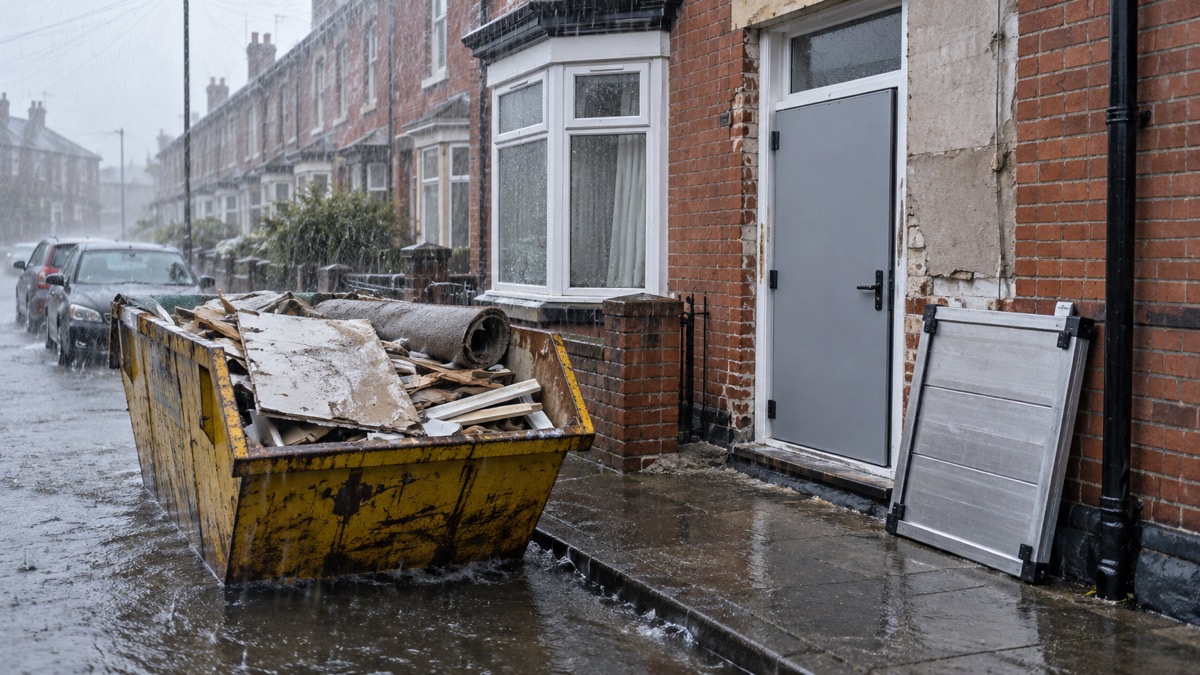
When your home has been flooded, the repair job that follows is also the best opportunity you will ever have to make the next flood less damaging. The walls are open, the floors are up and the kitchen is out: work that would be disruptive to do later can be done now while everything is already stripped back. The single most important step is to raise it with your insurer before any work begins. The Met Office's advice is direct: "If you've been flooded, contact your insurance company, follow their advice, and ask whether they offer Build Back Better"1.
Build Back Better is the scheme that matters most here. It offers householders the chance to install property flood resilience measures up to the value of £10,000 when repairing their properties after a flood2. Surrey County Council describes it as giving homeowners the opportunity to install flood resilience measures up to the value of £10,000 when repairing their properties after a flood, offered by some insurance companies3. Alongside it, some councils run property flood resilience grant schemes worth up to £5,000 for homes that qualify4.
This page sets out what to ask for, when, and which materials and design choices actually make a house recover faster: floors, plaster, insulation, sockets, kitchens and services. It follows the practical order of a real repair, from the first call to the insurer to the last coat of plaster.
First call: your insurer, before anything is touched
Your insurance company should be the first point of contact after a flooding incident, and they should guide you on what happens next6. This is not a formality. Repair work started too early, or damaged items thrown away before they have been seen, can invalidate a claim. Nottinghamshire County Council advises households with insurance to keep damaged items and avoid undertaking repair works until they have made contact with their insurance company, precisely because acting first may invalidate the claim7. Tewkesbury's flood recovery leaflet puts the same rule plainly: "Do not undertake any clearance or repair work until your insurer has given approval"5.
The first conversation should cover several things. Take photos of any damage to your home before clean-up begins, because the insurer may require evidence of damage before clean-up starts8. Do not throw damaged items away until your insurers have inspected them9. Ask how long it will take them to see you, and whether they will organise professional cleaners or whether you will have to do that yourself10. Insurers may also provide practical help on the spot: financial assistance for blowers, skips, and recommendations for reputable contractors11.
Most of the repair work after flooding will need to be undertaken by professionals appointed by your insurers, so the insurer is not just paying for the work, they are largely organising it1. Derbyshire County Council adds that you should contact your insurance company and, if applicable, your landlord, for advice and to get approval to carry out any repairs, keeping records and photographs as you go12. If you rent, the same sequence applies: your landlord and insurer come first.
If you are not insured, the sequence changes but the caution does not. Nottinghamshire advises uninsured households to seek several quotes for repair work from reputable businesses and to request references where possible to check the quality of work7. Help with costs may be available through recovery grants, which are covered on our page about recovery grants and help if you are not insured.
Build Back Better: up to £10,000 for flood resilience measures
Build Back Better exists because a like-for-like repair simply rebuilds the same vulnerability. The scheme gives homeowners the opportunity to install flood resilience measures up to the value of £10,000 when repairing their properties after a flood13. It is offered by some insurance companies2, and policies from some insurers will allow claims to include an amount for resilient repair over and above the cost of like-for-like reinstatement of the actual flood damage. That means the conversation with your insurer matters: the extra funding is not automatic, and it has to be agreed as part of the claim.
The measures this can pay for are the ones this page is about. Cornwall Council's resilience work describes "recoverability" measures such as using flood resilient building materials and raising sockets further up walls14. UK Health Security Agency guidance for frontline responders describes the two halves of property flood resilience: resistance, which means keeping water out, and recoverability, which means adapting the property to reduce damage from water entry15. Build Back Better funding is aimed mainly at the recoverability side, because those are the works that fit naturally into a repair.
The reason it pays is straightforward. When carrying out repair work, you may also be eligible for funding to help install property resilience measures through the Build Back Better scheme16. A house that floods to a depth of a few centimetres over a tiled floor with raised sockets and lime plaster can be cleaned and reoccupied in days; the same house with fitted carpets, gypsum plaster and low sockets is a strip-out job lasting months.
If your insurer can repair the property under Build Back Better, which includes property flood resilience measures, there may be no need for you to apply for a separate grant4. That is worth establishing early, because it affects who commissions the work and who pays. Householders can also contact Flood Re directly for more information on the scheme15. Our page on what Build Back Better means for a claim goes into the claim process in detail.
Insurers set their own rules, and not all of them offer the scheme
Build Back Better is offered by some insurance companies, not all of them3. If your insurer does not take part, the default position is like-for-like. nidirect's guidance is clear on what that means: your insurer will usually pay for like-for-like amendments, restoring your home to a similar state to before the flood, but you are likely to have to pay for any work beyond like-for-like amendments yourself17. A case study from Derbyshire records a householder's experience of exactly this: the insurance companies would not pay for flood resilience measures, only like-for-like repair18.
There are still options in that position. You can ask for a cash settlement and arrange the repair work yourself, as Natural Resources Wales advises, but you then become responsible for the quality of the work19. Council-run property flood resilience grant schemes can fill the gap: in Suffolk, eligible property owners, domestic and commercial, can apply for up to £5,000 (including VAT) to make their property more resilient to future flooding4, and similar schemes have run elsewhere, including up to £5,000 for properties flooded during Storm Babet20. Devon's scheme covers up to £5,000 per property, and that sum includes a detailed flood risk assessment survey of the property which identifies the required resilience measures21. Our page on property flood resilience grants sets out how these schemes work.
Two cautions from the grant rules are worth knowing before you spend anything. Devon County Council states that no retrospective payments will be made for property flood resilience arranged outside its scheme without prior approval22, so agree the arrangement before commissioning work. And Suffolk's scheme excludes garages, outhouses and storage areas, second homes, empty homes, basements or cellars not used as part of the habitable area, and holiday cottages that are not part of a commercial enterprise and not the owner's principal residence4.
One more thing that can help with insurance itself: insurers may accept additional information about an individual property's flood risk from reliable sources, such as an independent survey or flood risk assessment23. Resilience work you have had done, documented properly, can therefore matter at renewal as well as at repair time. The wider picture is set out on our page about home insurance in a flood risk area and Flood Re.
Drying out comes first, and it cannot be rushed
Resilient repairs happen at the end of drying, not the beginning. Drying out can take weeks or even months, and if it is done too quickly it can cause structural damage and long-term problems5. Flood repairs themselves can take weeks or months to complete, especially if there has been widespread flooding and builders are scarce, and some buildings may have to be gutted before repairs can start24. Surrey County Council warns that many flooded houses will take six months or even longer to repair3. Planning for that timescale, including where you will live, is part of the repair.
The drying method is low-tech: ventilation, heat and time. You can speed up the drying process by keeping the building well ventilated, opening as many windows and doors as possible and using a fan25. NHS clean-up advice adds heating to the mix: leave doors and windows open whenever possible and safe, and use fans, air conditioning units and dehumidifiers26. Our page on drying out a house with dehumidifiers covers the equipment side.
With wooden floors there is a specific job to do: remove dirty water and silt from your property, and if you have wooden floors this may be below the floor and will need pumping out. Air bricks may need unblocking, and loose material and dust will need vacuuming up regularly throughout the drying out process27. One safety rule governs pumping: do not pump out water until levels outside your property are lower than inside, because this reduces the risk of structural damage24. External water pressing on empty walls and floors is what does the damage.
Do not start clean-up or repairs until you are sure it is safe to do so28, and keep open cuts or sores clean and covered with waterproof plasters so they are not exposed to floodwater while you work around the house20. Damaged timber floorboards and tiles, even when they are dried out, may present a risk of injury to the young, so keep children away from rooms with damaged floors during this period26.
Floors that survive water, or lift out and dry fast
Flooring is the single biggest recoverability decision in a flooded house, and the official advice is consistent across the UK. Solid flooring such as concrete covered with treated timber or sealed tiles is more resistant than floor boards or chipboard3. Solid flooring is much more resistant to flood damage than floor boards29. Water-resistant flooring such as concrete or tiled floors limits damage to property and possessions16. The reason is simple: a solid floor can be washed down and dried, while chipboard swells and disintegrates, and timber boards cup and need lifting.
The standard resilient combination, repeated in guidance from Natural Resources Wales, Suffolk and the Cotswolds, is ceramic tiles with rugs instead of fitted carpets2. A rug that has been in floodwater can be thrown away and replaced in an afternoon; a fitted carpet has to be lifted, disposed of and replaced by professionals, and it holds water in the floor while it waits. Suffolk's booklet for properties prone to regular flooding sets out the same package: lay tiles and use rugs rather than fitted carpets, raise electrical sockets to at least 1.5 m above ground floor level, use lime plaster instead of gypsum on walls, and replace wooden window frames and doors with synthetic ones24.
Case studies show what this looks like in practice. In Corbridge, a householder filled in a suspended timber floor with concrete, laid hardwood flooring with rugs, and rendered the walls with waterproof cement18. At a gallery in Hebden Bridge, the floor is now concrete with steel supports and insulation below, finished with porcelain tiles18. Filling a suspended floor is a major structural decision that belongs in the professional repair, not a DIY job, but it is exactly the kind of measure a Build Back Better payment can cover.
Insulation, timber floors and the spaces underneath
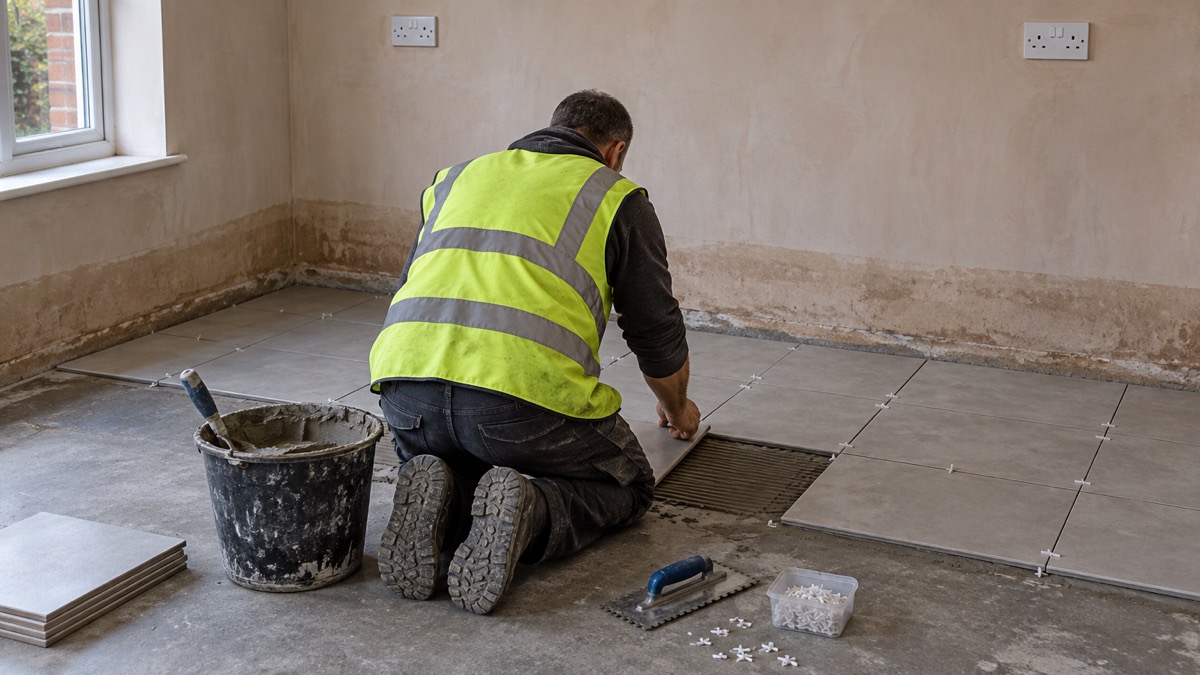
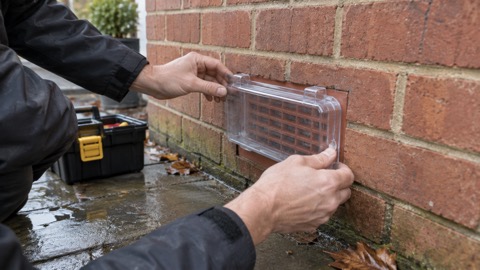
Where a suspended timber floor stays, the space beneath it becomes part of the flood story. Water and silt collect under the boards and have to be pumped out27, and the air bricks that ventilate that space may need unblocking during drying27. That ventilation is not optional: it is how a timber floor survives. The corresponding rule from the Environment Agency's damage limitation guidance is that you must not permanently seal any airbricks, wall vents, or air intakes and vents for appliances such as boilers, because these need to be re-opened as soon as possible after a flood, and permanently blocking them may be hazardous29. Temporary airbrick covers that are fitted only when a flood is coming and removed afterwards are the safe alternative, and our page on airbrick covers and self-closing airbricks explains them.
On insulation, the guidance points to type and position. nidirect's list of flood protection improvements includes installing closed-cell type insulation in the cavity17. Closed-cell insulation does not soak up and hold water the way absorbent insulation does, which matters both for how quickly a wall dries and for whether the insulation has to be stripped out after a flood. Where a floor has been replaced with concrete, insulation can sit below the slab, as in the Hebden Bridge gallery, where the new concrete floor has steel supports and insulation below18. What the guidance does not support is packing absorbent insulation into a floor void that floods and then stays wet: anything under a timber floor that holds water slows the drying the floor depends on. If in doubt about what is under your boards, this is a question for the surveyor or builder appointed to the repair, not something to guess at.
Lime plaster: why removing it is rarely justified
The plaster choice is where many repairs go wrong, and the official advice is unusually unanimous: use lime plaster instead of gypsum2. Gypsum plaster absorbs water, loses its integrity and generally has to be hacked off and replaced after a flood. Lime or waterproof cement render is more water resistant than normal plaster, which is why guidance for properties prone to regular flooding recommends it24.
There is a second reason, and it matters most in older houses. Lime plaster is breathable: it lets moisture move through the wall and evaporate away. A case study from York in Derbyshire's collection records that waterproof and breathable plaster is easy to apply, needs no specialist training and helps to keep the cost down18. That combination of waterproof and breathable is what you are looking for in a resilient wall finish: it resists floodwater on the way in and lets the wall dry out afterwards.
If your older house already has lime plaster, a flood is rarely a reason to lose it. The repair question is whether it can be dried and retained, and in most cases it can. Where walls have been taken back to bare stone or brick, as at the Hebden Bridge gallery, they were sealed and finished with a resilient concrete render18, which is the equivalent choice for a full strip-out. Either way, the specification belongs in the repair schedule agreed with your insurer's professionals, and raising it early is exactly what the Build Back Better conversation is for.
Where water-resistant coatings must never go
Waterproof coatings have a place, but it is a specific one. Surrey County Council's advice is to use waterproof sealant on external walls and waterproof paint on internal walls3. Those are wall finishes, applied as part of a proper repair, and they work alongside breathable plasters rather than instead of them.
The place coatings must never go is on ventilation. Permanently sealing airbricks, wall vents, or air intakes and vents for appliances such as boilers is hazardous, and the Environment Agency's guidance is explicit that these must be re-opened as soon as possible after a flood and never permanently blocked29. A sealed airbrick stops a timber floor and wall cavity drying, and a blocked boiler vent is a danger in its own right. The right products are temporary covers, fitted only when floodwater is coming and removed straight afterwards.
The same thinking applies to whole-house sealing. Wrapping a property against floodwater requires some DIY ability, plenty of suitable materials and enough time to construct the wrapping before the property is affected by flooding29, and it is a resistance measure for the flood itself, not a repair. If you are weighing up what to seal and what to leave breathing, our page on protecting your home: resistance and resilience measures separates the two approaches.
Sockets, kitchens, boilers and services: raising what water reaches
How the electrics are arranged matters as much as how high the sockets sit. One case study household went further and isolated the electrics so upstairs could continue to function during a flood18; nidirect similarly recommends separate electrical circuits for upper and lower floors17. Separate circuits mean the upstairs supply can keep working while the ground-floor wiring that does get wet is limited and easier to make safe. Electrical work of any kind must be done by a qualified electrician as part of the professional repair.
Kitchens are the other big loss in a flood, and the guidance is consistent: fit stainless steel or plastic kitchens, or free-standing units2. Free-standing units can be moved out or lifted onto plinths before water arrives, and stainless steel or plastic survives immersion. nidirect adds the detail of placing white goods on raised plinths17. A case study household in Derbyshire moved the kitchen upstairs altogether, alongside a flood door, a floodproof window and a boiler moved up the wall18. Most households will not go that far, but the boiler position is worth raising in every repair: position it upstairs, or raised well above the ground floor2.
The remaining service measures from the official lists are quick to state and belong in the same repair conversation: fit non-return valves to all drains and water inlet pipes30, install service vent covers and automatic airbricks17, and replace wooden window frames and doors with synthetic ones2. Non-return valves stop sewage and floodwater backing up into the house through drains, which is a separate and unpleasant flooding route covered on our page about non-return valves and toilet bungs.
| Measure | What it does after a flood | Guidance |
|---|---|---|
| Ceramic tiles with rugs, not fitted carpet | Floor washes down and dries; rugs are replaceable | 2 |
| Solid floor (concrete, sealed tiles) | Resists flood damage far better than boards or chipboard | 3 |
| Lime plaster instead of gypsum | Wall survives saturation and dries out; breathable | 2 |
| Sockets raised to at least 1.5 m | Wiring sits above typical flood depths | 2 |
| Stainless steel or plastic, or free-standing kitchen | Units survive immersion or can be moved | 2 |
| Boiler upstairs or raised well above ground floor | Heating survives the flood and aids drying | 2 |
| Closed-cell cavity insulation | Does not hold water; wall dries faster | 17 |
| Non-return valves on drains and inlet pipes | Stops backflow through the drains | 30 |
Choosing a builder for resilient repairs
Because most repair work after flooding is undertaken by professionals appointed by your insurers1, the builder is often chosen for you. Where you do choose, the official advice is to use a builder recommended by your local council or insurance company25, and to speak to your insurance company before engaging any companies offering to repair flood damage7. Firms that appear at the door after a flood are the reason for that warning: Nottinghamshire advises households to beware of companies offering a quick fix solution7. Our page on avoiding rogue traders after a flood covers the warning signs.
For work you commission yourself, whether through a cash settlement or a grant, seek several quotes from reputable businesses and request references where possible to check the quality of work7. Resilient repair is not a standard builder's skill set: the case studies that show it working well involve households who engaged with the specifics, from waterproof render to marine ply counter bases sealed against water18. A builder who can talk through lime plaster, closed-cell insulation and raised sockets, and who has done flood work before, is the one whose references will say so.
A property flood resilience review ties it together
Rather than choosing measures one at a time, a survey looks at the property as a whole. Property Flood Resilience involves installing measures on individual properties to reduce the impact of flooding14, and a review identifies products appropriate to the type of flooding, the property and the needs of the owners, including barriers on windows and doors, non-return valves, automatically closing airbricks and pump systems for groundwater flood risks31. Cornwall describes PFR as most suitable for properties in locations that are vulnerable to flooding but where a large-scale flood protection scheme is not viable14, which is the situation of most households reading this page.
Some grant schemes build the survey in. Devon's funding scheme covers up to £5,000 per property, and that sum includes a detailed flood risk assessment survey of the property which will identify the required resilience measures21. Suffolk's scheme likewise funds measures that make the property more resilient to future flooding4. The benefits Argyll and Bute records from its PFR work are the ones this page has been building towards: improved flood resilience against river and surface water flooding, reduced impacts and recovery time, increased self-sufficiency during a flood, and peace of mind31.
If your home is being repaired now, flood recovery guidance advises considering whether it could be made more resilient to flooding in the future, as there may be funding available or options through your insurer1. If you are preparing before any flood, the same measures can be introduced gradually, and our page on property resilience surveys and professional installation is the place to start.
Sources (31)
- Protecting your property from flooding, Met Office, 2026
- Preparing for a flood, Natural Resources Wales, 2026
- Getting back into your home following flooding, Surrey County Council, 2026
- Property flood resilience grant scheme, Suffolk County Council, 2026
- After a flood: flood recovery leaflet, Tewkesbury Borough Council, 2023
- Flooding recovery, Carmarthenshire County Council, 2026
- Advice for homeowners affected by flooding, Nottinghamshire County Council, 2026
- After a flood: flooding advice, London Fire Brigade, 2026
- Flooding advice, Mid and West Wales Fire and Rescue Service, 2026
- Flood risk in Anglesey: be prepared, Isle of Anglesey County Council, 2013
- Be prepared: flooding advice, Lancaster City Council, 2026
- Cleaning up after flooding, Derbyshire County Council, 2026
- Flood recovery support, Argyll and Bute Council, 2026
- Property flood resilience projects, Cornwall Council, 2025
- How to prepare for flooding: advice for frontline responders, UK Health Security Agency, 2023
- Personal resilience to flooding, Derbyshire County Council, 2026
- How to protect your home from flooding, nidirect, 2025
- Property flood resilience case studies, Derbyshire County Council, 2024
- What to do after a flood, Natural Resources Wales, 2026
- Flood recovery information for Suffolk, Suffolk County Council, 2023
- Property flood resilience funding, 2nd edition, Devon County Council, 2023
- Property flood resilience funding scheme, Devon County Council, 2022
- Insurance for properties at risk of flooding, Cornwall Council, 2026
- Before, during and after a flood booklet, Suffolk County Council, 2021
- After a flood: clearing up, nidirect, 2026
- Flood clean-up advice, NHS, 2021
- Flooding aftercare, Runnymede Borough Council, 2026
- Rain and flooding: respond, Ready Scotland, 2026
- Damage limitation guide, Dover District Council, 2001
- Preparing your home for flooding, Cotswold District Council, 2020
- Property flood resilience questions and answers, Argyll and Bute Council, 2026
 Flood Warning Checklist
 First Steps After a Flood
 Insurance Claim Records
 Checking Flood Risk by Postcode
 Types of Flooding
 Flood Alerts and Flood Warnings
 Flood Guidance Statement
 Wales Flood Warnings and Maps
 Making a Household Flood Plan
 Protecting Your Home
 Door Flood Barriers
 Sandbags and Alternatives
 Flood Doors and Windows
 Airbrick Covers
 Non-Return Valves and Bungs