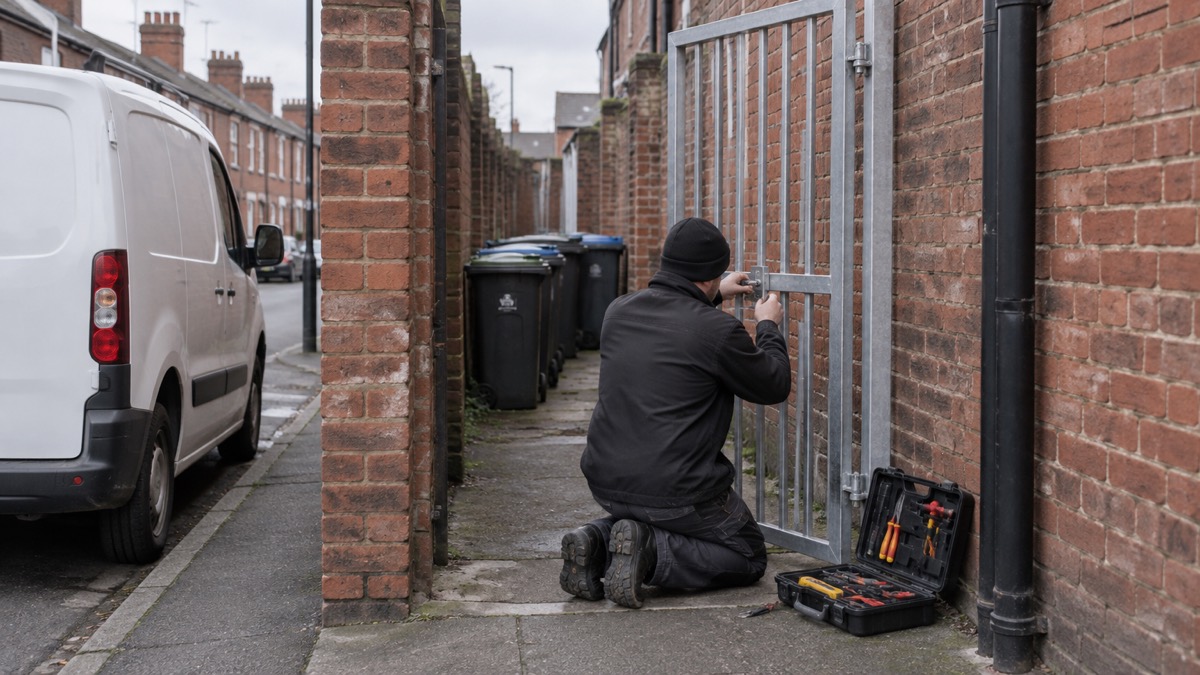
Many terraced streets across the UK have a shared alley or ginnel running along the back of the houses. It gives you rear access for bins, bikes and deliveries, and it gives a burglar a quiet place to work where the street cannot see them. Alley gating, putting a lockable gate across the alley entrance, closes that route to intruders while keeping it open to the households that need it. Done well, it makes the whole row harder to break into. Done badly, it blocks your fire escape, stops the fire service getting in, and turns a drainage problem into a flood.
The work falls into two halves. The first is security: a gate that a burglar cannot easily open or climb, a back door and rear gate that resist attack, and nothing in the garden that hands an intruder a ladder to your upstairs windows. The second half is safety: the alley must still work as an escape route in a fire, everyone in the house must be able to open the gate in the dark and in a hurry, and the fire service must be able to reach you. This page sets out both, and then covers the practical problems that come with rear alleys: who owns them, who unblocks the drains, and where to get help.
What alley gating means for a terraced house
A rear alley is the one part of a terraced street that nobody watches. The front of your house faces a public road with passers-by, neighbours at windows and often cameras; the back faces a narrow lane that only the residents use. Burglars know this. A gate at each end of the alley removes the easy, unseen approach to back doors, patio doors and ground-floor windows, and it does so for the whole row at once rather than one house at a time. That is why gating is usually a street decision rather than a single-household one: a gate only works if the alley behind it is closed off along its length.
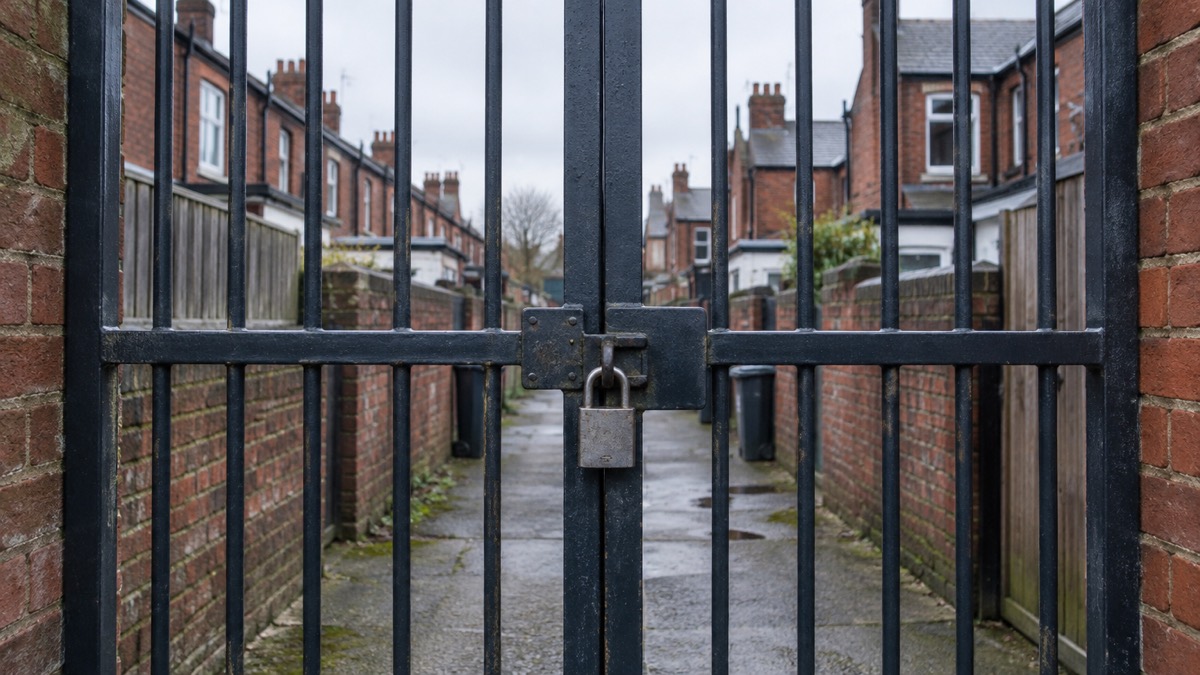
Gating is not only about the gate. The same rear access that helps a burglar can be helped or hindered by what you keep in the garden. nidirect's home security advice is to make sure any trellising or gazebos do not give burglars an easy way to get to your upstairs windows7. Anything climbable near the boundary, a trellis, a gazebo, a wall-mounted ladder, can turn a gated alley into a route to the first floor, which is often left with windows unlocked. Treat the gate as the start of the rear defence, not the whole of it.
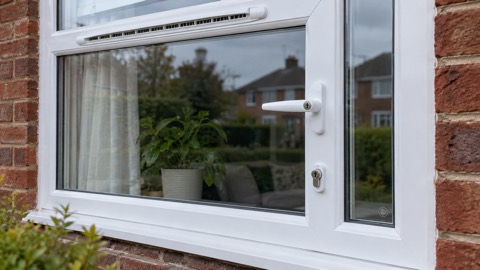
The back door itself deserves the same attention as the front. Police crime prevention advice on door security notes that if your door has a letterbox, a letterbox guard fitted to the rear of the door will prevent someone reaching in and opening the door or fishing for items nearby8. Many terraced back doors have a letterbox for the same reason the front door does, and a rear letterbox is the one nobody watches. For the door itself, the standards, locks and cylinders that matter are covered in Doors and Locks: Standards, Cylinders and Making Entry Harder, and the window risks at the back of a house are covered in Windows: Locks, Glazing and Ground-Floor Risks.
One more point sits between security and fire safety. London Fire Brigade's advice on reducing arson risk includes keeping entry points to buildings secure, including sheds or garages, perimeter walls, fencing and gates, and locking gates out of hours1. Secure rear boundaries do two jobs at once: they keep intruders out, and they make it harder for someone to enter the alley unseen and start a fire against a shed or a bin. The rest of this page is about keeping that security from getting in the way of escape and rescue.
Who owns and controls your rear alley
Before a gate goes up, find out who actually owns the alley, because that decides who can authorise it, who maintains it and who is liable for what happens in it. Rear alleys in terraced streets are usually one of three things: adopted public highway, which the council maintains; unadopted or private lane, where the rights and duties sit with the households that use it; or land belonging to a single owner, sometimes a landlord, a utility or a business at the end of the row. The answer is rarely obvious from looking at it.
The starting point is your property deeds and the council's highways records. Deeds will show whether the alley is included in your title, held in a neighbour's title, or left unregistered, and the highways records will show whether the council has ever adopted it as public highway. The same search will often surface an old right of way, a shared maintenance agreement or nothing at all, and each answer leads somewhere different.
Responsibility for what runs beneath and along the alley follows ownership too. Private foul sewers are the responsibility of the property owner5. Cumberland Council sets out the typical split for roadside drainage: blocked gullies, the roadside drainage gratings, are the council's, while roadside ditches and private sewers or drains are mainly the responsibility of the private landowners on each side of the ditch9. Property owners are responsible for looking after their homes, including protecting them from flooding and drainage issues within their own property boundary6. In practice that means the gully in the public road is the council's problem and the drain under your yard is yours, with the alley itself depending on its status.
| What it is | Who is usually responsible | Where to check |
|---|---|---|
| Adopted highway or alley | The council | Council highways records |
| Unadopted or private lane | The households with rights of access | Your deeds and any shared agreement |
| Private foul sewer | The property owner5 | Deeds; council drainage team |
| Roadside ditch or private drain | Mainly the landowners on each side9 | Deeds; council |
| Drainage within your boundary | You, the property owner6 | Your own maintenance |
Utilities in the alley follow their own rules. Wiltshire and Swindon Prepared explains that for independent utility companies, from the boundary of an estate to the "front door" the cables and pipework are owned and the responsibility of the Independent to maintain and fix10. If your property's next to a canal, contact the Canal and River Trust to check who is responsible for maintaining it11. And if you cannot find out who owns or controls an electrical installation in the alley that you think is unsafe, the Health and Safety Executive says contact your local authority or HSE12. None of this stops you gating the alley, but it tells you who you need on side and who to call when something in or under it fails.
If you employ someone to do work at the rear, such as installing a gate post or an oil tank, the responsibility chain continues to you. Government advice on oil storage at home says that if you do not use someone registered with a competent person scheme, you will have to get a Building Control Notice from your local council and arrange and pay for an inspection yourself, and you are responsible for making sure the installer's work meets the regulations13. Where a managing agent is involved, the HSE's gas safety advice is to make sure the management contract clearly specifies who is to make the arrangements for maintenance and safety checks, and to request copies of maintenance information and safety check records14. Both points matter on shared land where it is easy to assume someone else is checking.
Keeping a rear escape route open in a fire
The rear alley is often the second way out of a terraced house, and in a fire at the front of the property it may be the only way out. Every fire and rescue service in the UK makes the same point about escape routes: keep them clear. Cornwall Fire and Rescue Service says make sure exits are kept clear15. Staffordshire Fire and Rescue Service says keep all exits clear of obstructions, like bicycles2. Mid and West Wales Fire and Rescue Service adds that the best way to escape from your property is using the normal routes, and that you should make sure all landings, stairs and corridors to front and back doors are clear of anything that would slow you down or trip you up16.
A gated alley changes the escape route in one specific way: the gate is now part of it. That means the path from your back door to the gate, and the gate itself, must stay usable at all times, not just when the bins go out. North Yorkshire Fire and Rescue Service's hoarding safety advice makes the general principle plain: ensure escape routes are always accessible, with no obstructions blocking doorways or hallways17. Cheshire Fire and Rescue Service says to plan and practise your escape route and keep it clear at all times, noting that a clear route will also help firefighters get to you18. Practising matters especially with a gate, because opening an unfamiliar lock in smoke or in the dark is much harder than opening your own back door.
nidirect's fire advice for Northern Ireland compresses the whole plan into one line: planned escape, meaning have a fire escape plan, keep access routes clear, close all doors at night and have your keys at the ready19. Closing internal doors at night slows a fire's spread and buys time for the rear escape. Devon and Somerset Fire and Rescue Service advises anyone who uses mobility aids to make sure all exits and escape routes are kept clear, taking into consideration any mobility aids that you use20. A gate and alley planned around a wheelchair or guide frame must be tested from the chair, not assumed.
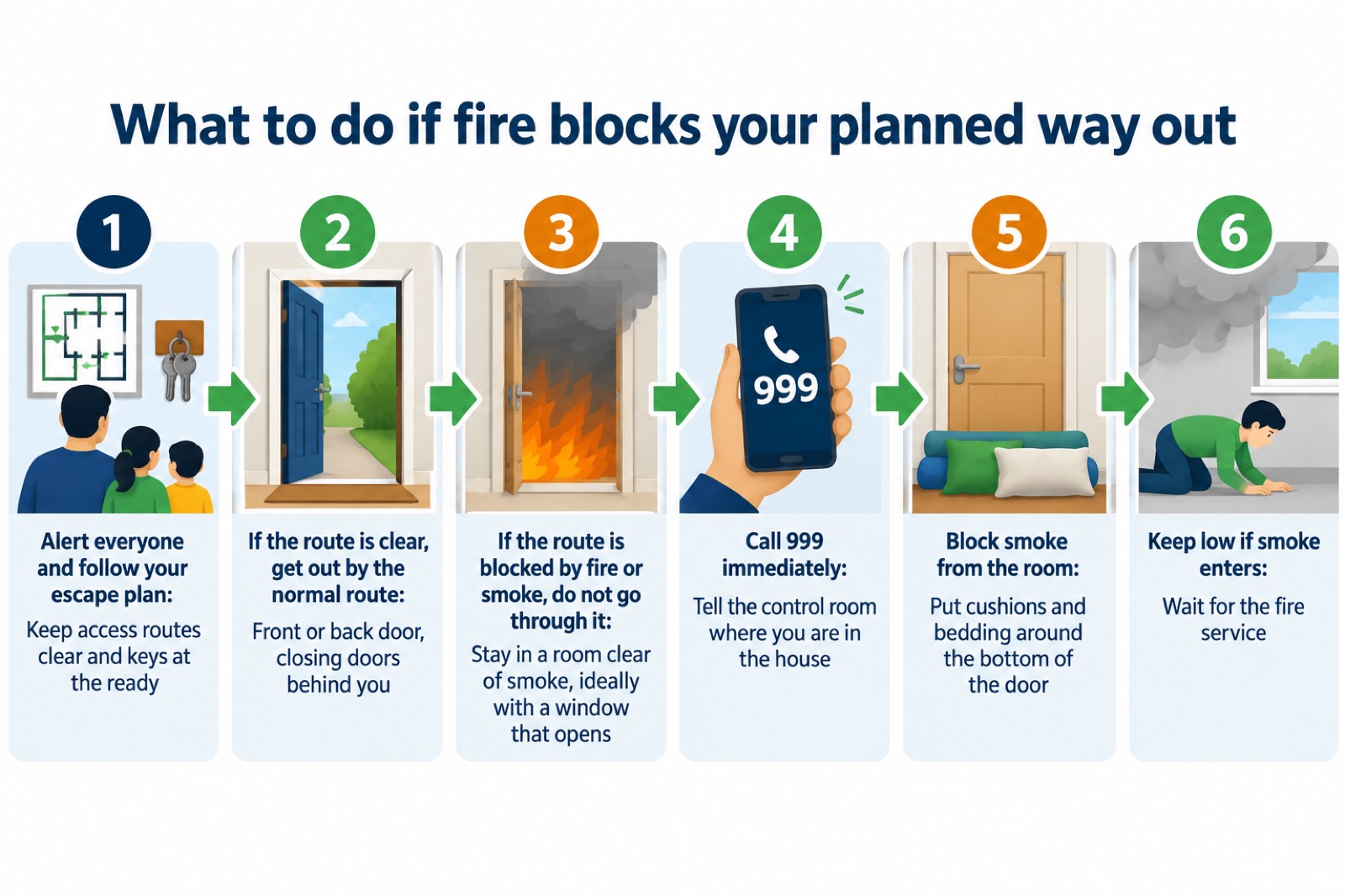
If the worst happens and the route is blocked, the advice is consistent across services. Manchester Fire and Rescue Service says that if your escape route is blocked and you cannot escape through a window, call 999 immediately and find a room to wait in until the fire service arrives, opening a window, putting cushions and bedding around the bottom of the door to block smoke, and keeping low to the floor if smoke enters22. South Wales Fire and Rescue Service gives the same instruction: if your escape route is blocked by fire or smoke, stay inside a room that is clear of smoke, ideally with a window that opens, and call 99921. A rear gate you can open is the best protection against ever needing this, which is why the fire services put so much weight on clear routes and ready keys.
Gate keys and codes: making sure everyone can get out
A locked gate that only one person in the house can open is not an escape route, it is a trap with a delay. Fire and rescue service advice on keys is direct. Manchester Fire and Rescue Service says keep door and window keys accessible and avoid keeping them in the kitchen, as this is where most fires in the home start, and everyone in the household should know where the keys are3. Devon and Somerset Fire and Rescue Service's advice for carers says ensure keys are accessible by the front door23, and its flats guidance says keep door keys where everyone you live with can find them easily24. Apply all of this to the alley gate key as well as the back door key.
For a shared alley gate, decide deliberately where the key lives. The kitchen is the one room to avoid, because that is where most home fires start3, and a fire between you and the key defeats the whole plan. A hook in the hall, or by the back door itself, away from the likely seat of fire, works better. Every adult in the house, and any older children, should know the location and be able to operate the lock in the dark. If the gate uses a code rather than a key, the same rule applies: everyone must know the code, and the keypad must be reachable and usable without light. Test it at night.
Spares deserve the same care. The general rules on spare keys, hiding places and lost sets are covered in Keys: Spares, Hiding Places and Lost Sets, and the option of a key safe for letting carers and responders in is covered in Key Safes: Letting Carers and Responders In. For an alley gate specifically, a spare held by a trusted neighbour on the row is often the most practical arrangement, because a neighbour can open the gate for you, for a visitor or for the fire service when you are not home. Agree who holds spares when the gate goes up, and review it when someone moves out.
One point on power. If the gate is electric rather than keyed, plan for the times it will not work. Official storm advice from nidirect is to make sure electric gates are open before a storm25, because storms bring power cuts and power cuts bring stuck gates. Everyone in the house should know where the manual release is and how to use it. The interaction between locks, gates and power cuts is covered more fully in Keeping Your Home Protected in a Power Cut.
Back doors, garden gates and emergency access
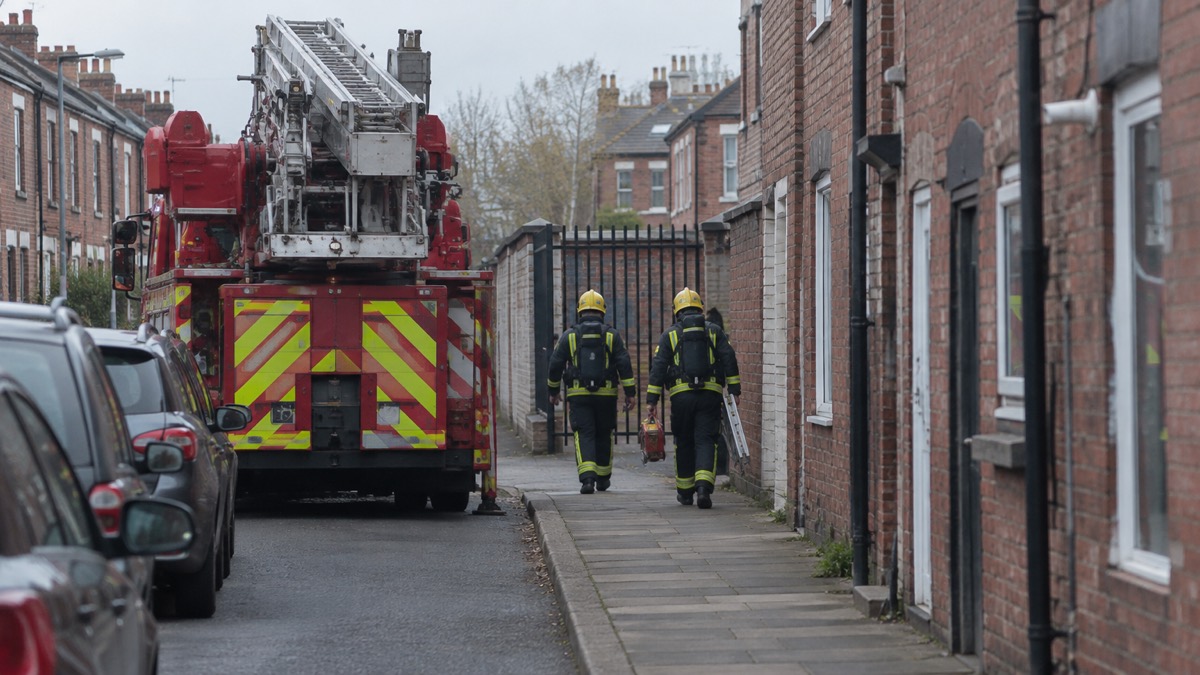
The fire service's needs and yours point the same way here. Devon and Somerset Fire and Rescue Service's guidance on flats and high-rise buildings states the principle that applies to any gated access: "We need to get as close as possible to the entrance so it is important that access areas are kept from obstructions."24 Manchester Fire and Rescue Service is blunter still: "Never block emergency access to your building or the hydrants. Firefighters need to get their fire engines as close as possible to the entrance and be able to access the hydrants for additional water supply."4 In a terraced street, the rear alley is often the only way fire engines can reach the back of the row, so a gate that the fire service cannot open quickly is a real problem.
There are two things to get right. The first is that the alley itself stays passable: no parked cars, no stored building materials, no bins left out permanently. The second is that the gate can be opened by the emergency services. When a council runs a gated scheme, this is normally solved centrally. Somerset Council's emergency road closure gates, installed following severe flooding on the Somerset Levels in 2014 at eight locations, can be opened by Somerset Council highways staff, the emergency services and the Environment Agency, as well as a small number of local people who require essential access26. That model, where the emergency services hold access as a matter of course, is what a well-run alley gating scheme should aim for. Ask your council or scheme organisers directly whether the fire service has keys or codes to your alley gate, and if not, how they would get in.
For your own back door and garden gate, the balance is between opening quickly from inside and resisting attack from outside. A rear gate that opens quickly in an emergency is one with a lock that every household member can operate in one movement, kept clear of the growth and clutter that gather at the back of gardens. London Fire Brigade's arson advice adds a maintenance angle: keep any paths well maintained and trimmed back, because this allows fire brigade vehicle access, and the paths can be used as a fire break1. An overgrown alley path is slower for you coming out and slower for firefighters coming in, and vegetation close to buildings burns.
Bins, bikes and stored items: what never goes in the alley
The rear alley is the natural place to put things, which is exactly why it needs rules. Fire and rescue services name the specific offenders. Staffordshire Fire and Rescue Service says keep all exits clear of obstructions, like bicycles2. Devon and Somerset Fire and Rescue Service says make sure escape routes are clear, removing any blockages to the front doors and walkways23. North Yorkshire Fire and Rescue Service says ensure escape routes are always accessible, with no obstructions blocking doorways or hallways17. A bike chained across the alley, a bin left out all week or a stack of stored timber turns a shared escape route into an obstacle course, and it does so for every household on the row, not just yours.
There is a second danger with stored items, and it is the one people least expect. nidirect's advice on avoiding accidental fires at home, and the fire services' hoarding guidance, both point at the same mechanism: material stored against or inside buildings feeds a fire and blocks the way out. Cheshire Fire and Rescue Service's advice to plan and practise your escape route and keep it clear at all times notes that a clear route will also help firefighters get to you18. Bins are a particular problem because they burn well and are often sited right against back doors, so put them in their place on collection day and bring them in promptly rather than leaving them as permanent street furniture.
A simple set of rules for the row keeps the alley working for everyone:
- Bring bins in after collection day rather than leaving them out27
- Keep paths trimmed back so fire brigade vehicles can gain access1
- Never store anything against vents, flues or hydrants4
Flooding and drainage at the back of a terraced house
Rear alleys are low points with hard surfaces, which makes them drainage channels in ordinary rain and ponds in a storm. The Greater London Authority's advice on preparing for flash flooding is to check drains outside your home and on your street are clear6. In an alley, that means the gullies and gratings along the lane as well as the ones in the road, because a blocked alley drain sends water straight into the lowest back door or airbrick on the row. Check them before forecast heavy rain, not after the water has arrived, and clear leaves and debris from the grating itself, which anyone can do safely.
When a blockage is more than surface debris, report it. Nottinghamshire County Council lists blocked highway drains and gullies as something that can be reported online or through its Customer Service Centre on 0300 500 80 80, and flooding at properties can be reported the same way28. Cumberland Council similarly takes reports of blocked gullies and flooding9. If the drain serves only your property, it is likely yours to clear: property owners are responsible for drainage issues within their own property boundary6, and private foul sewers are the property owner's responsibility5. Knowing which side of that line your alley drain falls on saves an argument in the rain.
If water does get in, the sequence afterwards matters. Runnymede Borough Council's flooding aftercare advice is to make sure the property is safe before you enter, and when returning to a flooded home to take care with the electricity and gas supplies and ensure you clean up properly to avoid contamination29. Government advice on preparing for flooding adds the wider context: check who is responsible for watercourses and boundaries near you, including contacting the Canal and River Trust if your property is next to a canal11. The full picture of protecting a home before, during and after a flood is in Flooding: A Household Guide, and securing a home that flood or storm damage has left open to intruders is covered in Making a Damaged Home Safe From Intruders After a Storm, Fire or Flood.
Where to get help with alley gates and rear access
Help comes from four directions, and knowing which to approach for what saves time. For the gate itself and anything on the highway, start with your council. Somerset Council's emergency road closure gates give a working model of how councils manage gated access: residents who require access through any of the gates, or believe they might in future, are asked to contact the council as soon as possible, on 0300 123 2224 or by email to RoadClosureGates@somerset.gov.uk, and an open or shut gate which is unlocked can be reported the same way26. Your own council's highways or community safety team is the equivalent first call for an alley gating scheme, a damaged gate or a gate left unlocked.
For shared street infrastructure more widely, councils do respond to organised residents. Lincolnshire County Council, for example, takes requests for a new grit bin from a business, parish council or residents' association calling 01522 78207030. The lesson for alley gating is the same: a request backed by a residents' association or parish council, speaking for most of the row, carries far more weight than a single household asking. If your street has no association, forming one, even informally, is often the practical first step, and Community Resilience: A Guide for Neighbours and Local Groups covers how to organise neighbours for exactly this kind of shared work.
For drainage and flooding, report to the council as above28, and for anything you think is unsafe in the alley, the HSE says that if you cannot find out who owns or controls an electrical installation you think is unsafe, contact your local authority or HSE12. For fire safety specifically, your local fire and rescue service will advise on escape routes and access, and every service quoted on this page, from Cornwall to Mid and West Wales, offers home fire safety advice on request. If a neighbour consistently blocks your escape route, first talk to the neighbour, then contact your local council or the fire brigade.
Sources (30)
- Reducing arson risk, London Fire Brigade, 2026-10-25
- Plan your escape, Staffordshire Fire and Rescue Service, 2026-10-29
- Know your escape plan, Manchester Fire and Rescue Service, 2026-10-29
- Know your escape plan, Manchester Fire and Rescue Service, 2026-10-29
- Report blocked drains, highways flooding issue, Lincolnshire County Council, 2026-10-29
- How to prepare for flash flooding, Greater London Authority, 2026-10-25
- Securing your home, nidirect, 2024-01-23
- Door security, Avon and Somerset Police, 2026-11-02
- Flooding, blocked gullies and drains, Cumberland Council, 2026
- Independent utility companies: what are they, Wiltshire and Swindon Prepared, 2026-10-25
- Prepare for flooding, GOV.UK, 2026-10-25
- Electricity safety FAQs, Health and Safety Executive, 2026
- Oil storage regulations and safety at home, GOV.UK, 2026-10-29
- Gas safety: domestic FAQs, Health and Safety Executive, 2026
- Fire safety at home: escape plan, Cornwall Fire and Rescue Service, 2026-10-29
- Protecting your home, Mid and West Wales Fire and Rescue Service, 2026-10-29
- Hoarding fire safety advice, North Yorkshire Fire and Rescue Service, 2026-10-25
- Hoarding: clutter and fire risk, Cheshire Fire and Rescue Service, 2026-05-20
- Avoiding accidental fires in the home, nidirect, 2025-10-16
- Fire safety for people with sight difficulties, Devon and Somerset Fire and Rescue Service, 2026
- In the event of a fire, South Wales Fire and Rescue Service, 2026-10-25
- Planning an escape route, Manchester Fire and Rescue Service, 2026-10-29
- Fire safety for carers, Devon and Somerset Fire and Rescue Service, 2026
- Fire safety in flats and high-rise buildings, Devon and Somerset Fire and Rescue Service, 2026
- Strong winds and weather warning: information and advice, nidirect, 2026-10-24
- Emergency road closure gates, Somerset Council, 2026-03-12
- Reducing arson risk | Devon and Somerset Fire and Rescue Service, Devon and Somerset Fire and Rescue Service
- Flooding help and advice: during a flood, Nottinghamshire County Council, 2026-10-29
- Flooding aftercare, Runnymede Borough Council, 2026-10-26
- Winter road management, Lincolnshire County Council, 2026-10-29
 Moving Home Locks Checklist
 After a Break-In Checklist
 Holiday Security Checklist
 Locking Up When Evacuating
 Flats and Shared Entrances
 Key Safes for Carers
 Keys and Spare Sets
 Smart Locks
 Windows and Ground-Floor Risks