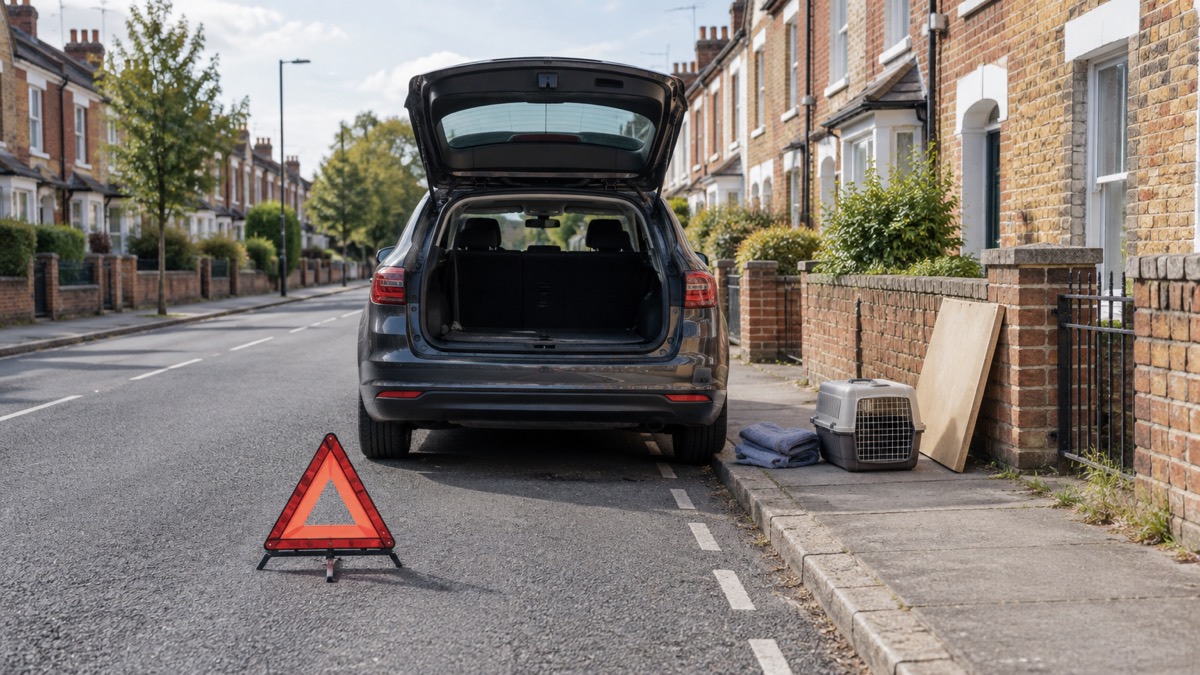
If your pet has been hit by a car, the first thing to do is make the road safe, for you and for other traffic, before you go near the animal. Then keep yourself from being bitten, give first aid, and get your pet to a vet as quickly as you can. The PDSA's advice is to try to stay calm, assess the situation, give your pet any necessary first aid, and call your vet1.
Do not wait to see whether your pet seems all right. Once you have given first aid, take them to your vet for a check-up as soon as possible1. If your own practice is closed, go anyway: all vets will provide emergency first aid care to a pet or wildlife in need, at no charge to the person that finds them2.
An injured animal is frightened and in pain, and may bite even a familiar owner. The PDSA warns that in an emergency your pet is likely to feel frightened and may react differently to normal, they may even bite1. Handle them carefully, keep them still and warm, and use a carrier or a box with air holes where you can3.
Make the road safe before you go near your pet
A pet hit by a car is usually lying in or beside a live carriageway, and the danger to you and to other drivers does not stop when the collision does. Before you cross to your animal, stop, look and listen, and choose a moment when the traffic has actually stopped or is clearly clear. Do not step out from between parked cars or stand in a lane while you attend to the animal.
The general road safety advice from ambulance services applies here as much as anywhere: look out for cyclists, scooter users and pedestrians, give plenty of space when passing, check before turning or opening vehicle doors, and be patient and aware, particularly in busy areas4. On a fast road, that means not turning your back on moving traffic and not crouching in a live lane.
If the animal is on a motorway or a busy dual carriageway, do not attempt a rescue yourself. National Highways' breakdown guidance is that animals must be kept in the vehicle or, in an emergency, under control on the verge5. Call 999 and describe the location, using marker posts or the emergency roadside telephone if there is one, and let the traffic officers deal with the road.
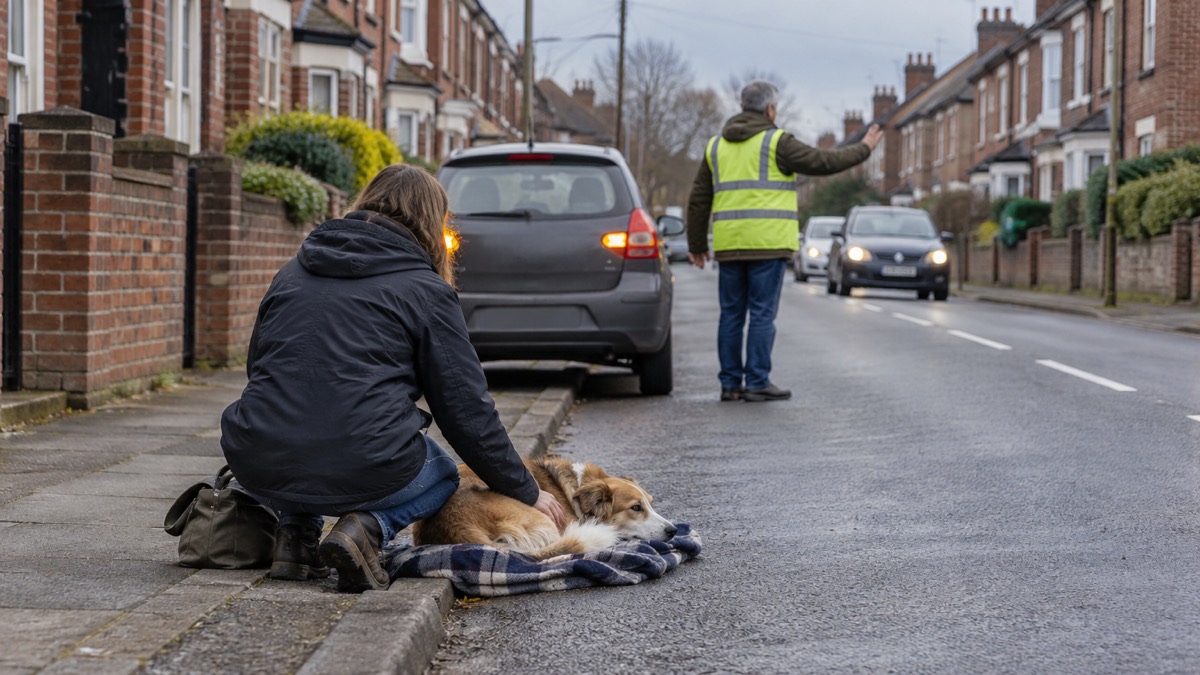
Once the road is safe, approach calmly and quietly. Speak softly, avoid looming over the animal, and crouch to its level rather than reaching down from above. If there is a second person, ask them to slow or warn traffic while you work.
Handling an injured pet without being bitten
An animal in severe pain does not know that you are trying to help. The PDSA is direct about this: in an emergency your pet is likely to feel frightened and may react differently to normal, they may even bite1. Treat every injured animal, including your own, as capable of biting.
- Muzzle only if it is safe to do so. Never muzzle a pet that is struggling to breathe, vomiting, or has an injury to the face or nose.
- Use a barrier. A thick towel, blanket or coat between your hands and the animal's mouth protects you and keeps the animal warmer.
- Keep movements slow and quiet. Sudden grabs and loud voices escalate fear.
- Work with a second person where you can, one to hold and one to give first aid.
If you are bitten, the St John Ambulance advice is to raise and support the wound and pat it dry, preferably with clean gauze from your first aid kit, then cover it with a sterile wound dressing6. Seek medical assistance or contact 111 if there may still be objects such as teeth, hair or dirt in the wound6. NHS guidance adds that you should contact NHS 111 if you are concerned about the injury, and seek urgent medical attention for severe wounds, heavy bleeding, signs of infection, or bites to the face, hands, feet or head7.
Getting your pet to a vet quickly
The PDSA's pet first aid guidance covers exactly the situations a road accident produces: bite wounds, bleeding, breathing problems, broken bones, bruises, burns, choking, collapse, CPR, cuts and grazes, electric shocks, heatstroke, hypothermia, insect stings and allergic reactions, moving an injured pet, poisons and toxins, road traffic accidents, and seizures1. Their free Pet First Aid guide covers everything from heatstroke and traffic accidents to how to perform CPR and what you need inside your first aid kit8.
Give first aid on the way, not before you set off. The PDSA advises giving your pet first aid treatment on the way to the vets2. Have the name of your veterinarian to hand, along with your pet's details, so the practice can be ready when you arrive9.
If your own vet is closed, ring the nearest practice that is open and go. All vets will provide emergency first aid care to a pet or wildlife in need, at no charge to the person that finds them3. That applies whether the animal is yours or a stray you have found at the roadside.
Moving a pet that may have back or internal injuries
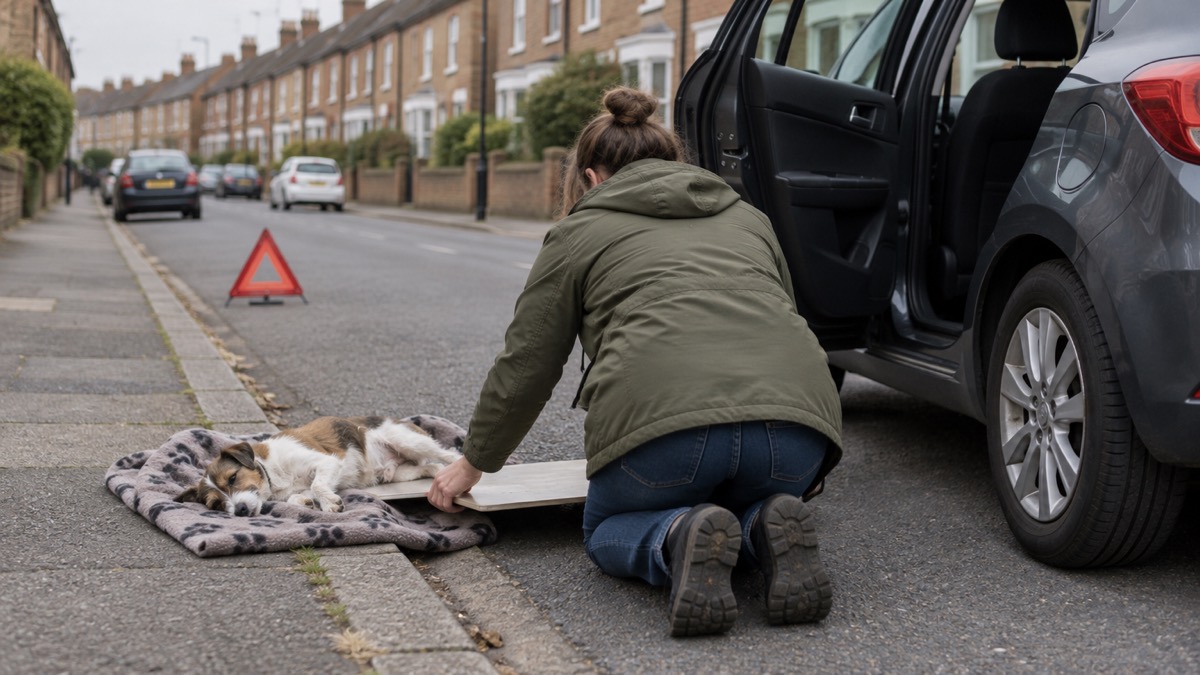
Moving an injured pet is one of the situations the PDSA covers in its first aid advice, and its guidance is blunt: if you need to move your pet when they are injured, this needs to be done really carefully1. A road accident can cause spinal damage, broken ribs or internal bleeding, and rough handling can make any of these worse.
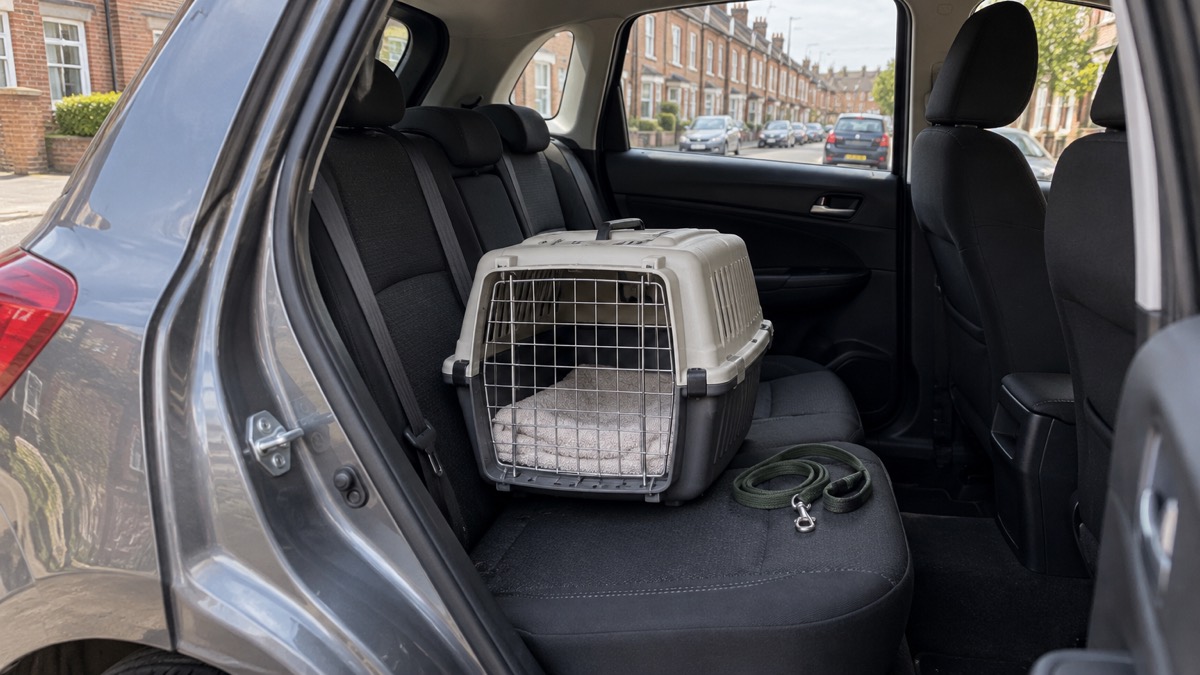
For a cat, the PDSA's advice is to give any necessary first aid, keep them still and warm, and put them in a pet carrier, or a box with plenty of air holes, then call the nearest vet to transport the cat there as soon as possible3. The same approach works for a small dog.
- Keep the body straight. Slide a rigid board, a folded blanket or a coat under the animal rather than lifting by the limbs or the scruff.
- Support front and back together. One hand under the chest and one under the hindquarters, or two people lifting as a unit.
- Keep them warm. Shock makes animals cold; a blanket over the body helps, but never cover the face.
- Do not give food or water. An animal that may need surgery should not be fed.
If you are in any doubt, ring the vet and ask them to talk you through the lift while you are beside the animal.
Put other pets somewhere safe while help is on its way
If you have more than one animal, the injured one is not the only one at risk. An ambulance service's advice for households is simple: put pets somewhere safe10. A frightened dog may bolt through an open door, and a cat may hide under a car.
- Shut other pets in a secure room with water, away from the door you will use to carry the injured animal out.
- Ask a neighbour to help. Agree in advance with a trusted neighbour and make sure they know your pet and where to find a lead or carrier11.
- Have a plan for who takes the other animals if you have to go to the vet and may be gone for hours. Ask friends or family if they would be able to look after your pet in an emergency12.
This is the moment a household plan earns its keep. Official guidance is clear that pets are an important part of family life and your emergency plans should include how you will look after them11. Leaving pets behind, even if you try to create a safe place for them, is likely to result in their being injured, lost, or worse13. Keep pet care items in your emergency kit if required9, and include pet supplies and any documents or supplies for assistance animals14.
If the driver or the owner cannot be found
If you have hit an animal, or found one injured at the roadside, and no owner is present, the priority is still the animal. The Scottish SPCA's advice for a dog in distress whose owner cannot be found is to take the dog to a nearby vet as a matter of urgency15. The same logic applies to any injured pet: get it to a vet, who can scan for a microchip and contact the registered owner.
Keep a record while it is fresh:
- Where and when you found the animal.
- The vehicle's registration number if a car was involved, and a description of the driver if you saw one.
- Any identifying features on the animal, such as a collar or tag.
If you are worried about an animal's welfare, you may wish to report the incident to the police16. In Scotland, if the owner is not located and the animal does not appear distressed but you still have concerns, contact Police Scotland on 101 and provide the details you have taken15.
If the animal is yours and has gone missing, call local vets and rescue centres and give them your number so they can call you if the pet is handed in3. Keep your pet's identification and contact details up to date in case they are lost11, and make sure your pet is microchipped and that your contact details are up to date11. If you think your pet may have been stolen, follow the same steps as if they had gone missing, but also notify the police as soon as possible3.
If the animal runs off before you can reach it
A cat or a small dog that is only slightly hurt may run and hide, and you may not be able to catch it. Cats often wander far from home, so be sure of what you are dealing with before you assume an animal is a stray3. If the cat appears healthy and well-groomed, it is likely to have a home3.
- Report it. Tell local vets and rescue centres, and give them your number so they can call you if the animal is handed in3.
- Tell the council if you think it may be a stray cat17.
- Keep checking the spot where it went to ground, quietly and at different times of day.
- If it comes back to you, give any necessary first aid, keep it still and warm, put it in a pet carrier or a box with plenty of air holes, and call the nearest vet to transport it there as soon as possible3.
Where to get help and what to have ready
The help you need in the first hour is a vet, a second pair of hands and a way to move the animal. Build the rest into your household plan before anything happens.
| What you need | Why it matters | Where the advice comes from |
|---|---|---|
| Your vet's name and number | So the practice can be ready when you arrive | Official guidance lists the name of your veterinarian as part of an emergency kit9 |
| A pet carrier or a box with air holes | To move an injured animal still and warm | PDSA advice for an injured cat3 |
| A towel or blanket | To protect against bites and keep the animal warm | PDSA warning that an injured pet may bite1 |
| A pet first aid kit | For bleeding, wounds and shock on the way | PDSA first aid guidance1 |
| A trusted neighbour's number | To take the other animals if you have to leave | Official advice to agree a plan with a trusted neighbour11 |
If you are going into hospital or cannot care for your pet yourself, some councils offer help. Nottingham and Nottinghamshire, for example, list dog walking for people unable to get out of the house as part of hospital discharge support18. Ask your local council what is available where you live.
For more on preparing before an emergency, see Including Your Pets in a Household Emergency Plan and Pet First Aid Kits: What They Contain and How to Choose. If you need to move an injured animal and want the detail in one place, read How to Move an Injured Dog or Cat to the Vet. For out-of-hours care, see Emergency Vets: Out-of-Hours Care and the 24-Hour Rule.
Sources (18)
- First aid for pets, PDSA, 2026-10-29
- Emergency care for pets, PDSA, 2026-10-29
- Missing pets, PDSA, 2026-10-29
- Staying safe in flooding, West Midlands Ambulance Service, 2026-10-29
- Driving on motorways, National Highways, 2026-10-29
- Human and animal bites, St John Ambulance, 2026-10-28
- Child safety, Berkshire Healthcare NHS Foundation Trust, 2026-10-29
- Free first aid guide, PDSA, 2026-10-29
- Get help and advice in an emergency, Lincolnshire County Council, 2026-10-29
- What to do when the ambulance is coming, South Western Ambulance Service, 2026-10-29
- Are you ready, Birmingham City Council, 2026-06-05
- Pets, West Yorkshire Prepared, 2026-10-29
- You prepare for emergency, Slough Borough Council, 2026-10-29
- Emergency kit, Ready Scotland, 2026-10-22
- Dogs die in hot cars, Scottish SPCA, 2026-03-19
- Dogs in hot cars, RSPCA, 2026-10-29
- Cats in winter, RSPCA, 2026-10-29
- Hospital discharge, Nottinghamshire County Council, 2026-10-29
 Pet Emergency Documents
 Storing Pet Food and Water
 Carer's Emergency Plan
 Pet Birds in Cold Weather
 Birds and Chickens in Heat
 Breaking a Car Window for a Dog
 Keeping a Cat Cool in a Heatwave
 Chocolate Poisoning in Dogs
 Christmas Hazards for Pets
 Dog Left Alone on a Hot Day
 Dog in a Hot Car
 Hypothermia in Dogs and Cats
 Dogs in Water or Coast Trouble
 Fireworks and Small Pets
 Fish in a Power Cut