
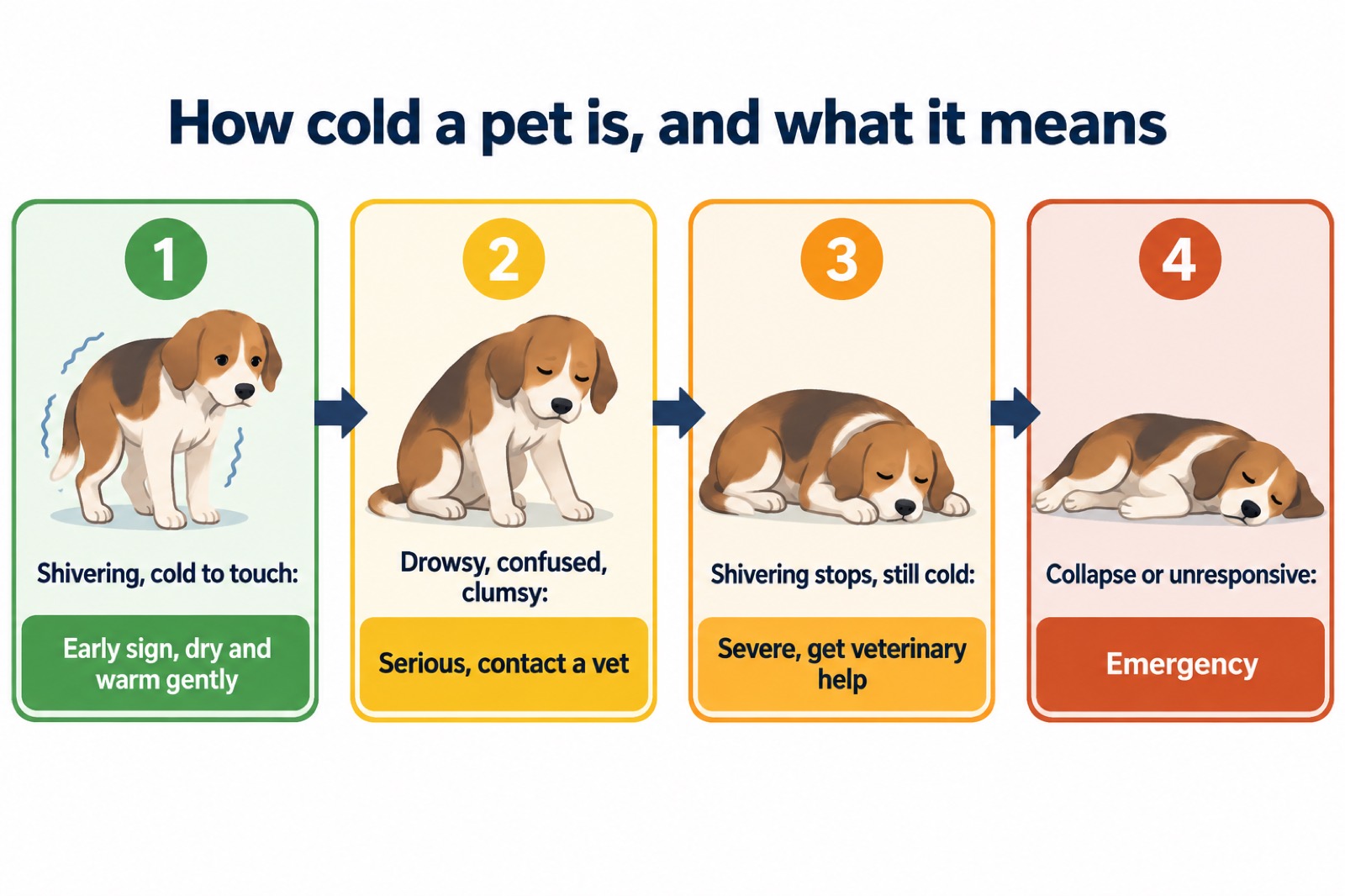
If your dog is shivering, cold to the touch and reluctant to move, treat it as a cold-weather emergency until you know otherwise. The RSPCA lists the signs of hypothermia in dogs as shivering, drowsiness and confusion, loss of coordination, pale gums, and loss of consciousness or collapse, and notes that shivering will stop if the dog becomes severely cold1. That last point matters more than any other: a dog that has stopped shivering is not recovering, it is getting worse.
What to do is simple and gentle. Move the animal indoors or somewhere sheltered, remove anything wet, and wrap them in a blanket, sleeping bag or dry towel with the head covered2. Warm the room gradually rather than applying heat, because the RSPCA says not to heat a dog up too quickly or place anything hot directly on the skin1. Then contact a vet.
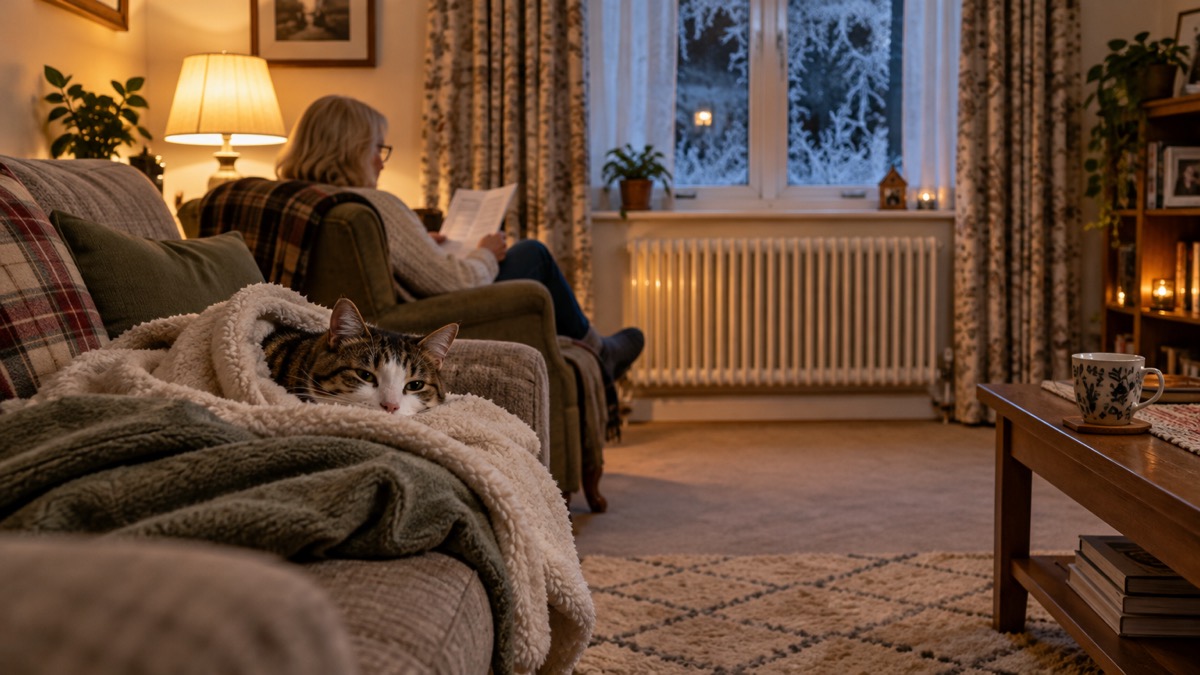
Cats follow the same pattern. Cats UK lists shivering, low energy, loss of coordination or confusion, pale gums, cold extremities, weakness, slow heart and breathing rates, and collapse among the symptoms, and warns that shivering stops suddenly once the body temperature reaches a dangerously low level3. Cats are at risk of hypothermia, frostbite or respiratory problems if exposed to temperatures below 10°C for too long3.
Signs of hypothermia in dogs and cats
The signs to look for are the same broad set in both species, though each charity describes them in its own words. In dogs, the RSPCA lists shivering, drowsiness and confusion, loss of coordination, pale gums, and loss of consciousness or collapse1. In cats, Cats UK lists shivering, low energy, loss of coordination or confusion, pale gums, cold extremities, weakness, slow heart and respiration rates, and collapse or loss of consciousness3. It separates these into serious signs, which include weakness or trouble walking, slow or shallow breathing and pale gums, and emergency signs, which include collapse, unresponsiveness and dilated pupils3.
| Sign | Dogs (RSPCA) | Cats (Cats UK) |
|---|---|---|
| Shivering | Yes, stops when severely cold1 | Yes, stops suddenly at dangerously low temperature3 |
| Drowsiness or confusion | Yes1 | Yes, as loss of coordination or confusion3 |
| Pale gums | Yes1 | Yes, a serious sign3 |
| Slow or shallow breathing | Not listed for dogs | Yes, a serious sign3 |
| Collapse or loss of consciousness | Yes1 | Yes, an emergency sign3 |
| Cold extremities | Not listed for dogs | Yes3 |
The human guidance from UK health bodies describes the same progression, which helps explain why the animal behaves as it does. The UK Health Security Agency lists shivering, slow breathing, tiredness or confusion, and pale, cold skin as typical signs in people5. NHS inform adds being unsteady on your feet, slurred speech, poor coordination, not responding as normal, and slow or shallow breathing2. Public Health Wales lists shivering, pale cold dry skin, blue or grey lips, slurred speech, slow breathing and tiredness or confusion6. These are descriptions of people, not pets, but they show the pattern: shivering first, then confusion and clumsiness, then quiet collapse.
Shivering that stops is a sign of severe cold
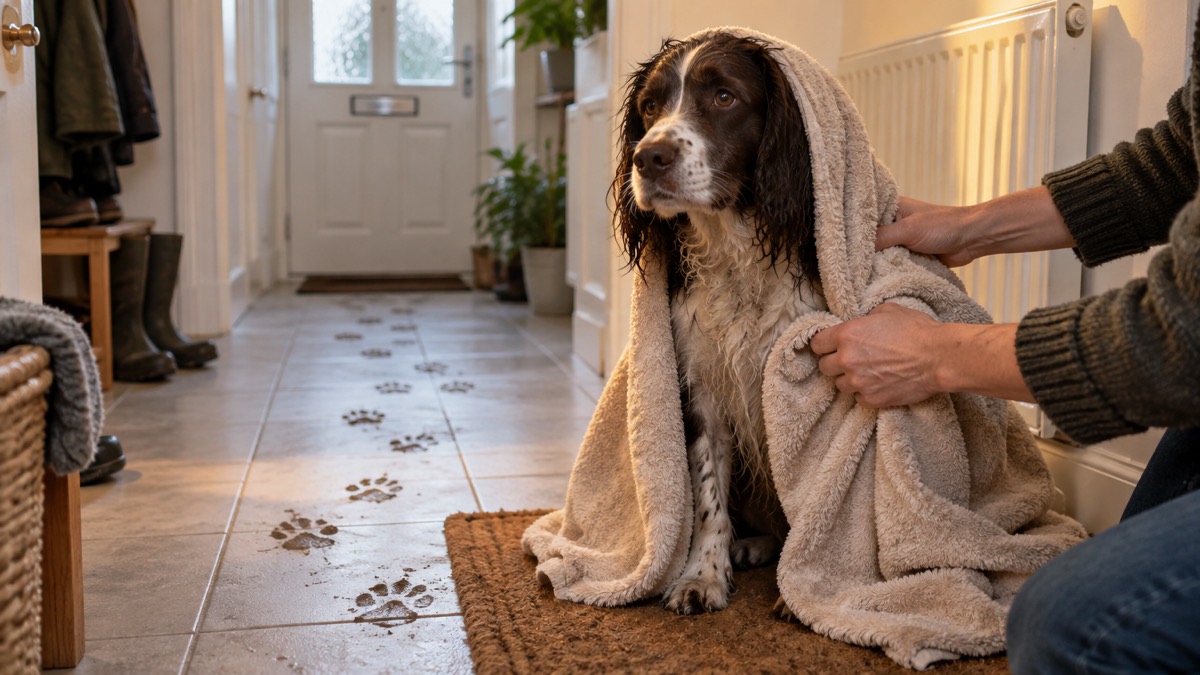
Shivering is the body's attempt to make heat, and it is the earliest and most visible sign that an animal is too cold. The RSPCA notes that pets can shiver when exposed to low temperatures for too long, and that this is more noticeable in smaller and short-haired breeds7. That is useful because it tells you which animals to watch most closely, but it is not a reason to relax when shivering stops.
Both pet charities are explicit that the stopping is the danger. The RSPCA says shivering will stop if the dog becomes severely cold1. Cats UK says shivering will stop suddenly when the cat's body temperature reaches a dangerously low level3. NHS guidance for people makes the same point: shivering by itself is not hypothermia, and in severe hypothermia you may no longer be able to shiver even if you feel very cold to touch2. Northern Ireland's hypothermia guidance states that if the temperature drops to 32°C or lower, a person will usually stop shivering completely and may pass out8.
For a household, the practical rule is this: a shivering pet needs drying and warming, and a pet that has stopped shivering but still feels cold needs a vet now. Do not read stillness as calm.
What to do straight away: dry, wrap and warm gently
The first actions are about stopping further heat loss, not adding heat. Wet fur is the main enemy: the RSPCA says wet coats or feathers can lead to hypothermia, and that you should dry your pet thoroughly if they get wet7. Northern Ireland's winter guidance says that after a walk in snowy, icy or wet conditions you should dry your pet off as quickly as possible and make sure they keep warm9.
Work through these steps in order:
- Move the animal somewhere sheltered as quickly as possible10.
- Remove any wet clothing, harness or bedding and replace it with dry material2.
- Wrap them in a blanket, sleeping bag or dry towel, making sure the head is covered11.
- Warm the room gradually rather than applying heat to the animal3.
- Stay with them and keep them calm10.
The wrapping advice comes from NHS guidance written for people with hypothermia, and it transfers directly to an animal: the aim is to hold the warmth the body is still making, not to blast it with heat. The same guidance says not to remove your own clothing to give to the person2, which is a reminder that you need to stay warm and functional yourself while you help.
If the animal is wet through, drying matters more than anything else you can do at home. Keep a spare towel by the door in winter so a wet walk ends with a rub-down rather than a damp dog on a cold floor. For more on preventing the problem, see Pets in Cold Weather, Snow and Ice and Walking a Dog Safely in Snow and Darkness.
Lukewarm, not hot: warming a cold pet safely
The instinct to reach for a hot water bottle is strong and wrong. Cats UK advises: do not use hot water, heating pads or hair dryers, or force food or water on them, as this can make them unwell4. NHS guidance for people with hypothermia says not to use a hot bath, hot water bottle or heat lamp to warm them up12. The RSPCA's frostbite advice for dogs repeats the principle: do not heat them up too quickly or place anything hot directly on the skin1.
The reason is that cold skin and cold extremities cannot regulate heat well, and direct heat can damage tissue that is already compromised. Gradual warming of the room around the animal, plus dry blankets, is the safe route4.
| Method | Safe for a cold pet? | What the guidance says |
|---|---|---|
| Dry towels and blankets | Yes | Wrap the animal, head covered11 |
| Warming the room gradually | Yes | Warm the temperature around them3 |
| Hot water bottle | No | Do not use12 |
| Heating pad or electric blanket | No | Do not use4 |
| Hair dryer | No | Do not use4 |
| Hot bath | No | Do not use12 |
| Rubbing the skin | No | Do not rub the area1 |
That is advice for people, not pets, and it does not make a hot water bottle suitable for an animal.
"Do not use hot water, heating pads or hair dryers or force food or water on them as this can make them unwell"
When to call the vet
Contact a vet promptly for any pet that is drowsy, confused, uncoordinated, has pale gums, is breathing slowly or shallowly, or has collapsed. These are the signs the charities group as serious or emergency1. Do not wait to see whether the animal improves on its own.
There is a specific duty where an animal has been left outside in the cold. The RSPCA says that if a dog left outside is showing signs of hypothermia, you should contact the RSPCA immediately to report this as neglect1. If you are worried about an animal in another household, that is the route.
For your own animal, the sequence is: dry and wrap, warm the room, then phone. Out-of-hours cover varies by practice and by nation, so check before you need it. Our guide to Emergency Vets: Out-of-Hours Care and the 24-Hour Rule explains how to find cover, and How to Move an Injured Dog or Cat to the Vet covers transporting an animal that cannot walk.
Cold, wet and windy: how pets get too cold
The risk is not only temperature. Wet fur loses heat far faster than dry fur, which is why the RSPCA links wet coats to hypothermia and tells owners to dry pets thoroughly7. Wind and rain together are worse than still cold air, and a dog that has been swimming or fallen through ice is in immediate danger. Our guide to Dogs and Frozen Ponds covers what to do if a dog goes through ice.
Some animals are more vulnerable. The RSPCA says that when the temperature reaches freezing, all dogs are at risk of hypothermia and frostbite, especially small, slim, young and old dogs, and those with little or no fur1. Cats UK gives a specific threshold for cats: below 10°C for too long brings risk of hypothermia, frostbite or respiratory problems3. Cats also suffer from upper respiratory diseases caused by a virus, similar to colds, with coughing, sneezing, fever, eye or nose discharge and lethargy3, so a cat that seems unwell after cold exposure may have more than one problem.
Cars are not shelter. The RSPCA says never leave a dog alone in the car, even if the heating is on, as they could develop hypothermia or overheat1. A car loses heat quickly once the engine stops, and a warm car with the engine running is a carbon monoxide risk if snow blocks the exhaust.
Outdoor cats and strays need thought too. See How to Help Outdoor and Stray Cats in Freezing Weather and, for smaller pets, How to Keep Rabbits and Guinea Pigs Warm in Winter and How to Keep Pet Birds Warm in Cold Weather.
Where to get help
For a pet that is cold but responsive, your own vet is the first call. For a pet that has collapsed or is unresponsive, phone the vet immediately and say what has happened and how long the animal may have been cold.
If you are worried about an animal left outside in cold weather, the RSPCA asks you to contact them immediately to report it as neglect1.
If a person and a pet are both cold, treat the person first and ask a neighbour or family member to help with the animal.
Preparing before the cold arrives makes all of this easier. Our Pets and Animals in an Emergency: A Household Guide sets out the wider picture, Including Your Pets in a Household Emergency Plan covers who does what, and Pet First Aid Kits: What They Contain and How to Choose lists what to keep ready, including towels and blankets for drying a wet animal.
Sources (12)
- Dogs in cold weather, RSPCA, 2026-10-29
- Hypothermia (low body temperature), NHS inform, 2026-07-15
- Cold Weather Care for Cats - RSPCA - rspca.org.uk, RSPCA
- Cats and cold weather, Cats Protection, 2026-10-29
- Top tips for keeping warm and well this winter, UK Health Security Agency, 2026-04-28
- Cold weather, Public Health Wales, 2026-06-16
- Pets in cold weather, RSPCA, 2026-10-29
- Hypothermia, nidirect, 2025-06-03
- Staying warm in winter, nidirect, 2026-10-06
- Keeping warm or cool in extreme weather, UK Health Security Agency, 2025-12-16
- Hypothermia, NHS 111 Wales, 2025-05-14
- Hypothermia, NHS, 2025-05-14
 Pet Emergency Documents
 Storing Pet Food and Water
 Carer's Emergency Plan
 Pet Birds in Cold Weather
 Birds and Chickens in Heat
 Breaking a Car Window for a Dog
 Keeping a Cat Cool in a Heatwave
 Chocolate Poisoning in Dogs
 Christmas Hazards for Pets
 Dog Left Alone on a Hot Day
 Dog in a Hot Car
 Dogs in Water or Coast Trouble
 Fireworks and Small Pets
 Fish in a Power Cut
 Flystrike in Rabbits