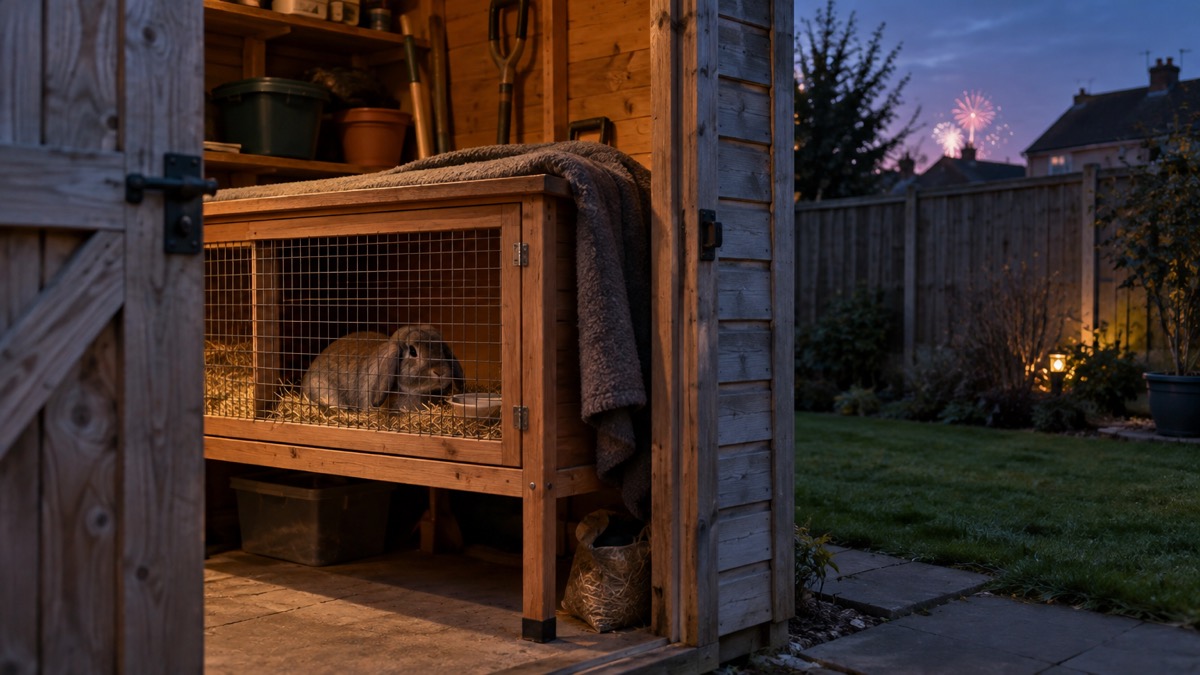
Rabbits and guinea pigs are prey animals, and loud bangs and whistles cause them significant stress1. The single most useful thing you can do is to get them out of the open garden before the displays start. Cornwall Fire and Rescue Service is direct about it: keep your pets indoors, including pets normally kept outside such as rabbits or guinea pigs2. If the hutch cannot come into the house, move it into a car-free garage or shed a few nights before fireworks are expected3.
Once they are in, partly cover the hutch with a blanket so it is more sound-proofed but still well ventilated, and give them extra bedding and something to burrow into3. Close the curtains or black out the windows to block the flashes, and put the TV or radio on to mask the noise1. Then leave them alone as far as you can, and watch for signs that they are not coping.
Fireworks are not a single night. Blue Cross advises that its guidance covers your pet right through from Bonfire Night to New Year's Eve, so treat it as a season and have the hutch ready before the first bangs5. If you are worried about your small animal during Bonfire Night, discuss it with your vet6.
Bring the hutch in before the first bang
Timing matters more than anything else. Moving a rabbit or guinea pig on the night itself, as the first rockets go up, adds handling and a strange place to the noise it is already frightened of. Blue Cross advises moving the hutch into a car-free garage or shed a few nights before fireworks are expected, so the animal has settled in its new position before anything goes off3. The Scottish SPCA makes the same point in general terms: consider whether your animals in an outdoor enclosure could be brought inside or into a garage during the fireworks6.
Where the hutch goes matters as much as when. A garage that houses a car is not suitable, because of fumes and the coming and going of the vehicle; the guidance specifies a car-free garage3. If you are bringing the animals right into the house, choose a room away from windows and the front door, and keep other pets out of it.
If none of this is possible, there is a fallback. Blue Cross advises that if you cannot bring the hutch inside, you should turn the enclosure around so that it faces a wall or fence instead of the open garden7. That reduces what the animal can see and takes the direct line of the blast away from the mesh front. It is second best to bringing them in, but it is better than leaving the hutch facing the display.
Covering the hutch without cutting off the air
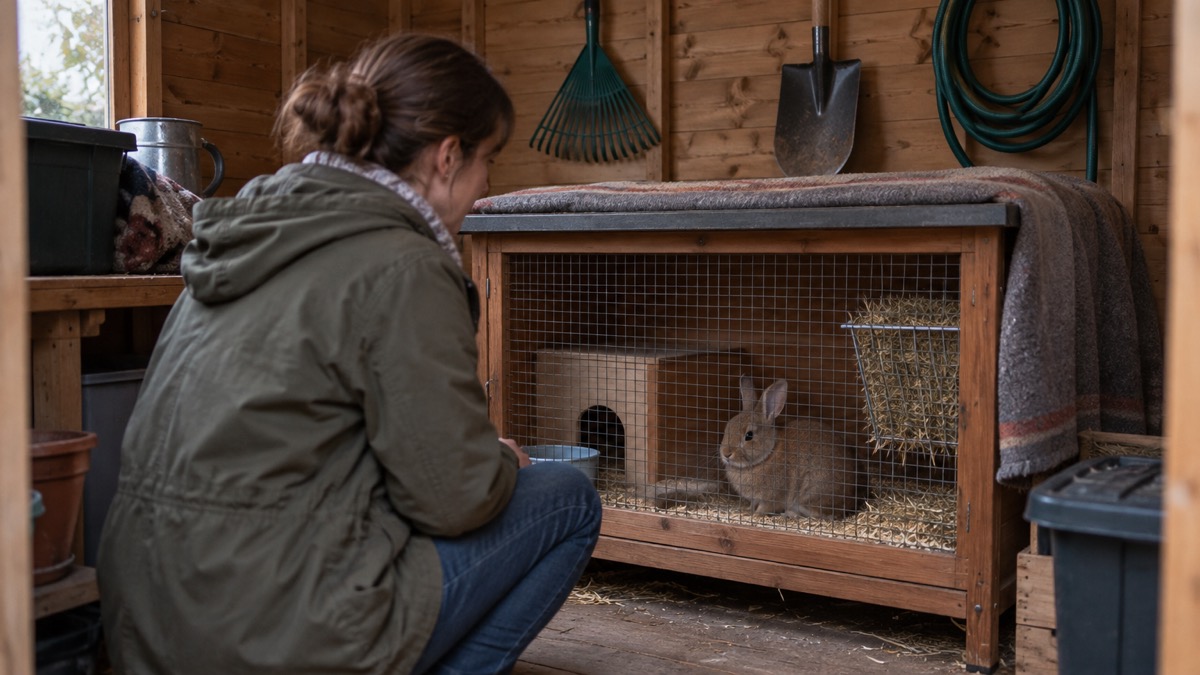
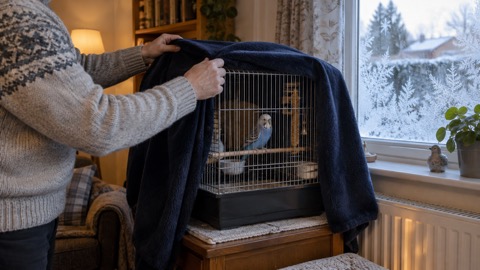
Covering is where well-meant help most often goes wrong. The aim is to block the sight of the flashes and deaden the sound, not to seal the hutch. Blue Cross advises covering aviaries or hutches with thick blankets or a duvet to block out the sight of the fireworks and deaden the sound, ensuring enough ventilation7. The PDSA puts it the same way: partly cover hutches and outdoor cages with blankets, so they are more sound-proofed but still well ventilated3.
In practice that means covering the top and the solid sides, and leaving the wire front open to the air. Never wrap the hutch completely, and never drape a cover over the mesh so that it lies flat against it. Check the cover during the evening: wind and rain can shift a blanket over the air supply, and a hutch that was fine at six o'clock can be stuffy by nine.
| What to cover | What to leave clear | Why |
|---|---|---|
| The top of the hutch | The mesh front | Blocks flashes from above while air still moves through the front |
| The solid sides facing the garden | Any ventilation gap | Deaden sound without sealing the animal in |
| The run, if attached | The entrance between hutch and run | Keeps the animal's usual route open |
If the hutch is inside the house, the covering job is smaller. Draw the curtains or black out the windows to block the flashes of light in the night sky, which is the advice Blue Cross gives for guinea pigs brought indoors1. Close the doors to the room so the animal is not disturbed by household traffic, and keep the cover over the hutch itself if it helps.
Extra bedding and somewhere to burrow
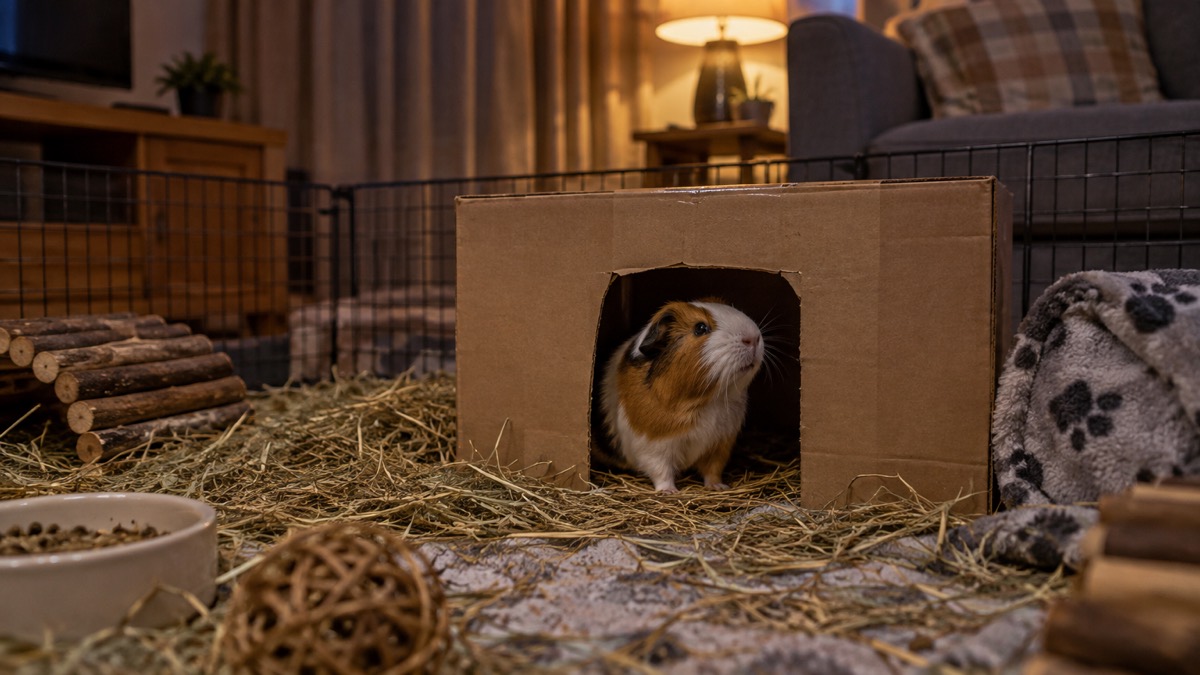
Rabbits and guinea pigs cope with fear by hiding, so give them somewhere to go. A cardboard box with a door cut in it, placed inside the hutch or the indoor enclosure, gives an animal a dark, enclosed space it can retreat to and leave again in its own time.
Extra bedding does two jobs. It gives the animal something to burrow into, which is a natural response to danger, and it keeps it warm if the hutch has moved to a cooler shed or garage7. Straw and hay are the usual materials; make sure whatever you add is clean and dry, and that it does not block the ventilation you have just protected.
Do not force the animal out of its hiding place to check on it. A rabbit or guinea pig that is hiding is doing what its instincts tell it to do, and pulling it out adds handling to an already frightening evening. Watch from a distance, keep the room quiet, and let it come out when it is ready.
Signs that your rabbit or guinea pig is struggling
Loud bangs and whistles can cause guinea pigs significant stress1, and the RSPCA notes that outdoor animals often try to escape the bangs out of fear, sometimes injuring themselves in the process8. That is the real risk on fireworks night: not that the animal is frightened, but that it panics and hurts itself trying to get away.
Watch for the behaviour that tells you it is not settling:
- Hiding constantly and refusing to come out for food or water
- Racing around the enclosure, or throwing itself at the mesh
- Heavy, rapid breathing that does not settle when the noise stops
- Sitting hunched and still, with the ears flat and the eyes wide
- Refusing food, which in a rabbit or guinea pig is always worth taking seriously
If your animal is panicking, do not chase it or pick it up. Reduce the noise and light further, make sure the cover is secure, and give it space.
Keeping a routine on fireworks nights
Rabbits and guinea pigs are creatures of habit, and a normal routine is reassuring. Feed and clean out at the usual times, keep the same food and the same bedding, and avoid rearranging the hutch on the night of a display. The more of the animal's day stays the same, the less the evening stands out.
Fire and rescue services across the UK give the same household advice for fireworks night: keep all your pets indoors and close all the curtains, possibly on several nights when other displays are taking place4. Mid and West Wales Fire and Rescue Service gives the same instruction in Welsh, to keep animals indoors and close all the curtains to avoid further disturbance9. Close the windows and doors as well, and block off any cat flap or gap that an animal could squeeze through10.
Background noise helps. Blue Cross suggests increasing the volume of music or the TV for indoor small pets that are used to it, to muffle the sound7. Start it before the displays begin, keep it at a steady level rather than loud, and leave it on until the bangs have stopped. A radio in the shed or garage does the same job for a hutch that has moved out there.
| Time | What to do |
|---|---|
| A few nights before | Move the hutch into a car-free garage, shed or the house3 |
| On the day | Feed and clean out at the usual time; check the cover and the ventilation |
| Before dark | Close windows, doors and curtains; put on the TV or radio4 |
| During the displays | Leave the animal alone; check the cover has not slipped |
| After the last bangs | Check the enclosure and the animal for injuries11 |
When to call a vet
Ring your vet if you are worried about your small animal during Bonfire Night6. That is the plain advice from the Scottish SPCA, and it applies to rabbits and guinea pigs as much as to any other pet. A vet can tell you whether the behaviour you are seeing is ordinary fear or something that needs treatment, and can advise on what is safe to give a small animal.
Ring sooner rather than later if the animal has injured itself trying to escape, has stopped eating or drinking, is breathing heavily and does not settle, or is sitting hunched and unresponsive. The RSPCA's warning that frightened outdoor animals sometimes injure themselves trying to escape is the reason to check the enclosure carefully after a noisy night8.
If you need an ambulance for a person in the house, put pets somewhere safe first, so they are not underfoot and do not get out when the door is opened12. For out-of-hours advice, see our guide to emergency vets and the 24-hour rule.
Checking the hutch and the garden afterwards
The morning after a display is the time to look for damage. Check the hutch and run for anything that could injure an animal that panicked, such as protruding nails, loose wire or sharp edges, and make sure the enclosure is still secure.
Look the animal over for cuts, grazes or other injuries, and check that it is eating and drinking normally. If you find an injury, ring your vet rather than treating it yourself.
If there has been a bonfire nearby, fire and rescue services advise checking the area to make sure there is no wildlife or pets hiding nearby before it is lit11. The PDSA warns that hedgehogs may think an unlit bonfire is a great place to sleep, so build any bonfire as close as possible to the day of the event, investigate thoroughly, and disturb the bottom of it before lighting to let any wildlife escape3. That is a job for the person building the fire, but it is worth raising with a neighbour who is planning one.
Asking neighbours about their displays
A quiet word in advance is worth more than any amount of covering on the night. North Yorkshire Fire and Rescue Service advises residents holding a home display to let neighbours know in advance and to consider how far the noise and debris may travel13. South Wales Fire and Rescue Service asks people to respect their neighbours and not let off fireworks late at night14.
If you know a display is planned nearby, ask what time it will start and finish, and move the hutch before then. If you have a rabbit or guinea pig that is badly affected, it is reasonable to explain that and ask for a warning next time. Fire and rescue services would always recommend that people attend an organised fireworks display4.
For a household with animals, the same preparation applies to other loud events. Our guide to including your pets in a household emergency plan sets out how to record what each animal needs, and the pets and animals section covers the wider picture. If the hutch is outdoors through the colder months, our guide to keeping rabbits and guinea pigs warm in winter covers draughts, bedding and frost.
Sources (14)
- Guinea pigs and fireworks, Blue Cross, 2026-10-09
- Keep your pets safe, Cornwall Council, 2025-09-02
- Pets and fireworks, PDSA
- Firework safety, Mid and West Wales Fire and Rescue Service, 2026-10-29
- Cats and fireworks, Blue Cross, 2025-12-11
- Fireworks, Scottish SPCA, 2025-11-04
- Fireworks and pets, Blue Cross, 2025-11-26
- Fireworks safety, RSPCA
- Diogelwch tân gwyllt, Mid and West Wales Fire and Rescue Service, 2026-10-29
- Fireworks and pets leaflet, Blue Cross, 2019
- Bonfires, London Fire Brigade, 2026-10-25
- What to do when the ambulance is coming, South Western Ambulance Service NHS Foundation Trust, 2026-10-29
- Celebrate Bonfire Night safely and be aware of your impact, North Yorkshire Fire and Rescue Service, 2026-10-22
- Halloween and bonfire, South Wales Fire and Rescue Service, 2026-10-20
 Pet Emergency Documents
 Storing Pet Food and Water
 Carer's Emergency Plan
 Pet Birds in Cold Weather
 Birds and Chickens in Heat
 Breaking a Car Window for a Dog
 Keeping a Cat Cool in a Heatwave
 Chocolate Poisoning in Dogs
 Christmas Hazards for Pets
 Dog Left Alone on a Hot Day
 Dog in a Hot Car
 Hypothermia in Dogs and Cats
 Dogs in Water or Coast Trouble
 Fish in a Power Cut
 Flystrike in Rabbits