
If you think your dog has eaten chocolate, contact your vet immediately. Do not wait to see whether symptoms appear. The RSPCA's advice is clear: if you think your dog has been poisoned, contact your vet immediately and never "watch and wait"1. Chocolate poisoning is the most commonly reported type of dog poisoning reported to the VPIS, the veterinary poisons service, so vets deal with it often and know what to do1.
The signs to watch for are vomiting, diarrhoea, dehydration, hyperactivity, a high temperature and blood pressure, an abnormal heart rhythm and tremors1. Some of these, such as vomiting and diarrhoea, can appear with many other illnesses, which is why the fact that chocolate has been eaten matters more than the symptoms alone. Tell your vet what was eaten, roughly how much, and when.
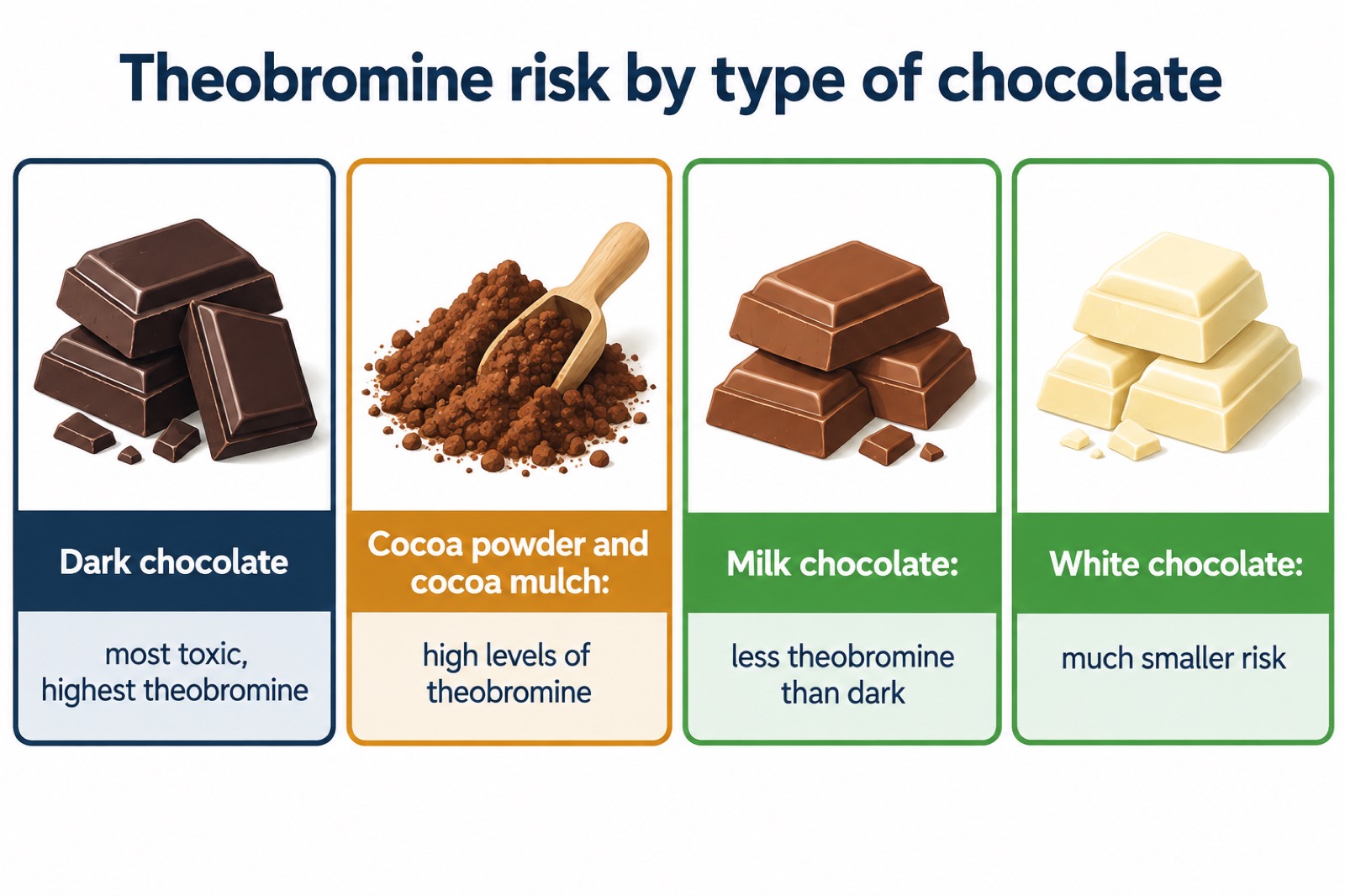
Chocolate is poisonous because it contains theobromine, a stimulant similar to caffeine2. Dark chocolate and cocoa contain the highest levels, milk chocolate less, and white chocolate a much smaller risk2. That does not make white chocolate safe to feed a dog, but it does explain why a small amount of dark chocolate or cocoa can matter more than a larger piece of milk chocolate.
Symptoms of chocolate poisoning in dogs
The RSPCA lists the symptoms of chocolate poisoning in dogs as vomiting, diarrhoea, dehydration, hyperactivity, a high temperature and blood pressure, an abnormal heart rhythm and tremors1. Not every dog will show every sign, and the severity depends on how much chocolate was eaten and what type. The darker the chocolate, the more theobromine it contains, so the same weight of dark chocolate carries more risk than milk chocolate2.
Some of these signs are easy to miss or to mistake for something else. Vomiting and diarrhoea are common to many illnesses, and a dog that is simply excited may look hyperactive. What marks chocolate poisoning out is the combination and the timing: a dog that has eaten chocolate and then becomes restless, sick or unsteady needs veterinary attention.
| Sign | What it can look like at home |
|---|---|
| Vomiting and diarrhoea | Sickness, loose stools, mess in the house1 |
| Dehydration | Sunken eyes, tacky gums, tiredness1 |
| Hyperactivity | Restlessness, pacing, unable to settle1 |
| High temperature and blood pressure | Panting, a dog that feels hot1 |
| Abnormal heart rhythm | A racing or irregular heartbeat, often found by the vet1 |
| Tremors | Shaking, twitching, muscle spasms1 |
The stimulant effect is what drives many of these signs. Theobromine is similar to caffeine, and the RSPCA notes that it can cause an increase in heart rate, tremors and seizures2. A dog with a racing heart and tremors is in a serious state, and that is the point at which waiting becomes dangerous.
What to do if your dog has eaten chocolate
Ring your vet immediately. The RSPCA's advice is to contact your vet straight away if you think your dog has been poisoned, and never to watch and wait1. The Dogs Trust gives the same instruction: speak to your vet right away if you think your dog has eaten or chewed anything poisonous4. Do not wait for symptoms to worsen; early intervention can save lives5.
- Ring your vet. Do this first, before you do anything else. Out-of-hours, ring the emergency number your practice gives; if you do not have it, our guide to emergency vets and out-of-hours care explains how the 24-hour rule works.
- Say what was eaten. Tell the vet it was chocolate, what type (dark, milk, white, cocoa, cake), roughly how much, and when. The type matters because dark chocolate contains more theobromine than milk chocolate2.
- Keep the packaging. The wrapper or box tells the vet what the product was, which helps them judge the risk.
- Do not wait for symptoms. A dog that seems fine now can deteriorate. The advice is not to watch and wait: if you think your dog has been poisoned, contact your vet immediately1.
- Follow the vet's advice on the way in. They may ask you to bring the dog straight down, or give you instructions for the journey.
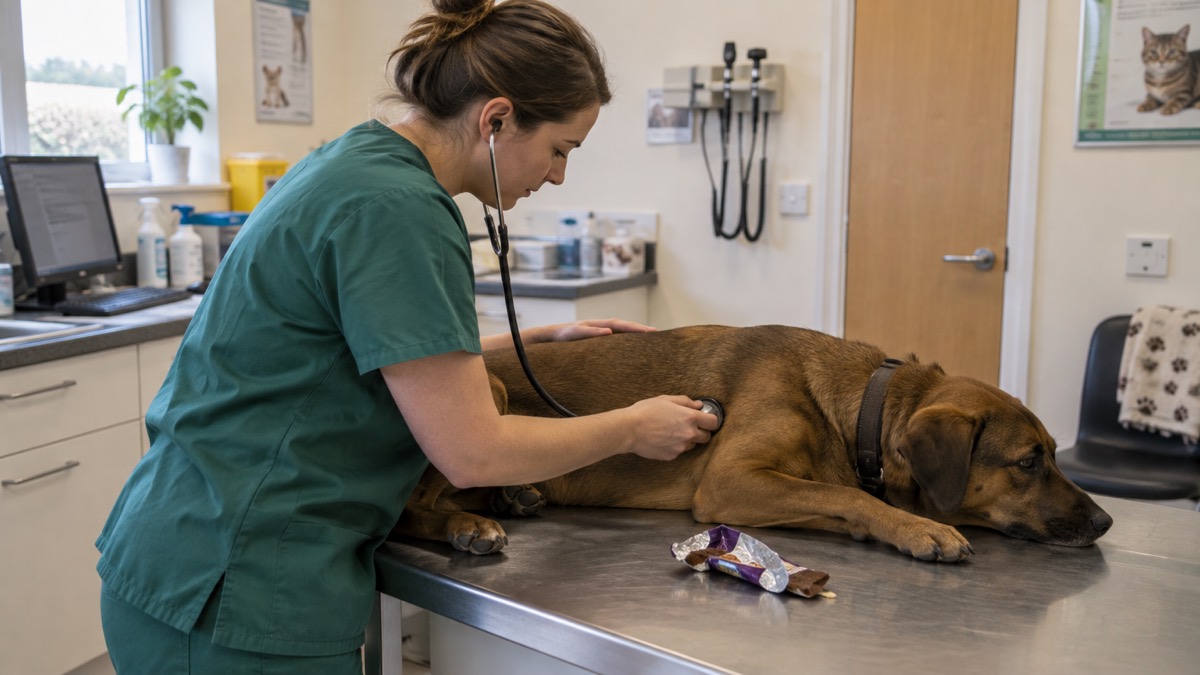
If your dog is showing tremors, seizures or collapse, treat it as an emergency and get to the vet without delay. The advice is not to wait for symptoms to worsen, because early intervention can save lives5. If you are unsure whether your dog can be moved safely, our guide to moving an injured dog or cat to the vet covers how to do it without causing further harm.
Why chocolate is poisonous: theobromine and caffeine
Chocolate contains theobromine, a chemical that is toxic to cats, dogs and other pets2. It also contains caffeine, and chocolate can cause vomiting, diarrhoea, an increased heart rate, restlessness, tremors, seizures and lethargy if ingested6. The two stimulants together are what make chocolate a poison rather than a treat for animals.
The amount of theobromine varies with the type of chocolate. Dark chocolate is the most toxic, because it contains more theobromine than milk chocolate, and white chocolate carries a much smaller risk2. Cocoa powder and cocoa mulch contain high levels of theobromine, as does dark chocolate1. That is why a small square of dark chocolate can be more dangerous than a larger piece of milk chocolate, and why the cocoa tin and the baking cupboard deserve particular care.
The same chemical affects other pets. The RSPCA warns that chocolate contains theobromine, a chemical that can be fatal to dogs, cats and rabbits, and that the darker the chocolate the higher the level3. For rabbits, chocolate contains theobromine and caffeine and can cause vomiting, diarrhoea, an increased heart rate, restlessness, tremors, seizures and lethargy6. For rodents, theobromine is described as a powerful stimulant similar to caffeine, and dark chocolate and cocoa contain high levels of it7.
Keeping chocolate out of reach at home
The simplest protection is to treat chocolate as a medicine, not a food, where pets are concerned. The RSPCA's instruction is blunt: never give chocolate to your pet7. Keep pets away from any foods containing chocolate, such as cakes, sweets, cookies and cocoa powder3. That covers the obvious chocolate bars and the less obvious sources: the cake cooling on the side, the bowl you licked out, the open cocoa tin, and the selection box left within reach.
- Store chocolate in a closed cupboard, not on a low shelf or a coffee table.
- Keep cocoa powder and baking chocolate with the rest of the baking ingredients, out of reach.
- Clear up after baking before you let the dog back into the kitchen.
- Watch the Christmas and Easter seasons, when chocolate is in the house in larger quantities and in more places.
- Keep pets away from food and food preparation surfaces8.
- Keep candles out of reach of animals and children if you are using them around a celebration9.
The RSPCA's Christmas advice is to keep chocolate away from pets, and the charity's pet-safe Christmas guidance names chocolate among the hazards of the season10. If you want a fuller list of seasonal risks, our guide to Christmas foods and decorations that harm dogs and cats sets them out.
Chocolate and other pets: cats, rabbits and rodents

Chocolate is not a dog-only problem. The RSPCA warns that theobromine can be fatal to dogs, cats and rabbits, and that the darker the chocolate the higher the level3. Cats are less likely to raid a chocolate box than dogs, but the risk is real, and the same advice applies: contact your vet immediately if you think a cat has eaten chocolate.
For rabbits, the advice is even more direct. The RSPCA says never to watch and wait if you suspect poisoning: act fast and contact a vet immediately11. The same charity's winter rabbit guidance repeats it: if you suspect your rabbit has been poisoned, contact a vet immediately and never watch and wait6. Rabbits can deteriorate quickly, so speed matters.
For rodents, the RSPCA describes theobromine as a powerful stimulant similar to caffeine, and notes that dark chocolate and cocoa contain high levels of it7. The same guidance says never to give chocolate to your pet7. If you keep hamsters, guinea pigs or other small furries, keep chocolate well away from their housing and from any treats.
| Pet | Chocolate risk | What to do |
|---|---|---|
| Dogs | Theobromine toxic; most commonly reported dog poisoning1 | Contact your vet immediately, never watch and wait1 |
| Cats | Theobromine can be fatal to cats3 | Contact your vet immediately |
| Rabbits | Theobromine and caffeine cause vomiting, diarrhoea, increased heart rate, tremors and seizures6 | Contact a vet immediately, never watch and wait6 |
| Rodents | Theobromine is a powerful stimulant similar to caffeine7 | Never give chocolate to your pet7 |
Cocoa mulch and the garden

Cocoa mulch is a garden product made from cocoa, and it carries the same risk as the cocoa in your kitchen. The RSPCA warns that dark chocolate, cocoa mulch and cocoa contain high levels of theobromine1. A dog that eats cocoa mulch in the garden can be poisoned just as it would be by eating chocolate, and the mulch may be more attractive because it smells of chocolate.
If you use cocoa mulch, keep it away from areas your dog can reach, and clear up any spills. If you think your dog has eaten some, contact your vet immediately and tell them it was cocoa mulch, because the theobromine level is high1. The same applies to compost heaps and garden waste where cocoa products may have been thrown.
Other garden hazards are worth knowing about too. The RSPCA lists a range of plants that can cause serious symptoms in pets, including autumn crocus, azalea and rhododendron, cotoneaster, daffodil, dumbcane, horse chestnut, oak, potato plants, yew, mushrooms and giant hogweed3. Our guide to garden and house plants that are poisonous to dogs and cats covers them in more detail.
Sources (11)
- Common dog poisonings, RSPCA, 2026-10-29
- Christmas pet safety, RSPCA, 2026-10-29
- Poisons and hazards for your pets, PDSA, 2026-10-29
- Toxic items for dogs, Dogs Trust, 2026
- Antifreeze poisoning in dogs, Scottish SPCA, 2025-11-17
- Rabbits in winter, RSPCA, 2026-10-29
- Poisoning in rodents, RSPCA, 2026-10-29
- Food poisoning advice, Northumberland County Council, 2026-08-11
- Candle safety, Lincolnshire County Council, 2026-10-29
- Pet-safe Christmas, RSPCA, 2026-10-29
- Poisoning in rabbits, RSPCA, 2026-10-29
 Pet Emergency Documents
 Storing Pet Food and Water
 Carer's Emergency Plan
 Pet Birds in Cold Weather
 Birds and Chickens in Heat
 Breaking a Car Window for a Dog
 Keeping a Cat Cool in a Heatwave
 Christmas Hazards for Pets
 Dog Left Alone on a Hot Day
 Dog in a Hot Car
 Hypothermia in Dogs and Cats
 Dogs in Water or Coast Trouble
 Fireworks and Small Pets
 Fish in a Power Cut
 Flystrike in Rabbits