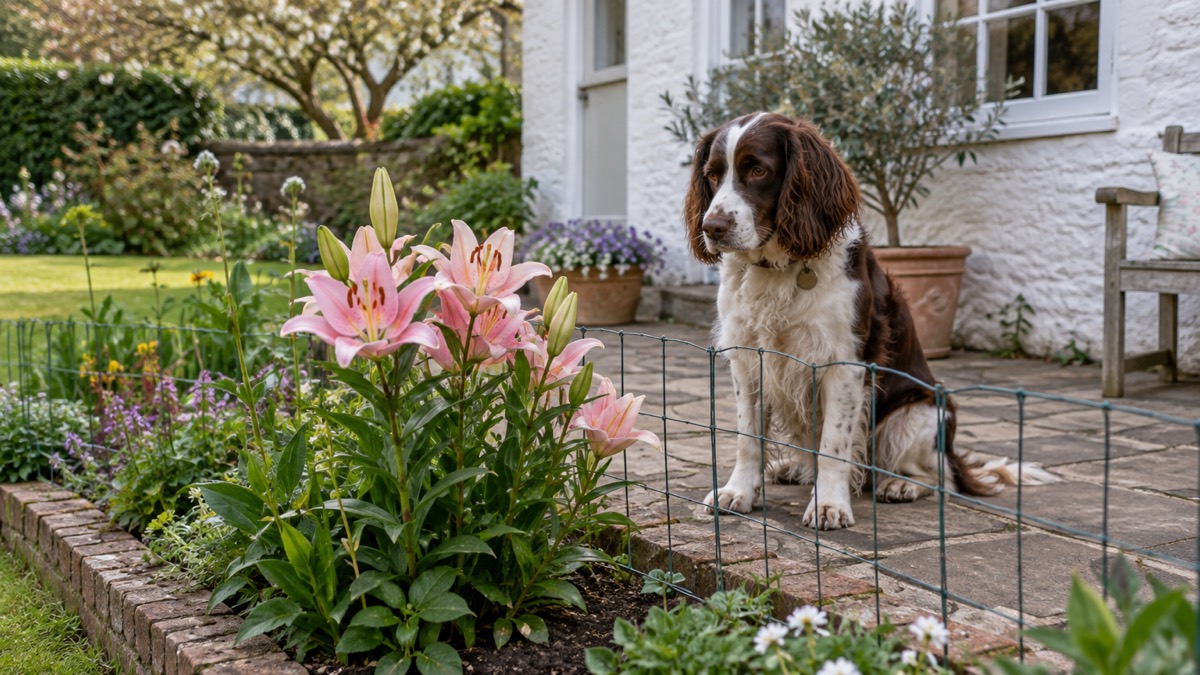
If you are asking which garden plants are toxic to dogs, the answer starts with one plant you should know by name: the lily. The RSPCA states that all parts of lily plants are highly toxic to cats and dogs and can cause life-threatening kidney failure, and advises avoiding all types1. The Blue Cross goes further for cats, warning that even a dusting of pollen from a lily on a cat's coat can be enough to cause a serious reaction2.
That makes lilies different from most of the plants on a long toxicity list. Many plants cause stomach upset or irritation; lilies can kill. So the first practical step for any household with a cat or dog is to remove lilies from the house and garden, and to check every bouquet that comes through the door before it goes into a vase.
Beyond lilies, a handful of common garden and house plants are worth knowing: daffodils, especially the bulbs, and tomato plants are toxic to dogs3, and the PDSA names Autumn Crocus, azalea and rhododendron, cotoneaster, dumbcane, horse chestnut, oak, potato plants, yew and giant hogweed among plants that can cause serious symptoms4. This page sets out what to keep away, why lilies are the priority, and how to make a garden and home that are safer for pets.
Lilies: the plant to remove first
Lilies are the one group where the advice is not "keep out of reach" but "do not keep". The RSPCA is direct: all parts of lily plants are highly toxic to cats and dogs, and can cause life-threatening kidney failure1. The Blue Cross names many types, including Easter, tiger and oriental lilies, as highly toxic, and adds the detail that matters most for cats: even a dusting of pollen on the coat can be enough to cause a serious reaction2.
The reason is how cats behave. A cat that brushes past a lily picks up pollen on its fur, then grooms itself. The Blue Cross notes that cats can be poisoned by grooming toxic substances from their paws or coat2. A dog is more likely to eat a dropped flower head or chew a stem, but the plant is toxic to dogs too1.
Because every part is toxic, there is no safe part to leave lying about. Fallen petals, cut stems and the water in a vase all belong to the same plant. The practical rule is simple: no lilies in a home with a cat or dog, and no lilies in a garden they use.
| Plant | Who it affects | What the guidance says |
|---|---|---|
| Lilies, all types | Cats and dogs | All parts highly toxic; can cause life-threatening kidney failure; avoid all types1 |
| Easter, tiger and oriental lilies | Cats | Highly toxic; even pollen on the coat can cause a serious reaction2 |
| Daffodils, especially bulbs | Dogs | Toxic3 |
| Tomato plants (green fruit, stems, leaves) | Dogs | Toxic3 |
Why lily poisoning is life-threatening
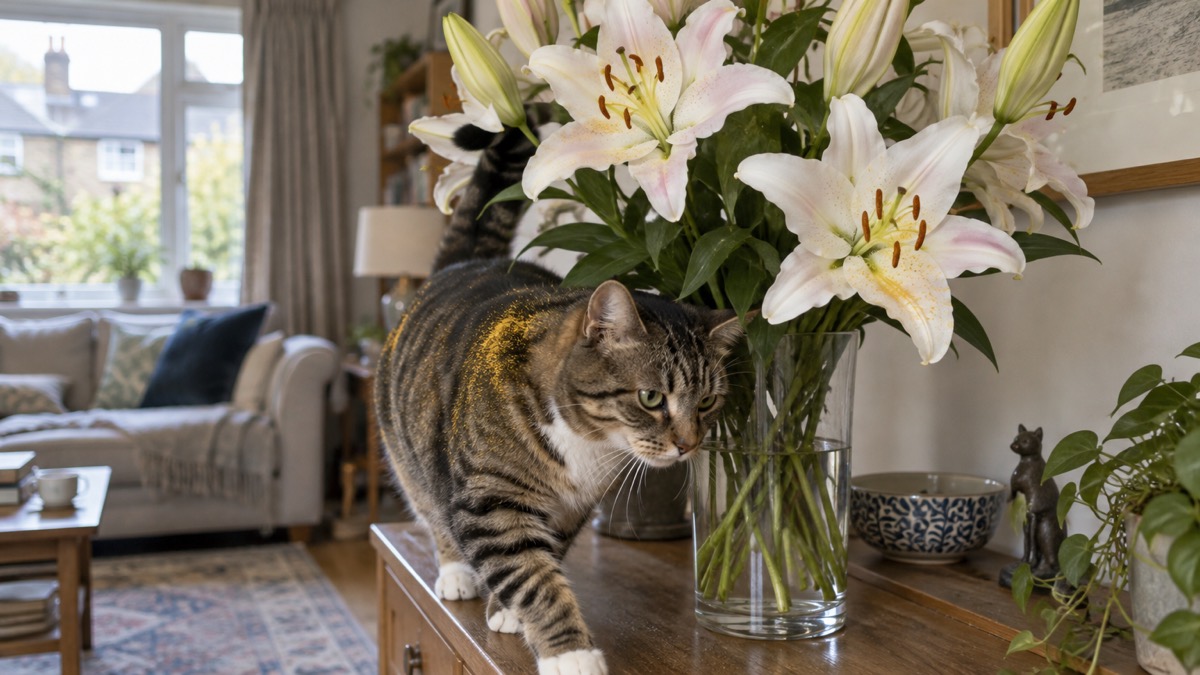
The danger with lilies is not a sore mouth or an upset stomach. The RSPCA states plainly that lily poisoning can cause life-threatening kidney failure1. Kidney failure is the mechanism that makes this plant different from the long list of plants that cause vomiting or diarrhoea.
The RSPCA's wider guidance on poisons shows how serious kidney damage is in pets. It warns that grapes, raisins, sultanas and currants contain toxins that are potentially fatal to dogs, and that in severe cases toxicity can cause kidney failure4. It also warns that antifreeze poisoning in cats and dogs can cause kidney failure, which can be fatal1. The pattern is the same with lilies: the harm is to the organs, not just the digestion, and it can be fatal.
That is why speed matters more than symptoms. A cat that has brushed against a lily may show nothing at first. The Blue Cross advises calling your vet right away if you think your pet has eaten or chewed part of a plant3. Do not wait for signs to appear before making the call.
Keeping lilies out of the house and garden
The Blue Cross advice for cat owners is unambiguous: to keep your cat safe, avoid having lilies in the house2. It adds that kittens and indoor cats are more likely to chew plants, which makes the risk higher in exactly the households where a lily on a windowsill might seem harmless2.
For dogs, Dogs Trust advises avoiding poisonous plants or finding a way of keeping your dog away, for example with a secure separating fence3. That works for a dog in a garden. It does not work for a cat, which will go over or under most boundaries, so for cat owners the garden answer is removal rather than separation.
A practical routine for a household with pets:
- Check every bouquet before it goes in a vase. Cut flowers are the most common way lilies enter a home. Remove lily stems and dispose of them where pets cannot reach them.
- Pick up dropped petals and leaves. The RSPCA advises keeping houseplants that can be harmful to rodents out of their reach and picking up dropped leaves and petals5. The same habit protects cats and dogs.
- Keep houseplants out of reach. Dogs Trust advises keeping any indoor plants out of your pup's reach, and calling your vet right away if you think your dog may have eaten or chewed part of one3.
- Check a plant is safe for every pet in the house. Dogs Trust notes that a plant safe for a dog may not be safe for a cat, so check for each species3.
- Think about rabbits and rodents too. The RSPCA lists species of lily, clematis, rhododendron and lily of the valley among plants linked to poisoning in rabbits6, and advises keeping houseplants that can be harmful to rodents out of reach and picking up dropped leaves and petals5.
Other garden and house plants to know
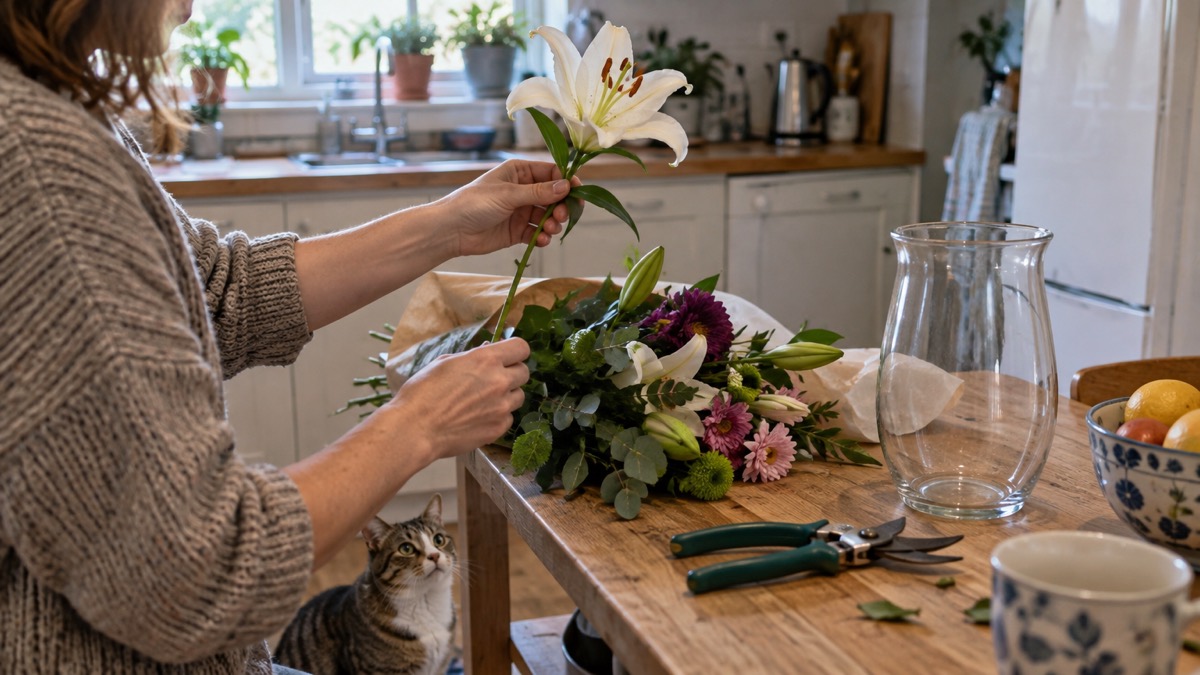
Lilies are the priority, but they are not the only plants worth knowing. Dogs Trust lists daffodils, especially the bulbs, and tomato plants, including the green fruit, stems and leaves, as toxic to dogs3. The PDSA names a longer set of plants that can cause much more serious symptoms: Autumn Crocus, azalea and rhododendron, cotoneaster, cordyline and dracaena, daffodil, dumbcane, horse chestnut, oak, potato plants, yew, mushrooms and fungi, and giant hogweed4.
Some of these are garden plants and some are houseplants. Cordyline and dracaena are common indoor plants; dumbcane is a houseplant; yew, oak and horse chestnut are trees a dog may meet on a walk or in a garden. The PDSA's list is a starting point for checking what you already grow, not a complete catalogue of every plant in the UK.
| Plant | Where you meet it | Guidance |
|---|---|---|
| Autumn Crocus | Garden | Can cause serious symptoms4 |
| Azalea and rhododendron | Garden | Can cause serious symptoms4 |
| Cotoneaster | Garden | Can cause serious symptoms4 |
| Cordyline and dracaena | Houseplant | Can cause serious symptoms4 |
| Daffodil | Garden | Toxic, especially the bulbs3; serious symptoms4 |
| Dumbcane | Houseplant | Can cause serious symptoms4 |
| Horse chestnut | Garden, park | Can cause serious symptoms4 |
| Oak | Garden, park | Can cause serious symptoms4 |
| Potato plants | Garden, allotment | Can cause serious symptoms4 |
| Yew | Garden, churchyard | Can cause serious symptoms4 |
| Giant hogweed | Wild, riverside | Can cause serious symptoms4 |
| Tomato plants (green fruit, stems, leaves) | Garden, greenhouse | Toxic to dogs3 |
The PDSA also warns that some garden plants, such as bright red yew berries, laburnum pods and foxgloves, are especially attractive to small children, incredibly toxic and can even lead to death7. That is a reminder that a pet-safe garden and a child-safe garden overlap: the same plants to keep away from a toddler are often the ones to keep away from a dog.
Making a garden that is safer for pets
The safest garden for a dog or cat is one built around plants you know are safe. Dogs Trust notes that many herbs are good choices for a dog-friendly garden and can be grown in containers as well as beds, so they are easy to keep where you want them3. It also cautions that any dog-friendly plant could still upset your dog's stomach if they eat a lot of it3, so "safe" means "not toxic", not "unlimited".
For a dog, Dogs Trust's approach is to avoid planting poisonous plants or to install a secure separating fence to keep the dog away from the ones that are already there3. For a cat, separation is harder, so removal is the more reliable answer.
A few practical points for a pet-safe garden:
- Check before you plant. Look up any new plant against a pet toxicity list before it goes in the ground or a pot.
- Check for every species in the house. A plant safe for a dog may not be safe for a cat, so check each pet separately3.
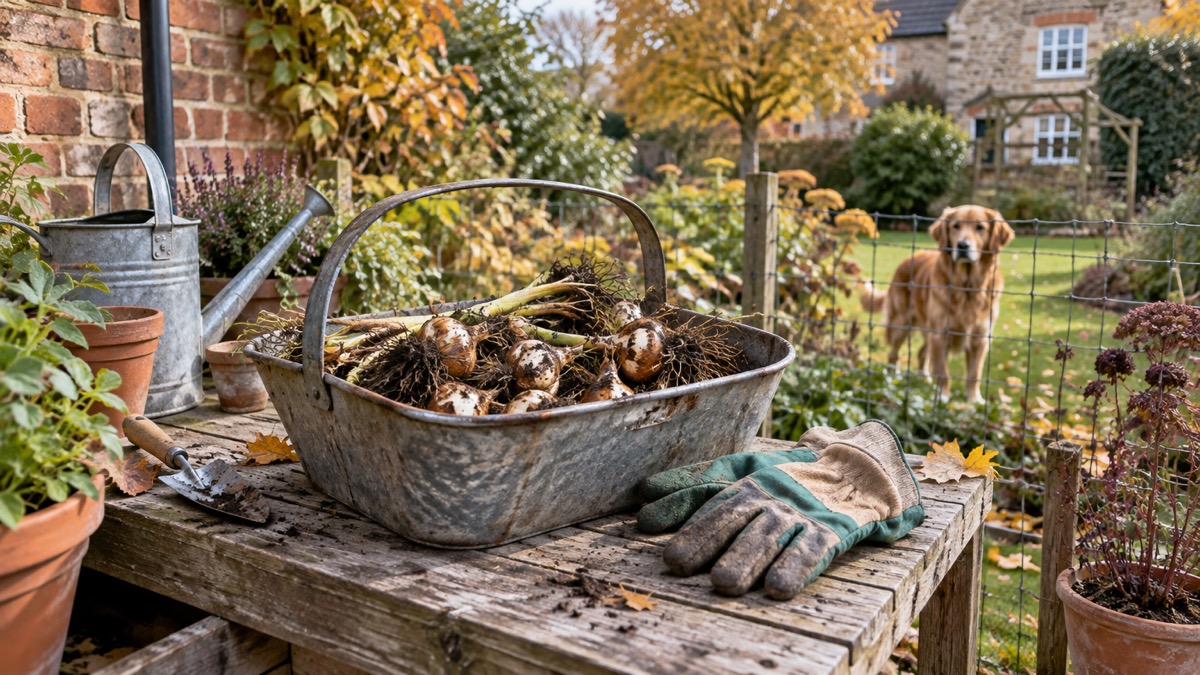
- Keep bulbs and cuttings out of reach. Daffodil bulbs are toxic to dogs3, and bulbs and cuttings left on a patio are easy for a dog to pick up.
- Watch the compost and the shed. The RSPCA warns that antifreeze is very poisonous to pets and is found in screen wash, de-icers and brake fluid, and that ingesting even the smallest amounts can cause kidney failure and can be fatal4. Store these out of reach and clean up spills.
- Pick up fallen fruit and leaves. Dropped leaves and petals are a route to poisoning for rodents and rabbits5, and the same habit helps with dogs and cats.
If you think your pet has eaten a poisonous plant
The first action is always the same: call your vet. Dogs Trust advises calling your vet right away if you think your dog may have eaten or chewed part of an indoor plant3. Do not wait for symptoms, and do not try to make your pet sick unless a vet tells you to.
For a cat with pollen on its coat, the Blue Cross's warning that even a dusting can cause a serious reaction means the coat itself is the emergency2. Contact your vet for advice on cleaning the fur safely rather than letting the cat groom it off.
If your pet needs out-of-hours care, plan where you would go before you need it. Our guide to emergency vets and out-of-hours care explains how the 24-hour rule works, and a pet first aid kit is worth keeping ready for the journey.
Where to get help and further reading
For advice on a specific plant or a suspected poisoning, your vet is the first call. For general guidance, the RSPCA, Blue Cross, Dogs Trust and PDSA all publish pet poison information, and their lists are updated as knowledge changes.
If you are preparing your household for an emergency, the same plant risks apply when pets are confined indoors or moved to a temporary home. Our guide to including your pets in a household emergency plan covers what to pack and who to call, and the pets and animals section brings together the wider advice on keeping animals safe.
For seasonal risks that sit alongside plants, see our pages on antifreeze poisoning, rock salt and paws and Christmas foods and decorations that harm dogs and cats.
Sources (8)
- Christmas pet hazards, RSPCA
- Protecting your cat from common toxins, Blue Cross, 2025-03-27
- Toxic items for dogs, Dogs Trust, 2026
- Poisons and hazards for your pets, PDSA, 2026-10-29
- Poisoning in rodents, RSPCA, 2026-10-29
- Poisoning in rabbits, RSPCA, 2026-10-29
- Keeping kids safe: poisoning, RoSPA, 2026-10-26
- Cats in winter, RSPCA, 2026-10-29
 Pet Emergency Documents
 Storing Pet Food and Water
 Carer's Emergency Plan
 Pet Birds in Cold Weather
 Birds and Chickens in Heat
 Breaking a Car Window for a Dog
 Keeping a Cat Cool in a Heatwave
 Chocolate Poisoning in Dogs
 Christmas Hazards for Pets
 Dog Left Alone on a Hot Day
 Dog in a Hot Car
 Hypothermia in Dogs and Cats
 Dogs in Water or Coast Trouble
 Fireworks and Small Pets
 Fish in a Power Cut