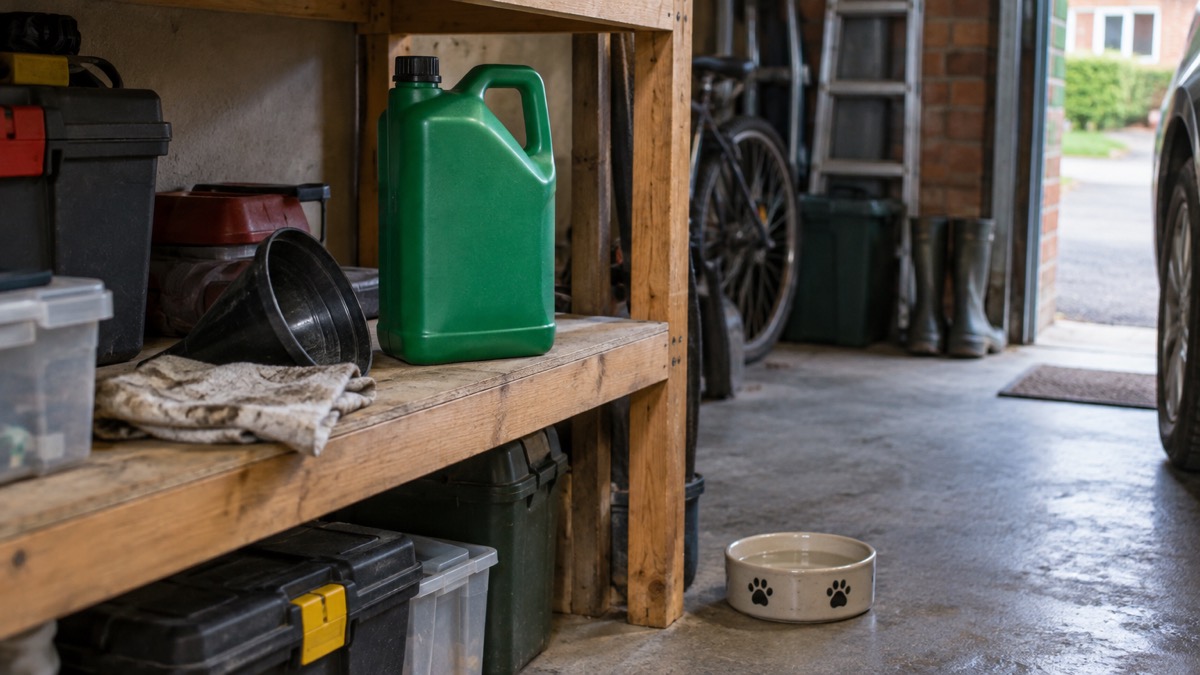
Yes, antifreeze is poisonous to cats, and it is one of the most dangerous everyday chemicals in a UK home. Most antifreeze contains ethylene glycol, a chemical that tastes sweet, which makes it tempting to animals and even children1. Even a very small amount of liquid containing ethylene glycol will cause antifreeze poisoning in cats2, and Battersea warns that a few drops in a puddle or spill under your car is enough to cause serious, if not fatal, kidney damage if eaten or walked through and then licked from paws3. Pets die every year from accidental poisonings from antifreeze spills and leaks, as well as from leaking water coolant from cars4.
If you suspect your pet has come into contact with antifreeze or leaked water coolant, get them to a vet immediately4. Never "watch and wait" if you suspect your pet has been poisoned: contact a vet immediately4. Antifreeze poisoning is usually fatal, but getting your cat to the vet immediately can increase their chance of survival5, and treatment has a much higher chance of working if it is started early, before the kidneys are damaged2.
If you think your cat or dog has licked antifreeze
Contact your vet immediately if you think your cat has been exposed to antifreeze2. The same urgency applies to dogs: if you suspect a dog has ingested antifreeze, seek veterinary help immediately1. Woodgreen puts it plainly: it is vital to seek veterinary help immediately if you suspect antifreeze poisoning7. This is not a situation where you wait to see whether your pet seems unwell, because the early symptoms can pass or seem to improve while the poison is still damaging the kidneys.
Do not wait for symptoms to worsen: early intervention can save lives1. The PDSA is equally direct about cats: never wait for symptoms to develop, because the quicker they are treated, the better their chance of survival2.
If your pet has walked through a spill rather than drunk it, they are still at risk. Cats can be poisoned by grooming antifreeze off their fur or paws after walking through a spillage2, and the same applies to dogs, who can ingest it by walking through a spillage and licking it off their paws6. If you can see liquid on their paws, legs or tummy, wipe it off thoroughly before or while you travel to the vet, but do not delay the journey to clean them.
Tell the vet what you think happened. The vet will examine your cat, ask about access to antifreeze or spillages near parked cars, and may do blood and urine tests to check the kidneys2. For dogs, the vet will ask about access to antifreeze, examine your dog and, if necessary, run blood and urine tests to check the kidneys6. Any detail you can give, such as the product name or where the spill was, helps.
If you are not sure where your nearest emergency vet is, or it is outside normal hours, see our guide to emergency vets and out-of-hours care. If your pet is injured or collapsed as well as poisoned, our advice on moving an injured dog or cat to the vet explains how to carry them safely.
Why antifreeze is so dangerous to cats
Antifreeze, used in car radiators, screen wash or car de-icers in the winter, is particularly poisonous to cats. The solution contains ethylene glycol, which can prove fatal if ingested, and even a few licks can cause serious harm such as kidney failure8. The Blue Cross agrees: antifreeze poisoning can be fatal for cats, and just a small amount can be extremely dangerous9.
The reason cats seek it out is the taste. Ethylene glycol is naturally sweet, which is why cats are tempted to drink it from containers, leaky car radiators or driveway spillages2. Woodgreen notes that cats in particular find it very palatable, as it tastes sweet7. A cat does not need to be thirsty or curious about chemicals: a sweet-tasting puddle under a car is simply attractive to them.
The dose needed to cause harm is tiny. Even a very small amount of liquid containing ethylene glycol will cause antifreeze poisoning in cats2, and Woodgreen describes ethylene glycol as extremely poisonous to cats, where even a small amount can prove fatal7. Cats can also be poisoned without drinking at all: walking through a spillage and then cleaning their paws could be enough to cause serious illness, or even death7.
The outcome of the chemical inside the body is kidney failure. The active ingredient in antifreeze, ethylene glycol, causes kidney failure and death in cats5, and the same is true for dogs10. Even small amounts of ethylene glycol, if swallowed, can be extremely toxic and cause permanent damage to the kidneys2. Sadly, most cats die from antifreeze poisoning unless it is treated very quickly2.
Stray and outdoor cats face the same risk as owned cats, and arguably more. Just like any other cat, stray cats are at risk of drinking antifreeze, especially as they might not always have access to fresh, clean water2. If you feed or shelter outdoor cats, providing clean water reduces the chance they drink from puddles and spills. Our guide on helping outdoor and stray cats in freezing weather covers this in more detail.
Signs of poisoning: from 30 minutes to kidney failure days later
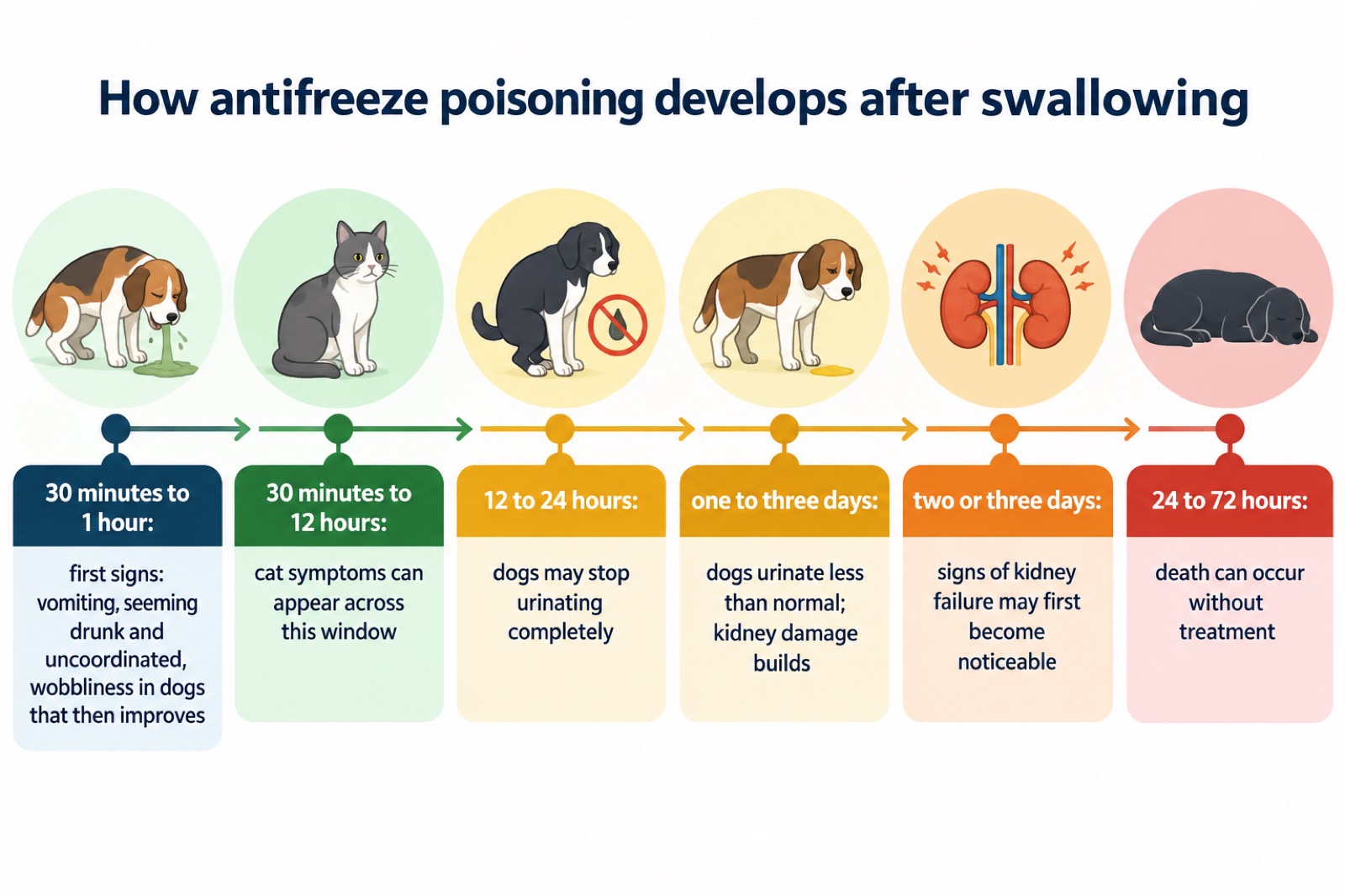
Signs of antifreeze poisoning can show 30 minutes after a cat has eaten it4. The PDSA gives a slightly wider window for cats: once swallowed, symptoms can be seen within 30 minutes to 12 hours2. For dogs, symptoms can develop in as little as an hour after swallowing6.
The early signs in cats, as listed by the RSPCA, are:
- vomiting
- seeming depressed or sleepy
- appearing drunk and uncoordinated
- seizures (fits)
- difficulty breathing4
Dogs show a similar pattern. Early symptoms of antifreeze poisoning in dogs include vomiting or nausea, lethargy or unusual weakness, loss of appetite, difficulty walking or breathing, excessive thirst or urination, and seizures1. The PDSA adds detail on the timeline in dogs: wobbliness and weakness tend to happen within one hour of ingestion and then improve again, which can lull an owner into thinking the danger has passed. Dogs may then wee more than normal to begin with, and less than normal from one to three days after ingestion, alongside low energy, difficulty breathing or fast breathing, seizures and collapse6.
The RSPCA's winter advice for dogs lists the fuller course of the poisoning: seeming depressed or sleepy, appearing drunk and uncoordinated, seizures, difficulty breathing, excessive thirst and urination, a complete lack of urination 12 to 24 hours after ingestion, vomiting and diarrhoea, loss of appetite, coma, and kidney failure10.
The most important thing to understand is that the worst damage comes later. It can be two or three days before you notice signs of kidney failure4. By that point the kidneys may already be badly damaged, which is why the early, "drunk" phase is the moment to act, not the later collapse. Woodgreen also lists drinking and urinating to excess among the signs in cats7, and Battersea notes excessive urination, or none at all, alongside vomiting, drooling and loss of appetite3.
Never watch and wait: treatment works best within 12 hours
Treatment has a much higher chance of working if it is started early, before the kidneys are damaged2. For dogs the PDSA gives a figure you can act on: your dog has a higher chance of surviving if treatment is started within 12 hours of coming into contact with it6. That window is the reason to go to the vet on suspicion alone, even if your pet currently seems fine.
What treatment involves depends on how early you arrive. For cats, treatment may include hospitalisation, medication to make them vomit (which will only help in the very early stages), specific medicine to try to stop the effects of the antifreeze, a fluid drip to support the kidneys, and washing antifreeze off the skin and coat2. Dogs receive much the same: medication to make them vomit in the very early stages, washing antifreeze off paws and coat, specific medicine to stop the effects of the antifreeze, a fluid drip to support the kidneys, and hospitalisation is likely6.
The outlook is serious even with treatment. Sadly, due to its very toxic nature, many dogs die from ethylene glycol poisoning, and the outlook also depends on the amount swallowed6. For cats it is starker still: most cats die from antifreeze poisoning unless it is treated very quickly2. These figures are not given to frighten, but to explain why a vet trip at 11 at night on a suspicion beats a wait-and-see morning.
The same rule applies to wildlife. If you suspect a wild animal has ingested antifreeze, seek veterinary help immediately, and do not wait for symptoms to worsen, because early intervention can save lives11.
Where ethylene glycol hides in and around the home
Antifreeze is most commonly used in car radiators and can be found in screen washes and de-icers, and it is sometimes wrongly used in garden ponds and water features12. The PDSA lists the same hiding places from the chemical's point of view: ethylene glycol is also found in car screen wash, brake fluid, radiator fluid and garden water features6. The RSPCA's general poisons guidance adds that antifreeze is very poisonous to pets and is found in screen wash, de-icers and brake fluid, and that ingesting even the smallest amounts can cause kidney failure and can be fatal13.
| Where it is found | Why it is a risk |
|---|---|
| Car radiators and cooling systems | Leaks and spills leave sweet-tasting puddles under parked cars4 |
| Screen wash and de-icer sprays | Often contain ethylene glycol; choose ones that do not8 |
| Brake fluid and radiator fluid | Contain ethylene glycol; store like antifreeze6 |
| Garden ponds and water features | Sometimes wrongly used to stop freezing; cats, dogs, other small animals and birds may drink from these features7 |
| Snow globes | Can contain antifreeze, which is poisonous15 |
| Old antifreeze containers holding rainwater | Cats may be poisoned by drinking rain water from containers that previously contained antifreeze2 |
Two of these deserve special attention. First, water features: Battersea advises avoiding the use of ethylene glycol products in garden ponds and water features, because cats, dogs, other small animals and birds may be inclined to drink from them12. Woodgreen gives the same warning7. Second, snow globes: the RSPCA warns that snow globes can contain antifreeze, which is poisonous15, and notes that antifreeze is used in cars' cooling systems, and sometimes snow globes14. A broken snow globe on the carpet at Christmas is a genuine poisoning risk, and it belongs on the same list of seasonal hazards as the foods covered in our page on Christmas foods and decorations that harm dogs and cats.
Rainwater deserves a mention of its own. The PDSA warns that cats may be poisoned by drinking rain water from containers that previously contained antifreeze2. An empty bottle left outside with its cap off can collect rain and poison a cat weeks after the antifreeze itself was used. Dispose of old containers rather than re-using them.
Storing, using and clearing up antifreeze safely
The prevention advice from every charity is consistent, and it is all practical.
- Use labelled and sealed containers to store any product containing ethylene glycol, such as antifreeze, screen wash, brake and radiator fluid2.
- Store it out of your pets' reach7, and out of the reach of children, who are also tempted by the sweet taste1.
- Mop up any spillages straight away7, and clear up spillages immediately6.
- Wipe up drained radiator solution quickly8.
- Dispose of old containers rather than re-using them2.
- Aim to use screen wash or de-icer sprays that do not contain ethylene glycol8.
- Buy antifreeze with a bittering agent where you can, but do not rely on it6.
- Exercise dogs away from possible spills near parked cars6.
After walks in cold weather, wipe your pet down. The RSPCA advises looking out for antifreeze and rock salt on the ground, as these can be fatal to both dogs and cats: they may lick the substances off their paws or fur, so thoroughly wipe their feet, legs and tummy after a walk or time outside during cold weather when there may be grit on the ground16. For cats, the RSPCA advises thoroughly wiping down their paws and tummy after a trip outside to remove any antifreeze and rock salt, which is poisonous to cats5. Our page on rock salt and pets' paws covers the salt side of this in detail.
Disposal has clear rules. The Scottish SPCA advises taking used antifreeze to a recycling centre, and never pouring it on the ground or down drains, and not re-using the container1. The same instructions appear in its wildlife guidance11. Pouring antifreeze down a drain or onto ground anywhere a cat, dog, fox or hedgehog can reach simply moves the poisoning somewhere you cannot see.
A note on bittering agents: some antifreeze products use propylene glycol, which is far less toxic to dogs, and some have an added bitterant to make it less appealing1. But the PDSA cautions that it is important to be aware this is not completely reliable, and dogs may still want to drink it6. A bitterant makes the product less attractive; it does not make it safe.
Protecting hedgehogs, foxes and birds in autumn and winter
Antifreeze poisoning is not only a pet problem. The Scottish SPCA warns that hedgehogs, squirrels, foxes and birds are at high risk during autumn and winter11, when car maintenance and freezing nights coincide. The mechanism is the same as for pets: most antifreeze contains ethylene glycol, a chemical that tastes sweet, which makes it tempting to animals and even children11. Even tiny drips on driveways or garage floors can be deadly if licked11.
Wild animals are poisoned by drinking spills and by grooming. There is a risk that animals' fur may become contaminated, which they could ingest while grooming themselves11. The consequences are the same as in pets: severe illness, such as kidney failure, and death, sometimes within 24 to 72 hours11. Early symptoms in wildlife mirror those in dogs: vomiting or nausea, lethargy or unusual weakness, loss of appetite, difficulty walking or breathing, excessive thirst or urination, and seizures11.
If you suspect a wild animal has ingested antifreeze, seek veterinary help immediately, and do not wait for symptoms to worsen, because early intervention can save lives11. A vet or wildlife charity can treat a contaminated hedgehog or fox in the same window that saves cats and dogs.
What you do around your home and car is the protection. The Scottish SPCA's disposal rules exist for wildlife as much as pets: never pour antifreeze on the ground or down drains, and do not re-use the container11. Clearing drips under your car promptly, and checking the driveway and garage floor after any coolant work, removes the source. If you feed hedgehogs or birds in your garden, keep feeding areas away from where cars park, and provide clean water so animals are not driven to drink from puddles.
Cold weather itself brings other risks worth preparing for alongside this one. Cats are at risk of hypothermia, frostbite or respiratory problems if exposed to temperatures below 10°C for too long5, and Cats Protection advises that anything below about 7°C can start to be unsafe for cats to stay outside, especially for long periods8. Frostbite causes severe damage to body tissues such as the tail, toes, nose and tips of the ears in freezing temperatures5. Keep the cat flap clear, as freezing temperatures or snowy nights might cause it to freeze or ice over, blocking access back inside5. Our guides on pets in cold weather, snow and ice and keeping rabbits and guinea pigs warm in winter cover these preparations.
Rabbits need mentioning here too, since many live outdoors in hutches near garages and driveways. The RSPCA warns that the active ingredient in antifreeze, ethylene glycol, can cause kidney failure and death in rabbits17. Store antifreeze and similar products well away from hutches and runs, and clear up spills before letting rabbits exercise on hard standing.
One further winter hazard sits alongside antifreeze on the ground. The Met Office, quoting the British Veterinary Association, warns that grit or rock salt can be extremely toxic to dogs and cats if ingested18. The practical response is the same wipe-down after walks that antifreeze calls for16.
Frequently asked questions
How much antifreeze does it take to kill a cat or dog? Only a very small amount. The PDSA says even a very small amount of liquid containing ethylene glycol will cause antifreeze poisoning in cats2, and Battersea warns that a few drops in a puddle or spill under a car is enough to cause serious, if not fatal, kidney damage3. How much it takes also depends on the animal's weight and the strength of the product1, so never assume a small spill is safe. Treat any suspected contact as an emergency.
Is propylene glycol antifreeze safer for pets? Yes, it is far less toxic than ethylene glycol. The Scottish SPCA says some antifreeze products use propylene glycol, which is far less toxic to dogs, and some have an added bitterant to make it less appealing1. Choosing such a product reduces the risk, but it does not remove it. Store and clear up any antifreeze carefully whatever type you buy.
Can snow globes poison my pet? They can. The RSPCA warns that snow globes can contain antifreeze, which is poisonous15. If a snow globe breaks, keep pets away from the liquid, clear it up straight away, and wipe pets' paws if they have walked through it. Contact your vet immediately if you think any has been swallowed.
Can rainwater in an old antifreeze container poison a cat? Yes. The PDSA warns that cats may be poisoned by drinking rain water from containers that previously contained antifreeze2. Never re-use an antifreeze container for anything else, and dispose of old containers rather than leaving them where rain can collect in them11.
Do bittering agents make antifreeze safe? No. The PDSA says it is important to be aware that a bittering agent in antifreeze is not completely reliable, and dogs may still want to drink it6. A bitterant makes the product less appealing, but it does not make it less toxic.
Is antifreeze dangerous to rabbits? Yes. The RSPCA says the active ingredient in antifreeze, ethylene glycol, can cause kidney failure and death in rabbits17. If you keep rabbits outside, store antifreeze and similar products well away from their enclosure, and clear up any spills promptly.
What are the chances of survival after treatment? It depends mainly on how quickly treatment starts. Treatment has a much higher chance of working if it is started early, before the kidneys are damaged2, and dogs have a higher chance of surviving if treatment begins within 12 hours of contact6. Sadly, most cats die from antifreeze poisoning unless it is treated very quickly2, and many dogs also die because of how toxic ethylene glycol is6.
Is antifreeze dangerous to children as well as pets? Yes. The Scottish SPCA notes that ethylene glycol tastes sweet, which makes it tempting to animals and even children1. Store antifreeze, screen wash and brake fluid in sealed, labelled containers well out of the reach of both children and pets, and clear up spills straight away2.
Sources (18)
- Antifreeze poisoning in dogs, Scottish SPCA, 2025-11-17
- Antifreeze (ethylene glycol) poisoning in cats, PDSA, 2024-01
- Toxic items for cats, Battersea, 2023-06-02
- Antifreeze poisoning in cats, RSPCA, 2026-10-29
- Winter advice for cats, RSPCA, 2026-10-29
- Antifreeze poisoning in dogs, PDSA, 2024-01
- Antifreeze poisoning in cats, Woodgreen, 2023-11-29
- Cats and cold weather, Cats Protection, 2026-10-29
- Protecting your cat from common toxins, Blue Cross, 2025-03-27
- Winter advice for dogs, RSPCA, 2026-10-29
- Antifreeze and wildlife, Scottish SPCA, 2025-11-17
- Winter cat care, Battersea, 2023-06-02
- Poisons and hazards for your pets, PDSA, 2026-10-29
- Christmas advice, RSPCA, 2026-10-29
- Pet-safe Christmas, RSPCA, 2026-10-29
- Winter advice for pets, RSPCA, 2026-10-29
- Winter advice for rabbits, RSPCA, 2026-10-29
- Weather hacks for cold weather, Met Office, 2026-10-26
 Pet Emergency Documents
 Storing Pet Food and Water
 Carer's Emergency Plan
 Pets in Cold Weather and Snow
 Emergency Vets and Out-of-Hours
 Pet First Aid Kits
 Keeping Pets Safe in Floods
 How Fast a Car Heats Up
 Keeping Pets Cool in Hot Weather
 Oak Processionary Moth and Dogs
 Pets in Your Emergency Plan