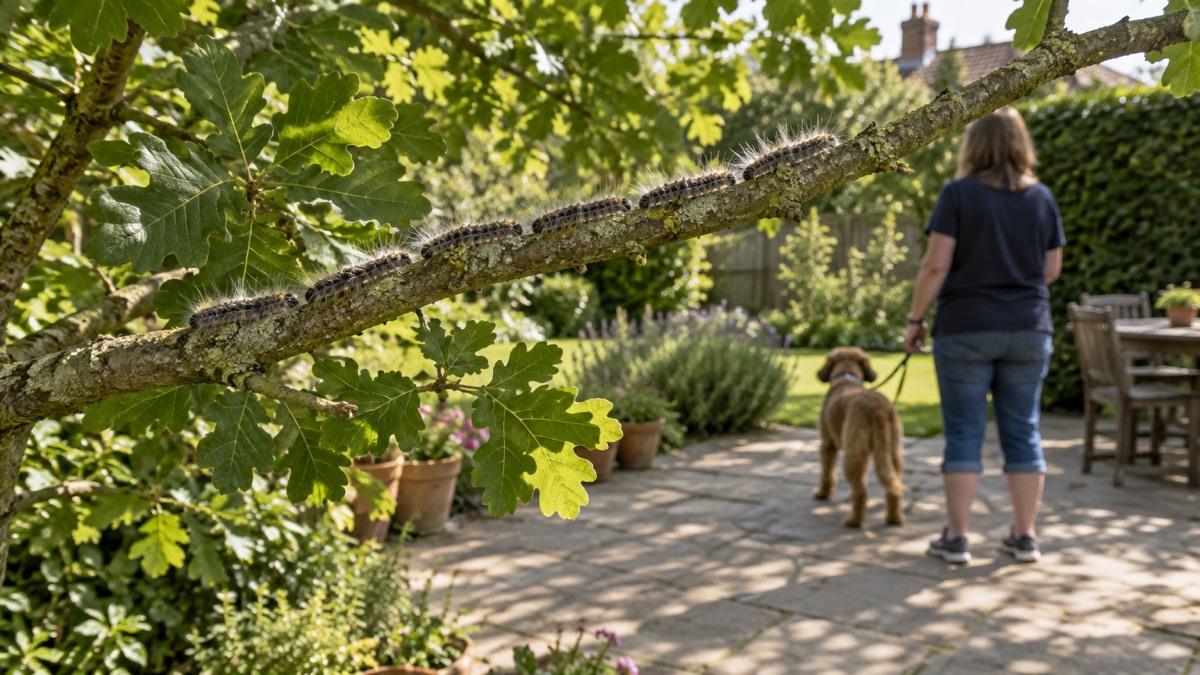
Yes, oak processionary moth (OPM) caterpillars can be harmful to dogs. Their bodies carry hairs containing an irritating substance called thaumetopoein, which can cause health risks to pets and to humans1. In dogs and cats, contact can cause excessive drooling, a swollen tongue, conjunctivitis, gagging, vomiting, difficulty breathing and an inflamed or swollen mouth1.
The good news is that serious allergic reactions are rare, and most pets only experience slight irritation or discomfort1. If your dog shows symptoms or is in discomfort after coming into contact with an OPM caterpillar, call your vet for advice, and keep an eye on your pet for a couple of days1. There is no vaccine or spot-on treatment that protects against the hairs, so the practical protection is keeping your dog away from the caterpillars and their nests, especially from May to July when they are active1.
The caterpillars are found almost exclusively in oak trees, and in the UK they are generally found in the south east of England, though they could be spreading1. If you see caterpillars or a nest, do not touch or move them yourself: report the sighting to the Forestry Commission using the Tree Alert online form1.
Symptoms to watch for after contact
The hairs on oak processionary moth caterpillars contain an irritating substance called thaumetopoein, which can cause health risks to pets and humans1. For a dog, the most likely route of contact is the mouth and face: sniffing, licking or picking up a caterpillar with its nose, mouth or tongue. That is why the symptoms Blue Cross lists centre on the mouth, throat and eyes.
Watch for these signs in dogs and cats after any contact with an OPM caterpillar or its nest1:
- Excessive drooling
- A swollen tongue
- Conjunctivitis
- Gagging
- Vomiting
- Difficulty breathing
- An inflamed or swollen mouth
Not every symptom will appear, and the severity varies from pet to pet. Serious allergic reactions are rare, and Blue Cross advises that pets should only experience slight irritation or discomfort, but it is best to keep an eye on your pet for a couple of days after contact1. Symptoms that involve breathing, or vomiting that does not settle, are the ones to take most seriously.
If your dog or cat is suffering with any of these symptoms, or is in discomfort after coming into contact with an oak processionary moth caterpillar, call your vet for advice1. Do not wait to see whether things worsen on their own if your pet is visibly struggling. For guidance on getting help outside normal opening hours, see our page on emergency vets and out-of-hours care, and for the kit that helps you handle a pet health problem at home, see our guide to pet first aid kits.
How serious reactions are, and when to call the vet
It helps to keep the risk in proportion. Blue Cross, whose guidance was reviewed by a veterinary surgeon in March 2023, states that serious allergic reactions are rare and that pets should only experience slight irritation or discomfort1. Most dogs that sniff at a caterpillar will have an unpleasant hour or two, not an emergency. But "rare" is not "never", and the symptoms list includes difficulty breathing, which in any animal is a reason to get professional advice promptly.
The practical rule is straightforward. If your dog or cat is suffering symptoms or is in discomfort after coming into contact with an OPM caterpillar, call your vet for advice1. Say what you saw: whether your pet touched a caterpillar, a nest, or the ground beneath an oak tree, and roughly when. That helps the vet judge how closely to monitor your pet.
After the initial call, watch your pet for a couple of days1. Look for symptoms that persist or worsen rather than fade, particularly any continued difficulty with breathing, repeated vomiting, or swelling in the mouth or tongue that does not go down. A pet that stops eating or drinking because its mouth is sore also needs the vet's attention.
One pattern worth knowing about in any household illness is symptoms appearing in several members at once. The fire and rescue service's carbon monoxide guidance notes that when others in your household, including pets, experience symptoms at a similar time, that points to a shared cause in the home2. OPM irritation is different: it comes from contact with caterpillar hairs outdoors. But if you and your dog both develop irritated skin, eyes or mouths after the same walk under oak trees, that shared timing is a useful clue to mention to both your pharmacist and your vet.
Recognising the caterpillars and their nests
Knowing what to look for lets you steer your dog away before contact happens. Blue Cross gives three identifying features1.
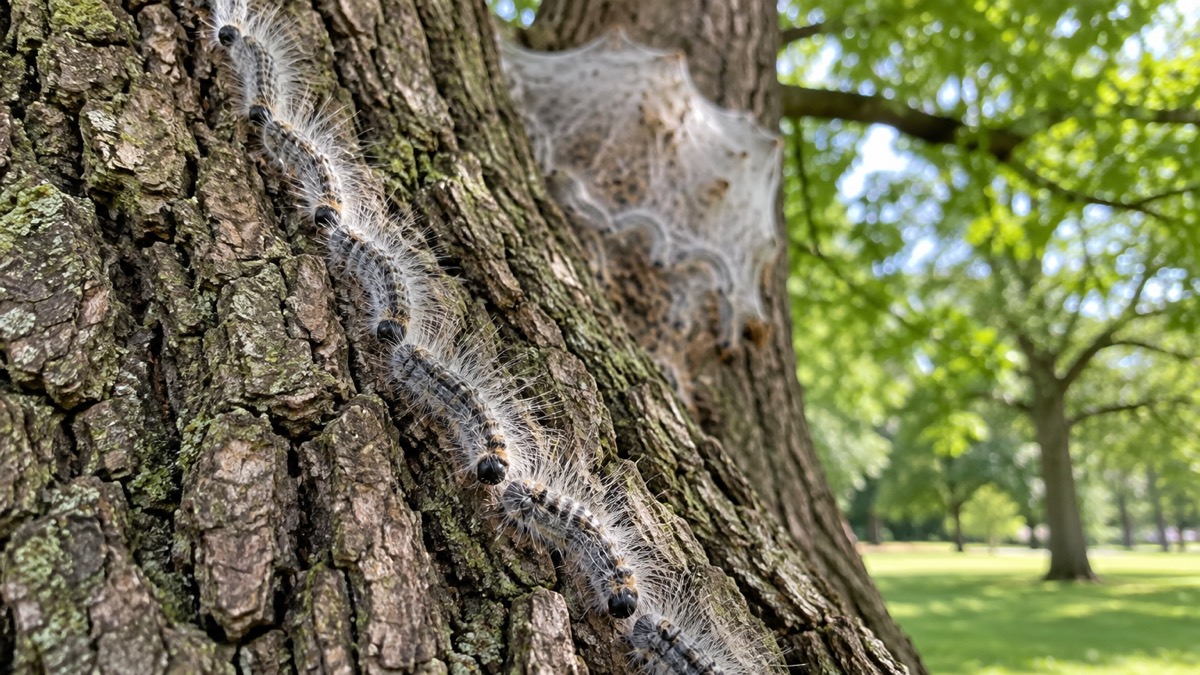
The caterpillars. OPM caterpillars have grey bodies, black heads, and very long white hairs that are noticeable among the rest of their much shorter hairs1. It is those hairs that carry the irritating substance, so the caterpillar's most distinctive feature is also its dangerous one. A curious dog sees a small, hairy, slow-moving thing on a trunk or path: exactly the kind of object many dogs want to sniff or mouth.
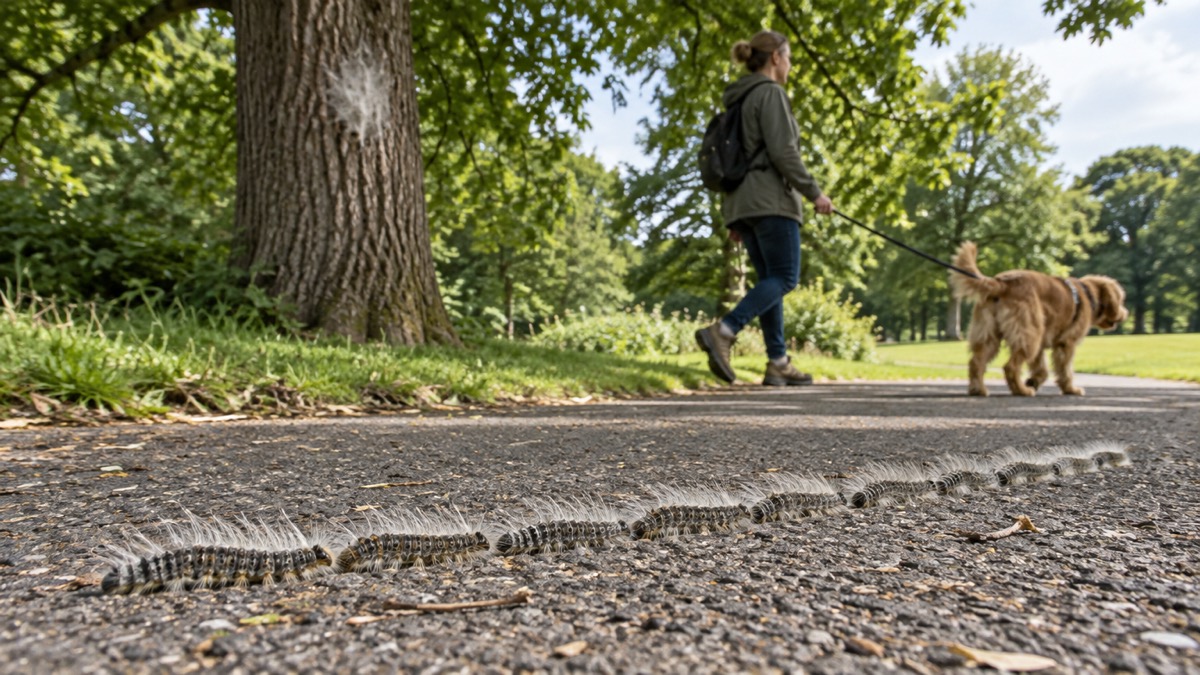
The procession. The caterpillars move nose-to-tail in a distinctive procession, and they are often clustered together1. A line of caterpillars travelling head to tail along a branch or trunk is the behaviour that gives the species its name, and a cluster on the ground under an oak is a particular hazard for a dog that sniffs around the base of trees.
The nests. The caterpillars often cluster together and build white, silk-like nests in the branches or trunks of oak trees1. On the trunk, a nest looks like a pale, webbed pad or pouch stuck to the bark; in the branches it can be a silken mass among the leaves. Nests can remain on the tree after the caterpillars have gone, and the hairs stay irritating, which is one reason the advice is to keep away at all times, not just in summer1.
| What you might see | What it looks like | Why it matters |
|---|---|---|
| A caterpillar | Grey body, black head, very long white hairs among much shorter ones | The hairs carry the irritant thaumetopoein1 |
| A procession | Caterpillars moving nose-to-tail, often clustered together | The behaviour that identifies the species1 |
| A nest | White, silk-like webbing on branches or the trunk of an oak | Hairs in and around nests can remain irritating1 |
Because OPM caterpillars are found almost exclusively in oak trees1, you do not need to inspect every tree on a walk. Focus your attention on oaks: the trunk, the main branches, and the ground beneath the canopy where caterpillars and shed hairs can fall.
The risk period: May to July, but keep away all year
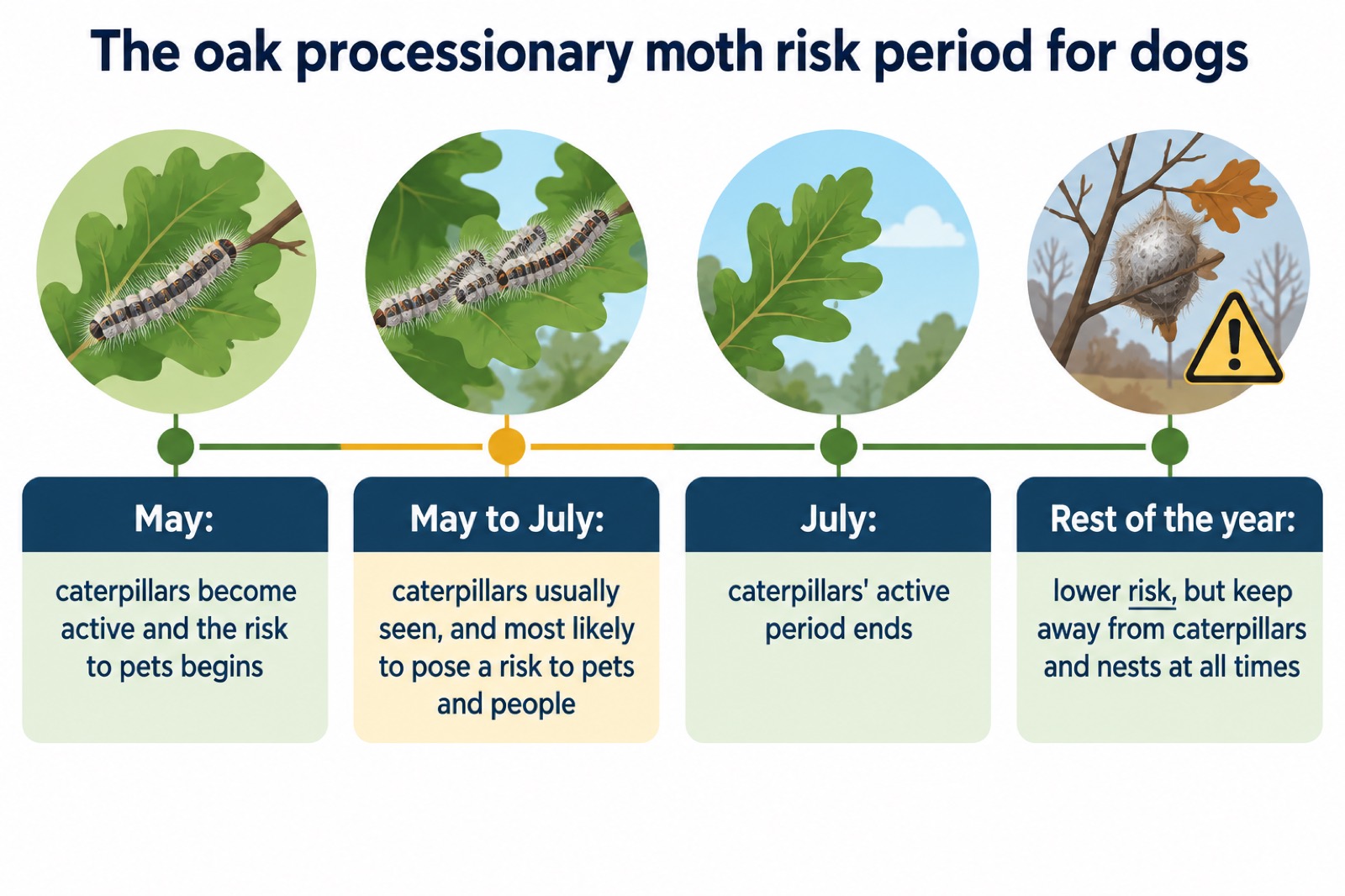
OPM caterpillars are usually seen from May to July, and they are most likely to pose a risk to pets and people during those months1. That is when the caterpillars are active, feeding and moving, and when a dog nosing around the base of an oak is most likely to meet one.
But the advice from Blue Cross is not to relax completely once August arrives. The caterpillars are most likely to pose a risk from May to July, but it is best to keep away from them at all times1. Old nests, shed skins and fallen hairs can persist on and around a tree after the caterpillars themselves have gone, and those hairs do not lose their irritant simply because summer has ended. A nest you notice on an oak in February is still something to keep your dog away from and to report.
The May to July window overlaps with other seasonal hazards that dog walkers in England are advised to plan around. Derbyshire County Council notes that ticks can be active all year round but are most active from April to July, and sometimes later in the autumn3, so a summer walk under oaks in grassy country can bring both risks at once. Checking your dog over after a walk in that period covers more than one hazard. For the wider picture of seasonal pet risks, see our pets and animals section.
Where oak processionary moth is found in the UK
Oak processionary caterpillars are not native to the UK. They were accidentally imported from mainland Europe, arriving on trees brought in for tree planting schemes1. Once here, they established themselves in oak trees, and they are now generally found in the south east of England, though they could be spreading1.
Blue Cross lists the counties where OPM caterpillars have either been found, or are likely to be found1:
- Bedfordshire
- Berkshire
- Buckinghamshire
- Essex
- Hampshire
- Hertfordshire
- Kent
- London
- Surrey
- Wokingham
- West Sussex
If you walk your dog anywhere in those counties, especially where there are mature oaks in parks, commons, woodland edges and street trees, it is worth knowing what the caterpillars and nests look like. Surrey County Council's summer health and wellbeing advice includes information and advice on oak processionary moths among its seasonal hazards for residents4, which reflects how established the moth has become in that part of the country.
If you live outside the listed counties, the risk is lower today, but the guidance that the moth could be spreading means it is sensible anywhere in the country to keep your dog from mouthing hairy caterpillars or touching silk-like nests on oaks1. A sighting well outside the south east is also exactly the kind of thing the Forestry Commission wants to know about through Tree Alert1.
Keeping your dog away: leads, recall and oak trees
Because there is no vaccine or spot-on treatment to prevent the caterpillars' hairs from irritating your dog or cat1, avoidance is the whole of the protection. That comes down to two things you can train and one decision you make on each walk.
Use a lead under and around oaks in the risk period. The habit of keeping dogs on leads in hazardous spots is well established in official safety advice for other countryside risks. Derbyshire County Council advises dog walkers to keep their dogs on leads close to water, because dogs running free risk sliding on slippery banks and ending up in deep or fast-flowing water5. Devon and Somerset Fire and Rescue Service tells dog owners to keep dogs on leads near fast flowing or flooding rivers, where banks are steep or unstable, and near cliffs6. The same principle applies to an oak tree with caterpillars on it: a dog on a lead cannot range under the canopy and sniff out a nest at the trunk's base.
Work on recall. Blue Cross advises that making sure your dog has good recall can help you call them away if you notice them getting close to an OPM caterpillar1. Recall is worth practising before you need it, in safe places, so that it holds when the distraction is a cluster of hairy caterpillars on a path.
Control on and off the lead. London Fire Brigade advises dog walkers to make sure they can control their dog on and off the lead near water7, and the same standard of control is what protects your dog around oaks. Derbyshire's flooding guidance repeats the advice to keep dogs on leads close to water to keep them safe8, and Devon and Somerset Fire and Rescue Service lists keeping dogs on leads near quarries, clifftops and fast-flowing water among its top causes of rescues and how to avoid them9. The Met Office's strong wind advice adds keeping dogs on a lead at the coast10. These are all different hazards, but the message is consistent across the fire services, councils and the Met Office: in places where something can go wrong quickly, the lead is the control that works.
A simple checklist for walks in OPM country between May and July:
- Call your dog away if you notice them getting close to a caterpillar1
- Do not let them sniff, lick or mouth caterpillars, nests, or debris under oaks1
- Check the tree for white, silk-like nests before letting your dog explore beneath it1
- Keep your dog on a lead near water, cliffs and fast-flowing or flooding rivers, where banks can be slippery, steep or unstable1
For the broader job of planning walks and pet care around emergencies, see our guide to including your pets in a household emergency plan.
Never move a caterpillar or nest yourself
If you find caterpillars or a nest, leave them exactly where they are. Blue Cross is direct on this point: do not attempt to move an OPM caterpillar or nest yourself, because oak processionary moth caterpillars can also cause health risks to people1. The hairs that irritate your dog's mouth will irritate your skin, eyes and airways too, and a nest can contain large numbers of them. Disturbing a nest, bagging one up, or brushing caterpillars off a branch all put you in contact with the hairs.
This fits a wider principle that runs through all the emergency services' advice on animal rescues: do not put yourself at risk to help an animal. London Fire Brigade tells dog walkers never to enter the water to rescue a dog, and not to get into danger themselves while trying to rescue a dog from water, because dogs often manage to scramble out on their own7. The same discipline applies here. Keep people, children and pets back from the tree, and let the professionals handle what is on it.
The reason professional handling matters is that the hairs contain thaumetopoein, an irritating substance that can cause health risks to pets and humans1. Trained crews deal with OPM nests with the right protective equipment. Your job as a dog owner is containment and reporting, not removal.
Reporting a sighting to the Forestry Commission
You can report any sightings of OPM caterpillars to the Forestry Commission by using the Tree Alert online form1.
When you report, the useful details are the ones you have already learned to notice as a dog owner: where the oak tree is, as precisely as you can describe it; what you saw, whether caterpillars with grey bodies, black heads and long white hairs moving in a procession, or a white, silk-like nest on the branches or trunk1; and roughly how many caterpillars or nests there were. A photograph taken from a safe distance, without touching or disturbing anything, helps identification.
A report is worth making even if you are not completely sure what you have seen. The caterpillars are found almost exclusively in oak trees1, so a hairy caterpillar cluster on an oak in one of the affected counties between May and July is a reasonable report. Outside the listed counties, a report is more valuable still, because it is the mechanism by which a spreading moth gets noticed.
If your own dog has already had contact before you spotted the hazard, deal with the pet first: call your vet for advice if your dog or cat is suffering symptoms or is in discomfort1. Then make the report, so the next dog walker past that tree faces less risk than yours did.
What the caterpillars do to people, and where to get help
The hairs do not distinguish between species. They contain thaumetopoein, an irritating substance that can cause health risks to pets and humans1, so an owner who picks a caterpillar off their dog with a bare hand, or brushes against a nest while pulling a dog away, can be affected too.
For people, the outlook is reassuring. Although unpleasant, symptoms are not usually medically serious and pass in a few days1. Blue Cross advises consulting a pharmacist for relief, or a doctor for a serious allergic reaction, which is rare1. The pharmacist is the right first stop for the common case of irritated skin, eyes or throat; the doctor is for the rare reaction that goes beyond that.
The practical sequence for a household where dog and owner have both had contact is therefore: call the vet for the dog1, speak to a pharmacist for yourself1, and report the sighting to the Forestry Commission1. Nobody in that sequence should be touching the caterpillars or the nest to "clear them up", because that simply creates more contact with the hairs1.
For related seasonal hazards to pets, from hot weather to cold, see our pets and animals section. If your dog gets into trouble in water or at the coast on the same kind of countryside walk, our page on what to do if your dog gets into trouble in water covers that hazard.
Sources (10)
- Dogs, cats and toxic oak processionary moth caterpillars, Blue Cross, 2023-03-31
- Carbon monoxide safety at home, Manchester Fire and Rescue Service, 2026-10-29
- Keeping cool in summer, Derbyshire County Council, 2026-10-29
- Staying safe and well in summer, Surrey County Council, 2026-10-28
- Communities affected by flooding, Derbyshire County Council, 2026-10-29
- Water safety outdoors, Devon and Somerset Fire and Rescue Service, 2025-08-20
- Water safety advice for runners and walkers, London Fire Brigade, 2026-10-25
- Communities affected by flooding, Derbyshire County Council, 2026-10-29
- Top causes of rescues and how to avoid them, Devon and Somerset Fire and Rescue Service, 2026
- Stay safe in strong wind, Met Office, 2026-10-26
 Pet Emergency Documents
 Storing Pet Food and Water
 Carer's Emergency Plan
 Antifreeze Poisoning
 Pets in Cold Weather and Snow
 Emergency Vets and Out-of-Hours
 Pet First Aid Kits
 Keeping Pets Safe in Floods
 How Fast a Car Heats Up
 Keeping Pets Cool in Hot Weather
 Pets in Your Emergency Plan