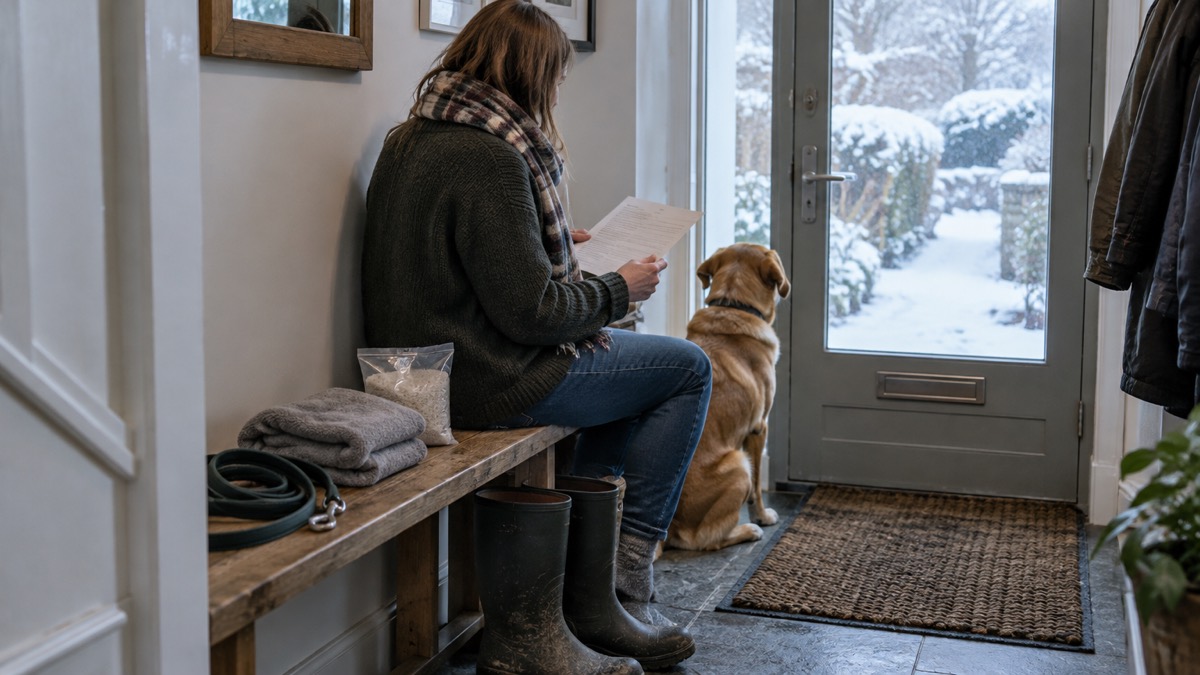
Cold weather is hard on pets in ways that are easy to miss: a dog that seems fine on a snowy walk can be developing hypothermia, and the grit spread on pavements is toxic if your cat licks it off their fur. The good news is that the risks are well understood, and the steps that protect your pets are simple. Dry them off quickly after wet or icy walks, give them a warm draught-free bed, wipe salt from paws and fur, keep dogs on a lead near frozen water, and call your vet at the first sign of trouble1.
The most serious cold-weather emergency is hypothermia, which the PDSA describes as a pet's body temperature dropping dangerously low. It is extremely dangerous and, if not treated quickly, can cause the whole body to shut down and death1. The signs to watch for are shivering that may stop completely when the pet becomes severely cold, drowsiness, confusion and clumsiness, pale gums, and in the worst cases loss of consciousness, collapse and coma1. If you see them, warm your pet gently and call your vet immediately.
This page covers what to do now, what to have ready, the hazards specific to winter, and where to get help. It applies across England, Scotland, Wales and Northern Ireland, because the veterinary and safety advice is the same everywhere; where local arrangements differ, such as road gritting, that is noted.
Signs of hypothermia: shivering that stops, pale gums, drowsiness
Hypothermia in pets mirrors the condition in people, but the signs are easier to miss because a pet cannot tell you it is confused or exhausted. The PDSA lists the symptoms as shivering, which may stop completely when the pet is severely cold, drowsiness, confusion and clumsiness, pale gums, and loss of consciousness, collapse and coma in the most serious cases1.
The point about shivering stopping matters. In people, the NHS explains that when body temperature drops to 32°C or lower, a person usually stops shivering completely and may pass out6. A pet that was shivering on the walk home and has gone quiet and still by the fire is not necessarily recovering: the shivering may have stopped because they have become severely cold. Treat a quiet, drowsy, cold pet as an emergency, not a pet that has settled down.
Pale gums are the other sign worth learning to check. Lift your pet's lip and look at the colour of the gums: healthy gums are pink, and gums that look pale or white suggest a serious problem that needs a vet now1. Combine that with drowsiness, confusion or clumsiness, and the picture is one of a pet whose body is losing the fight against the cold.
The PDSA also sets out what hypothermia does to the body if it is not treated: a slow, irregular heart beat, kidney damage, gut damage, damage to blood vessels and the heart, electrolyte imbalances, blood clots and a reduced ability to fight infection1. This is why the advice throughout this page is to act early and to call your vet even when a pet seems to have come round. For more detail on the condition itself, see our page on hypothermia in dogs and cats.
What to do straight away if your pet is too cold
If you think your pet is hypothermic, the PDSA's first aid advice is to work through these steps in order:
- Dry them off with a towel if they are wet1
- Warm them with blankets, placed underneath as well as over them1
- Give lukewarm, not hot, water if they are awake and able to drink1
- Slowly increase the surrounding temperature, without warming them too quickly or burning them1
- Call your vet immediately, and take them to the vet even if they seem okay1
The order matters. Getting wet fur dry comes first because a wet animal loses heat fast, and blankets underneath stop heat draining into a cold floor. The surrounding temperature should rise slowly: move them into a warm room rather than pressing something hot against them.
The same principles apply to people with hypothermia, which is useful to know if you are out together in severe weather. NHS guidance for people says to remove any wet clothing, wrap them in a blanket, sleeping bag or dry towel making sure their head is covered, and not to use a hot bath, hot water bottle or heat lamp to warm them up7. Public Health Wales lists the same symptoms in adults: shivering, pale, cold and dry skin, slurred speech, slow breathing, tiredness or confusion8. If a person in your household is hypothermic, get medical help: in an emergency, telephone 9995.
Never warm a cold pet too quickly
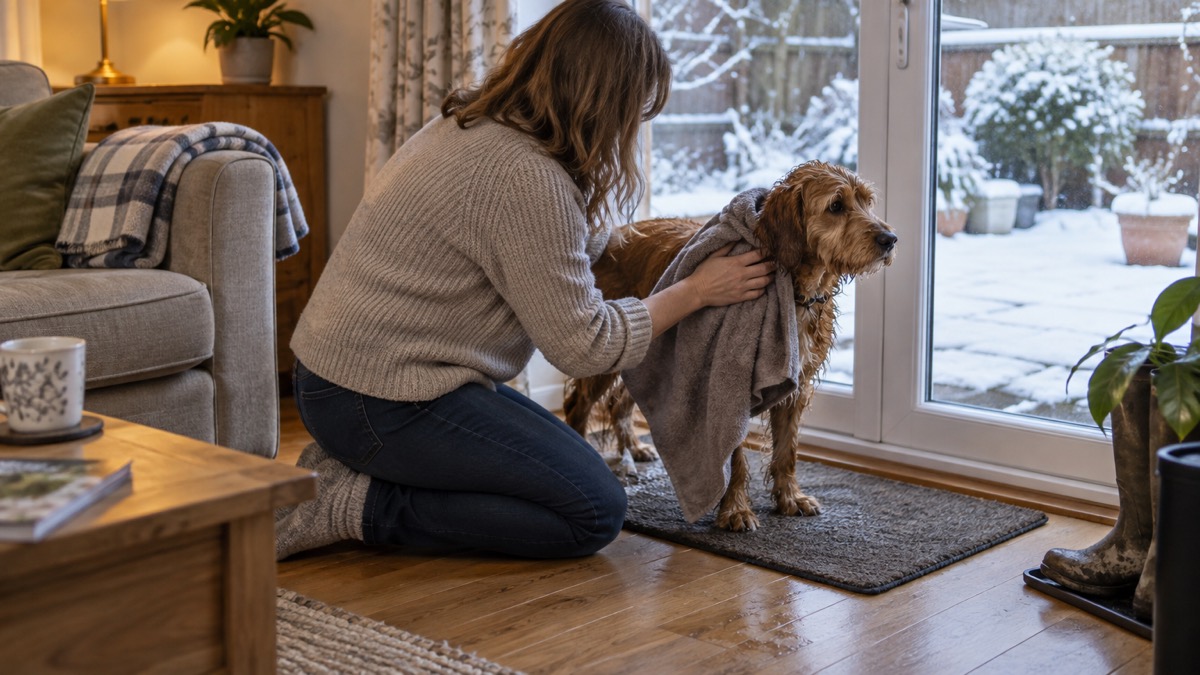
The single most important "do not" in cold-pet first aid is not to warm them too quickly. The PDSA is explicit: do not warm them up too quickly or burn them with anything hot such as a hot water bottle1. Rapid warming with direct heat can burn skin that is cold and has poor circulation, and it can cause harm beyond the burn as the body reacts.
That rules out the things people instinctively reach for: hot water bottles, heat lamps, and hot baths. The NHS gives the same warning for people, adding not to rub their arms, legs, feet or hands7. For pets, the safe approach is always indirect and gradual: towels, blankets, and a warm room, with lukewarm water only if the pet is awake and able to drink1.
If your pet needs more help staying warm in ordinary winter weather rather than in an emergency, the PDSA suggests extra bedding and a heat mat for their bed, and for newborn animals a warm draught-free room, often with a heat lamp at a safe distance, with young, small and old pets supervised closely in cold environments1. Note the difference in context: a heat mat or supervised heat lamp for a vulnerable pet's bed is a planned set-up; a heat lamp applied to a hypothermic pet as a quick fix is not.
Which pets are most at risk in the cold
Not every pet faces the same risk. The PDSA identifies young, old, frail, small and newborn pets as particularly at risk from the cold1. A large, thick-coated adult dog on a short walk is in a different position from a puppy, a elderly cat, or a newly born litter.
The risks also depend on what the pet is asked to do. Northern Ireland's nidirect guidance is blunt about the basics: don't leave your dog or cat outdoors in freezing temperatures for long, and don't leave your dog or cat alone in a car during cold weather9. A car is not a warm place in winter; the PDSA makes the same point, advising you never to leave a pet anywhere cold such as a car after a walk1.
| Pet | Why they are at risk | What to do |
|---|---|---|
| Puppies and kittens | Young and small, still regulating temperature poorly | Keep in a warm, draught-free room; supervise closely1 |
| Elderly or frail pets | Less able to cope with cold; may have other illnesses | Warm bed, extra bedding, consider a heat mat; limit time out1 |
| Newborn animals | Cannot maintain their own body temperature | Warm draught-free room, often a heat lamp at a safe distance1 |
| Thin-coated dogs | Little insulation | Consider a dog coat1 |
| Outdoor cats | Exposed overnight | Provide a warm, dry shelter with bedding; do not leave out all night1 |
| Rabbits and guinea pigs | Hutches face snow, draughts and winter rain | Protect hutches from snow, cold draughts and rain3 |
The British Veterinary Association adds a subtler point: even simple things like leaving your dog outside a shop in extremely cold weather can be stressful for them10. A quick errand that seems harmless can leave a dog standing in the cold, and stress compounds the physical effects.
Does my dog need a coat?
For most healthy dogs with full coats, a coat is unnecessary. The PDSA suggests considering a dog coat for breeds like greyhounds, lurchers and whippets1: these are dogs bred with very little body fat and thin coats, and they lose heat quickly when standing around in the cold. The same logic applies to elderly or frail dogs of any breed, since they are in the PDSA's at-risk group1. A coat is a tool for particular dogs, not winter uniform for all of them.
Rock salt and grit are highly toxic to pets
The salt spread on roads and pavements in winter is a poison risk to dogs and cats. The British Veterinary Association warns that grit or rock salt can be extremely toxic to dogs and cats if ingested3. The RSPCA confirms that the rock salt used to grit roads can be toxic to animals2.
The route in is usually the paws and fur. A dog walks through salted slush, the salt clings to their paws and legs, and they lick it clean later. A cat that crosses a treated path carries it home on its feet and tummy. The RSPCA advises thoroughly wiping your pet's feet and tummy after time outside2, and the British Veterinary Association suggests packing a towel to remove salt and grit from your dog's paws when you are out and about11.
The symptoms of salt poisoning, from the RSPCA, are thirst, vomiting and lethargy, and in severe cases there is a risk of convulsions and kidney damage2. The signs can be non-specific, so the RSPCA notes a vet will need a blood test to check the blood sodium concentration to diagnose it2. If you know your pet has walked through grit and they start drinking heavily, being sick or going quiet, contact your vet promptly.
How well does gritting actually work?
Understanding gritting explains why the salt hazard persists through winter. Councils explain that salt works by lowering the freezing temperature of water, which prevents ice or frost forming on roads as they otherwise would12. But it has real limits:
- One council guide explains that rock salt has a limited impact on icy surfaces where the temperature drops below 8 degrees centigrade13
- The same guidance notes that salt does not directly melt snow on contact: it works by mixing with snow or moisture on the road to form a saline solution that does not freeze as quickly as water14
- Because of this, salt is best applied before ice forms rather than after, so it can work into the surface and act before freezing takes hold14
Two things follow for pet owners. First, salted surfaces can still be icy in a hard frost, so do not assume a gritted path is safe underfoot for you or your dog. Second, because salt is spread repeatedly through the winter and only works when worked into the surface, salt residue on pavements and roads is a constant presence on your pet's paws for months, not just on gritting days. The cleaning routine below is therefore a habit for the whole season, not a one-off.
Cleaning paws, legs and fur after winter walks
The routine is simple and takes a minute. After every walk or outdoor time in salted, snowy or slushy conditions:
- Wipe feet and tummy thoroughly with a towel, the RSPCA advises, after time outside2
- Pack a towel on walks so you can remove salt and grit from your dog's paws while you are out and about, the British Veterinary Association suggests11
- Wash with a mild, pet-safe shampoo and warm water if they could have rock salt on their feet or fur, then dry completely with a towel, the RSPCA advises2
- Dry your pet off as quickly as possible and make sure they keep warm after a walk in snowy, icy or wet conditions, nidirect advises9
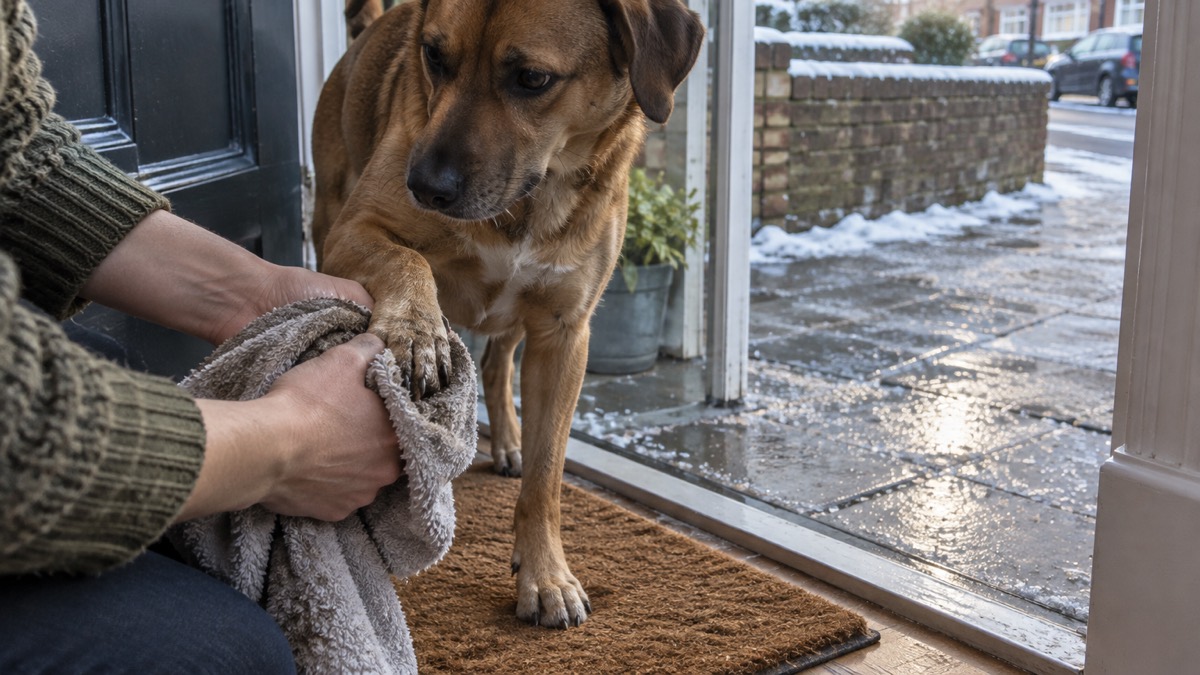
The shampoo step is for when salt has genuinely got onto the coat, not after every walk. A dog that has waded through salty slush, or a cat that has walked across treated surfaces and then groomed, is worth washing properly; a quick towelling handles the ordinary case. The British Veterinary Association advises packing a towel to remove salt and grit from your dog's paws when you are out and about2.
Check between the toes and around the legs, where salt and compacted snow collect. Ice balls can form in the fur between pads on snowy walks, and these hurt as well as carrying salt. If your dog will tolerate it, a quick inspection of each paw at the door catches both problems.
Cats in cold weather: a dry shelter and a way back indoors
Cats need two things from a cold snap: a warm place to sleep and a way to get back into it. The PDSA's advice is to make sure they have a warm, comfy bed in a draught-free area of the house, never to leave them locked outside, and to provide outdoor cats with a warm, dry shelter with bedding1. Dry them off if they come in wet and cold, and never leave them anywhere cold such as a car1.
The British Veterinary Association is clear that cats should not be left outside all night in cold weather10. An outdoor cat that is fed and sheltered by day still needs somewhere warm overnight when temperatures drop. If your cat is used to a cat flap, check it is not blocked by snow or frozen shut, so the way back indoors stays open. For cats that genuinely live outdoors, our page on helping outdoor and stray cats in freezing weather covers shelter options in more detail.
Elderly and hairless cats need particular care. The PDSA's at-risk list, young, old, frail, small and newborn pets, includes both1. An old cat with thin fur, or a hairless breed, loses heat faster than a young cat in full coat, and both should have the warmest bed in the house and the shortest possible time outside in freezing weather. Extra bedding and a heat mat for the bed are the PDSA's suggestions for high-risk pets1.
Rabbits and guinea pigs are the other small pets to think about. The Met Office, carrying British Veterinary Association advice, says owners need to be vigilant and take steps to ensure their hutches are protected from the snow, cold draughts and winter rain3. Our page on keeping rabbits and guinea pigs warm in winter goes through hutch protection in detail, and our page on keeping pet birds warm in cold weather covers caged birds.
Keep dogs on the lead near frozen lakes, ponds and rivers
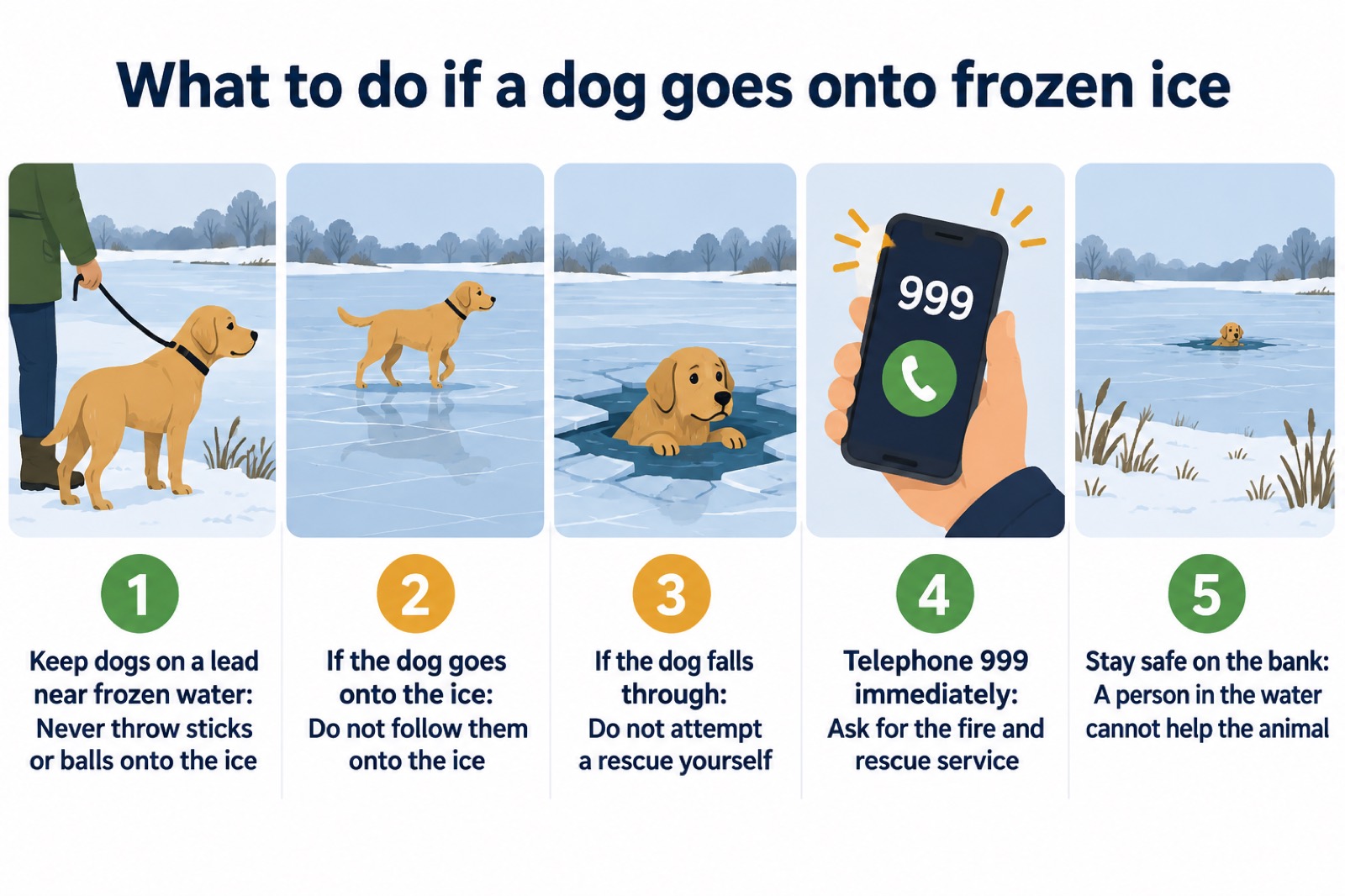
Frozen water is the most lethal winter hazard for dogs, and the advice from fire and rescue services is unambiguous. North Yorkshire Fire and Rescue Service tells dog owners: never throw sticks or balls onto the ice for your dog, and keep them on a lead near frozen water4. A dog chasing a ball onto ice is the classic route to a tragedy, and the throw is entirely within your control.
If a dog or other animal ventures onto the ice, or falls through it, do not go onto the ice to rescue it. North Yorkshire Fire and Rescue Service explains that you are likely to end up in the freezing water and unable to help the animal4. Derbyshire County Council's guidance is the same: do not walk on ice-covered lakes, ponds or rivers when walking your dog or by yourself, and if you see a person or animal fall through the ice, do not try to rescue them; telephone 999 immediately and ask for the fire and rescue service5.
"Never throw sticks or balls onto the ice for your dog, keep them on a lead near frozen water."
Devon and Somerset Fire and Rescue Service's general advice reinforces the habit: keep dogs on leads when near quarries, clifftops and fast-flowing water15. In winter, frozen ponds, canals and rivers join that list. The lead is not about your dog's obedience; it is about removing the chance to chase something onto ice that will not hold them.
Ice safety also affects you. Nidirect advises taking care when walking your dog in icy conditions, as a dog pulling on the lead can cause you to lose your balance9. A fall on ice with a dog attached is a common winter injury, so keep the lead short on icy pavements and consider footwear with grip. Our page on dogs and frozen ponds covers what to do if the worst happens, and walking a dog safely in snow and darkness covers the ordinary winter walk.
When snow is forecast: a warm place for pets if you are cut off
Snow that cuts off a household is a different problem from a cold walk. The Met Office's snow safety advice is to create a place where pets can be comfortable in severe winter weather16, and its Weather Ready campaign makes the same point: don't forget your pets, make sure they have a comfortable place in severe weather17.
Before snow arrives, work through this list:
- A warm, draught-free bed for every pet, moved away from doors and windows1
- Extra bedding for at-risk pets, and a heat mat if you use one1
- Hutches protected from snow, cold draughts and winter rain for rabbits and guinea pigs3
- A way back indoors for cats: check cat flaps and keep them clear18
- Enough pet food and water in the house to last being cut off for several days
- Towels by the door for drying pets and wiping salt from paws11
The Met Office's wider advice for being cut off by snow covers the household as a whole: if you are cut off and cannot access services, prepare by gathering essentials such as torches and batteries, candles and matches, plenty of blankets, and warm clothing17. If it is cold, wrap up warm and close internal doors to keep the heat in16. Open kitchen and bathroom cabinet doors to let warmer air circulate around the plumbing and prevent frozen pipes16. And turn off electrical heaters and put out your fire before going to bed, to avoid fire risk16.
Pets fit into that household plan rather than sitting beside it. A pet's warm place is easiest to maintain if the room they are in stays warm, which is one more reason to close internal doors and keep the heat concentrated where people and animals actually are. If you keep larger animals, our page on horses and livestock in floods and snow covers them, and our storms, snow and ice guide covers the household side of a severe winter event. If a power cut is part of the picture, see our power cuts guide and, for fish keepers, how long fish survive without a filter.
Including pets in your planning before winter is worth an hour of thought: our page on including your pets in a household emergency plan walks through it, and the pets and animals section guide lists everything by season and hazard.
Where to get help
The first port of call for a cold-weather pet problem is your own vet. The British Veterinary Association says owners with any concerns about their pet in cold weather should speak to their local vet3, and the PDSA says to call your vet immediately if you think your pet is suffering from hypothermia, and to take them to the vet even if they seem okay1. Suspected salt or antifreeze poisoning falls squarely in this category: the RSPCA's symptoms list for antifreeze poisoning includes vomiting, seeming depressed or sleepy, appearing drunk and uncoordinated, seizures and difficulty breathing2, and any of these after a winter walk needs an urgent call. Our page on antifreeze poisoning in cats and dogs covers that hazard in full.
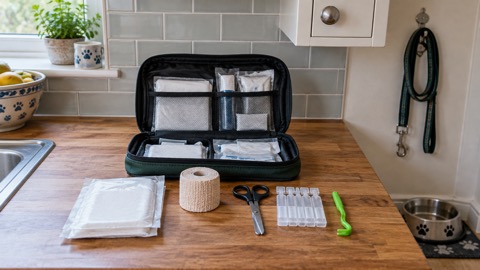
Out of hours, vets operate emergency services, and our page on emergency vets and out-of-hours care explains how to find and use them. If you need to move a cold or injured pet to the vet, how to move an injured dog or cat covers it safely, and a pet first aid kit is worth assembling before winter rather than during it.
For a person in danger from cold, including anyone who falls through ice, telephone 9995. The fire and rescue service handles ice rescues, and Derbyshire County Council's guidance is explicit that you should telephone 999 immediately and ask for them rather than attempting any rescue yourself5.
Sources (18)
- Hypothermia in pets, PDSA, 2021-12
- Antifreeze and rock salt poisoning in cats, RSPCA, 2026-10-29
- WeatherReady hacks: winter pet care, Met Office, 2026-10-26
- Ice safety, North Yorkshire Fire and Rescue Service, 2022-12-12
- Keep warm in winter, Derbyshire County Council, 2026-10-29
- Hypothermia, nidirect, 2025-06-03
- Hypothermia, NHS, 2023-06-09
- Cold weather, Public Health Wales, 2026-06-16
- Staying warm in winter, nidirect, 2026-10-06
- Weather hacks to try as clocks go back, Met Office, 2023-10-26
- Winter hacks this winter, Wiltshire and Swindon Prepared, 2026-10-25
- Common myths about gritting, Cheshire West and Chester Council, 2026-10-29
- Does gritting always work? - Derbyshire County Council, Derbyshire County Council
- Keeping winter roads safe | Bedford Borough Council, Bedford Borough Council
- Top causes of rescues and how to avoid them, Devon and Somerset Fire and Rescue Service, 2026
- Stay safe in snow, Met Office, 2026-10-25
- Met Office Weather Ready tips for snow and ice, Met Office, 2025-11-19
- Cold Weather Care for Cats - RSPCA - rspca.org.uk, RSPCA
 Pet Emergency Documents
 Storing Pet Food and Water
 Carer's Emergency Plan
 Antifreeze Poisoning
 Emergency Vets and Out-of-Hours
 Pet First Aid Kits
 Keeping Pets Safe in Floods
 How Fast a Car Heats Up
 Keeping Pets Cool in Hot Weather
 Oak Processionary Moth and Dogs
 Pets in Your Emergency Plan