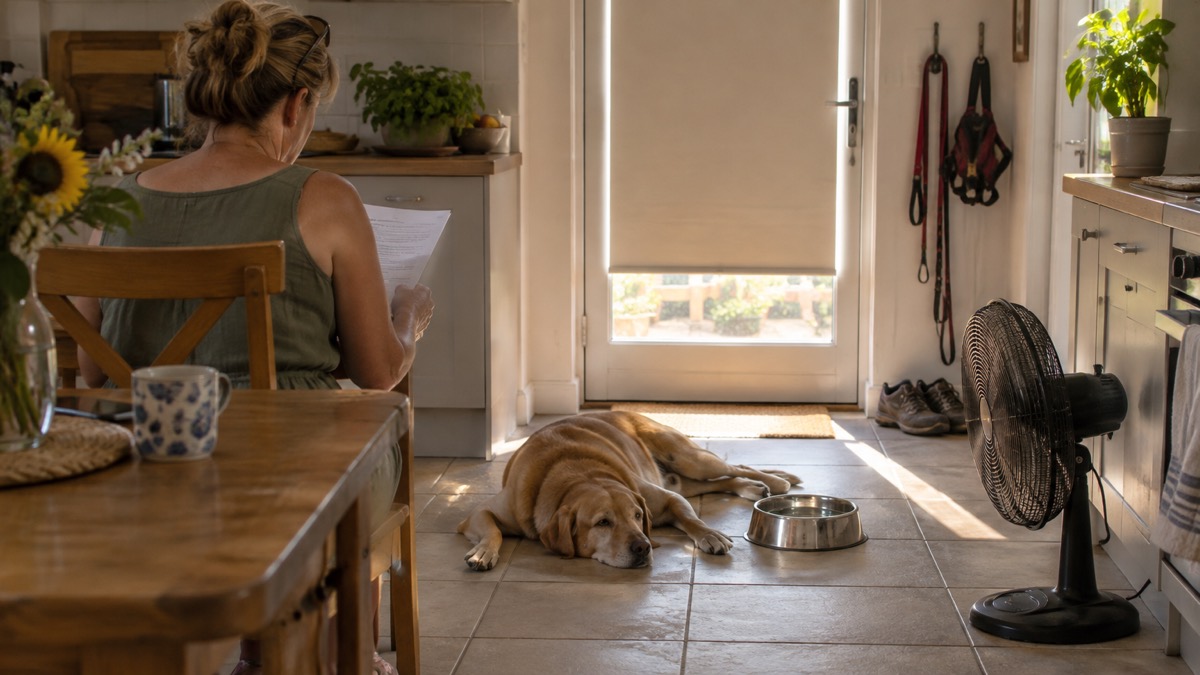
On a warm day the question is not really whether your dog wants a walk, but whether the walk is safe. The short answer: most dogs walk comfortably between 15 °C and 25 °C, and the hottest hours of the day, usually 11am to 3pm, are the ones to avoid1. If the day is very hot or humid, it may be safer to miss the walk altogether and let your dog rest at home3.
The ground matters as much as the air. Tarmac, artificial grass, pavements and sand can become extremely hot in the sun and may burn a dog's paws4. Before you set out, hold your hand flat on the pavement for five seconds: if it is too hot for you, it is too hot for your dog2. Walk early in the morning or late in the evening instead, take water, shorten the route and keep your dog on the lead3.
Heat is a real risk to dogs, not a minor discomfort. Dogs lose heat through panting, can only sweat through their paws, and are at high risk of heatstroke5. The RSPCA reports that dogs are 10 times more likely to experience heat-related illnesses when out in hot weather than overheating in cars, and the Dogs Trust reports that 67.5% of heat-related illness cases came from walking only6. A little planning around the clock and the ground keeps a normal walk a safe one.
Why the middle of the day is the wrong time for a walk
The single most useful habit in hot weather is to move the walk out of the middle of the day. Official guidance from Derbyshire County Council is blunt: do not walk pets during the hottest time of the day, usually 11am to 3pm7. The Met Office gives the same window for people, advising you to keep out of the sun and avoid any exercise between 11am and 3pm when the sun is strongest8.
That window is when ultraviolet levels are highest, which is why the government's hot weather guidance tells people to avoid direct sunlight especially between 11am and 3pm9. For a dog, the same hours combine hot air, hot ground and strong sun. The Met Office warns that too much exercise when it is very hot can cause heat exhaustion or heat stroke, and to watch for signs of heat stress, an early sign being fatigue10.
The practical answer is to walk early in the morning or late in the evening, when temperatures are cooler3. The Dogs Trust adds a caveat worth remembering: early and late walks are a good start, but if the weather is very hot or humid, it may be safer to miss the walk altogether that day3.
If you are leaving your dog at home on a hot day, the RSPCA suggests that as long as the dog has had a dawn or late evening walk and you are not leaving them for longer than four hours, they should be happy napping or with things to do11. For more on that, see how long a dog can be left at home on a hot day.
What temperature is too hot to walk a dog?
There is no single cut-off, because a dog's comfort depends on its age, breed, size, coat length, how much exercise it is used to, and its general health and fitness1. The Scottish SPCA gives the most useful benchmark: most dogs will be comfortable walking between 15 °C and 25 °C1.
Above that, risk climbs. The Blue Cross says temperatures up to 20 degrees celsius are suitable for most dogs and you can continue to walk and play with your dog in this weather, but that generally temperatures over 20 degrees celsius can put dogs at higher risk of heatstroke, especially during strenuous exercise12. So a gentle stroll on a day just above that mark is a different proposition from a long, fast walk or a run.
| Air temperature | What it means for a walk | Source |
|---|---|---|
| 15 °C to 25 °C | Comfortable for most dogs, depending on age, breed, coat and fitness | 1 |
| Up to 20 degrees celsius | Suitable for most dogs; normal walking and play | 12 |
| Over 20 degrees celsius | Higher risk of heatstroke, especially with strenuous exercise | 12 |
| Very hot or humid | May be safer to miss the walk altogether | 3 |
A dog's body runs hot compared with ours. The RSPCA gives a dog's average body temperature as 37.5 °C to 39.2 °C13, and the PDSA puts normal body temperature at 38 to 39 °C14. The PDSA warns that if a dog's body temperature goes above 40 °C they are at risk of heatstroke14. That is a narrow margin, which is why even moderate exercise on a warm day can tip a dog over.
Normal walks and play for most dogs
For a healthy, fit dog on an ordinary warm day, you do not need to cancel everything. The Blue Cross says temperatures up to 20 degrees celsius are suitable for most dogs and you can continue to walk and play with your dog in this weather12. The key is to keep the effort moderate and the timing sensible.
The Dogs Trust's figure is the one to hold on to: 67.5% of heat-related illness cases in UK dogs were just from walking only, so even moderate exercise can cause dogs to overheat2. The PDSA makes the same point from the other direction, noting that every year more dogs suffer from heatstroke due to exercise than from being left in a hot car3. A walk is not automatically the safe option simply because it is not a car journey.
When you do go out in warmer weather, the PDSA's checklist is a good template3:
- Take water for your dog to drink.
- Shorten your usual route.
- Keep your dog on the lead so they do not get too hot racing around.
- Take it slow: a gentle stroll rather than a forced march.
- Take regular breaks for sniffing, drinking and cooling down.
The RSPCA adds that you should not run or cycle with your dog when it is hot5. If you want to keep your dog active on a hot day, indoor play, scent games and short training sessions in the shade do the job without the heat load. For the wider picture on keeping a dog cool at home, see keeping dogs, cats and small animals cool in hot weather.
The five-second test for hot ground
Air temperature tells only half the story. Devon County Council warns that surfaces such as tarmac, artificial grass, pavements and sand can become extremely hot and may cause burns to bare feet and pets' paws4. National Highways notes that in some isolated instances when it is very hot, tarmac can soften, and in the most severe cases lanes may be closed for safety reasons15. If the road surface itself is softening, a pavement in full sun is no place for paws.
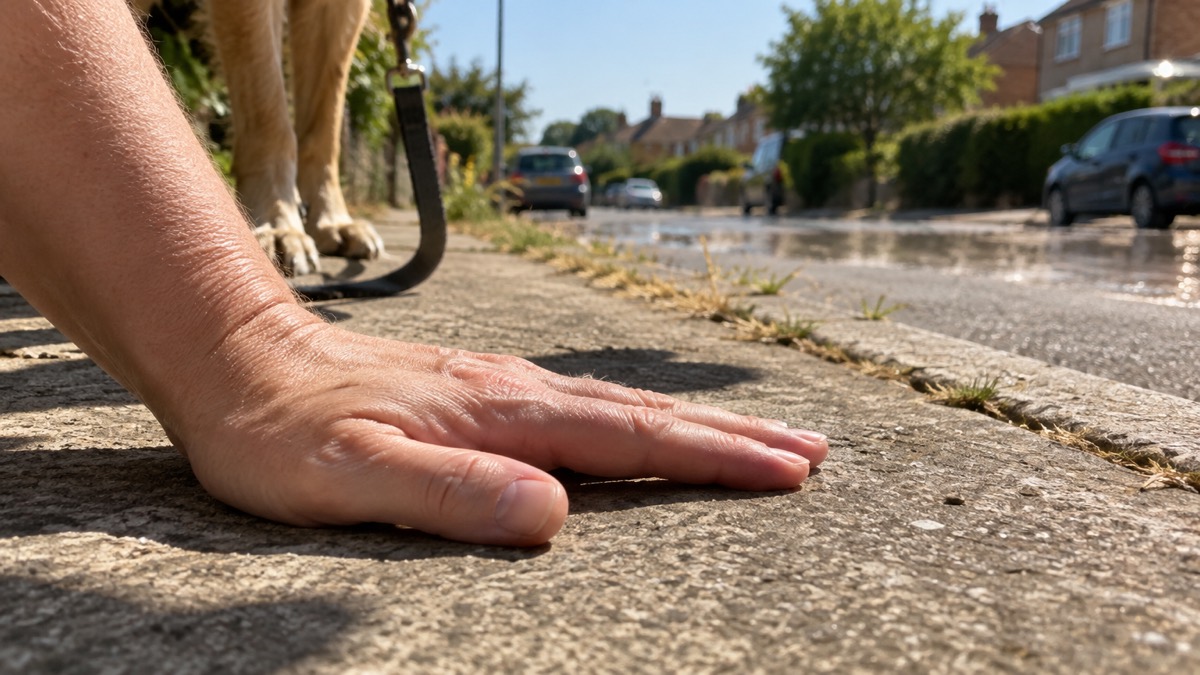
The test is simple and takes five seconds. The Dogs Trust advises holding your hand down on the pavement for five seconds; if it is too hot for you, walk your dog later when it has cooled down to avoid burning their paws2. The Scottish SPCA gives the same rule: if you cannot hold your hand down on the tarmac for five seconds, then it is too hot for your dog's paws1. The Blue Cross puts it as a general rule: if it is too hot for your hand, it is too hot for their paws12.
The PDSA uses a slightly longer check, suggesting that if you can comfortably place the palm of your hand on the ground for seven seconds it is okay, and noting that sand, artificial grass and tarmac get especially hot14. The two tests differ by two seconds; either will tell you what you need to know. If in doubt, wait.
If you need to cool a dog down with water, the Scottish SPCA has a practical warning: if rinsing with a hose, run the water for a few minutes before wetting the dog, as the water that remains in the hose can get extremely hot1. The Dogs Trust adds that you should always closely monitor cooling and stop if you notice signs of shivering2.
Which dogs need more care in the heat
Some dogs cope with heat far less well than others, and the difference is not about toughness. The Dogs Trust lists the higher-risk groups as overweight dogs, flat-faced breeds such as Pugs and French Bulldogs, older dogs over 8 years old, and younger dogs under 6 months old1. The Blue Cross adds that dogs who are elderly, flat-faced, overweight or of a large breed are more at risk of becoming overheated16. The RSPCA lists thick coats, young or old age, and health conditions affecting the respiratory system among the risk factors for heatstroke6.
| Dog | Why the heat is harder | What to do | Source |
|---|---|---|---|
| Flat-faced breeds (Pugs, French Bulldogs, English Bulldogs, Shih Tzus, Boxers) | Less space in the nose to release body heat; unable to pant as effectively | Extra care to keep cool; avoid the hottest hours entirely | 5 |
| Older dogs (over 8 years) | Listed among higher-risk groups | Early or late walks only; short routes; watch for fatigue | 1 |
| Puppies (under 6 months) | Listed among higher-risk groups | Very short outings; carry if ground is hot | 1 |
| Overweight dogs | Listed among higher-risk groups | Shorter, gentler walks; avoid strenuous exercise | 1 |
| Dogs with heart or lung problems | Named in official guidance as needing care | Stick to early morning or late evening walks | 17 |
| Thick or long coats | Listed as a heatstroke risk factor | Consider a shorter, thinner coat for summer | 6 |
Flat-faced dogs deserve a section of their own. The RSPCA says brachycephalic, or flat-faced, animals are at greater risk of health problems in hot weather, including being very vulnerable to heatstroke, and that you should take extra care to keep them cool5. The PDSA explains why: they have much less space inside their nose to release body heat, which puts them at a very high risk of heatstroke, even on cool days14. The Dogs Trust reports that over a third of owners of flat-faced dogs say heat regulation is a problem for their pet2.
For thick or long coats, the Scottish SPCA is direct: if you want your dog to stay cooler in hot weather and reduce the risk of heatstroke, it needs a shorter, thinner coat1. Ask a groomer about your dog's coat type before clipping, and never shave a dog down to the skin without advice.
Official guidance names older pets, flat-faced breeds and dogs with known heart or lung problems as the ones to keep out of the hottest part of the day, and to stick to early morning or late evening walks17. The Blue Cross adds that you should pay close attention to elderly and brachycephalic dogs, as well as dogs who are overweight, as they may struggle with breathing and panting in warm weather12.
Walking safely when it is warm but not extreme
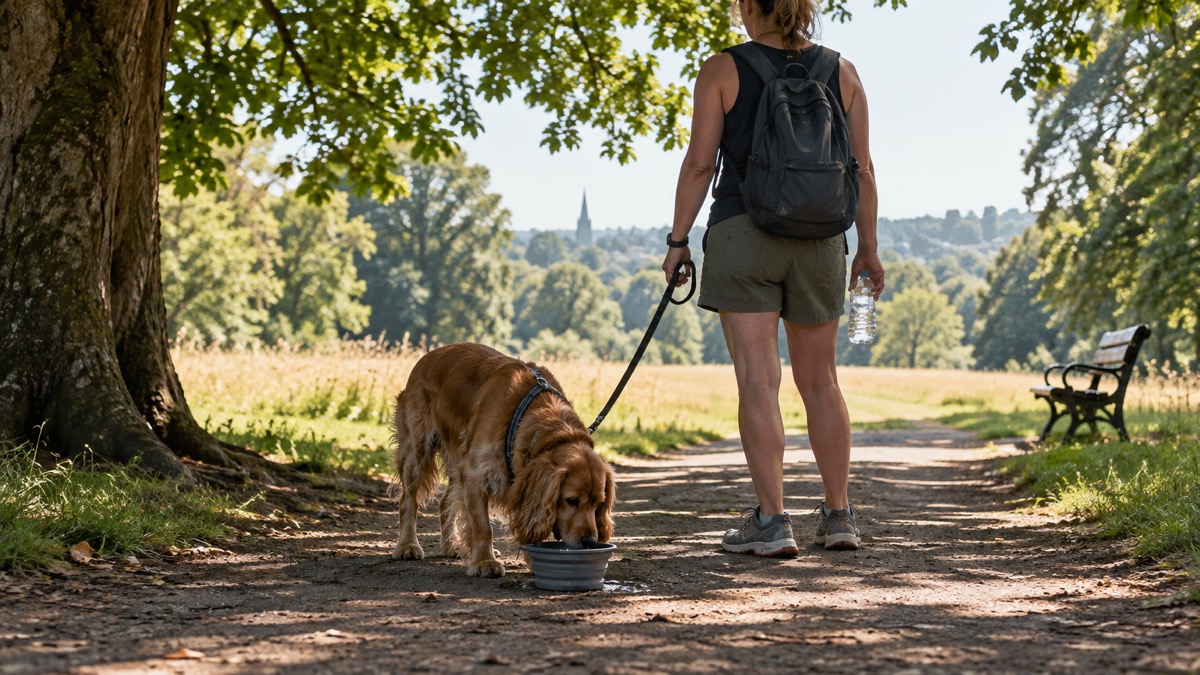
Most British summer days fall short of a heatwave, and a sensible routine covers them. Plan the walk for the coolest part of the day, take water, keep the route short and watch the ground. The PDSA's advice to travel in the early morning or late evening applies to car journeys too: these tend to be the coolest times of day and make the journey easier on your pet18.
If you are driving somewhere for a walk, remember that a car heats up far faster than the air outside. The RSPCA warns that a car can become dangerously hot within an hour on a warm day19. Never leave a dog in a parked car on a warm day, even briefly, and if you see a dog in distress in a hot car, see what to do if you see a dog in a hot car.
Wherever you live, the rule is the same: walk early or late, test the ground, take water and know which dogs need more care.
Sources (19)
- Dog care in summer, Scottish SPCA, 2026-06-22
- Hot weather advice for dogs, Dogs Trust, 2026
- Dogs die in hot cars and on hot walks, PDSA, 2026-10-29
- Staying well in hot weather, Devon County Council, 2026-07-02
- Dogs in hot weather, RSPCA, 2026-10-29
- Heatstroke in dogs, RSPCA, 2026-10-29
- Severe weather planning, Derbyshire County Council, 2026-10-29
- Stay safe in extreme heat, Met Office, 2026-10-29
- Beat the heat: staying safe in hot weather, GOV.UK, 2026-07-21
- Hot weather and its impacts, Met Office, 2026-10-29
- Dogs in hot cars, RSPCA, 2026-10-29
- How to keep dogs cool in the summer heat, Blue Cross, 2023-06-12
- Dogs in winter, RSPCA, 2026-10-29
- Heatstroke in dogs, PDSA, 2023-09
- Travelling in summer, National Highways, 2026-10-29
- Dogs in hot cars, Blue Cross, 2026-02-24
- Adverse weather events, Llangattock Community Council, 2026-10-25
- Safe car travel for pets, PDSA, 2026-10-29
- Dogs in hot cars infographic, RSPCA, 2026-10-29
 Pet Emergency Documents
 Storing Pet Food and Water
 Carer's Emergency Plan
 Pet Birds in Cold Weather
 Birds and Chickens in Heat
 Breaking a Car Window for a Dog
 Keeping a Cat Cool in a Heatwave
 Chocolate Poisoning in Dogs
 Christmas Hazards for Pets
 Dog Left Alone on a Hot Day
 Dog in a Hot Car
 Hypothermia in Dogs and Cats
 Dogs in Water or Coast Trouble
 Fireworks and Small Pets
 Fish in a Power Cut