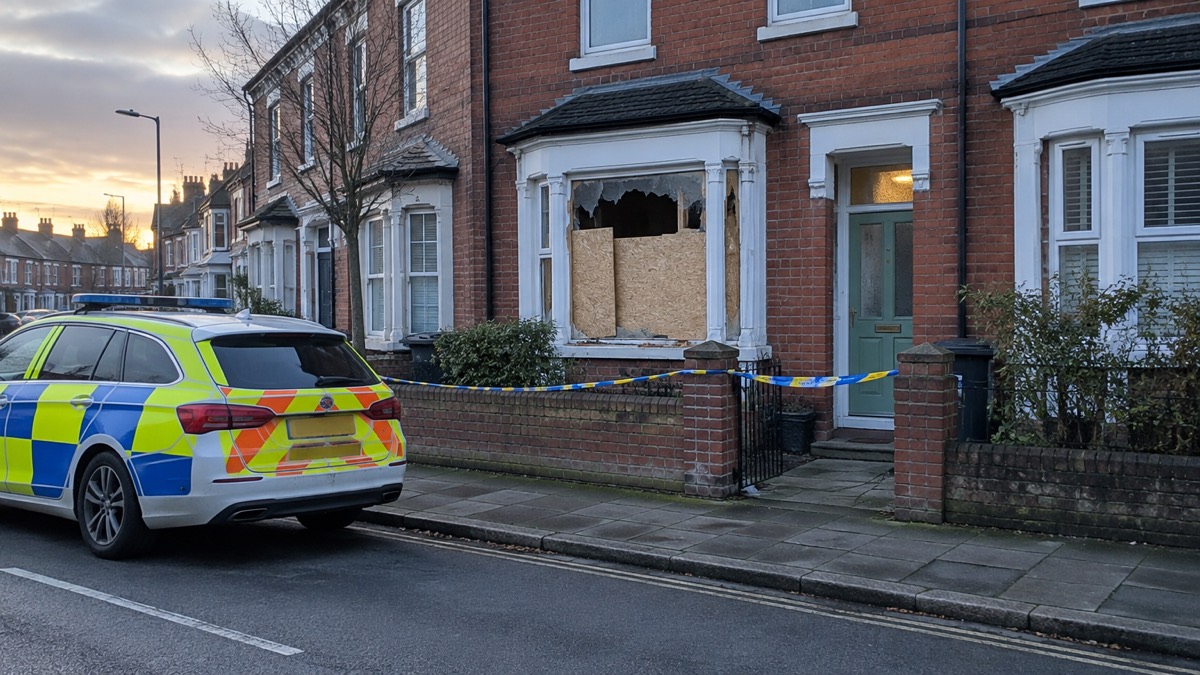
If someone breaks into your home while you are there, the first instruction from the police is simple: call 999 if you think the intruder is still there1. Confrontations of this kind are very unlikely, but if one does happen, you can use reasonable force to protect yourself, your family or your property2. The law does not expect you to weigh your options calmly in a sudden and frightening moment, and since 2013 householders have had extra legal protection that recognises exactly that3.
The core rule is that force you use must not be grossly disproportionate in the circumstances as you believed them to be4. Force that turns out to have been disproportionate may still be lawful in a householder case, and the prosecution authorities have said publicly that the law will give you the benefit of the doubt2. What the law never protects is force that is grossly disproportionate, or violence that becomes revenge5.
This page explains what to do in the moment, what reasonable force means, where the householder protection starts and stops, what you must not keep or carry for defence, and what happens once the police are involved.
What to do if someone breaks in while you are at home
Your first call is to the police. Police Scotland's housebreaking guidance is direct: call 999 if you think the intruder is still there1. The Crown Prosecution Service (CPS) and the National Police Chiefs' Council, in their joint statement on householders and the use of force against intruders, say the same thing in general terms: wherever possible you should call the police when faced with an intruder2. Everything else in this page sits behind that instruction. The law on reasonable force exists for the moments when calling the police is not enough on its own, not as an alternative to it.
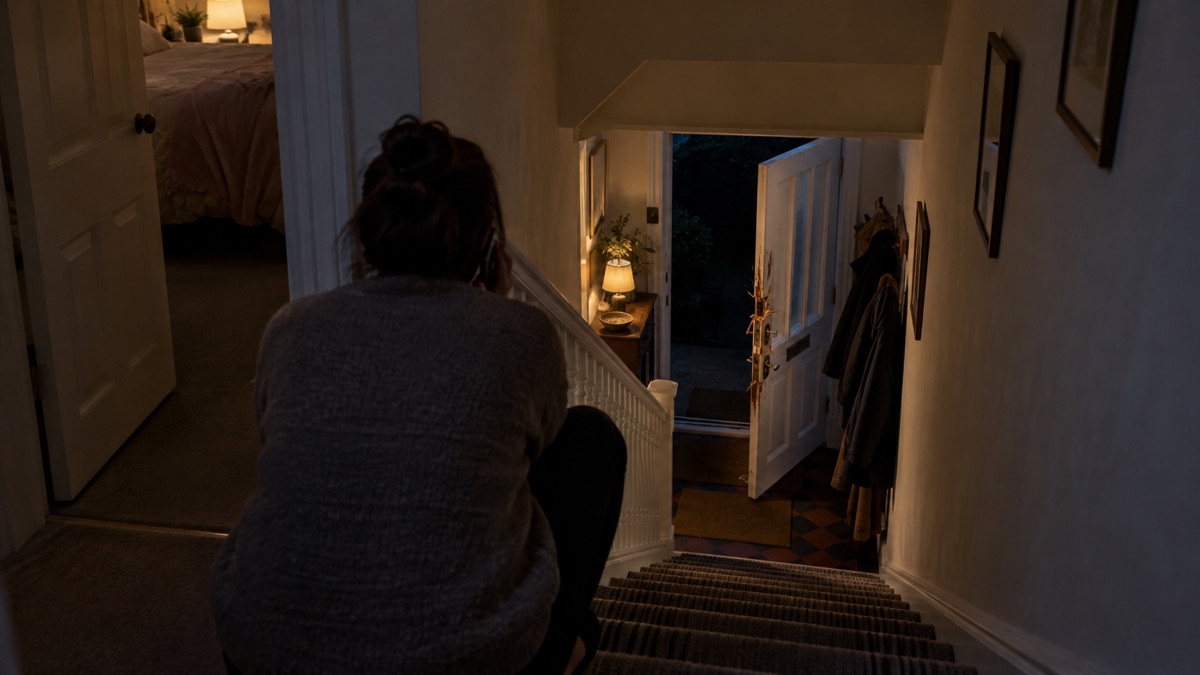
If you discover a break-in rather than witness it happening, do not go inside, in case the intruder is still there1. If you come home to signs of entry, stay out, call the police, and let them check the property. Our page on coming home to a break-in covers that situation step by step.
If you are inside and hear or see an intruder, the priorities are to get yourself and anyone else in the household away from the intruder if you can, and to get help. A panic button on an alarm system is described in police-backed security advice as invaluable if there is an intruder in the house6, and our page on panic buttons explains how they work and who is told when one is pressed. If you can do so safely, stopping other people from entering the building is also advised in official guidance on reporting an ongoing incident7.
When you speak to the emergency call taker, give them what they need to send help: the nature of what is happening, the location, descriptions of anyone involved, the direction they went, and any further information such as casualties, injuries, entrances, exits or hostages7. If you cannot speak or make a noise, listen to the instructions given by the call taker7. Stay calm while help is on its way, as NHS guidance for waiting for an ambulance puts it8.
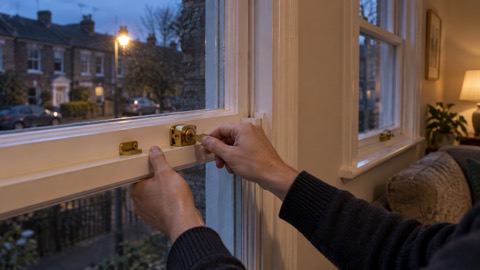
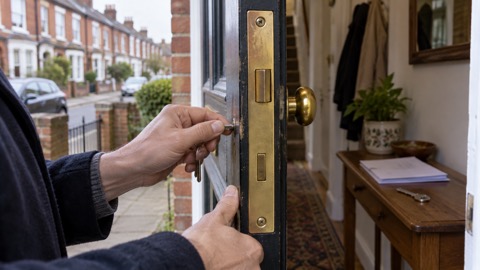
Prevention is worth a sentence here, because the best confrontation is the one that never happens. Many break-ins are carried out by simply smashing a weak door or forcing a vulnerable lock, so solid doors and secure locks matter9. Our pages on doors and locks and windows set out what to check, and how burglars choose a home explains what puts them off.
Reasonable force: what the law allows a householder
The starting point is broad. Anyone can use reasonable force to protect themselves or others, or to carry out an arrest or to prevent crime2. That right is not limited to householders, and it is not limited to your own home. What the law asks is that the force be reasonable, and the test for reasonableness is set out in section 76 of the Criminal Justice and Immigration Act 20084.
For householders, the law goes further. Section 43 of the Crime and Courts Act 2013 amended section 76 to give people who defend themselves or others from intruders in their homes greater legal protection5. The government circular that accompanied the change explained its purpose plainly: the provision is designed to give householders greater latitude in extreme situations where they may not be thinking clearly about the precise level of force that is necessary3.
The practical effect, in the government's own words, is that householders who use a disproportionate level of force to protect themselves or others in their homes will not automatically be regarded as having acted unlawfully and treated as criminals3. The CPS joint statement makes the same point from the prosecution side: force that is subsequently considered disproportionate may still be reasonable in the circumstances, and the law will give you the benefit of the doubt2.
That benefit of the doubt is real, not rhetorical. The CPS states that if you have acted in reasonable self-defence and the intruder dies, you will still have acted lawfully, and that there have been cases where the householder has not been prosecuted2. The law does not treat an intruder's death in itself as evidence of wrongdoing by the householder; what matters is whether the force used was reasonable in the circumstances as you saw them.
Two limits frame all of this. First, the extra latitude applies only in householder cases, which the statute defines precisely, as the next section explains. Second, the latitude has a floor: the use of grossly disproportionate force will continue to be unlawful, and violent or calculated acts of revenge or retribution will not go unpunished3. Reasonable force is a shield for frightened people, not a licence for punishment.
The householder test: force must not be grossly disproportionate
What makes a case a householder case is defined in section 76(8A) of the Criminal Justice and Immigration Act 2008. It is a case where the defence is the common law defence of self-defence, the force was used while you were in or partly in a building that is a dwelling or forces accommodation, you were not a trespasser, and you believed the other person to be in or entering as a trespasser4. The government circular sets out the same conditions: using force to defend yourself or others, in or partly in a dwelling, not a trespasser yourself, and genuinely believing the person was in or entering as a trespasser3.
The phrase "partly in" matters. The parliamentary notes on the 2013 Act explain that a householder could rely on the defence if he or she encountered an intruder on the threshold of the dwelling, since "partly in" and "entering" cover that situation5. The protection does not stop at the doorframe, but it does stop somewhere: the heightened defence would not apply if the confrontation occurred wholly outside the building5. A struggle that begins in the hallway and spills onto the doorstep is one thing; a fight entirely in the garden is another.
The belief element is deliberately generous. A genuine belief that the person is a trespasser is sufficient, even if that belief is mistaken, and the notes confirm that householders can still rely on the defence in those circumstances5. You do not have to be right about what is happening, only genuine.
Within a householder case, the test is set by section 76(5A): the degree of force used is not to be regarded as having been reasonable if it was grossly disproportionate in the circumstances as you believed them to be4. This is the key change from 2013. The parliamentary notes put it clearly: the level of force used by householders when defending themselves from trespassers is not reasonable if it was grossly disproportionate, but disproportionate force may be reasonable5.
Outside a householder case, the older and stricter test still applies. In any case other than a householder case, force is not reasonable if it was disproportionate in the circumstances as you believed them to be4. The notes give examples of where this applies: defending yourself when attacked outside your dwelling, defending property, or preventing crime, where force must be reasonable and proportionate5. The table below sets the two tests side by side.
| Situation | Test the law applies | What it means |
|---|---|---|
| Householder case: in or partly in your home, defending yourself or others | Force must not be grossly disproportionate4 | Disproportionate force may still be lawful5 |
| Everything else: outside the home, defending property, preventing crime | Force must not be disproportionate4 | Only proportionate force is lawful5 |
What counts as reasonable force depends on what you believed at the time
Section 76(3) of the 2008 Act sets the perspective the courts must use: the question whether the degree of force used was reasonable is to be decided by reference to the circumstances as you believed them to be4. You are not judged with hindsight, against what actually turned out to be true, but against what you genuinely thought was happening at the time.
This matters most in the dark, in the seconds after a noise downstairs. If you genuinely believed the intruder was armed, or that someone in the house was in immediate danger, the law assesses your force against that belief, not against the facts as they later emerged. The government circular captures the spirit of this: if householders act honestly and instinctively to protect themselves or their loved ones from intruders, using force that was reasonable in the circumstances as they saw them, they will not be guilty of an offence if the level of force turns out to have been disproportionate in those circumstances3.
The CPS joint statement gives examples of what the law does not tolerate, and they are useful precisely because they mark the boundary. Further hurting or killing an intruder who has been knocked unconscious, in order to punish them, would be acting with very excessive and gratuitous force and could be prosecuted2. Setting a trap for an intruder you know is coming, instead of involving the police, falls on the same side of the line2. The common thread is that the force has stopped being a response to a threat and has become something else: punishment, or a planned ambush.
So the honest answer to "how much force can I use?" is that the law does not set a number, a weight or a weapon. It sets a question: was what you did, in the moment, in the circumstances as you genuinely believed them, something other than grossly disproportionate? If it was, and you were in or partly in your home defending yourself or others, the law stands behind you4.
Where the law stops protecting you
The boundaries of the householder defence are geographical and behavioural, and it is worth knowing both.
Geographically, the defence covers force used while you are in or partly in a dwelling or forces accommodation4. It does not apply where the confrontation occurs wholly outside the building5. If you chase an intruder down the street, or confront someone in your garden or shed, you are outside the heightened protection, and the ordinary test applies: your force must not be disproportionate4. The notes are explicit that the pre-amendment law continues to apply when people are defending themselves outside their dwellings, defending property or preventing crime5.
Behaviourally, the defence is for defence. It covers force used to protect yourself or others3. It does not cover revenge: violent or calculated acts of retribution will not go unpunished3. It does not cover force continued after the threat has ended, such as attacking an unconscious intruder2. And it does not cover traps set in advance instead of calling the police2.
There is also a condition on your own status: you must not be a trespasser in the property yourself4. The notes add a subtle point about the other party: a person does not cease to be a trespasser because they have another trespasser's permission to be on the premises5. The law is looking at genuine belief and genuine presence, not at paperwork.
One further boundary is worth noting for completeness, because it shows how specific legal protections can be. The Fire Safety (Residential Evacuation Plans) (England) Regulations 2025 came into force on 6 April 2026 and apply in England only10. Territorial limits of this kind are common, and the self-defence rules described on this page come from UK-wide legislation for England and Wales; if you are in Scotland or Northern Ireland, our page on reporting crime and getting support covers the differences that matter there.
Weapons and items kept for defence: what the law says
This is where well-meaning people most often get into trouble, so it is worth being plain.
The Prevention of Crime Act 1953, Section 1 makes it an offence for any person, without lawful authority or reasonable excuse, to have with them in a public place an offensive weapon11. The Act defines an offensive weapon as any article made or adapted for use for causing injury to the person, or intended by the person having it for such use11. That definition has three limbs, and the third is the one that catches people out: an everyday object becomes an offensive weapon in law if you intend to use it to cause injury. Carrying something "for protection" is precisely the intention the Act covers, and the burden of proving lawful authority or reasonable excuse lies on the person carrying it11.
The practical consequence is that you should not carry any item intending to use it as a weapon, and you should not keep items at home specifically to harm an intruder. The householder defence protects reasonable force in the moment; it does not convert a planned weapon into a lawful one. The CPS examples of traps and punishment attacks show the same principle from the other direction2.
If the intruder has already gone, the police ask you to report the break-in by calling 101 or filling in the online form rather than calling 9991. Give the call taker as much detail as you can about what happened and what, if anything, was taken. This matters even if nothing of value was lost, because a report builds the picture police use to target patrols and crime prevention work in your area.
What the law does allow is preparation of a different kind. Security measures that deter or detect intruders are entirely lawful and are actively encouraged by the police: solid doors and secure locks9, garden security such as keeping gates, fences and walls in good repair and locking ladders to a secure fixture12, and alarm systems, including panic buttons described as invaluable when there is an intruder in the house6. Our pages on burglar alarms, home cameras and outdoor lights cover the options.
A related boundary: landlords and force. Health and Safety Executive guidance on gas safety is explicit that a landlord must not use force to enter a property; access for maintenance or safety checks should be allowed for in the contract with the tenant13. Force has a lawful place only in defence, not in disputes over entry.
After an intruder: calling the police and what happens next
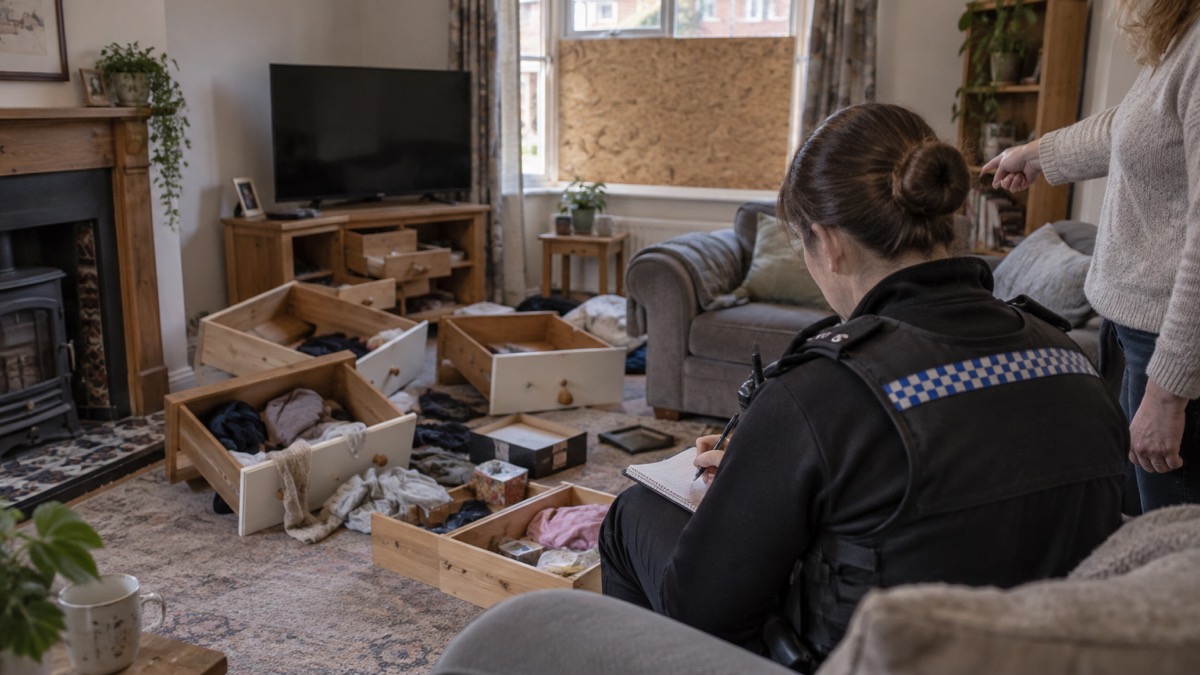
If the intruder has gone, call 101 or use the police online reporting form1. If you think they are still there, call 9991. When you make that call, official guidance on reporting incidents lists what to give the call taker: the nature of the incident, the location, suspects, the direction they went, descriptions, and further information such as casualties, type of injury, building information, entrances, exits and hostages7. If you cannot speak or make a noise, listen to the instructions given by the call taker7.
Once police are alerted, follow their advice and instructions, and maintain the integrity of the scene: do not touch or clean up anything14. That instruction comes from official personal security guidance on what to do if an attack has happened or is attempted, and it matters for the investigation and for any insurance claim. Give no information out other than to the police14.
If someone has been hurt, NHS guidance on waiting for an ambulance is to stay calm8, and if there is a fire, get out, stay out and call 99915. If someone is still inside a burning building, wait for the fire and rescue service to arrive and tell them about the person, as they will find them quicker than you16. Never go back in.
If the case involves force used against an intruder, the process is designed to be swift and senior. The CPS states that an experienced investigator will oversee the case, and if the CPS considers the evidence, the case will be prioritised so that a senior lawyer makes a quick decision2. The Director of Public Prosecutions is the Head of the CPS2, and the 2018 joint statement was issued by the CPS and the National Police Chiefs' Council together, reflecting a shared approach between investigators and prosecutors. The point for you as a householder is that a decision on whether you acted lawfully is not left to drift.
Afterwards, secure your property to prevent further damage or unauthorised entry, such as boarding up broken windows or securing damaged doors17. If the property cannot be secured and must be left unattended, close and lock all doors and windows, remove valuables and important documents, seek alternative accommodation, and contact the local police station to make them aware the property will be empty18. Our page on after a burglary covers crime numbers, insurers and repairs in detail.
Where to get help and support after a break-in
A break-in is a violation as well as a loss, and support is part of the recovery, not an afterthought. Official guidance on recovering from an emergency is blunt: seek support if you need it once home19.
Practical help comes from several directions. If you are uninsured and in immediate hardship after an incident, assistance is available: accommodation help from the local authority, furniture, bedding, clothing and money help from Job Centre Plus, legal advice from Citizens Advice, and general advice from social services, the fire and rescue service and the police18. If the incident leaves you struggling to cope, seek advice from your GP, NHS 111 or, in an emergency, A&E20.
Repairs need a word of caution. Do not carry out remedial work until your insurer or landlord has given authorisation21. Most insurance policies only cover burglary claims on an unoccupied home if there are signs of forced entry22, so preserve the scene and the evidence, and let the insurer see it before anything is repaired or cleaned.
Some households can get a home visit. Fire and rescue services offer home safety visits for eligible residents23, and some can fit specialist fire or smoke detection and alarm equipment free of charge for people with impairments that need it, specified through the home safety visit request form24. If you care for someone who is vulnerable, police guidance on protecting vulnerable adults covers the wider steps25.
Finally, prevention after the event. Police advice on garden security applies to homeowners and landlords alike: secure outbuildings as well as the main building, keep gates, fences and walls in good repair to stop intruders, and lock ladders to a secure fixture in the shed or garage so they cannot be used to reach the top floor windows12. Our after a break-in checklist pulls the first days into one list, and home security as a whole is the place to start making the next break-in less likely.
Sources (25)
- Break-in and housebreaking advice, Police Scotland, 2026
- Householders and the use of force against intruders, Crown Prosecution Service, 2018
- Self-defence circular on section 43 of the Crime and Courts Act 2013, Home Office, 2013
- Criminal Justice and Immigration Act 2008, Section 76, legislation.gov.uk, 2008
- Crime and Courts Act 2013, Section 43 explanatory notes, legislation.gov.uk, 2013
- Alarms advice for domestic properties, Secured by Design, 2023
- Run Hide Tell: marauding terrorist attack guidance, Protect UK
- What to do when the ambulance is coming, South Western Ambulance NHS Foundation Trust
- While you are away: home security advice, Mid and West Wales Fire and Rescue Service, 2026
- Residential PEEPs factsheet, GOV.UK, 2026
- Prevention of Crime Act 1953, Section 1, legislation.gov.uk, 1953
- Garden security advice, Police Service of Northern Ireland, 2026
- Gas safety FAQs for landlords, Health and Safety Executive, 2026
- Personal security guidance, Protect UK, 2022
- Get out, stay out and call 999, North Wales Fire and Rescue Service, 2026
- If you are trapped by fire, Essex Prepared, 2026
- Dealing with the aftermath of a fire, Warwickshire County Council, 2026
- After the Fire booklet, Mid and West Wales Fire and Rescue Service, 2013
- Recovering from an emergency, Essex Prepared, 2026
- NHS England » Update on London Bridge incident from the NHS Chief Executive, NHS England
- Get help and advice in an emergency, Lincolnshire County Council, 2026
- Pre-holiday routine: home protection advice, Avon and Somerset Police, 2026
- Falls prevention and home safety visits, Staffordshire County Council, 2026
- Home safety partnerships for carers, Devon and Somerset Fire and Rescue Service, 2026
- Protecting vulnerable adults, Avon and Somerset Police, 2026
 After a Break-In Checklist
 Holiday Security Checklist
 Moving Home Locks Checklist
 After a Burglary
 Bogus Callers
 Coming Home to a Break-In
 Catalytic Converter Theft
 Riots and Disorder Near Home
 Securing a Damaged Home
 Dogs as a Burglar Deterrent
 Doorstep Selling and Your Rights
 Empty Homes and Long Absences
 Leaving Home on Holiday
 How Burglars Choose a Home
 Home Insurance Conditions