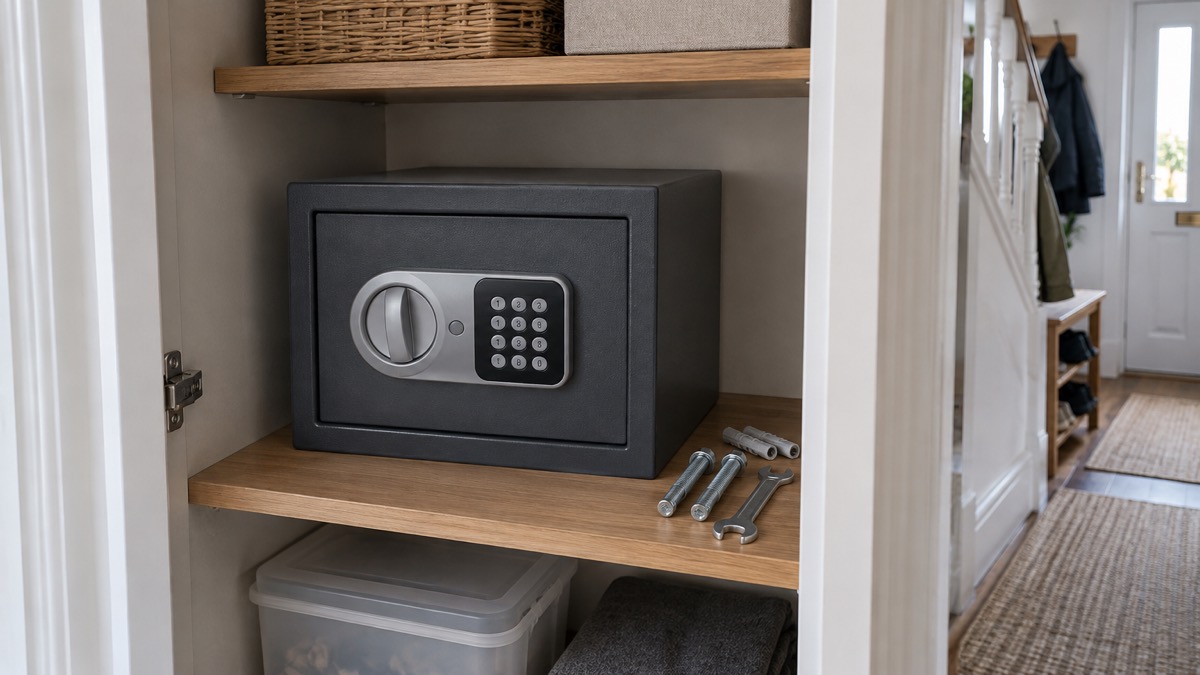
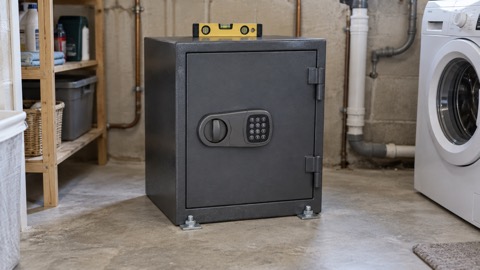
The Burton Home Safe S2 Size 1 is a small domestic safe that has been independently attack tested and certified to EN14450 Grade S2 by Sold Secure, and approved by the Association of Insurance Surveyors (AiS)1. In plain terms, it is a box for the things you would not want to lose to a burglar: documents, a few valuables, spare keys. It is not a cash safe and it is not fire rated.
The Size 1 body measures 300 x 350 x 300mm externally and 220 x 270 x 190mm internally, giving 11 litres of space, and it weighs 17kg2. It has an electronic keypad lock with one master code and nine user codes, three-way locking bolts, a dog bolt on the hinge side, and one removable shelf2.
The single most important thing to know before you buy one: the rating only counts if the safe is bolted down. The maker states that for the rating to apply, the safe should be secured to a solid floor, and that it must be bolted to the floor or wall to maintain its security certification1. A safe left loose in a cupboard is a heavy box that can be carried out of the house.
What the Burton Home Safe S2 Size 1 is, and what it is for
This is a domestic safe built for household use rather than for a business till. The maker describes it as independently attack tested to domestic safe standard and certified for insurance purposes to EN14450 Grade S2 by Sold Secure1. The AiS approval is the part that matters to most households, because it is the mark insurers recognise when they set conditions on how valuables are stored2.
The range was launched by Burton Security on 12 June 2023, alongside other new products including the Home Safe Grade 1, Krystal display safes, Embassy walling and Metal+ Doors. The July 2024 product guide that followed describes the Home Safe S2 as insurance approved by the AiS, carrying the SBD Police Approved Specification, and independently attack tested to EN14450 Grade S2 by Sold Secure3. The maker's own listing for the Size 1 states that it is "independently attack tested to domestic safe and certified for insurance purposes to EN14450 Grade S2 by Sold Secure" and "Insurance approved by the Association of Insurance Surveyors, AiS"2.
What it suits is the ordinary household problem: a passport, birth certificate, insurance schedule, a few pieces of jewellery, a spare set of car keys. Those are exactly the items official emergency kit lists tell you to keep together and protected, with Wiltshire Council advising spare keys for your windows, car and house in a household kit, and Ready Scotland listing copies of important documents such as insurance policies, birth certificates and photo ID4. A small bolted safe is one way to hold that bundle in one known place.
What it does not do is protect paper from fire. Nothing in the maker's specification claims a fire rating, so if fire protection for documents is what you need, that is a different kind of product and a different set of standards. Our guide to home safes and their fire, burglary and cash ratings explains how those ratings work and what each one promises.
Certification: what EN14450 Grade S2 and the AiS approval mean
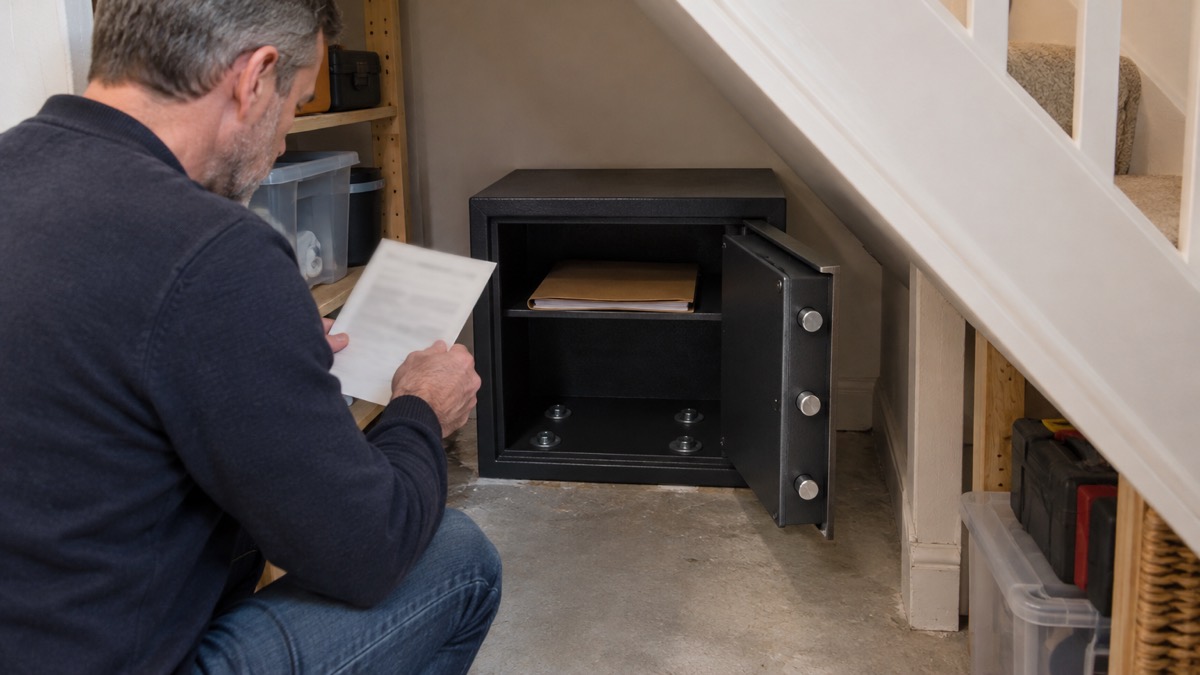
EN14450 is the standard for domestic safes, and Grade S2 is a level within it. The Burton Home Safe S2 carries that certification from Sold Secure, an independent testing body, and the AiS approval sits alongside it1. Police Scotland's break-in advice points households in the same direction, telling people to look for a safe that is Sold Secure gold standard, which it equates with BS EN 14450 S26. That is a useful cross-check: the standard named by the police and the standard on this safe's label are the same one.
The maker also lists the SBD Police Approved Specification for the range3. If you want to understand what police approval schemes do and do not mean, our page on how to tell if a security product is police approved sets out how the marks differ.
Two limits are worth being clear about. First, the certification is an attack resistance rating, not a guarantee. It tells an insurer how long the safe is expected to resist a determined attempt with tools, which is why insurers use it to decide what they will cover. Second, the rating is conditional on installation. The maker is explicit that the safe must be bolted to the floor or wall to maintain its security certification1. Police Scotland makes the same point about safes generally, advising that the safe is installed into the fabric of your home, such as beams or concrete6.
Insurers sometimes set a minimum RU score for the value of contents they will cover, so if you are buying the safe to satisfy a policy condition, check the required score with your insurer first rather than assuming any certified safe will do.
Size 1 dimensions and what fits inside
The Size 1 is the smallest of three compact sizes in the range1. Its external body is 300 x 350 x 300mm and its internal space is 220 x 270 x 190mm, which gives 11 litres2. The difference between the two sets of figures is the wall and door thickness, and it is worth picturing: an A4 document folder will not lie flat in a 220 x 270mm opening, so check the size of what you plan to store against the internal figures, not the external ones.
| Specification | Size 1 | Size 2 | Size 3 |
|---|---|---|---|
| External (H x W x D) | 300 x 350 x 300mm | 300 x 445 x 400mm | 450 x 445 x 400mm |
| Internal (H x W x D) | 220 x 270 x 190mm | 220 x 365 x 290mm | 365 x 365 x 290mm |
| Volume | 11 litres | 23 litres | 39 litres |
| Weight | 17kg | 28kg | 31kg |
| Shelves | 1 removable | 1 | 1 |
All figures from the maker's product page and July 2024 product guide2.
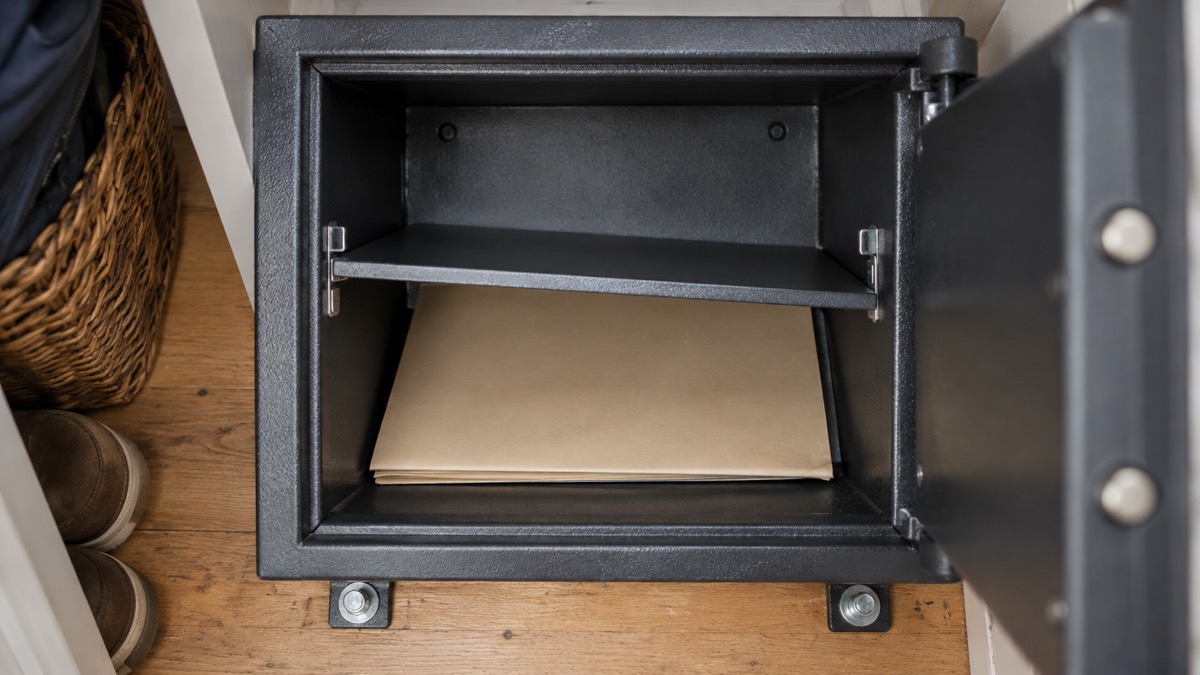
The Size 1 is supplied with one removable shelf2. Taking it out gives you the full 220mm internal height for a tall item; leaving it in lets you keep small valuables apart from papers. The Size 2 and Size 3 each have one shelf as well2.
The keypad lock: codes, dual user and time delay
The lock is an electronic keypad with a number pad, holding one master code and nine user codes2. In a household that means you can give each adult their own code, give a temporary code to a carer or a relative and remove it afterwards, and keep the master code for yourself. The master code is the one that can add and delete the others, so it should not be the code you hand out.
The maker lists two further lock features on the Size 1: dual user and time delay functionality1. Dual user means the safe can be set to need two codes before it opens. Time delay means there is a wait between entering a correct code and the door releasing. Both are there for the same reason: if someone tries to make you open the safe, a second code you do not have to give, or a delay you cannot shorten, buys time. The maker does not publish the length of the delay on the product page, so read the instruction booklet that comes with the safe before you rely on the setting.
For comparison, the Chubbsafes Senator with a Class B electronic lock carries one master code and one user code7. The Burton keypad's nine user codes give a larger household or a rota of carers more room to give each person their own entry.
Locking bolts, the dog bolt and the fixing points
The door is held by three-way locking bolts: double bolted to the side and single bolted top and bottom2. On the hinge side there is a dog bolt, which the maker describes as protection against hinge attacks2. The point of a dog bolt is that cutting the hinges off does not let the door be levered out, because a bolt on that edge still holds it into the frame.
The safe is built for back and base fixing, and the maker says it installs to floors and walls with the fixing kit included1. The Size 1 has one pre-drilled fixing hole in the base and one partially drilled fixing hole in the rear1. The partially drilled rear hole is finished on site, which lets the installer line it up with a wall or a joist rather than being fixed by where the factory put the hole.
Fixing the safe: surfaces, holes and what is in the box
The fixing kit is included, and Burton's own support guidance for its safes says the dowels and screws are supplied in a bag inside the safe8. That is the maker's instruction for its own product, and it means you should open the door and look inside before you assume a part is missing.
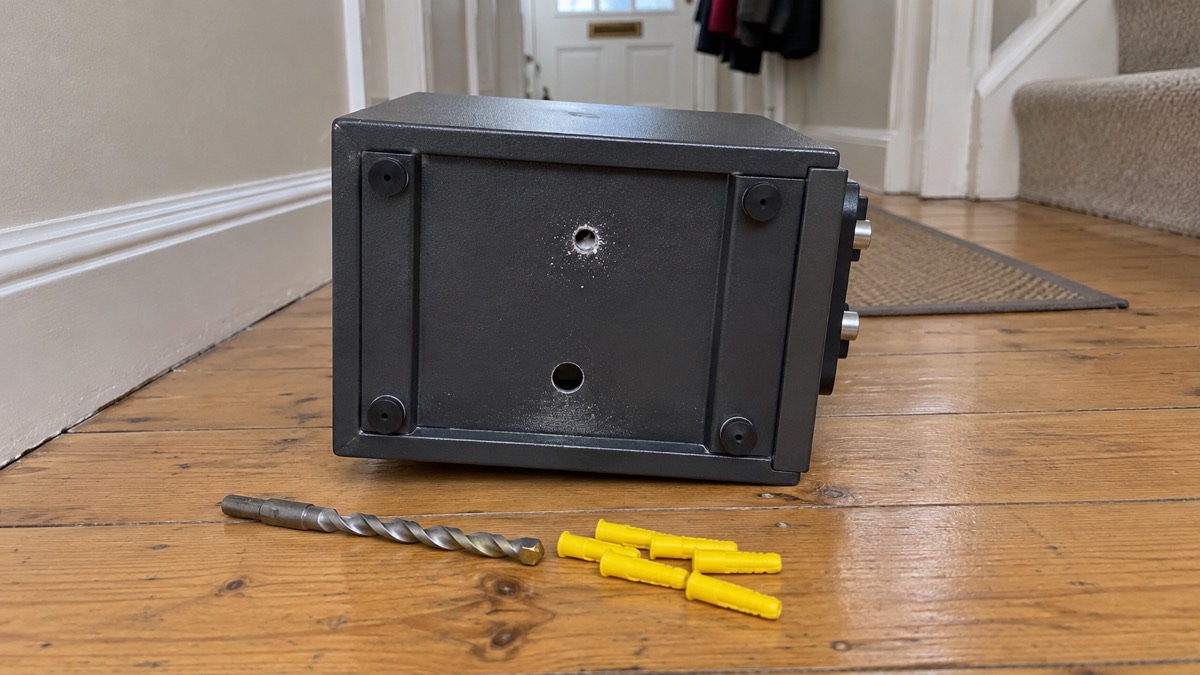
The surface matters as much as the fixings. The maker requires a solid floor or wall for the rating to apply2, and Police Scotland advises installing a safe into the fabric of your home, such as beams or concrete6. A stud partition or a hollow floor is not the fabric of the building in that sense. The same principle appears in official advice on key safes, where Torbay and South Devon NHS Trust states that to maintain police accreditation a key safe must be installed into brick or dense concrete, not breeze block or mortar9. A safe is heavier and takes more force than a key safe, so the surface requirement is at least as strict.
A sensible order of work:
- Decide the position first, allowing 28mm extra depth for the keypad and hinges and clear space in front for the door to open to 90 degrees1.
- Check the surface is solid: a concrete floor, a solid wall, or a beam, not plasterboard alone2.
- Open the door and take out the bag of dowels and screws from inside the safe8.
- Fix through the base hole, the rear hole, or both, following the maker's instructions1.
- Test the door opens and closes freely, then keep the installation details with your insurance paperwork.
If you are fitting a safe as part of a wider review of the home, our guide to doors and locks covers the entry points a burglar reaches first, and how burglars choose a home explains why a visible, well-fitted safe is one part of the picture rather than the whole of it.
Size 1, Size 2 or Size 3: choosing within the range
The range comes in three compact sizes1. The step up from Size 1 to Size 2 keeps the same height and internal height but widens the body from 350mm to 445mm, taking the volume from 11 litres to 23 litres and the weight from 17kg to 28kg2. The step from Size 2 to Size 3 adds height as well, from 300mm to 450mm externally, taking the volume to 39 litres and the weight to 31kg2.
The practical question is what you are storing and whether you can lift it into place. A Size 1 at 17kg is a one-person lift for most adults over a short distance; 28kg and 31kg are two-person jobs, and both need the same bolting down as the smallest model2. If your reason for buying is a document folder and a few small items, the Size 1's 11 litres may be enough. If you want to keep a laptop, a camera bag or a box of family papers, the wider Size 2 gives you 365mm of internal width against 270mm2.
The range offers 3 compact sizes1. The choice is about space and weight, not about a different level of security.
Support, warranty and where to get help
The Size 1 carries a 1 year warranty as standard2. Keep the receipt and a note of the date and method of fixing, because the rating depends on the installation and a claim may turn on it. For comparison, Phoenix Safe Company offers a 2 year onsite materials and labour warranty on some of its series, so warranty length is one of the things that varies between makers and is worth checking before you buy any safe10.
If the keypad stops responding, the first thing to check is the batteries, and our page on opening an electronic safe when the batteries are flat sets out the options. If you have been burgled and the safe was forced or taken, report it to the police and tell your insurer what was inside; our guide to what to do after a burglary covers crime numbers, insurers and repairs. In Scotland and Northern Ireland, reporting and support arrangements differ, and our page on Scotland and Northern Ireland explains how.
For the wider picture of how a safe fits into protecting a home, start with our home security guide, and for the standards behind the label, see home safes: fire, burglary and cash ratings explained.
Sources (10)
- Burton Home Safe S2 Size 1, Burton Safes, 2026
- Burton Home Safe S2, Burton Safes, 2026
- Burton Security Product Guide July 2024, Burton Security, July 2024
- Planning for an Emergency: Kit, Wiltshire Council, 2026
- Emergency Kit, Ready Scotland, 2026
- Break-in and housebreaking, Police Scotland, 2026
- Senator 2p Master, Chubbsafes, 2026
- Safes FAQs, Burg, 2026
- Keeping Safe and Warm at Home, Torbay and South Devon NHS Foundation Trust, 2023
- Phoenix Product Guide, Phoenix Safe Company, 2026
 Burton Home Safe G3 Size 1