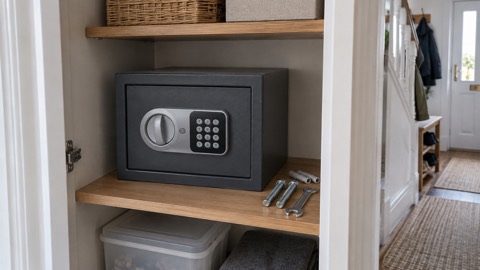
The Burton Home Safe G0 is a small, heavy home safe for documents and valuables. Burton lists the Size 1 as certified by ECBS to EN1143-1 Grade 0, with an EN1300 Class B certified lock, and as offering up to 30 minutes of fire protection for paper documents1. It is an electronic keypad safe with a 9V battery, a 30mm thick door with 3 way locking bolts, and one removable shelf1.
The single most important thing to understand before you buy or fit one is that the rating is conditional. Burton states plainly that for the rating to apply, the safe should be secured to a solid floor, and that it must be bolted to the floor or wall to maintain its security certification1. An unbolted safe is a heavy box that can be carried out of the house. Bolted down, it is a rated container.
This page sets out what the safe is and who it suits, its specifications, what its fire rating does and does not cover, how to fit it, how to live with the electronic lock and its battery, and what support Burton offers. It does not give a price, and it does not rank the safe against others.
What the Burton Home Safe G0 is, and who it suits
This is a compact domestic safe in Burton's Home Safe range, which Burton lists with three sizes and four product variations2. The Size 1 electronic lock model is the version described here: a keypad safe with a number pad, a 30mm thick door and three-way locking bolts of 23mm diameter1. It is designed to sit in a cupboard, under a desk or in a bedroom, bolted down, holding passports, certificates, a few pieces of jewellery and a folder of papers.
It suits a household that wants a rated, certified container for documents and small valuables, and is willing to have it fixed properly. The Grade 0 rating is a recognised European burglary standard, and Burton is not alone in using it: Chubbsafes describes its Consul range as offering burglary-resistant protection for cash and valuables in Grade 0 and I according to EN 1143-1 standards, certified by ECB•S4. That tells you the grade is a shared benchmark rather than a marketing label, and that a Grade 0 container is the entry point of a graded range.
It does not suit someone who wants to keep a large collection, a long gun or a big box of paperwork: 11 litres of internal volume is roughly the space of a small archive box1. Nor does it suit a rented flat where drilling the floor is not permitted, because the rating depends on fixing. If you are weighing up whether a safe is the right purchase at all, the wider guide to home safes and what the ratings mean sets out the options.
Specifications of the Size 1
Burton publishes a full specification for the Size 1 electronic lock model, which is the version to check against your own storage needs1.
| Specification | Size 1 electronic lock |
|---|---|
| Certification | EN1143-1 Grade 0, certified by ECBS1 |
| Lock certification | EN1300 Class B1 |
| Fire protection | Up to 30 minutes for paper documents1 |
| External dimensions (H x W x D) | 300 x 400 x 300 mm1 |
| Internal dimensions (H x W x D) | 215 x 320 x 165 mm1 |
| Volume | 11 litres1 |
| Weight | 65kg1 |
| Door | 30mm thick, 3 way locking bolts, 23mm bolt diameter1 |
| Door opening | 180 degrees for full access1 |
| Lock | Electronic keypad, 1 master code and 8 user codes, 6 digit PINs, time delay1 |
| Power | 1 x 9V battery, supplied1 |
| Fixing | 2 pre-drilled holes in the base, 2 partially drilled holes in the rear1 |
| Fixing bolts supplied | 2 x 12mm diameter, 150mm long, suitable for concrete1 |
| Shelf | 1 removable shelf, supplied1 |
| Hinge protection | Dog bolt on the hinge side1 |
| Warranty | 1 year1 |
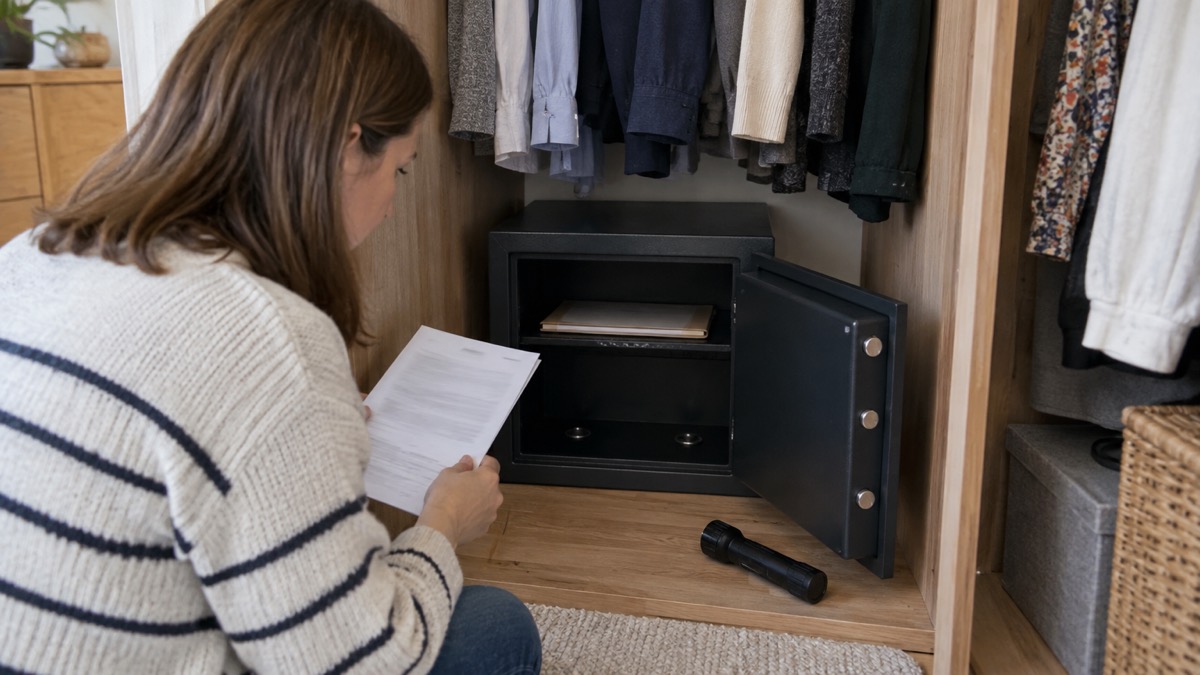
Two figures decide whether it fits your life. The first is the internal height of 215mm: an A4 folder stood on end will not fit upright, so papers go in flat or in a smaller wallet. The second is the weight of 65kg, which is heavy enough that you will want help moving it into position before it is bolted, and heavy enough that a burglar cannot simply tuck it under an arm once it is fixed1.
What the rating means, and why bolting it down is the whole point
Grade 0 under EN1143-1 is a certified level of resistance to burglary attack, and Burton states that the Size 1 has been certified by ECBS to that grade1. The lock carries its own certification, EN1300 Class B1. Together these are the two claims that matter: the body resists attack to a tested standard, and the lock meets a tested standard of its own.
All of that is conditional on installation. Burton's own wording is that for the rating to apply, the safe should be secured to a solid floor, and that it must be bolted to the floor or wall to maintain its security certification1. The reason is simple: a rated container that can be lifted and carried away is not protecting anything, because the thief takes it home and opens it at leisure. The bolts are what turn the safe into part of the building.
Police advice in Scotland makes the same point in general terms, advising householders to make sure the safe is installed into the fabric of your home, such as beams or concrete8. That is the standard to aim for wherever you live: fix into something structural, not into plasterboard or a joist you have not checked.
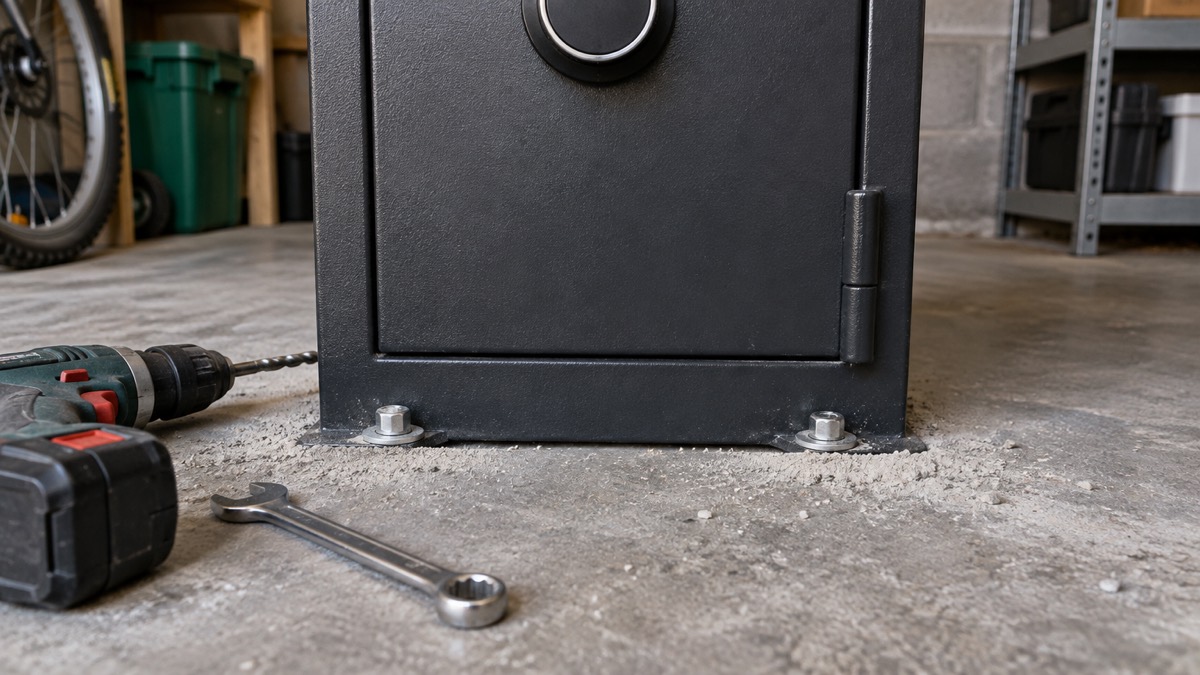
The Size 1 comes with two 12mm diameter, 150mm long fixing bolts suitable for concrete, and has two pre-drilled holes in the base and two partially drilled holes in the rear1. The base holes are the straightforward route on a solid floor. The rear holes are partially drilled, which means the final breakthrough is made on site so the fixing positions can be matched to your wall or floor. If you are not confident drilling into concrete, Burton states that its stockists can arrange an installation service if required1.
Fire protection: 30 minutes for paper, and what that leaves out
Burton states that the safe offers up to 30 minutes of fire protection for paper documents1. That is the claim, and it is a specific one: paper, for up to half an hour. It is not a claim about digital media, photographs, film, jewellery or anything else, and it is not a claim that the contents will be undamaged in every fire.
Thirty minutes is a meaningful window in a house fire. For context, official guidance on purpose-built flats notes that walls, floors and doors will hold back flames and smoke for a minimum of 30 to 60 minutes9. A domestic fire can be well developed within that time, and the safe is designed to give papers a chance while the fire is fought or the building is evacuated, not to survive a fire that burns for hours.
The practical consequences for a household are worth spelling out:
- Keep paper in it. Burton states that the Home Safe G0 offers up to 30 minutes fire protection for paper documents1.
- Do not assume digital media is protected. Burton makes no claim for hard drives, USB sticks or memory cards. Keep a second copy of anything digital somewhere else, such as with a relative or in an online account protected by a strong password.
- Do not treat it as a cash rating. The fire claim is about paper. If you are thinking about cash or jewellery, the guide to cash and jewellery in a fire safe explains how fire ratings and cash ratings differ.
- Remember the rating is for the safe, not the room. A safe in a shed or garage is exposed to a fire that starts there.
If fire protection for documents is your main reason for buying, Burton also lists a separate Firebrand Fireproof Safe with three product variations, and describes its fire and security safe range separately3. Compare the stated fire durations before deciding which suits your papers.
Fitting it safely: floor, wall and the limits of a rented home
Fitting is the step that decides whether the safe does its job. Burton's requirement is a solid floor, with the alternative of bolting to the wall, and the certification depends on it1. The supplied bolts are 12mm diameter and 150mm long, suitable for concrete1. That length tells you the fixing needs a substantial depth of solid material behind it, which is why a concrete floor slab or a solid wall is the target and a timber floor with a void beneath is not.
Work through it in this order:
- Choose the position. Somewhere discreet, out of sight of windows and front doors, with enough clearance for the door to open to 180 degrees1.
- Check what is under the floor or behind the wall. You need concrete or solid masonry for the supplied bolts1.
- Mark and drill the base holes first. The two base holes are pre-drilled; the two rear holes are partially drilled and finished on site1.
- Bolt down, then test. Once fixed, check the door swings freely and the bolts engage.
- If in doubt, use the installation service. Burton states that its stockists can arrange an installation service if required1.
In a rented home, drilling the floor is usually a decision for the landlord, and the rating depends on fixing, so an unfixed safe gives you storage but not certified protection1. If you cannot fix it, consider whether a smaller, lighter container hidden elsewhere, or a bank deposit box, meets the need better. The guide to keeping valuables safe from thieves covers the alternatives.
The electronic lock, the 9V battery and the time delay
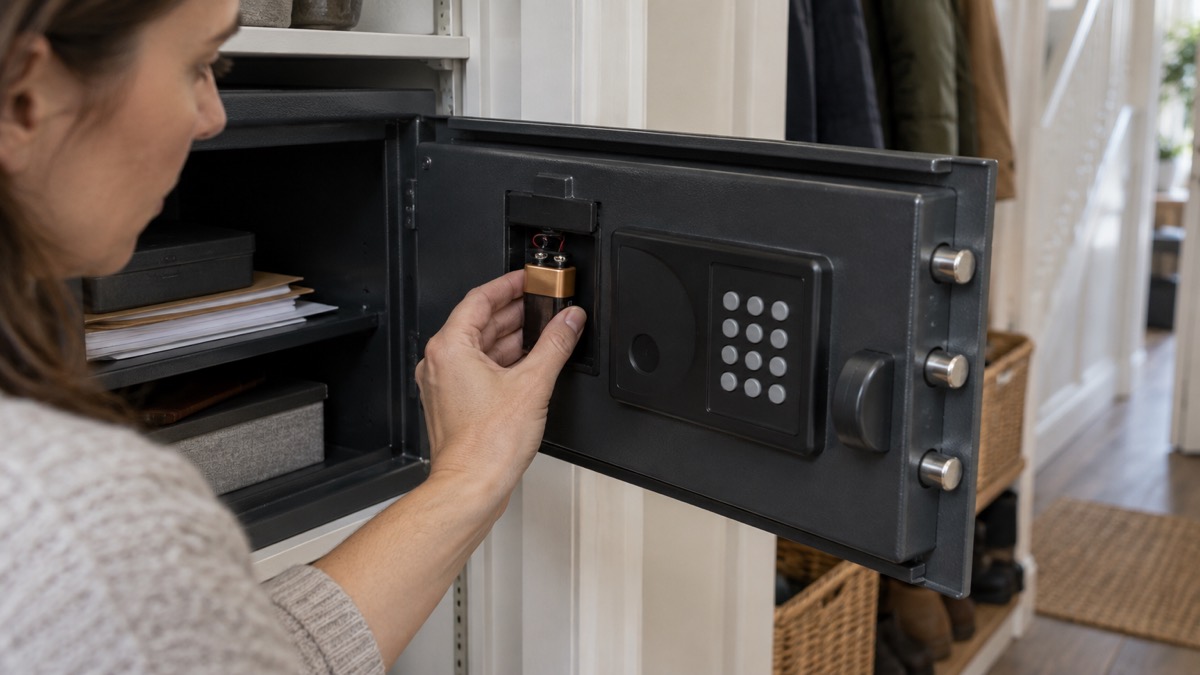
The Size 1 uses an easy to use electronic lock with a number keypad, powered by one 9V battery which Burton supplies1. The lock supports one master code and eight user codes, each a 6 digit PIN that you program yourself, and it has time delay functionality1. Eight user codes means a household can give each adult a separate code, and change one without disturbing the others.
The time delay is a deliberate obstacle. It introduces a wait between a correct code being entered and the door opening, so that someone who has watched you type the code, or forced you to give it, cannot open the safe and empty it in seconds. Burton lists the time delay as a feature of the Home Safe G01.
On the battery, Burton does not publish a step-by-step replacement procedure for this model. The safe maker BURG-WÄCHTER, in its own general support guidance for its safes, advises that if the electronic lock gives no signal you should change the batteries, clean the contacts, then remove the batteries, press ON/Enter at least three times, insert new batteries and try the known code11. It also states that if the OK symbol lights but the knob turns only a quarter turn, one of the batteries is defective and all must be replaced with high quality brand batteries, not rechargeables11. Those are BURG-WÄCHTER's instructions for its own products, not Burton's, but they describe the same kind of keypad lock and are a sensible routine when a keypad misbehaves.
A 9V battery is not a button cell, but the same discipline applies: know where your spares are, store them safely, and replace them before they fail rather than after. A safe has no routine maintenance visit, so put a reminder in your diary to check the battery once a year, and keep one spare 9V in the house.
Sizes, variations and the rest of the range
Burton lists three sizes in the Home Safe range and four product variations on the G0 page2. The Size 1 detailed here is the smallest of the three, with 11 litres of internal space1. If your documents run to several archive boxes, or you want to store a laptop as well as papers, the larger sizes in the range are the ones to measure against your space.
The wider Burton range includes other models you may come across while comparing:
- Home Safe S2 Size 1 and Home Safe G3 Size 1, both listed as separate product pages in the same family13.
- Firebrand Fireproof Safe, which Burton lists with three product variations10.
- Burton's general home safes and fire and security safes ranges3.
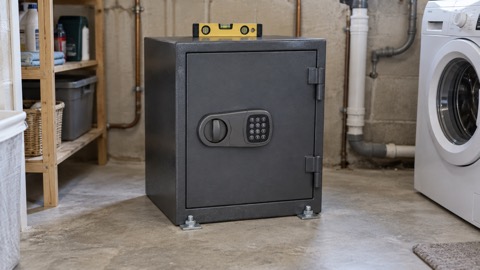
The Size 1 has one removable shelf, supplied, so you can configure the interior for a folder plus a small box, or take the shelf out for taller items1. The door opens to 180 degrees, which matters in a tight cupboard: you need clearance in front as well as beside the safe1. The hinge side carries a dog bolt for protection against hinge attacks, a small detail that matters if someone tries to cut the hinges rather than attack the lock1.
If you are comparing this safe with others, the useful comparison is internal volume and fixing method, not brand. A safe that fits your papers and can be bolted into your floor is doing its job; one that is too small, or that you cannot fix, is not.
Warranty, installation help and where to get advice
Burton gives the Home Safe G0 a 1 year warranty1. That is the maker's stated term, and it is worth registering the purchase and keeping the receipt with the safe's paperwork, because a warranty claim will need proof of purchase and date.
Installation help is available through Burton's stockists, who can arrange an installation service if required1. If you use an installer, ask them to confirm they will fix into a solid floor or wall using the supplied concrete bolts, because that is what the certification depends on1. The supplied bolts are 12mm diameter and 150mm long, suitable for concrete, so an installer turning up without the right drill or fixings is a warning sign1.
For general home security advice, your local fire and rescue service offers a free home fire safety visit, which can help spot fire hazards, sort out an escape plan and provide information about smoke, heat and carbon monoxide alarms; the process takes about 20 minutes15. Several services also offer an online home fire safety check that takes around 15 minutes16, and the London Fire Brigade's Home Fire Safety Checker takes 2 minutes and is completely free17. Warwickshire Fire and Rescue Service lists home security among the topics covered by a safe and well visit18. These visits are about the home as a whole, not the safe, but they are a sensible moment to review where your valuables are kept and whether your smoke and carbon monoxide alarms are working.
For the wider picture on securing a home, the guide to home security covers doors, locks, alarms and lighting, and the guide to how burglars choose a home explains what puts them off. If you have just moved in, the moving house locks and keys checklist is a good place to start before you decide where a safe goes.
Sources (18)
- Burton Home Safe G0, Burton Safes, 2026
- Burton Home Safe Size 1 Electronic Lock, Burton Safes, 2026
- Home Safes, Burton Safes, 2026
- Graded Safes, Chubbsafes, 2026
- Graded Safes range, Chubbsafes, 2026
- Home Safes, Chubbsafes, 2026
- Consul, Chubbsafes, 2025
- Break-in and housebreaking, Police Scotland, 2026
- Fire safety in the home, Westminster City Council, 2017
- Fire and Security Safes, Burton Safes, 2026
- Safes FAQs, BURG-WÄCHTER, 2026
- New button battery safety features, Child Accident Prevention Trust, 2026
- Burton Home Safe S2 Size 1, SafePrepared
- Burton Home Safe G3 Size 1, SafePrepared
- Keep Safe Keep Well winter safety campaign, NHS Western Isles, 2024
- Home safety visits, Devon and Somerset Fire and Rescue Service, 2026
- Home fire safety, London Fire Brigade, 2026
- Apply for a safe and well visit, Warwickshire County Council, 2026

 Burton Home Safe G3 Size 1
 Burton Home Safe S2 Size 1