
BURG-WÄCHTER is a lock and safe maker whose range reaches UK households in three practical forms: safes for documents and valuables, key safes that let a carer or relative get in when you cannot reach the door, and padlocks and other locks for sheds, gates and outbuildings. For an emergency-preparedness plan, each does a different job. A fire-resistant safe is about keeping the paperwork you will need after a fire, flood or burglary, such as insurance policies, identification and contact numbers. A key safe is about access: getting help to a vulnerable person quickly when something goes wrong. A padlock is about keeping stored kit where you left it.
None of these replaces the basics. Working smoke alarms, a practised escape plan and copies of key documents held somewhere else do more for a household than any single box. What a safe adds is a fixed, lockable place for the things that are hard to replace, and a key safe adds a way in for people you trust.
This page covers what each type does in an emergency, how to fit it, what to do when a lock fails or a battery dies, and how to reach the maker's support. It does not rank products or quote prices.
What BURG-WÄCHTER makes for UK households
The range that matters for a household plan falls into four groups. Safes hold documents and valuables and, in the fire-rated versions, are built to keep paper intact while a fire is put out. Document boxes and cash boxes are the smaller, simpler end of the same idea: somewhere fixed to keep papers and a little cash. Key safes are fixed outside the door and hold a key behind a code, so that someone else can get in. Padlocks, locks and letterboxes secure sheds, gates, outbuildings and the post.
The maker's own guidance draws one distinction that decides most purchases. If you want a safe that offers both tested fire protection and certified burglary protection, BURG-WÄCHTER recommends a Combi-Line series safe, the MTD F 60 or an OfficeDoku1. A safe with only one of those ratings will do one job and not the other, so decide which risk you are buying against before you choose.
For the wider picture of securing a home against burglary, and what to do before and after one, see our guide to home security. For the documents themselves, the emergency kit guide covers what a household should keep ready and where copies belong.
| Kit type | What it does for the household | Where it fits in a plan |
|---|---|---|
| Fire-rated safe | Keeps paper documents protected during a fire | After a house fire, when you need policies and ID |
| Burglary-rated safe | Resists attack and anchors to the building | Keeping valuables and documents out of a break-in |
| Document or cash box | A fixed, lockable place for papers and a little cash | Small flats, rented homes, a grab-and-go box |
| Key safe | Lets a trusted person or the emergency services in | Illness, falls, carers, a household member who lives alone |
| Padlock and locks | Secures sheds, gates and outbuildings | Keeping stored kit and tools where you left them |
Fire-resistant safes for documents and valuables
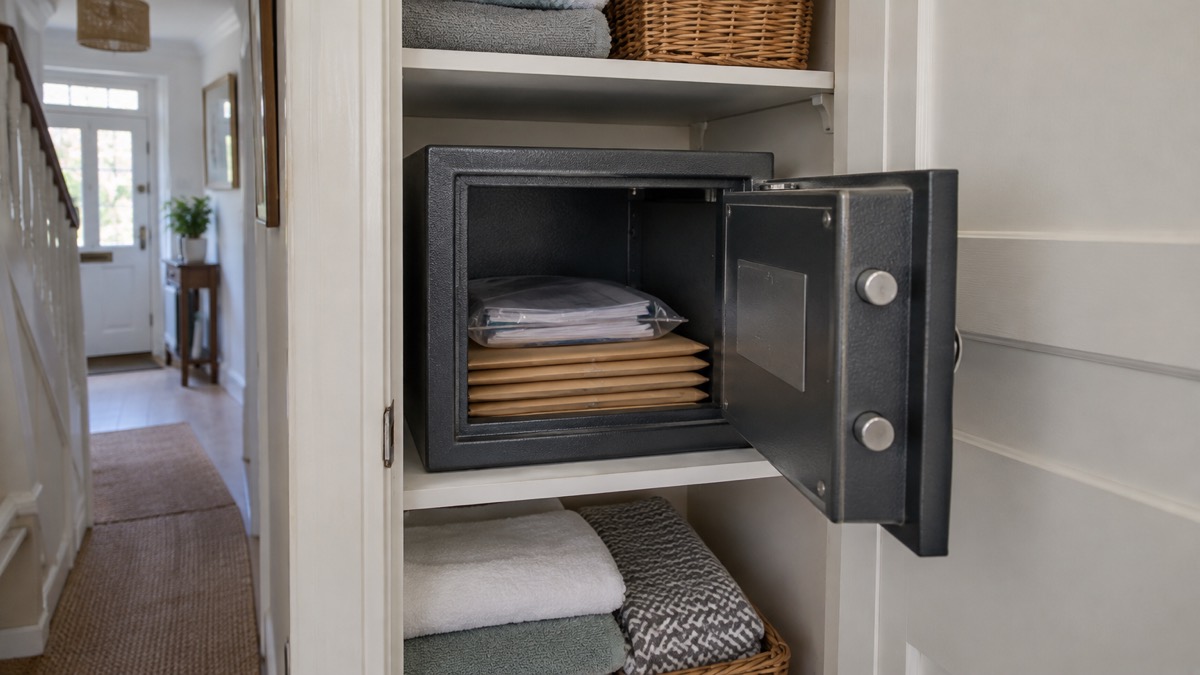
A fire-resistant safe is bought for the hours after a fire, not the minutes during it. The point is that when the fire is out and you are standing in a damaged home, the paperwork you need to start again is still readable. That is why the maker's recommendation for a safe with both tested fire protection and certified burglary protection is a Combi-Line series safe, the MTD F 60 or an OfficeDoku1: a household that wants one box to do both jobs is pointed at those.
What goes inside is set by official emergency checklists rather than by the safe. The Be Ready checklist suggests cash in a mix of coins and notes and cards, copies of identification and documents, and important phone numbers and information such as regular medication and doses4. Scottish guidance suggests copies of important documents like birth certificates and insurance policies5. Argyll and Bute's list adds telephone numbers, insurances and reference numbers for utility companies6. A safe is a sensible home for those copies, kept alongside the originals where you can.
Two practical points. First, a fire rating says nothing about water, so a document that must survive a flood needs a sealed bag inside the safe as well. Second, keep the safe where you can reach it quickly and where a fire is least likely to start, away from the cooker and heaters, and fit a secure fire guard fixed to the wall where there is an open fire8.
Document boxes and cash boxes
Not every household needs a safe bolted to a wall. A document box or cash box is the smaller answer: a lockable container for papers, a little cash and the small items you would want to pick up on the way out of the door. It suits a rented flat, a house where fixing a safe to the structure is not possible, or a household that wants a single place for the paperwork rather than a permanent installation.
The contents are the same as for a larger safe, and the official checklists are the guide. Cash in a mix of coins and notes and cards, copies of identification and documents, and important phone numbers and medication details4. Copies of birth certificates and insurance policies5. Utility account numbers and insurance reference numbers6. A household emergency box, as Argyll and Bute describes it, might also hold prescriptions or medicines, toiletries, contact lenses or glasses, a first aid kit, a battery powered radio, torch and spare batteries, a notebook and pen, and a mobile phone charger6.
A box has one advantage over a fixed safe in an emergency: you can carry it. If your plan is to leave the house in a hurry, a box you can lift is more use than a safe you cannot. The trade-off is that a box is easier to carry away in a burglary too, so keep it out of sight and consider fixing it down if it holds anything valuable.
For what else belongs in a bag by the door, see the emergency kit guide, and for the documents themselves, the getting started section sets out how to build a household plan around them.
Key safes for carers and emergency access
A key safe is a lockable box that holds a key, fixed to an outdoor wall with a code set to it, so that carers, family or emergency services can get into the home if they need to2. Some key safes are police-approved2. For a household with an older or disabled member, or anyone who lives alone, it answers a different emergency from a flood or a storm: a fall, an illness, or a carer arriving when no one can reach the door. You may wish to consider purchasing and installing a key safe to enable fast and easy access to your home in an emergency, and the control centre can store the key safe PIN and pass it on to friends, family or the rapid response service in an emergency9.
Warwickshire County Council suggests considering a key safe to enable fast and easy access to your home in an emergency, and notes that the control centre can store the key safe PIN and pass it on to friends, family or the rapid response service in an emergency9. That last point is the one to act on: a key safe is only useful if the people who might need the code have it. Tell your family, your carer and, where the scheme operates, your telecare or community alarm provider.
A key safe also belongs in the household's own emergency kit thinking. Wiltshire's emergency kit list includes spare keys for your windows, car and house10. A key safe is where a spare house key can live when there is no neighbour to hold one.
For the wider arrangements for households that need extra help, including the Priority Services Register, see our guide to extra help in an emergency.
Padlocks, locks and letterboxes
The padlock range is the part of the BURG-WÄCHTER catalogue most households will meet first, on a shed, a gate or a bike. The maker's 116 HB 50 180 is a padlock with a high shackle, a solid brass body, a steel-hard double-locked shackle and a rust-free precision locking mechanism11. It is supplied with two keys, is also available keyed alike, and can be ordered with six keys per lock11. The maker lists its intended use as securing gates and various objects, and does not specify indoor or outdoor use11.
For a household plan, the details that matter are the ones about keys and weather. Padlocks in the range are supplied with two keys, and a six-key version is available on request for each lock11. Keyed-alike locks mean one key opens several, which is convenient but means losing one key loses access to all of them. The rust-free mechanism matters for a lock that stays outside through a winter.
A padlock is also how stored emergency kit stays where you left it. If you keep water, torches or tools in a shed or outbuilding, the lock is what stops them walking, and a spare key in the house is what stops you being locked out of your own supplies. Keep a note of the key blank, 66 R66 L for this model, so a spare can be cut without the original11.
For the wider subject of securing a home and outbuildings, see our guide to home security.
Fire and burglary ratings: what the test labels mean
The ratings on a safe are the whole purchase, and they are easy to misread. A fire rating tells you the safe has been tested to keep the contents below a damaging temperature for a stated period during a fire. A burglary rating tells you it has been tested against attack and, usually, that it is meant to be anchored. A safe with one rating does not have the other. That is why the maker's own answer to a household wanting both is a Combi-Line series safe, the MTD F 60 or an OfficeDoku1.
The same principle applies across household safety kit: buy the tested article and look for the mark. On smoke and heat alarms, the advice is to make sure any alarms you buy are marked with a current British Standards or European (CE) safety mark, which shows they meet the standard12. On flood protection, choose BSI kitemark certified products that meet the British standard for quality and safety, because installing the wrong products could mean they are ineffective, or even cause more damage in a flood3. On children's fancy dress, a swing label saying "This garment has undergone additional safety testing for flammability" shows the costume has had tests beyond the legal minimum8.
| What you are buying | What to look for | Why it matters |
|---|---|---|
| Safe with fire protection | A tested fire rating, stated by the maker | Keeps paper readable after a fire1 |
| Safe with burglary protection | A certified burglary rating | Resists attack; usually anchored1 |
| Smoke and heat alarms | Current British Standards or CE mark12 | Shows the alarm meets the standard |
| Flood protection | BSI kitemark certification3 | Uncertified products may fail or worsen damage |
| Children's fancy dress | Additional flammability testing label13 | Beyond the legal minimum |
Fitting and anchoring a safe
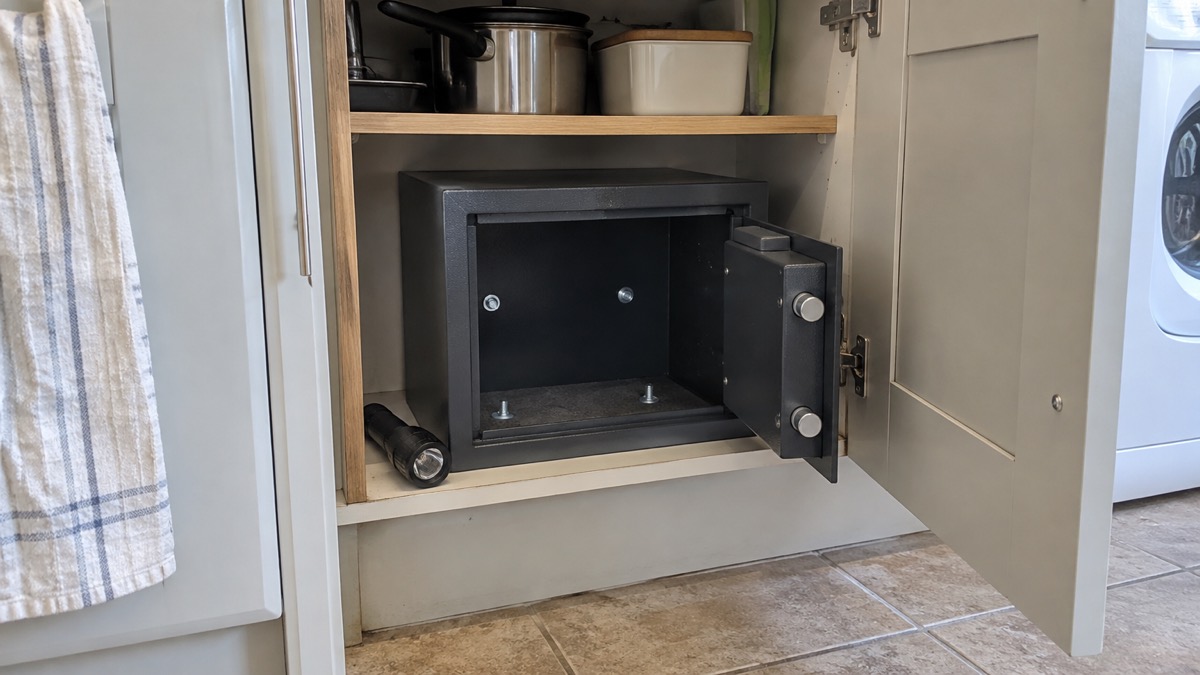
A safe that is not fixed down is a box that can be carried out of the house. The maker's product pages give the construction details that decide how a lock behaves, and the 116 HB padlock shows the pattern: a solid brass body and a steel-hard, double-locked shackle11. For a safe, the equivalent decision is where it goes and how it is fixed, and the maker's guidance points anyone wanting tested fire protection and certified burglary protection together towards specific series1.
Practical fitting advice for a household:
- Put the safe where you can reach it quickly and where a fire is least likely to start, away from the cooker, portable heaters and open fires, and fit a secure fire guard fixed to the wall where there is an open fire8.
- Fix it to a solid wall or floor so it cannot simply be lifted; a burglary-rated safe is designed to be anchored.
- Keep the area around it clear, and do not stack items around or on top of it to a height where they become unstable14.
- Make sure all internal doors can be closed and keep the escape route clear, so that fitting a safe does not compromise the route out14.
- Keep a note of the model, the key blank and any code somewhere outside the safe.
Locked out: lost keys, codes and dead batteries
The failure that matters most for a household is not a burglary but a lock that will not open when you need the contents. The maker's guidance covers the common cases. If the electronics fail, the circuit board must be replaced, so ask a local dealer or call the BURG-WÄCHTER service line on +49 (0)2335 965 3661. For a PointSafe furniture safe, the maker says to call the same service line to reset the electronics1. On the Basic-Safe, Smart Safe and Uni-Safe, the emergency key is located in a bag in front of the door1.
For keys, the padlock range shows what to plan for: two keys supplied, a six-key option on request, keyed-alike versions available, and a stated key blank, 66 R66 L, so a spare can be cut11. Record the blank and keep a spare key somewhere outside the lock, in the house or with a trusted neighbour.
For the wider subject of batteries, chargers and electrical safety at home, see our guide to backup power and the home emergencies section.
Support, spare keys and warranty
The maker's support route is a single service line, +49 (0)2335 965 366, which it says will help you find a specialist1. It is also the number to call to reset PointSafe electronics and to arrange replacement of a failed circuit board on a Home Safe or Ranger cabinet1. Have the model name and any product details to hand before you call, and note that the line is in Germany, so allow for that when you plan a call.
On keys and spares, the maker's product pages are the record. The 116 HB padlock is supplied with two keys, can be ordered with six keys per lock, is available keyed alike, and takes the 66 R66 L blank11. It is also suitable for master key and general master key systems at extra cost11. If your household relies on one key for several locks, decide now what happens if that key is lost, and keep a spare somewhere outside the set.
On warranty, register what you buy. Fire and rescue services and the Office for Product Safety and Standards advise registering electrical items and appliances with the manufacturer so you can be contacted about faults or recalls18. The same habit is worth applying to a safe with an electronic lock: it is the route by which a maker can reach you if a fault is found.
| Support need | What to do | Who says so |
|---|---|---|
| Find a specialist or dealer | Call +49 (0)2335 965 3661 | BURG-WÄCHTER |
| Reset PointSafe electronics | Call the service line1 | BURG-WÄCHTER |
| Replace a failed circuit board | Ask a local dealer or call the service line1 | BURG-WÄCHTER |
| Spare padlock key | Use the 66 R66 L blank11 | BURG-WÄCHTER |
| Hear about a recall | Register electrical items with the manufacturer to be informed of any safety recalls18 | Fire and rescue services |
Safety notices and recalls
There is no recall of a BURG-WÄCHTER product in the material behind this page, so the practical advice is about how you would hear of one. The Office for Product Safety and Standards issues recalls and alert notices on its website18. Electrical Safety First lists recalls and safety notices for white goods19. Registering a product with its maker is the other route, because it lets the manufacturer contact you directly18.
For a household, the safety notices that bear on a safe or key safe are mostly about what goes around them. Keep the area around the cooker clear, keep combustible items away from portable heaters and open fires, do not stack items until they become unstable, do not store gas cylinders in your home, make sure internal doors can be closed, plan and practise your escape, keep the escape route clear, and fit working smoke alarms, considering one in the bedroom and in the room where you spend most time14. A key safe should be checked so that the code works and the box opens freely, and the people who might need it should know it exists9.
For the wider picture of fire, carbon monoxide and other home emergencies, see our guide to home emergencies, and for keeping a household secure through a power cut or storm, the security section.
Sources (21)
- FAQs about safes, BURG-WÄCHTER, 2026-11-02
- Equipment for carers, Dorset and Wiltshire Fire and Rescue Service, 2026
- Preparing for a flood, Natural Resources Wales, 2026-10-29
- Be Ready checklist, UK Government, 2026
- Prepare for emergencies, Dumfries and Galloway Council, 2026
- Preparing for civil emergencies, Argyll and Bute Council, 2026
- Safety plea following two house fire fatalities, Northern Ireland Fire and Rescue Service, 2025-12-12
- Stay safe this Halloween, Wiltshire and Swindon Prepared, 2026-10-25
- Assistive technology, Warwickshire County Council, 2026-10-29
- Planning for an emergency kit, Wiltshire Council, 2026
- 116 HB 50 180 padlock, BURG-WÄCHTER, 2026-11-02
- Smoke alarms and heat alarms, London Fire Brigade, 2026-10-25
- Keeping your home warm, Frimley Healthier Together, 2026-10-25
- Home Fire Safety - Northern Ireland Fire & Rescue Service, Northern Ireland Fire & Rescue Service
- Swallowed something, Alder Hey Children's NHS Foundation Trust, 2025-09-25
- Be battery aware, Greater Manchester Fire and Rescue Service, 2026-10-29
- E-feiciau ac e-sgwteri diogelwch tan, Mid and West Wales Fire and Rescue Service, 2026-10-29
- Electrical items, London Fire Brigade, 2026-10-25
- White goods, Cheshire Fire and Rescue Service, 2026-05-20
- Electrical fire safety leaflet, Greater Manchester Fire and Rescue Service, 2026
- Electrical safety, Greater Manchester Fire and Rescue Service, 2026-10-29