
Phoenix Safe is a British maker of safes and security storage, and the model most relevant to a household preparing for an emergency is the Fire Fox SS1622K: a size 2 fire and S2 security safe with a key lock, rated by the maker for 60 minutes of fire protection for digital media, DVDs, USB memory sticks and hard drives1. It carries the EN14450 security standard and has five key hooks inside1.
For a household, a safe is not about hiding valuables from burglars alone. It is about making sure the things you cannot replace, your passports, certificates, insurance details and backup drives, are still there and still readable after the fire, flood or break-in you are preparing for. That is the job this page covers: what the kit does in an emergency, how to install it so it works, and how to keep it ready.
The short answer
A Phoenix Safe is a fire and security safe for the home. The Fire Fox SS1622K is a size 2 fire and S2 security safe with a key lock, a maker's rating of 60 minutes of fire protection for digital media, DVDs, USB memory sticks and hard drives, five key hooks inside, and the EN14450 security standard1. In plain terms: it is a lockable box designed to keep documents and small valuables intact through a fire of up to an hour, and to resist a casual thief who finds it.
What it is not is a substitute for a household plan. A safe protects what is inside it. It does not warn you of a fire, get you out of the building, or keep the lights on. The fire and rescue services are clear that the priority in any fire is people, not property: get out, stay out, and call 999 as soon as you are safe to do so5. The safe matters afterwards, when you need the paperwork to claim, replace and rebuild.
That is why the sensible way to think about a home safe is as one line in a wider emergency kit, alongside water, a torch, a radio and a written plan. It earns its place because the documents inside it are the ones that make recovery possible: proof of identity, proof of address, insurance details, and the backup drives that hold photographs and records.
What to do
Before an emergency: install it properly and decide what goes in
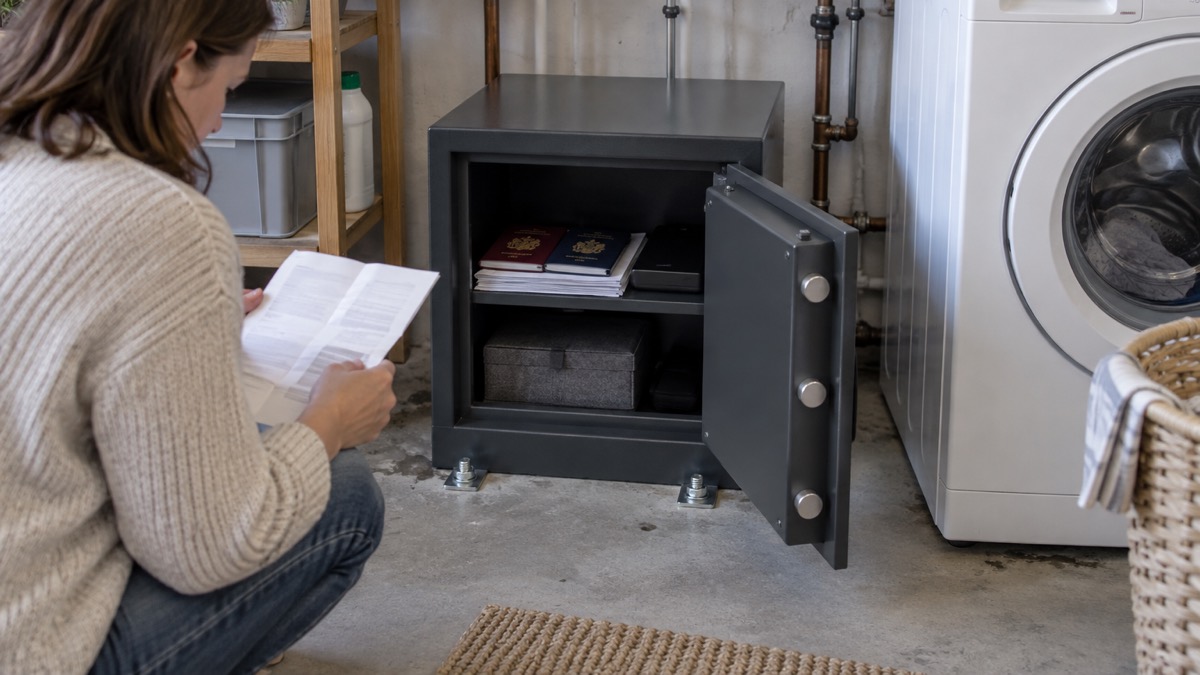
The single most important thing you can do with a home safe is fix it down. Police Scotland advises householders to make sure the safe is installed into the fabric of your home, such as beams or concrete2. A safe that can be lifted out of a cupboard and carried away offers almost no security at all, whatever its rating. Bolted to a joist or set into a concrete floor, it has to be attacked where it sits.
Decide what goes in before you need it:
- Passports, birth and marriage certificates, and insurance documents.
- A written household emergency plan, so anyone can find it.
- Backup drives and USB sticks, which the Fire Fox SS1622K is rated to protect for 60 minutes1.
- Spare keys to the house, kept apart from the key to the safe itself.
Keep the safe's own key somewhere you can reach in the dark, and never inside the safe. A key locked in the box it opens is no use in a power cut or a smoke-filled room.
During an emergency: leave it, and come back for it later
If there is a fire or smoke in your flat, the fire and rescue service advice is to alert anyone else in your flat, close the door to the room where the fire is, get out of your flat making sure the flat door closes behind you, call 999 and ask for "Fire", and leave the building using the stairs if you can5. Do not try to fight the fire, stop to collect belongings, go back into your flat, use the lifts, or re-enter the building until told it is safe5.
That instruction covers the safe. No document inside it is worth going back for. If you cannot get out of your flat, move to a room away from the fire and call 999, keep the door to the room closed and use towels or bedding at the bottom of the door to stop smoke getting in5.
"Get out, stay out, call 999 as soon as you are safe to do so."
After an emergency: secure the property, then open the safe
Once the fire is out and you are allowed back, the first job is not the safe. Warwickshire Fire and Rescue Service advises securing your property to prevent further damage or unauthorised entry, such as boarding up broken windows or securing damaged doors3. A home left open after a fire is vulnerable, and the safe inside it is exactly what an opportunist would look for.
Only then open the safe and check the contents. A fire rating is a tested period, not a guarantee, so look at the documents and drives rather than assuming they survived. If the safe has been through a flood, let it and its contents dry thoroughly before closing it again.
What you need
Fire protection: what the rating means for your documents
The Fire Fox SS1622K is rated by the maker for 60 minutes of fire protection for digital media, DVDs, USB memory sticks and hard drives1. That figure is the one that matters when you are choosing where to put your paperwork. A house fire can be intense and fast, and an hour of protection gives the fire and rescue service time to reach you and put it out, and gives you a window afterwards to retrieve what is inside.
Digital media is the part households most often overlook. Photographs, scanned certificates and computer backups now live on drives and sticks, and those are more fragile in heat than paper. A safe rated for digital media is doing a different job from a tin box under the bed.
| What the maker states | Detail |
|---|---|
| Product type | Size 2 Fire & S2 Security Safe with Key Lock1 |
| Fire protection (digital media) | 60 minutes for digital media, DVDs, USB memory sticks and hard drives1 |
| Security standard | EN144501 |
| Locking | Key1 |
| Key hooks | 51 |
Security: what EN14450 tells you
EN14450 is the security standard the maker lists for this model1. It is the benchmark that tells you the safe has been assessed against a defined level of attack, rather than being a locked box with no testing behind it. For a household, the practical meaning is that the safe resists the kind of opportunistic break-in that follows an unlocked window or a kicked-in door, not a determined attack with tools and time.
Security at home is mostly about the building, not the box. Police Scotland's break-in advice and the arson prevention guidance from Cheshire Fire and Rescue Service both point the same way: keep the outside of the home in good order. Cheshire Fire and Rescue Service advises ensuring any damage to fencing is repaired promptly to deter intruders7. A safe inside a home with a broken gate and an unlit path is doing less work than its rating suggests.
Where the safe fits your household plan
A safe is one item in a wider kit. The emergency kit a UK household should keep ready covers water, food, light, power and information, and the safe sits alongside those as the place your documents live. If you are building that kit from scratch, start with the Emergency Kit guide and the Getting Started plan, then decide whether a fire-rated safe is worth adding for your paperwork.
Two other guides bear directly on what a safe protects. Home Security covers locks, lighting and the fabric of the building, which is what stops a thief reaching the safe in the first place. Home Emergencies covers fire, carbon monoxide and the other events a fire-rated safe is designed around.
Staying safe
Fire safety comes before property
A safe protects documents. It does not protect people, and no household should let the safe change the order in which they do things in a fire. The fire and rescue services are consistent on this. Get out, stay out, call 9996. Do not stop to collect belongings5.
The wider home fire safety routine is what makes the safe worth having, because a fire you spot early is a fire that does less damage to what is inside it. Fire and rescue services advise making a bedtime check as part of safety at home8. A free home fire safety risk assessment is available through your local fire and rescue service, in partnership with the National Fire Chiefs Council9.
If you live in a flat
Flats bring their own rules, and a safe fixed into a flat needs thought. If you have a fire or smoke in your flat, alert anyone else in your flat, close the door to the room where the fire is, get out making sure the flat door closes behind you, call 999 and ask for "Fire", and use the stairs if you can5. If you cannot get out, move to a room away from the fire, call 999, keep the door closed and use towels or bedding at the bottom of the door to stop smoke getting in5.
Keep the safe, and anything else heavy, out of the hall, landing and stairs. The London Fire Brigade's easy-read fire safety booklet advises keeping hallways, landings and stairs clear of anything that might block or slow down your escape, and keeping door and window keys nearby so you can get out quickly10. A safe in the escape route is a hazard, not a safeguard.
If someone in the household needs extra help
Where a household includes someone older, disabled or using medical equipment, the safe should not be the only thing planned for. Fire and rescue services offer home safety visits for eligible residents11, and Safe and Well visits are designed to help you spot fire risks early and offer support if you are feeling alone or need help staying safe12. If someone uses oxygen at home, take extra care when oxygen tubing is trailing behind you and around your feet, especially on staircases13.
For households managing falls risk, the NHS advises considering a personal alarm or falls detector if it would help, and arranging for someone to check in regularly14. None of this replaces the safe. It sits alongside it, in the same household plan.
Where Scotland, Wales and Northern Ireland differ
The safe itself is the same product wherever you buy it, and the maker's ratings do not change at the border. What changes is who gives you fire safety advice, who visits your home, and what the local risks are.
| Nation | Who to approach | What to know |
|---|---|---|
| England | Your local fire and rescue service, which offers a free home fire safety risk assessment in partnership with the National Fire Chiefs Council9 | Safe and Well visits offer home safety advice to help you spot fire risks early12 |
| Scotland | Scottish Fire and Rescue Service | Police Scotland's break-in advice, including fixing a safe into the fabric of your home, applies here2 |
| Wales | Your local fire and rescue service | Fire safety in flats and high-rise buildings is covered by the Welsh services6 |
| Northern Ireland | Northern Ireland Fire and Rescue Service | NIFRS runs an online home fire safety check, an easy-to-follow self-assessment that produces a personalised fire safety action plan15 |
The local risk picture differs too, and it is worth knowing yours. The Scottish Environment Protection Agency's national flood risk assessment found that 1 in 8 properties across Scotland are at risk in a medium likelihood scenario, a sharp rise from 284,000 in its 2018 assessment16. A household in a flood-prone area should think about whether a floor-fixed safe is the right choice, and keep documents in a watertight container inside it.
Power cuts are another shared risk. The Low Frequency Demand Disconnection scheme sets out how demand is disconnected in stages across Great Britain, with different percentages applying in England and Wales, Southern Scotland and Northern Scotland: at Stage 6, 7.5% of demand is disconnected in England and Wales, 10% in Southern Scotland and 10% in Northern Scotland17. A safe does not need power, which is one small advantage in a long outage: the documents stay locked and protected while everything else is dark.
For households thinking about the wider picture, How the UK Prepares for Emergencies explains who does what, and Extra Help in an Emergency covers the support available to older, disabled and medically dependent households.
Sources (17)
- Phoenix Fire Fox SS1622K, Phoenix Safe, 2026-07-02
- Break-in and housebreaking, Police Scotland
- Dealing with the aftermath of a fire, Warwickshire County Council, 2026-10-29
- Keep Safe Keep Well Winter Safety Campaign 2024-2025, NHS Western Isles, 2024-10
- Fire safety information for residents living in flats operating a stay safe policy, Greater Manchester Fire and Rescue Service, 2026-10-29
- Fire safety in flats and high-rise buildings, Devon and Somerset Fire and Rescue Service
- Protect your property from arson, Cheshire Fire and Rescue Service, 2024-05-30
- Safety at home, Dorset and Wiltshire Fire and Rescue Service, 2026-04-30
- Fire safety at home, Surrey County Council, 2026-10-15
- Digital easy read fire safety booklet, London Fire Brigade
- Home safety visits for eligible residents, Staffordshire County Council
- Living alone, Cheshire Fire and Rescue Service, 2026-05-20
- Home oxygen and fire safety, Greater Manchester Fire and Rescue Service, 2026-10-29
- Stay Steady and Safe home safety checklist, NHS Norfolk and Suffolk Integrated Care Board, 2026
- Ten lives lost in accidental house fires in Northern Ireland this year, Northern Ireland Fire and Rescue Service, 2025-10-13
- National Flood Risk Assessment, Scottish Environment Protection Agency, 2025
- Power disruption 9 August 2019 final report, Department for Business, Energy and Industrial Strategy, 2020-01