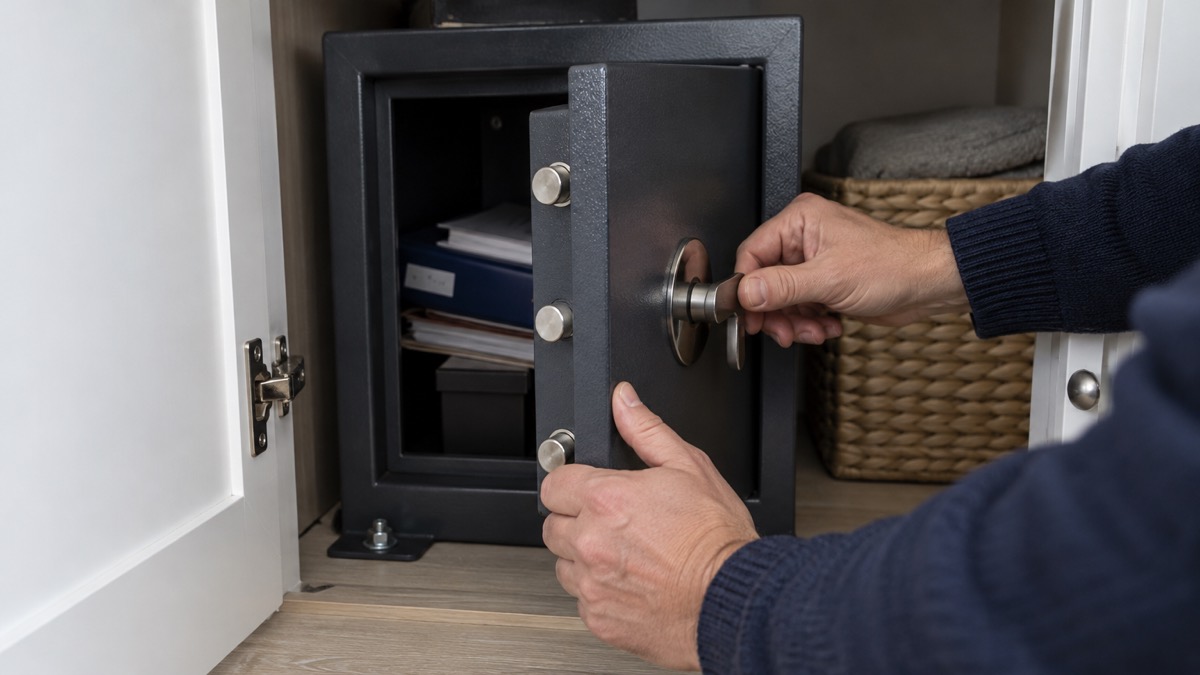
A home safe is one of the few pieces of household kit that earns its place twice: it keeps your valuables out of a burglar's hands day to day, and it gives you one fixed place to keep the documents you would need if you had to leave in a hurry or rebuild after a fire or flood. The Chubbsafes Senator is a compact safe the maker describes as ideal for the home or office, sold in four sizes from 30 to 190 litres1. It carries a Grade I burglary rating certified by ECB•S to EN 1143-1, and fire protection to EN 15659 at LFS 30 P for up to 30 minutes1.
If you are weighing one up, the decisions come down to four things: which of the four sizes fits your space and your paperwork, whether you want a key or an electronic lock, where you will bolt it down, and what you will actually put inside it. The maker states the range is ready to use on delivery and can be fixed to the floor, with the required bolts included1. Each safe comes with one shelf as standard1.
This page sets out what the Senator does for a household preparing for emergencies, its specifications, how to fit and keep it, and what it can and cannot protect. It does not cover price, and it does not set the Senator against other safes.
What the Chubbsafes Senator is, and what it does for a household
The Senator is a compact safe for storing valuable personal items in the home or office, according to the maker2. It is part of the Chubbsafes range of certified safe storage for private residences3. The maker lists the valuables it is intended for as cash, documents, collectables, jewellery and other valuables2.
For an emergency-preparedness household, that list is the point. The documents you would most want to survive a fire, flood or hurried evacuation are exactly the kind of thing a safe is built to hold: passports, birth certificates, insurance papers and identification. Official household emergency planning advice is consistent on this. The government's Be Ready household emergency plan tells households to keep copies of IDs and important documents, along with cash in a mix of coins and notes and cards4. Local authority grab bag guidance goes further, advising copies of important documents such as ID and birth certificates kept in a waterproof case5, and flood guidance lists passports, driving licence and insurance documents in a waterproof wallet6. The maker describes the Senator as a compact safe to store valuable personal items in your home or office2.
A safe is not a substitute for a grab bag. If you have to leave, you cannot carry a bolted-down safe with you, so the documents you would need on the road should still have a copy in your emergency kit. What the Senator gives you is a fixed, rated place for the originals and for the things you would not carry every day.
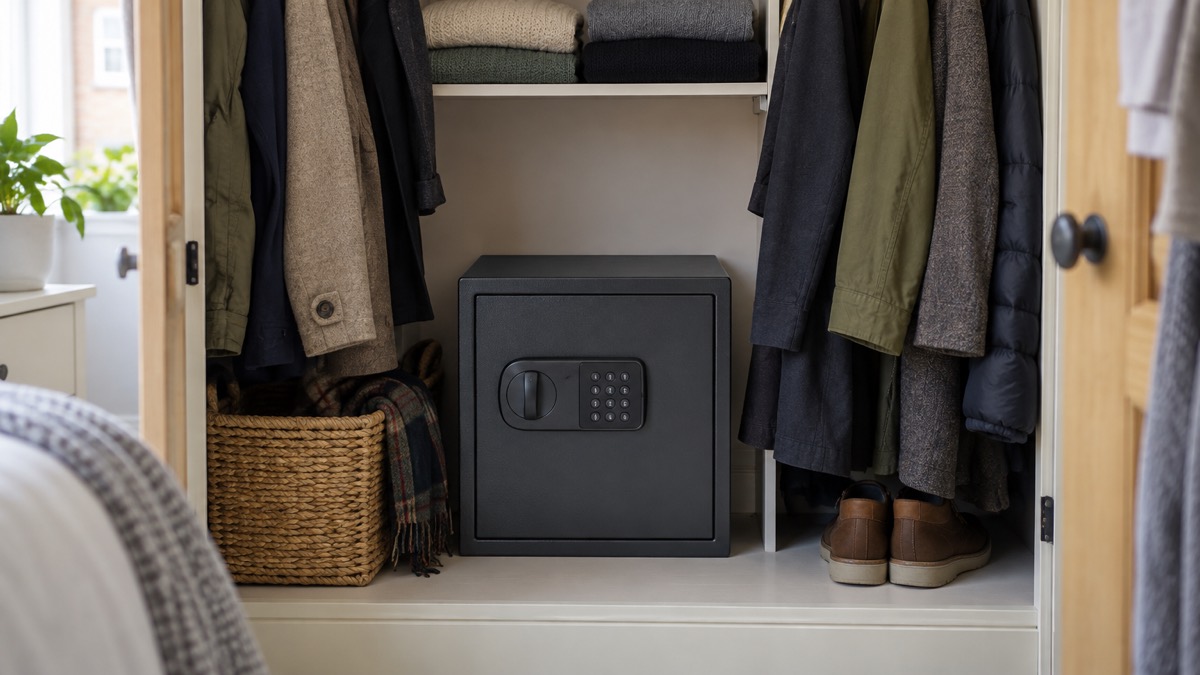
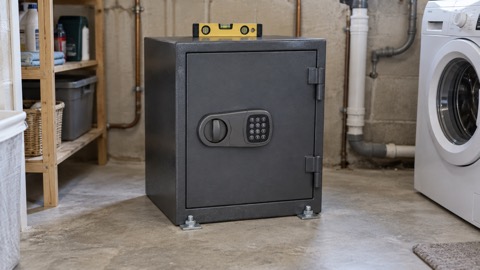
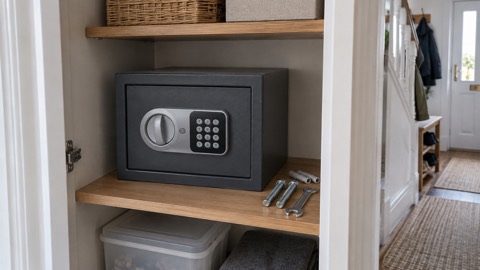
The maker also describes the range as less deep than a full-size safe, with the ability to conceal it in cupboards, wardrobes or under a desk2. That matters in a UK home where space is tight: a safe you can tuck away is one you are more likely to keep in use rather than leave in a box.
Sizes: four models from 30 to 190 litres
The range comes in four models, given by the maker as 32, 46, 63 or 190 litres1. The product page describes the range as four sizes from 30 to 190 litres7. The model numbers follow the capacity: the M-30 is the 32 litre, the M-45 is 46 litres, the M-65 is 63 litres and the M-190 is 190 litres1.
The jump from the 63 litre model to the 190 litre one is large, and so is the difference in footprint. The three smaller models share the same external depth of 403 mm and the same internal depth of 263 mm, while the M-190 is 563 mm deep outside and 423 mm inside1. If you are fitting the safe into a standard cupboard or under a desk, that difference decides whether it will go in at all.
| Model | Capacity | External H x W x D | Internal H x W x D | Clear opening width | Bolts |
|---|---|---|---|---|---|
| M-30 | 32 litres | 370 x 500 x 403 mm | 290 x 420 x 263 mm | 404 mm | 5 |
| M-45 | 46 litres | 500 x 500 x 403 mm | 420 x 420 x 263 mm | 404 mm | 5 |
| M-65 | 63 litres | 650 x 500 x 403 mm | 570 x 420 x 263 mm | 404 mm | 4 |
| M-190 | 190 litres | 862 x 654 x 563 mm | 782 x 574 x 423 mm | 558 mm | 4 |
All dimensions from the maker's datasheet1. External depth excludes the handle, which protrudes beyond the front face.
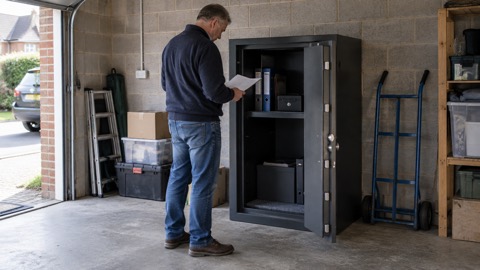
The practical question is what you need to store. A4 paperwork is the usual test: the maker's Consul range notes that its model 25 and above can store A4 binders8, which gives a sense of how quickly a small safe fills once you add ring binders. If your aim is a folder of documents, some cash and a jewellery box, the smaller models will do. If you want to keep a full household file, several binders and larger items, the 190 litre model is the one with the internal height and width for it.
Measure the space before you choose, and remember the door has to swing open and your hand has to reach the handle. The clear opening width is 404 mm on the three smaller models and 558 mm on the M-1901.
Burglary rating: Grade I, certified by ECB•S to EN 1143-1
The Senator carries a burglary resistance grade of Grade I, certified by ECB•S to the European standard EN 1143-11. The maker's datasheet describes it as dual certification, covering both burglary to EN 1143-1 Grade I and fire to EN 156591.
What that means in plain terms is that the safe has been tested to a published European standard by a certification body, rather than simply described as strong by the seller. EN 1143-1 is the standard for secure storage units, and Grade I is the entry grade in that system. The maker's wider range shows how the grades step up: the Consul is offered in Grade 0 and Grade I8, the ProGuard is certified as Grade III9, and the DuoGuard GIII is certified to Grade III10. Higher grades mean more resistance, and generally more weight and cost.
For a household, Grade I is the sensible starting point for the valuables a family keeps at home. It is not a bank vault, and it is not intended to be. Judge the Senator by its own certificate: the maker lists the range as Grade I to EN 1143-1, certified by ECB•S1, and the product page gives the European burglary standard as EN 1143-1 T2 GI, certified by ECB•S2. The same certificate covers fire as well as burglary, with the range dual-certified to EN 15659 at LFS 30 P1.
Two things follow for how you use it. First, a rated safe only does its job if it is fixed down, because an unbolted safe can be carried away and opened elsewhere. Second, the rating protects the contents, not the room: a burglar who cannot open the safe may still take other things, so the safe sits alongside the rest of your home security rather than replacing it. Our guide to home safes and what their fire, burglary and cash ratings mean explains how the grades compare, and how burglars choose a home sets out what puts them off.
Fire protection: up to 30 minutes to EN 15659 (LFS 30 P)
The Senator is certified to EN 15659 at LFS 30 P, giving up to 30 minutes of fire resistance1. LFS stands for light fire storage, and the 30 P rating means the contents are protected for that period in a fire test to the standard.
Thirty minutes is a meaningful window in a house fire, because it covers the time between the fire starting and the fire service arriving and getting water on it. It is not unlimited. The maker's wider range shows what more fire protection looks like: its Executive range offers up to 60 minutes11, and its DPC range is certified for up to 120 minutes13. Those are larger, heavier cabinets aimed at offices and institutions. For a domestic safe holding paper documents, 30 minutes to a published standard is the realistic level.
Paper is the thing the rating is really about. Passports, certificates, deeds and insurance schedules are all paper, and paper is destroyed quickly by direct flame and damaged by the heat and steam of a fire even without burning. A fire-rated safe buys you the chance to recover them.
The safe is not a place for everything. Items that are damaged by heat or that you need to grab in a hurry belong in your evacuation kit, not locked in a box you cannot carry. Our guide to whether you can keep cash or jewellery in a fire safe looks at what a fire rating does and does not cover.
Lock options: Class A key lock or Class B electronic lock
The Senator can be fitted with either a high-security electronic lock, Class B, or a key lock, Class A, according to the maker's datasheet1. The product page describes an EN 1300-certified Class A key lock and/or Class B high-security electronic lock2. The maker states that all locks are independently tested and certified in accordance with the EN 1300 standard1.
EN 1300 is the European standard for high-security locks, so whichever option you choose, the lock itself has been tested to a recognised grade. That is worth knowing, because the lock is the part an attacker deals with first.
| Lock type | What it means for you | Suits |
|---|---|---|
| Class A key lock | A physical key you carry; no batteries or codes to fail | Households that want simplicity and no dependence on power |
| Class B electronic lock | A code-based lock with a master code and a user code1 | Households that do not want a key to lose, and are happy to manage codes and batteries |
The electronic lock is set up with one master code and one user code1. The maker also gives an opening window of between 1 and 19 minutes for the Class B electronic lock1, which is a delay built into how the lock operates. If you choose the electronic lock, keep the master code somewhere safe and separate from the safe, and change the factory settings as soon as it is installed.
The maker's product page also lists combination lock among the range's lock types2, while the datasheet describes only the key and electronic options1. The two documents do not fully agree on this point. If a dial combination lock is what you want, confirm the exact specification with the supplier before ordering.
Whichever lock you choose, the safe is only as good as your key or code discipline. Our guide to keys, spares and hiding places covers how to keep a spare without leaving it where a burglar would look first.
Fitting it: floor bolts included and a removable door
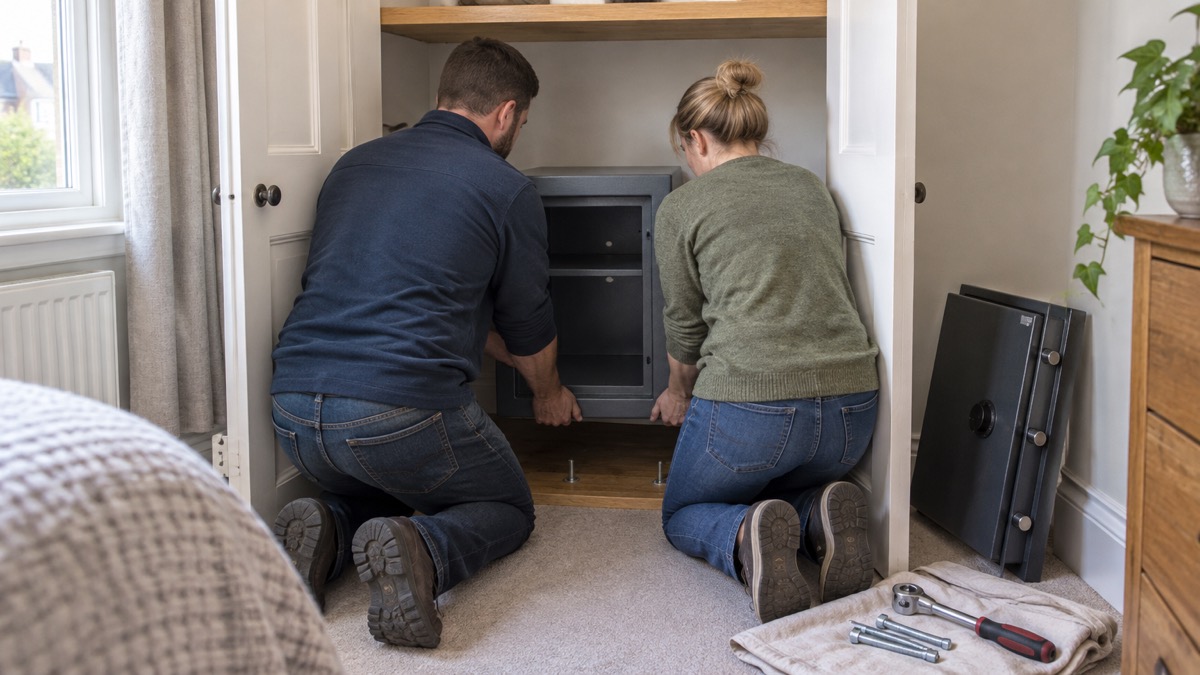
The maker states that the Senator range is ready to use on delivery and can be fixed to the floor, as the required bolts are included1. The door is removable, which the maker describes as an enhanced design for easy installation and reduced weight2. The maker states that removing the door reduces the overall weight by 15 per cent1.
That 15 per cent matters on installation day. A safe is awkward rather than simply heavy: it is a box with no handles on the sides, and getting it into a cupboard and onto its bolt holes is a two-person job. Taking the door off first makes it manageable, and the maker has designed it to come off for exactly that reason.
A sensible order of work:
- Measure the space, including the door swing and the handle protrusion, before the safe arrives1.
- Decide the fixing position: floor fixing is what the maker describes, with the bolts supplied1.
- Remove the door to reduce the weight by the stated 15 per cent1.
- Lift the body into position and mark the bolt holes.
- Drill and fix the bolts, then refit the door.
- Test the lock, set the codes if electronic, and record the serial number.
The handle protrudes beyond the front face, and the maker's datasheet gives the figure as 56 mm1. Allow for roughly 56 mm when measuring clearance. The maker's Consul range offers base or rear fixing with an anchoring kit supplied8; the Senator's stated fixing is to the floor with the bolts included1.
If you rent, check your tenancy agreement before drilling the floor, and talk to your landlord. Our guide to keeping valuables safe from thieves covers the wider picture, and home insurance conditions explains why a fixed safe can matter to your cover.
What to keep inside: cash, documents and jewellery
The maker lists the valuables the Senator is intended to protect as cash, documents, collectables, jewellery and other valuables2. For an emergency-preparedness household, the useful way to think about it is in three groups.
- Documents you would need to prove who you are and what you own: passports, birth certificates, insurance schedules and identification. Official grab bag guidance advises keeping copies of these in a waterproof case or wallet5, and the government's household plan advises keeping copies of IDs and important documents4.
- Cash: the government's Be Ready plan advises keeping cash in a mix of coins and notes alongside cards4, because card payments and cash machines can fail in a power cut or a wider disruption. A safe gives that cash a fixed home.
- Jewellery and small valuables: the maker lists jewellery and collectables2. These are the items most often taken in a burglary and the hardest to replace.
A few practical rules follow from the ratings. Keep paper documents flat and dry, and do not pack the safe so tightly that you cannot get to the things you need quickly. Do not store anything in the safe that you would need to grab in the first minute of an evacuation: that belongs in your grab bag, which official guidance suggests should hold prescribed medication, copies of important documents in a waterproof wallet, keys, a torch and radio, and cash14.
The safe also has a role after an emergency. If you have had to leave your home and come back to damage, having your documents and insurance papers intact and in one place makes the recovery far easier. Our guide to making a damaged home safe from intruders covers the period after a storm, fire or flood.
Keeping it ready, and where to get help
A safe is passive kit: it needs no charging and no maintenance schedule in the maker's documents. What keeps it ready is discipline.
- Keep the key somewhere secure and separate, or memorise your code and keep the master code written down somewhere away from the safe.
- If you have the electronic lock, check it opens cleanly from time to time rather than discovering a problem when you need the contents.
- Keep a copy of the most important documents outside the safe as well, in your grab bag.
- Record the safe's serial number and keep it with your household paperwork.
On support and warranty, no warranty period or service arrangement for the Senator is stated in the maker's published material, so ask the supplier for the maker's warranty terms in writing when you order.
For the wider picture, our home security section covers doors, locks, alarms and cameras, and our guide to home safes and their ratings explains how burglary and fire grades compare across the market. If you are building a household plan around your valuables, start with getting started and the emergency kit guide, so the safe is one part of a plan rather than the whole of it.
Sources (16)
- Senator datasheet, Chubbsafes, 2026
- Senator product page, Chubbsafes, 2025-05-21
- Home and residential, Chubbsafes, 2026-09-01
- Be Ready household emergency plan, UK Government, 2026
- Emergency kits and grab bags, Central Bedfordshire Council, 2026
- Resident grab bags, Harborough District Council, 2026-10-29
- Home safes, Chubbsafes, 2026-07-02
- Consul product page, Chubbsafes, 2025-05-21
- Graded safes category, Chubbsafes, 2026-07-31
- DuoGuard GIII datasheet, Chubbsafes, 2025-04-15
- Fireproof safes, Chubbsafes, 2026-09-01
- Fireproof safes range, Chubbsafes, 2026-09-01
- Fireproof safes category, Chubbsafes, 2026-09-01
- Are You Ready booklet, Culham Parish Council, 2025-09
- Household emergency plan, Hillingdon Council, 2025-08
- Personal safety whilst out shopping, Ask the Police, 2023
 Burton Home Safe G3 Size 1
 Burton Home Safe Grade 1 MKII
 Burton Home Safe S2 Size 1