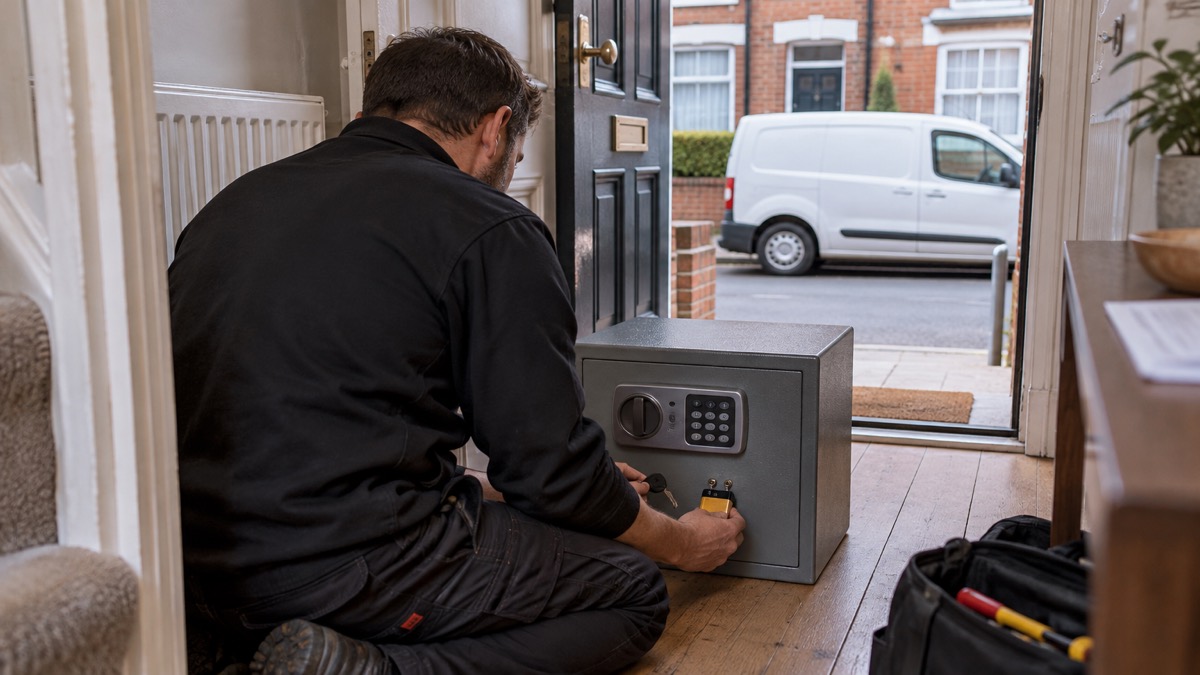
If your electronic safe will not open because the batteries are flat, you almost certainly have a way in that does not involve force. Most electronic safes are built with one of two fallbacks: a set of external battery terminals on the front of the door, which let you hold a fresh battery against the keypad to give it enough power to accept your code, or an emergency override key that turns a mechanical lock and opens the door regardless of the electronics1.
Try the external terminals first if your safe has them. They are the least disruptive route and leave the safe's settings untouched. If there are no terminals, or they do not wake the keypad, use the override key. Phoenix, for example, supplies two emergency keys with its KS0030 series and instructs you to insert one into the emergency lock and turn it anticlockwise2. Sentry Safe's X041E, X055 and X075 models likewise come with an electronic code lock and an emergency override key, with two keys provided3.
Once the door is open, replace the batteries with the type the manual specifies. Do that while the door is still open, so you are not shut out again.
Use the external battery terminals to power the keypad
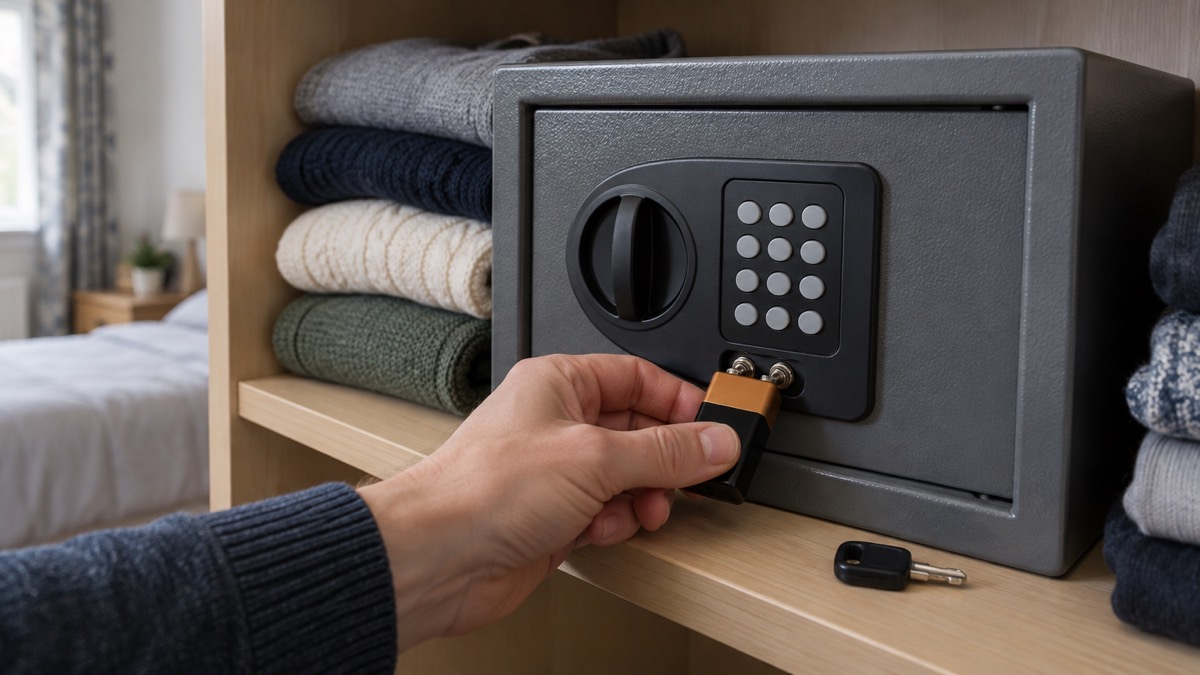
External battery terminals are two small contacts, usually on the front of the door below the keypad. You hold a fresh battery of the right voltage against them, and the keypad draws enough power to accept your code and release the lock. It is a jump start, not a repair: the safe's own batteries are still flat, and you still need to replace them once the door is open.
The method is well established across makers. Codelocks fits its CL2000 surface latch with a battery override that works via a PP3 battery placed against external contacts1. igloohome tells owners of its rim lock for wooden doors that they can jumpstart the lock with a 9V battery as an emergency measure if the batteries are drained5. BURG-WÄCHTER's secuENTRY easy smart lock can be opened from outside with the special key supplied in the unlikely event of an empty battery, and from inside the door can always be opened6.
Before you try it, check three things:
- The right battery. The manual will name the type and voltage. Check it for your model rather than assuming.
- Clean contacts. Dirt or corrosion on the terminals stops the current getting through. Wipe them and try again.
- A steady hand. Hold the battery firmly against both contacts while you enter the code. It is easier with two people, one holding and one typing.
If the keypad lights up and accepts your code, open the door and go straight to replacing the batteries. If nothing happens, the terminals may be dirty, the battery may be flat, or your model may not have this feature. Move on to the override key.
Open it with the emergency override key
The override key is a mechanical lock, independent of the electronics. It is the fallback that works when there is no power at all, and it is why the key matters so much. Phoenix supplies two emergency keys with the KS0030 series and instructs you to insert one into the emergency lock and turn it anticlockwise2. Sentry Safe's X041E, X055 and X075 models have an electronic code lock with an emergency override key, two keys provided3.
To use it:
- Find the override lock. It is often hidden behind a small cap or plug on the front of the door, sometimes below or beside the keypad.
- Insert the key fully and turn it as the manual directs. On the Phoenix KS0030 series, insert one of the two emergency keys supplied into the emergency lock and turn it anticlockwise2.
- Pull or turn the handle to open the door.
If the key turns but the door will not budge, do not force it. Check the manual for the correct sequence, because some safes need the handle held in a particular position. If the key will not turn at all, the lock may be seized or the wrong key may be in use. Stop and seek help rather than forcing it, since a broken override lock removes your last non-destructive route in.
Replacing the batteries once the door is open
With the door open, replace the batteries before you close it again. Use the type and size the manual specifies, and fit good-quality cells from a reputable seller. BURG-WÄCHTER advises high-quality brand batteries of type LR6 and no rechargeable batteries4. Fire and rescue services advise buying batteries and chargers from reputable sellers and checking for a UKCA or CE safety mark7, and Essex Fire and Rescue Service gives the same advice for electrical and battery items generally9.
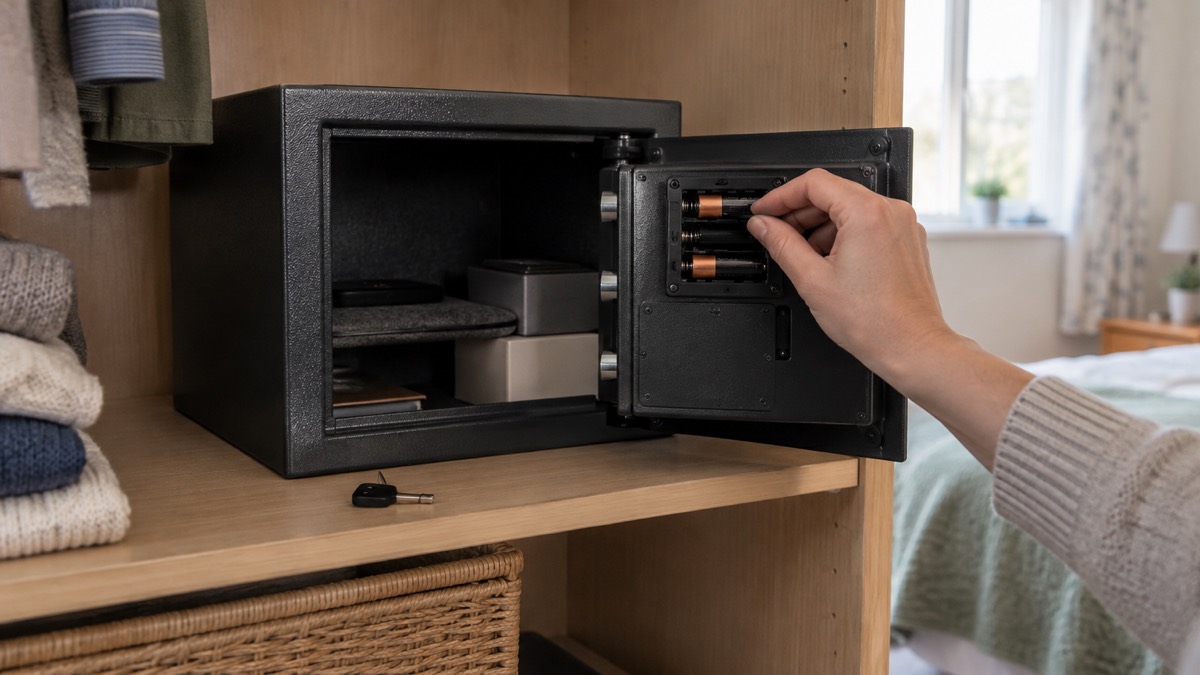
Take the old batteries out carefully. Even a battery too flat to power the device can still hold a charge powerful enough to cause harm, particularly the small button cells used in some fobs and keypads10. The Child Accident Prevention Trust warns that even used flat batteries still hold enough charge to be dangerous11, and that small children typically find batteries that have dropped out of products with loose backs, or spare batteries in a drawer or on the floor after a packet spills open12. Store spares in a sealed container out of reach, and recycle used cells safely so they are out of reach of children13.
Once the new batteries are in, follow the sequence in your manual. Then test the lock with the door still open before you close it.
When the safe still will not open
If neither the external terminals nor the override key works, work through the possibilities in order before calling anyone.
The keypad gives no signal at all. BURG-WÄCHTER's advice for an unresponsive electronic lock is to change the batteries, clean the contacts with pole grease or contact spray, then remove the batteries, press the ON/Enter key at least three times, insert new batteries and try the known code4. That sequence discharges any residual power and resets the electronics. It is worth trying before you conclude the lock has failed.
The keypad lights but rejects the code. Check you are entering the right code, and that the safe is not in a lockout period after repeated wrong entries. Some safes pause for a set time after several failed attempts. Wait, then try again carefully.
The safe responds but the door will not open. The boltwork may be stiff or the door may be under pressure. Check the manual for the correct handle position. Do not lever the door.
The batteries are new but the safe is still dead. The battery contacts may be corroded, or the wrong battery type may be fitted. BURG-WÄCHTER specifies LR6 and no rechargeable batteries for its models4. Rechargeable cells often run at a lower voltage than alkaline ones and may not suit the electronics.
If you have tried all of this and the safe still will not open, stop. Further attempts risk damaging the lock and making a professional opening harder. The same principle applies to any battery-powered device showing warning signs: fire services advise contacting the manufacturer for advice if a battery shows warning signs17, and never trying to open or fix a failing battery yourself15.
Getting help from the manufacturer or a locksmith
The manufacturer is the first call. They know the model, the override sequence and the common faults, and they can tell you whether a replacement key can be cut or sent. Have the model and serial number ready, and the receipt or order confirmation if you have it.
A locksmith is the next step if the manufacturer cannot help or the safe needs opening on site. Before you book, gather what you will need to prove the safe is yours:
- The receipt or order confirmation, showing the date and place of purchase.
- The model and serial number, usually on a plate or sticker on the safe.
- Photographs of the safe in place in your home.
- Identification matching the name on the paperwork.
If the safe came with the property, say so and show whatever paperwork you have. A locksmith will want to be satisfied that you have the right to open it, and a clear explanation plus any documents you hold will speed things up. Ask before booking whether they charge for a callout and what happens if the safe cannot be opened on the first visit.
For a safe that is part of a wider security setup, it is worth reviewing how it fits with the rest of your home security. Our guide to home safes explains fire, burglary and cash ratings, and keys: spares, hiding places and lost sets covers what to do when a key goes missing.
Where to keep the override key, and other questions
Where should the override key live? Somewhere secure, memorable and away from the safe. A key safe by the door, a locked drawer, or a trusted neighbour all work, provided you can reach it in an emergency. Record where it is and tell one other person in the household. Do not leave it on top of the safe or in the same room, because a burglar who finds it has the contents.
What are the low battery warning signs? The safe usually tells you before it fails. On the Codelocks CL2000 a red LED flashes on opening to indicate low battery1. On the Phoenix KS0030 series, if the red and green LEDs light up simultaneously after code entry or when opening the door, the battery status is too low and the batteries should be replaced as soon as possible2. Act on the warning rather than waiting for the safe to stop responding.
Which batteries should I use? The type the manual specifies, from a reputable seller, with a CE or UKCA mark7. BURG-WÄCHTER advises high-quality brand batteries of type LR6 and no rechargeable batteries4. GP rates its alkaline N battery for everyday appliances such as clocks, key fobs, garage door openers and medical devices18, which gives a sense of the kind of small cell these devices use, but always match the manual.
Why is my fingerprint not recognised after a battery change? Check the manual for the order of steps before you start, so you are not locked out mid-way.
Will my code survive a power loss? Not always. Check the manual for what your model does, and test the lock with the door still open before you close it.
What if the safe is a smart lock rather than a safe? The same principles apply. Smart locks such as the Aqara U200 run on AAA batteries or can be hard-wired to the front door19, and many have a key override or external power option. Our guide to smart locks explains how they work and what to check, and do smart locks work in a power cut? covers the backup arrangements in more detail.
What about other battery-powered safety equipment at home? The same discipline helps. Battery-operated smoke alarms need the batteries replacing every year, so set yourself reminders20, and in Scotland sealed, tamper-proof battery units must be used because they are safer than those which allow the user to change the batteries21. Check the battery of any medical or accessibility equipment, such as a stairlift, by reading the instructions or contacting the manufacturer22. A defibrillator can be stopped from working by simple issues like flat batteries or expired pads23, so check yours.
Sources (23)
- CL2000 Surface Latch with Key Override, Codelocks, 2026-11-02
- KS0030 Series Instructions, Phoenix Safe, 2026-09
- Sentry Safe Home and Office Safes, Deraat, 2026-11-03
- Safes FAQs, BURG-WÄCHTER, 2026-11-02
- Rim Lock for Wooden Doors, igloohome, 2026-11-02
- Smartlock für Privat, BURG-WÄCHTER, 2026-11-02
- Battery Safety, Greater Manchester Fire and Rescue Service, 2026-10-29
- Batteries and Chargers, London Fire Brigade, 2026-10-25
- Batteries and Charging Safety, Essex County Fire and Rescue Service, 2026-10-29
- Are Your Used Batteries Really Flat?, Child Accident Prevention Trust, 2026-04-15
- Button Battery Factsheet, City of London Corporation, 2024
- Button Batteries: Where Are They?, Child Accident Prevention Trust, 2024-11-11
- Product Safety Campaigns, Peterborough City Council, 2026-10-29
- Check for Loose Button Batteries, Child Accident Prevention Trust, 2024-11-11
- Charging Safety, Oxfordshire County Council, 2026
- Battery Safety for E-Cycle Users, GOV.UK, 2024-02-01
- Rechargeable Lithium-Ion Battery Safety Advice, Cheshire Fire and Rescue Service, 2026-09-30
- GP Alkaline Battery N, GP Batteries, 2026-10-25
- Do I Need a Smart Door Lock?, Which?, 2026-04-15
- Smoke Alarms, Cheshire Fire and Rescue Service, 2026-07-27
- Fire and Smoke Alarms in Scottish Homes: Where and What to Buy, Scottish Government, 2024-08-14
- Prepare for a Power Cut, Citizens Advice, 2023-11-14
- Check Your Defib Week, Resuscitation Council UK, 2026
 After a Break-In Checklist
 Holiday Security Checklist
 Moving Home Locks Checklist
 When to Call 999 or 101
 Reporting a Burglary Anonymously
 Doorstep Caller Will Not Leave
 Car Running While De-Icing
 Checking a Doorstep Caller
 Burglary at Christmas
 Cash in a Fire Safe
 Heating Oil Tank Theft
 Making a House Look Occupied
 Police Approved Products