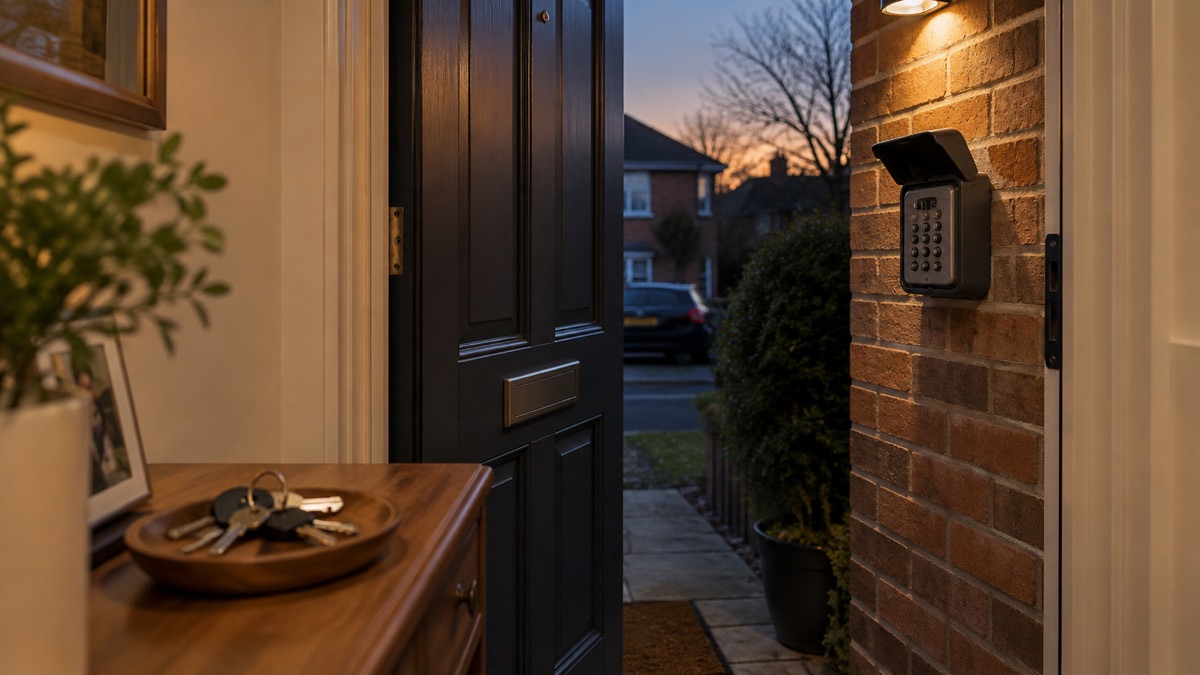
A key safe is a lockable box that holds a key, fixed to an outside wall with a code set to it, so that a carer, a family member or the emergency services can get in when you cannot reach the door1. Some key safes are police approved, and that phrase is the one to look for, but it is not a single badge. It means the box has been tested to a security standard and listed under the Police Preferred specification of Secured by Design, the police crime prevention initiative2.
For an ordinary household the practical answer is this. Choose a key safe that is police approved and meets the British Loss Prevention Standard LPS 1175, such as the C500, P500 or Keyguard Digital XL3. Fit it to brick, concrete or flat stone, not render, because installing a C500 or P500 into another surface voids its certification and police accreditation4. Set a code you can change, share it only with people who need it, and tell your insurer what you have had fitted.
The rest of this page explains what the standards mean, how to fix the box so it stays secure, how to manage the code, and what to do when something goes wrong.
Police preferred means tested to a security standard
"Police preferred" is not a legal category and no law controls who may print it. It is a specification run by Secured by Design, the police crime prevention initiative, and the products recommended in its guides meet that specification2. In practice a box carrying it has been assessed against a security standard rather than simply described as strong on the packaging.
The standard most often named for key safes is LPS 1175, the British Loss Prevention Standard for security products. Official health guidance for people at risk of falls is explicit: leave a spare key in a police-approved key safe, and if you are buying one, purchase a key safe that is police approved and meets LPS 1175, tested to the same standard as the C500, P500 or Keyguard Digital XL3. Police Scotland's break-in advice puts it slightly differently, suggesting a key safe that meets the Sold Secure gold standard and keeping it out of sight6. The two are different testing regimes, so if a box claims one, check which, and prefer a box that names the standard it has passed rather than a general claim of approval.
It helps to know what the box is for. A key safe exists so that someone can reach you. The NHS in Wales advises that you make sure someone trusted has a key, or that you have a key safe outside, and that emergency services are aware of the code5. That last point matters: a police-approved box with a code nobody official holds is no better than a locked door in an emergency.
"A key safe is a lockable box that holds a key. This means carers, family or emergency services can get into the home if [you need help]."
Standards to look for on the box and the safe
When you are standing in a shop or reading a listing, the useful move is to look for named certification rather than adjectives. The pattern is familiar from other safety products: for smoke alarms, official fire safety guidance says to look out for the British Standard Kitemark and Loss Prevention Certification Board (LPCB) symbols, which show the alarm is approved and safe7. For carbon monoxide alarms, the advice is to make sure the alarm meets British Standard EN50291 and ideally the British Standard Kitemark8. A key safe should be held to the same discipline.
| What to look for | What it tells you | Where it comes from |
|---|---|---|
| Police Preferred specification (Secured by Design) | The product has been assessed under the police crime prevention scheme | Secured by Design2 |
| LPS 1175 | Tested to the British Loss Prevention Standard for security products | NHS Scotland falls guidance3 |
| Sold Secure gold | An alternative independent security standard named by police | Police Scotland6 |
| Named model in official guidance | C500, P500 and Keyguard Digital XL are given as examples | NHS Scotland3 |
Two cautions. First, a logo on a box is only as good as the box: counterfeit goods bought from online auction sites or social media marketplaces can fail UK safety laws, have not been properly tested, and could pose a serious risk of fire, serious injury or even death9. Buy from a reputable seller and keep the receipt. Second, certification is not a guarantee. The Metropolitan Police make the point about bike locks that security measures cannot guarantee your property will not be stolen, but using several measures makes it harder and less attractive for thieves10. The same reasoning applies to a key safe: it is one layer, alongside good door locks and lighting.
If you want to check a specific product's claim, our guide to how to tell if a security product is police approved walks through the listings.
Where to fit a key safe and how to fix it to the wall
Position and fixing decide whether a police-approved box keeps its approval. The maker's own installation guidance is the place to start: all police preferred key safes are suitable for installation onto brick, concrete and flat stone4. The C500 Pro and P500 Pro must be installed directly onto suitable flat brick, blockwork or good-quality concrete to maintain the security accreditation, and installing them into render voids their LPS certification and police accreditation4.
That rules out the most common mistake, which is screwing the box to a rendered or pebbledashed wall because it is the easiest surface at hand. The supplied standard security screws are not suitable for rendered walls either4. If you are unsure whether your wall is suitable, contact the maker before installing4.
The sequence for a typical box is straightforward. The Phoenix KS0030 manual describes it: secure the safe in a location that provides a solid surface, mark the drill holes with the door open, remove the safe, drill, insert the dowels, reposition the safe and tighten the screws from the inside, using two 6 mm screws or bolts to attach it to a suitable wall11. If you move a key safe, use new fixings to ensure maximum adherence to the wall12.
- Choose the spot: out of sight from the street where you can, as Police Scotland advises6, and within reach of the door it serves.
- Check the surface: brick, concrete or flat stone only for an accredited box4.
- Fix properly: follow the maker's sequence and use the fixings supplied11.
- Do not reuse fixings: the screws in fitting kits cannot be reused, because the thread weakens on every install and makes the key safe less secure; if you move the box, use new fixings4.
- Keep the paperwork: police advice is to have a safe installed by a vetted professional and get an installation certificate, which your insurer might need if you make a claim6.
Setting and sharing the code safely
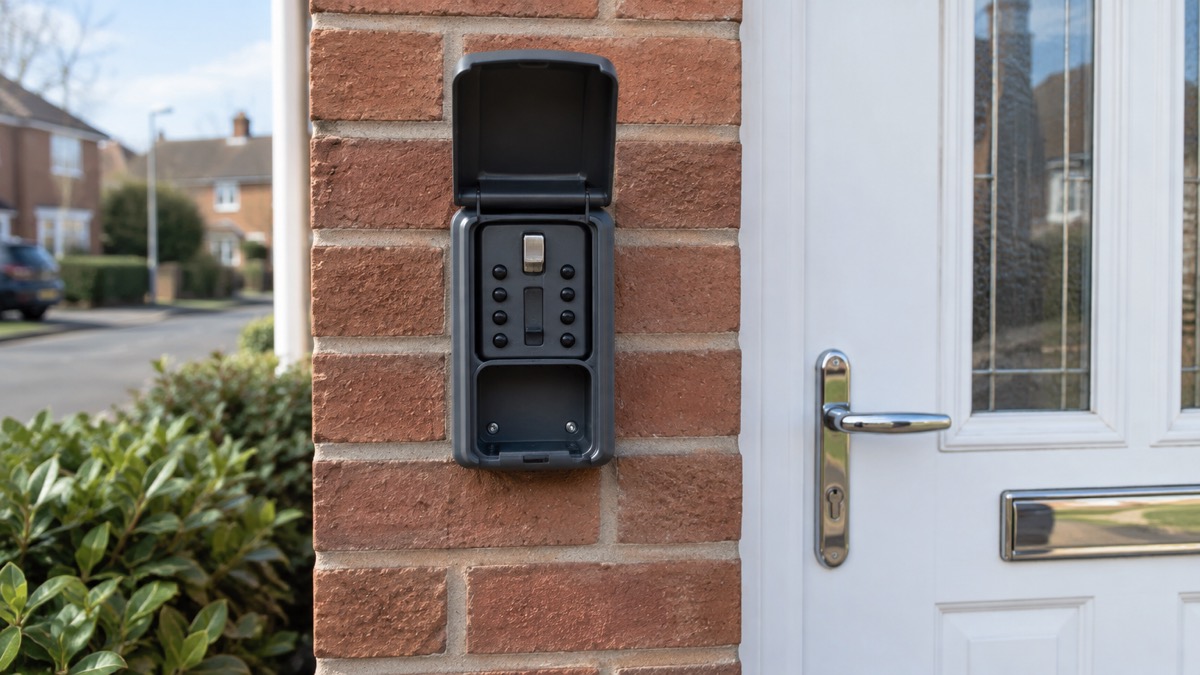
The code is the weakest part of any key safe, because a box is only as private as the list of people who know the number. Set it deliberately and change it when circumstances change.
Some models make this easy. The Supra C500 Pro allows unlimited code changes for extra security13. Others are built to resist tampering: the Supra P500 Pro has an anti-tamper plate preventing unexpected code changes13, which is good against interference but means a forgotten code is a job for the maker or a locksmith rather than a quick reset. Before you buy, decide which behaviour you want.
Sharing the code is where official advice converges. If you use a personal alarm or falls detector service, the provider will usually ask for the key safe location and code and share it only with the emergency services so they can reach you quickly14. Warwickshire County Council's assistive technology guidance makes the same offer: the control centre can store the key safe PIN and pass it to friends, family or the rapid response service in an emergency16. Do give the code to the people who might need it, and do not give it to anyone else.
- Tell the emergency services, or the monitoring centre that will call them, so the code is available when it is needed5.
- Tell one trusted neighbour or family member, in case the carer cannot come3.
- Tell guests and visitors where keys are kept, as fire safety advice for celebrations and for anyone staying over recommends17.
- Change the code when a carer, cleaner or contractor leaves, if your model allows it13.
What can go wrong with a key safe
Most key safe failures are not break-ins. They are the box that will not open when a carer is standing in the rain, the code that nobody wrote down, and the fitting that pulled out of a wall.
The box will not open. Flat batteries affect electronic models; the KG Keyguard range uses an electronic lock19, so keep a note of when it was fitted and test it regularly. Push-button boxes can stiffen with grit or cold. Test the box yourself before you rely on it, ideally on a wet evening rather than a sunny afternoon.
The code is lost. On a model with an anti-tamper plate, a forgotten code cannot simply be reset13. Keep the code written somewhere secure inside the house, not on a note taped beside the box.
The fitting fails. Reused screws weaken, and render crumbles4. Use the supplied fixings once, on a solid surface, and if you move the box start again with new ones.
The box is not what it claims. Counterfeit or untested goods from online marketplaces can fail safety laws and pose a serious risk9. A cheap box that has never been tested is not a bargain if it is the only way into your home.
It is the only plan. A key safe is one part of access planning. The Alzheimer's Society suggests a keysafe as one option for a spare set of keys20, and the NHS in Scotland advises ensuring a family member or neighbour has a spare key, or leaving one in a police-approved key safe3. Have both if you can.
Where to get help choosing and fitting one
You do not have to work this out alone. The first call is usually your local council's adult social care or telecare service. Warwickshire's guidance is typical: you may wish to consider purchasing and installing a key safe to enable fast and easy access to your home in an emergency, and the control centre can store the PIN16. Ask what your area offers before you buy.
For fitting, police advice is to use a vetted professional and obtain an installation certificate6. Safe manufacturers say the same: talk to a professional when choosing a safe22, and install home safes in a discreet, secure location, anchored to the floor or wall to prevent removal23. A key safe is a smaller job, but the principle holds: a proper fixing on the right surface is what keeps the accreditation valid4.
If you rent, ask the landlord first. Private landlords must follow fire safety regulations24, and drilling the wall is a change to the property. In a flat, remember that each flat has its own keys plus one or two security fobs for common entrances, depending on the number of occupants25, so a key safe by the front door does not solve access through a communal entrance. Our guide to flats and shared entrances covers that.
For the wider picture, see Key Safes: Letting Carers and Responders In and Where to Fit a Key Safe for Emergency Access. If you are choosing door hardware at the same time, Doors and Locks and Keys: Spares, Hiding Places and Lost Sets set the key safe in context, and Home Insurance Conditions explains what insurers tend to ask about locks and access.
Sources (25)
- Equipment for carers, Derbyshire Fire and Rescue Service, 2026
- Cyber security advice, Secured by Design, 2026
- Creating a falls plan, NHS Inform Scotland, 2026
- DIY installation, The Key Safe Company, 2026
- Some of the reasons people call 999, NHS Wales Ambulance Service, 2026
- Break-in and housebreaking, Police Scotland, 2026
- Fire alarms and carbon monoxide detectors, Lincolnshire County Council, 2026
- Carbon monoxide, Derbyshire Fire and Rescue Service, 2026
- Laser Party Light product recall, Electrical Safety First, 2026
- Scooter security, Metropolitan Police, 2026
- KS0030 Series Cygnus instructions, Phoenix Safe, 2026
- Falls Detector Package v2 FAQs, Taking Care, 2026
- Key safes for commercial access control, The Key Safe Company, 2026
- MindMe GPS Alarm FAQs, Taking Care, 2026
- Winter matters, Suffolk County Council, 2026
- Assistive technology, Warwickshire County Council, 2026
- Celebrating safely, Greater Manchester Fire and Rescue Service, 2026
- Celebrate safely, Humberside Fire and Rescue Service, 2026
- Key safes, Burton Safes, 2026
- Keeping secure at home, Alzheimer's Society, 2026
- What to do if you fall, NHS Inform Scotland, 2026
- Derbyshire Safe Place scheme, Derbyshire County Council, 2026
- Home safes, Chubb Safes, 2026
- Winter water safety, Met Office, 2026
- Your landlord's safety responsibilities, GOV.UK, 2026
 Moving Home Locks Checklist
 After a Break-In Checklist
 Holiday Security Checklist
 Fitting an Anti-Snap Cylinder
 British Standard Door Locks
 Double Locking a uPVC Door
 Garage to House Door Safety
 Where to Fit a Key Safe
 Letterbox Guards
 Measuring a Euro Cylinder
 PAS 24 Doors and Windows
 Securing Patio Doors
 Smart Lock Battery Life
 Smart Locks in a Power Cut
 Smart Locks in Rented Homes