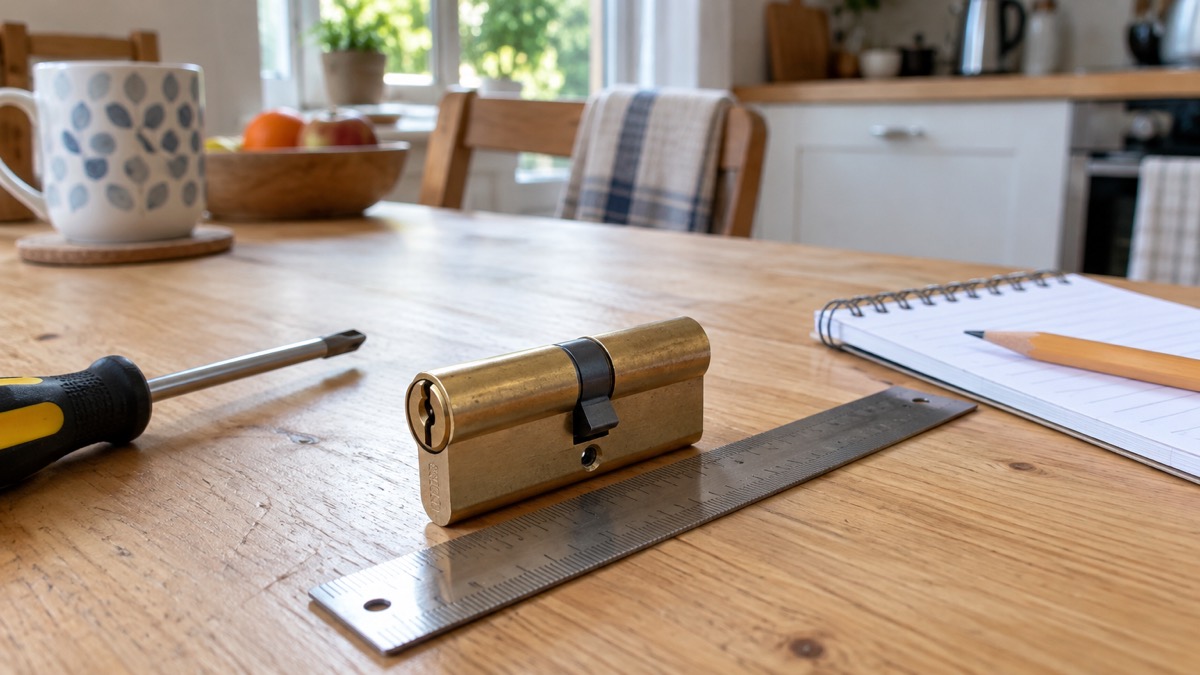
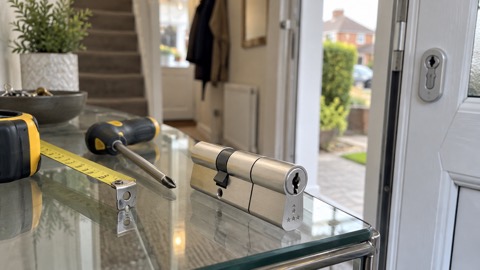
A euro cylinder is the barrel that sits inside most uPVC and composite front doors, and it is measured in two parts: the distance from the centre of the cam to the outside face, then the distance from the centre of the cam to the inside face. UK suppliers write this as external/internal, so a 35/35 is equal on both sides and a 40/50 is 40mm outside and 50mm inside1. Get those two numbers right and the replacement drops straight in.
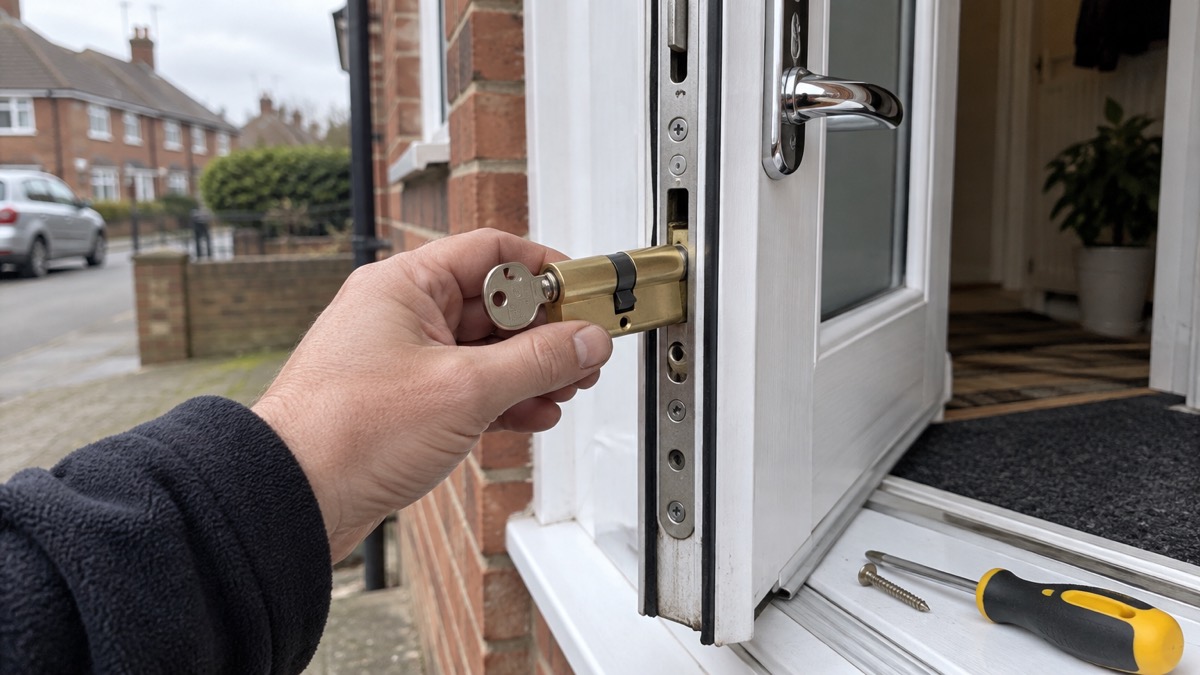
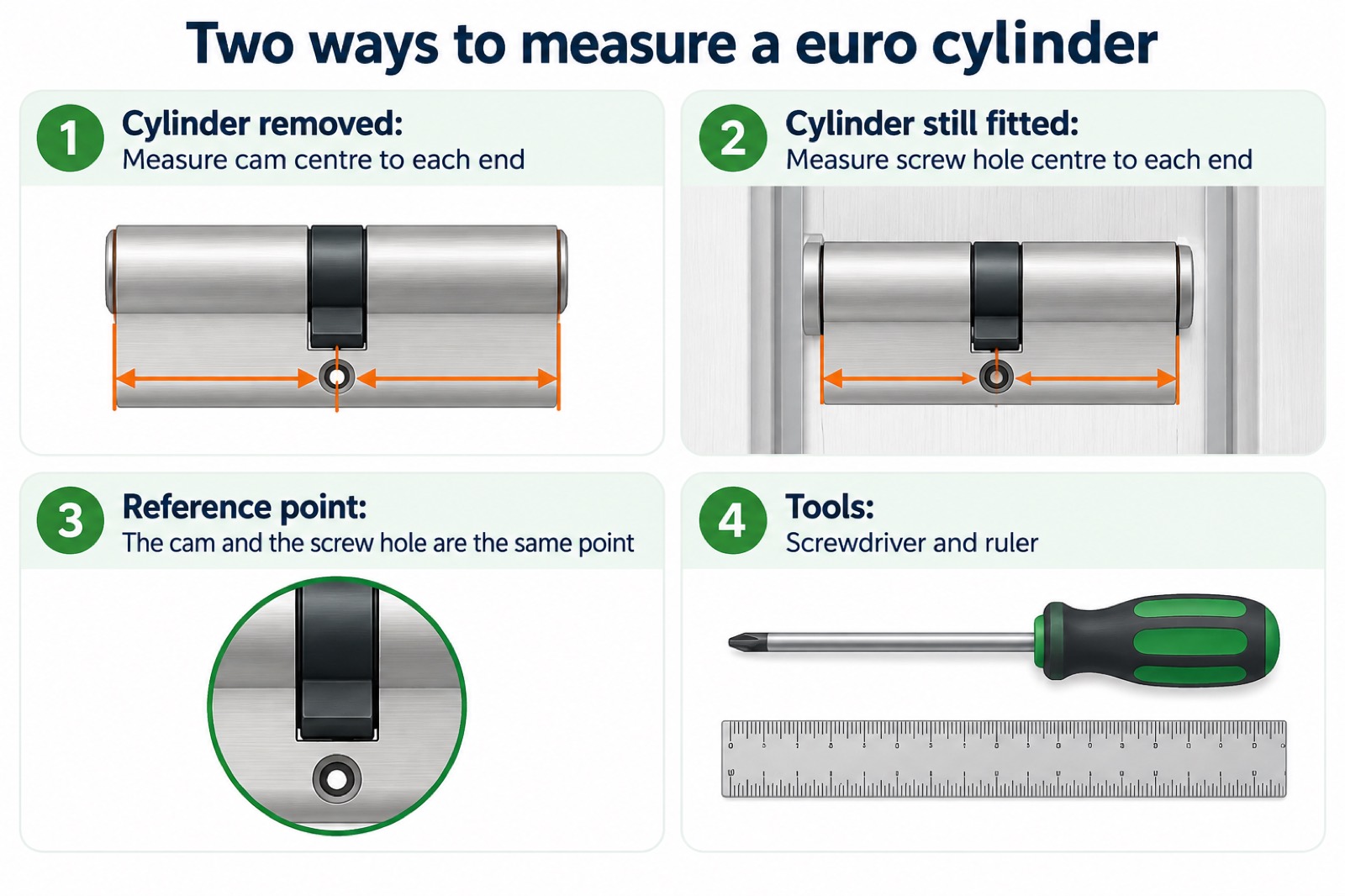
The simplest way to measure is to take the cylinder out. Undo the retaining screw in the door edge, slide the cylinder free, then measure from the centre of the cam to each end2. If you would rather not remove it, measure from the centre of the screw hole to each end of the cylinder instead, taking the inside-facing edge as internal and the outside-facing edge as external3.
Order the same two figures, in the same order, and fit the new cylinder with the external side facing the street. On equal-sized cylinders the security protection is only on the external side, so the maker requires the cylinder to go in the correct orientation, marked O or EXT on the body4.
What external and internal mean, and why the order matters
External is the side of the door that faces the street. Internal is the side inside your home. Every UK cylinder size is quoted external first, internal second, so the order is not a formality: a 40/50 and a 50/40 are different cylinders, and fitting the wrong way round puts the shorter end where the longer one should be1.
Makers reinforce this on the product itself. ERA marks the outside face with EXT and states that the security protection sits on the external side5. Fortress uses an O marked on the cylinder body and instructs that the cylinder must be installed so the external side is visible from outside the door4. If you are fitting a cylinder with equal dimensions on both sides, such as 45/45 or 50/50, this is the only thing that tells you which way round it goes, and getting it wrong puts the anti-snap protection on the inside where it does nothing.
A quick way to remember: stand in the street looking at your front door. The half of the cylinder nearest you is external. Stand in the hall with the door shut. The half nearest you is internal.
Measuring a cylinder you have taken out
Removing the cylinder first gives the cleanest measurement, and it is the method Ultion recommends: measure from the centre of the screw hole to each end of your existing cylinder, which gives you two figures such as 35mm/35mm or 40mm/35mm2. ERA's instruction is the same idea expressed from the cam: measure from the centre of the cam to the edge of the cylinder on the internal side, then from the centre of the cam to the edge on the external side, both in millimetres3.
To get the cylinder out:
- Open the door and find the retaining screw in the door edge, level with the cylinder.
- Undo it with a screwdriver. The makers list a screwdriver and a ruler as the tools required3.
- Slide the cylinder out towards you.
- Measure from the centre of the cam to each end, and write both figures down, external first.
The retaining screw that comes with a new cylinder may be too long for your door and can need cutting down to size before it will hold the cylinder securely3. Keep the old screw as a spare.
Measuring with the cylinder still in the door
If the cylinder is stiff, painted in, or you simply do not want to remove it yet, you can measure in place. ERA's instruction for a cylinder still fitted is to measure from the centre of the screw hole to the end of the cylinder, taking the internal measurement as the centre to the inside-facing edge and the external measurement as the centre to the outside-facing edge3. The earlier ERA manual gives the same method5.
The screw hole is the reference point because it sits directly over the cam. That is why the two methods agree: the centre of the screw hole and the centre of the cam are the same place on the cylinder.
Two practical points. First, measure with the door open so you can get the ruler flat against the cylinder face. Second, measure each side separately rather than measuring the whole cylinder and halving it, because many doors are not symmetrical and halving will give you the wrong pair.
Uneven sizes such as 40/50 are normal
A cylinder that is longer on one side than the other is not a fault. ERA notes that your cylinder may be longer on one side than the other, giving the example of 37mm internal and 40mm external3. Door furniture, thresholds and the thickness of the door leaf all vary, and the cylinder has to reach through to the handle on both faces.
Suppliers stock a wide spread of uneven combinations. One distributor lists 40/50 as a 90mm cylinder, alongside 40/40 at 80mm, 40/55 at 95mm and 40/60 at 100mm, among many others7. The total length is simply the two figures added together, so 40/50 gives 90mm. That total is useful for checking you have been sent the right part, but it is not what you order by: order by the two separate figures.
Sizes are usually sold in 5mm steps. Avocet lists its cylinders from 30mm to 60mm in 5mm increments for both the internal and external parts8. If your measurement lands between two steps, do not round to the nearest and hope: ask the supplier, because a cylinder that is too long will not sit flush with the handle and one that is too short leaves the cylinder recessed, which is exactly the gap an intruder wants.
Tools to have ready before you start
The list is short. ERA specifies a screwdriver and a ruler to fit a high security cylinder3. A tape measure is easier than a ruler for the initial measurement, and a pencil and paper to write the two figures down before you order are worth having, because it is easy to forget which way round you measured them.
You will also need:
- The retaining screw supplied with the new cylinder, which may need cutting down to size3
- A cloth to wipe the old cylinder so you can read any markings on it
- The old cylinder itself, kept until the new one is fitted and working
If the door has a multi-point lock, the cylinder is only one part of the locking system, and the handle and gearbox have to line up with it. Our guide to doors and locks sets out how the parts work together.
Finding the fixing screw hole
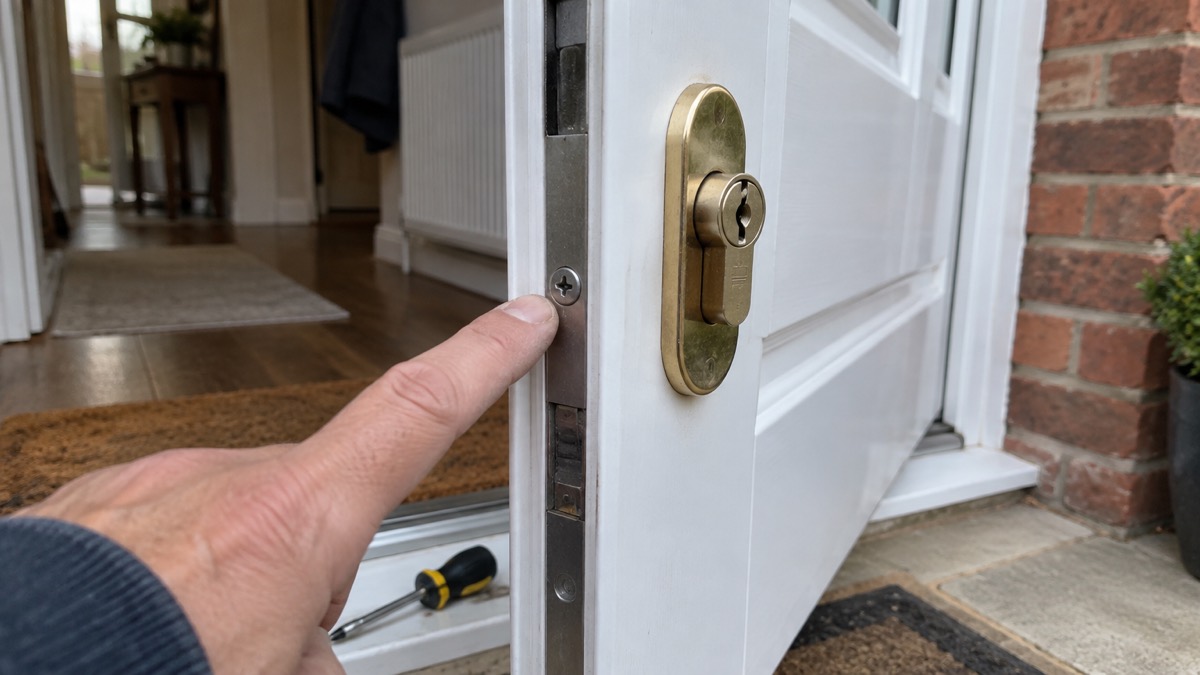
The fixing screw hole is in the edge face of the door, level with the cylinder, usually a short distance in from the face. It holds a single screw that passes through the door and into a groove in the cylinder body, stopping it from turning or sliding out.
If you cannot see it, close the door and look at the edge from the hinge side, running your eye along the line of the lock case. On most doors it is a small countersunk hole, sometimes covered by a plastic plug or filled with paint. A torch helps. Once the screw is out, the cylinder will slide out towards you; if it will not move, do not force it, because the screw may not be fully withdrawn.
The screw itself is a standard size on many cylinders: Fortress supplies M5 x 45mm and M5 x 70mm nickel plated screws with its cylinders9. If yours is missing or chewed, a replacement of the same thread will do, cut to length if needed.
Thumbturn cylinders and the emergency function
A thumbturn cylinder replaces the inside key with a knob, so you can lock and unlock from inside without hunting for a key. Avocet describes its thumbturn version as having an easy internal locking and unlocking function, so you only need to use the key when leaving and entering the house11. That is a real benefit for anyone who wants a fast exit in the dark, and for households where a key left in the lock is a habit.
Thumbturns come in the same size range as key cylinders, measured the same way. Avocet lists its thumbturn cylinder from 30mm to 60mm in 5mm increments for both the internal and external parts11. ERA's part numbering makes the same point from the other direction: on its thumbturn cylinders the first size in the part number is the internal turn side measurement3.
There is a trade-off to weigh. A thumbturn can be operated from inside by anyone who can reach it, so if it sits close to a letterbox or a glass panel, think about what is within arm's reach. Our page on doors and locks covers the wider question of what makes entry harder.
Replacing a cylinder to current security standards
A new cylinder is a chance to bring the door up to date. West Yorkshire Police advise checking whether your doors have euro-cylinder locks and, if so, whether they meet the very latest standards: TS007, the 3 star rating, or SS312, the Sold Secure Diamond Standard6. A standard cylinder is vulnerable to lock bumping, a technique where pressure is applied to the cylinder using a bump key, causing it to unlock the door14. A rated cylinder is built to resist that.
Ratings appear on the cylinder and in the paperwork. ERA's 3 star cylinder carries the British Standard 3 star Kitemark to TS007:2014+A2:2018 and BS EN 1303:20153. Avocet stamps the 3 star kitemark on the front of all its key/key and thumbturn cylinders from 35mm to 60mm internal and external8. If you cannot find a marking, treat the cylinder as unrated.
Fitting is straightforward once the size is right:
- Check the new cylinder matches your two measurements.
- Identify the external side, marked O or EXT4.
- Slide it in with the external side facing the street.
- Fit the retaining screw, cutting it down if it is too long3.
- Test the key from outside and the thumbturn or key from inside before closing the door on it.
Our page on which way round to fit a 3 star anti-snap cylinder goes further into orientation, and what British Standard your door lock should meet explains the ratings in more detail.
Where to get help and what to check before you buy
If you are not confident removing the cylinder, or the door has a multi-point lock that feels stiff or misaligned, a qualified locksmith can measure and fit it. Ask what standard the replacement will meet before work starts, and check the old cylinder's markings so you know what you are replacing.
Before ordering, run through this list:
- Both measurements written down, external first1
- The total length checked against the old cylinder
- The standard confirmed as TS007 3 star or SS312 Sold Secure Diamond6
- The external side identified on the new cylinder4
- The retaining screw checked for length3
- The emergency function confirmed if a smart lock is going on12
For the wider picture, our guide to home security covers doors, windows, alarms and lighting, and keys: spares, hiding places and lost sets deals with what to do with the keys once the new cylinder is in.
Sources (14)
- Best smart door lock UK, The Smart Home Guide, 2026-09-09
- Ultion locks, Ultion, 2026-11-03
- Fitting instructions, ERA 3 Star cylinder Sold Secure, ERA, 2023
- ERA Fortress 3 Star Double Cylinder fitting instructions, ERA, 2023
- ERA 3 Star High Security Euro Cylinder fitting instructions, ERA, 2021
- Home security, West Yorkshire Police, 2026-11-02
- Asec 5 Pin Euro Double Cylinder range, Safe.co.uk, 2026-11-02
- ABS Ultimate Series Euro Cylinder Lock, keyed alike pair, Avocet Hardware, 2026
- Fortress 3 Star Euro Profile Cylinder data sheet, ERA, 2025
- Fortress 3 Star BS Euro Profile Cylinder data sheet, ERA, 2025
- ABS Ultimate Series Euro Cylinder Lock, thumbturn, Avocet Hardware, 2026
- Aqara Smart Lock U200, Aqara, 2026-11-03
- Nuki Smart Lock Pro compatibility guide, Nuki, 2026-11-02
- Ultion vs standard euro cylinder locks, Ultion, 2024-02-06
 Moving Home Locks Checklist
 After a Break-In Checklist
 Holiday Security Checklist
 Fitting an Anti-Snap Cylinder
 British Standard Door Locks
 Double Locking a uPVC Door
 Garage to House Door Safety
 Police Preferred Key Safes
 Where to Fit a Key Safe
 Letterbox Guards
 PAS 24 Doors and Windows
 Securing Patio Doors
 Smart Lock Battery Life
 Smart Locks in a Power Cut
 Smart Locks in Rented Homes