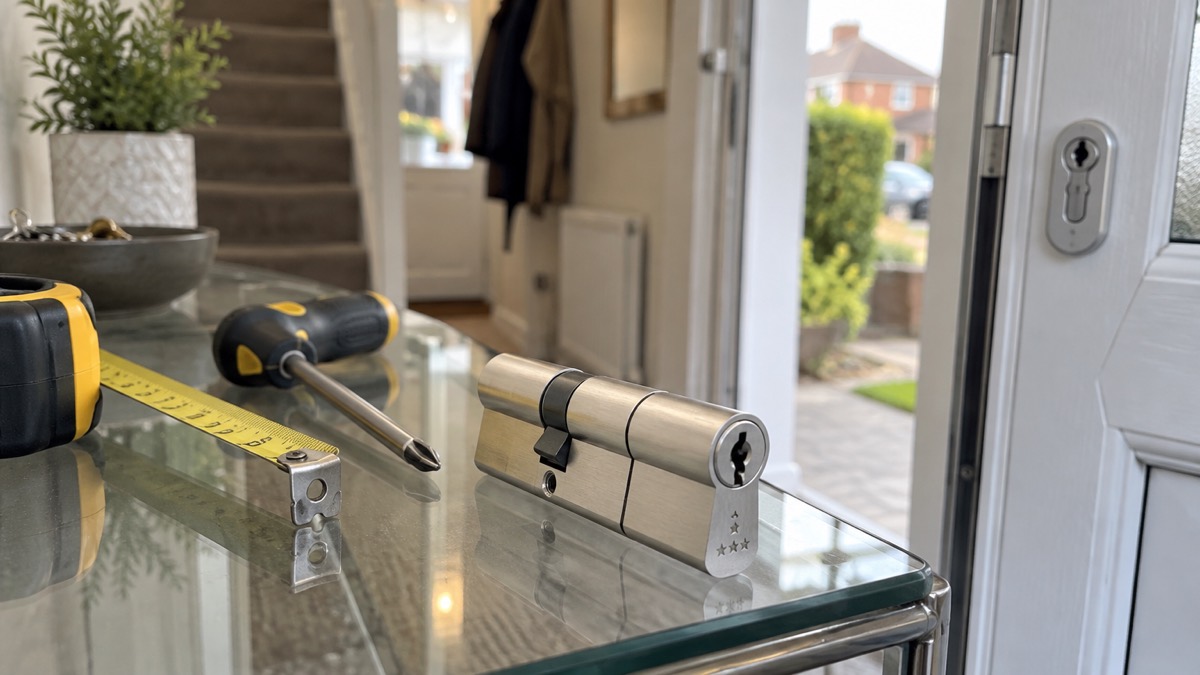
A 3 star anti-snap cylinder goes in with its sacrificial snap line facing the outside of the door. That is the whole point of the design: the outer section is built to break away under attack, and the break triggers a mechanism that keeps the door locked. Fit it the other way round and you have put the weak point on the inside, where an intruder never needs to reach it.
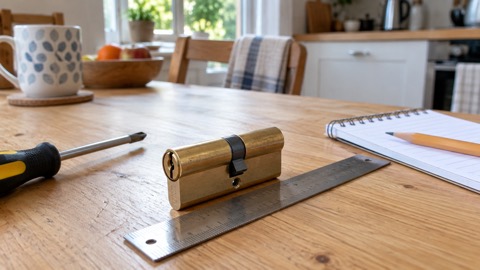
Before you order, measure the old cylinder from the centre of the retaining screw hole to each end, giving two figures such as 35mm/35mm or 40mm/35mm1. Keep the new cylinder's projection from the handle to a maximum of 3mm, the figure the maker gives in its fitting instructions2. Then fit it with the cam lined up, the retaining screw firm and the door open while you test the key.
The snap line goes on the outside, every time
An anti-snap cylinder is not symmetrical. The maker of the ABS range states that all of the snap technology is focused on the outside part of the lock only, and that the external part has two sections that will break away if an intruder attacks it3. The same principle runs through the ERA 3 Star Dual cylinder, which is fitted with a sacrificial snap line so that the cylinder snaps at a designated point under attack, protecting the central cam6. The snap line is the deliberate weak point, and it belongs where the burglar can reach it.
What happens when it breaks is the reason the orientation matters. The ABS ATK+ is designed to break away at a specific point, which immediately triggers Active Snap Protection, firing an internal locking mechanism that blocks access to the door bolt7. The Fortress 3 Star cylinder works in the same way: if attacked, a security pin automatically triggers and blocks the cylinder cam, preventing unlawful entry, and the cylinder can still be operated from the inside with a key8. That last detail is the safety case for fitting it correctly. The lock fails secure on the outside and stays usable on the inside, so you can still get out.
"All of the snap technology is focused on the outside part of the lock only."
Get the orientation wrong and the consequences are practical, not theoretical. The sacrificial section sits indoors, where no one attacks it, and the solid end faces the street. The cylinder may still lock and unlock, so nothing feels wrong, but the protection you paid for is pointing the wrong way. If you are unsure which end is which, look for the 3 star kitemark: the maker states that all sizes from 35 to 60mm internal and external, key/key and thumbturn, are 3 star kitemark stamped on the front of the cylinder. The stamped face is the face that goes outside.
Measuring the cylinder from the centre of the cam
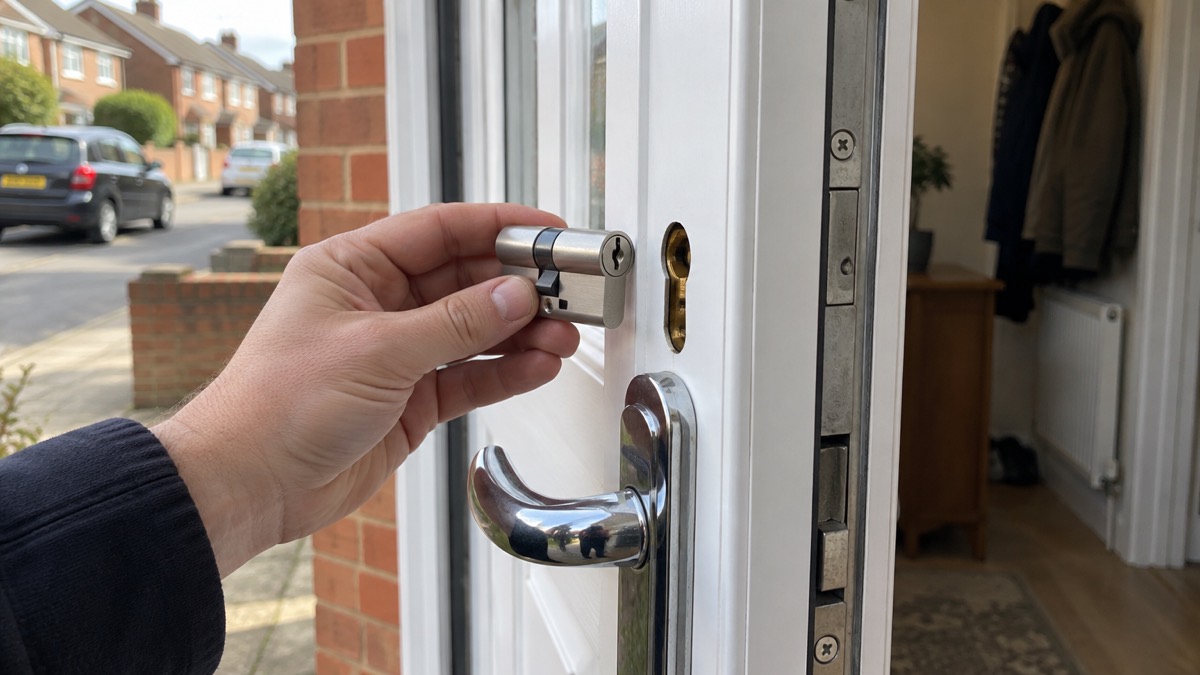
Every euro cylinder is measured from the centre of the retaining screw hole, which sits over the cam, to each end. The maker's instruction is plain: measure from the centre of the screw hole to each end of your existing cylinder, which gives you two measurements, for example 35mm/35mm or 40mm/35mm1. Write both down. The order matters when you order, because the first figure is normally the outside length.
The maker's range runs from 30 to 60mm in 5mm increments for both the internal and external parts of the cylinder5. That covers most domestic doors, and it means you should never need to cut or pack a cylinder to make it fit. If your measurement falls between two steps, take advice rather than guessing, because a cylinder that is too long projects past the handle and one that is too short leaves the cam poorly supported.
| What you are measuring | Where to measure from | What to record |
|---|---|---|
| Outside length | Centre of the screw hole to the outer end | First figure, in mm1 |
| Inside length | Centre of the screw hole to the inner end | Second figure, in mm1 |
| Total | The two figures added together | Check against the old cylinder |
| Projection | Outer face beyond the handle | 3mm maximum2 |
Offset sizes exist for doors where the two sides differ. The maker lists fixed offset options of 10-30, 10-35, 10-40, 10-45, 10-50, 10-55 and 10-60mm for its half cylinder range4. These are for specific door constructions rather than the ordinary domestic door, so if your measurements are unequal but close, an ordinary pair such as 40/35 is the usual answer. For a step-by-step walk through with the door in front of you, see how to measure a euro cylinder.
How far the cylinder should stick out
The cylinder should sit flush or nearly flush with the handle, and the maker's fitting instructions give the limit as a maximum of 3mm protruding2. That figure is not cosmetic. A cylinder that stands proud of the door gives a thief something to grip, and it is exactly the overhang that snap attacks are designed to exploit.
The same logic appears in police guidance. For aluminium doors, the advice is that if the cylinder lock protrudes beyond the frame handle, you should get a member of the Master Locksmiths Association to change it to a shorter, more snap-resistant one9. The principle applies to any door: if the cylinder sticks out, it is the wrong length.
There is a second reason to keep the projection tight. Smart lock retrofits sit over the inside of the cylinder, and some have their own length limits. The Nuki Smart Lock Ultra states that the outer length should not exceed 55mm, measured from the retaining screw to the outer door plate and not including the cylinder overhang10. If you plan to add a smart lock later, measure for that now rather than discovering the problem after the cylinder is in. Our guide to smart locks covers what else to check.
Fitting the cylinder: screw, cam and testing
With the right cylinder in hand, the fitting itself is a short job. Work with the door open throughout, so a mistake cannot lock you out or trap you inside.
- Remove the old cylinder by taking out the retaining screw, usually a single screw in the door edge level with the cylinder, then turning the key or thumbturn slightly to draw the cam clear.
- Check the new cylinder against the old one, end for end, and confirm the stamped face will point outside.
- Slide the cylinder in with the cam in the position that lets it pass through the lock case, then turn it to engage the cam with the mechanism.
- Refit the retaining screw and tighten it firmly but not so hard that the cylinder binds.
- Test with the door open: the key should go in and out smoothly, the cam should throw the lock, and a thumbturn should turn without force.
- Close the door and test from both sides, then check the projection against the 3mm limit2.
A cylinder that will not turn after fitting is usually a cam that is out of line with the lock case, a cross-threaded retaining screw, or a cylinder that is the wrong length and is binding against the handle. Do not force the key. Take it out and start again. If it still will not work, stop.
The features you are paying for are worth understanding while the cylinder is in your hand. The ABS Ultimate Series is described as anti-snap, pick, drill and bump resistant4. The Smith & Locke 1 star cylinder, by comparison, provides anti-bump, anti-drill and anti-pick features but is a 1 star product11. The star rating is the summary of how well a cylinder resists the common attack methods, and a certified cylinder is specially tested and must withstand drilling, impact picking and lock picking12.
Thumbturn or key on the inside
The choice between a key/key cylinder and a key/turn, or thumbturn, cylinder is about how you get out. A thumbturn lets you open the door from inside without finding a key, and the maker states that its thumbturn locks allow easy exit in an emergency13. For a household with children, older residents or anyone who might need to leave quickly in the dark, that is a real advantage.
The trade-off is a small one. A thumbturn can be operated from inside through a letterbox or a broken pane if it is within reach, so consider what sits next to the door. The maker's thumbturn range uses 8 pins plus 1 magnetic pin14, and the same 30 to 60mm sizing in 5mm steps applies14. Fitting follows the same sequence as a key/key cylinder: measure from the cam, keep the snap line outside, and check the projection against the 3mm limit2.
| Cylinder type | Inside operation | Suits |
|---|---|---|
| Key/key | Key needed both sides | Doors where no one needs quick exit and the key is always to hand |
| Key/turn (thumbturn) | Turn by hand inside, key outside | Households wanting easy exit in an emergency13 |
| Half cylinder | Key one side only | Doors where the inside is not a security face4 |
Whichever you choose, the outside face carries the protection. The Fortress 3 Star BS cylinder notes that on double cylinders where the dimensions are equal both sides, the security protection is only on the external side8. That is not a fault; it is how the design works, and it is another reason the outside end must be the one with the snap line.
When to stop and call a locksmith
Some jobs are not for a Saturday afternoon. Police guidance points to the Master Locksmiths Association when a cylinder protrudes beyond the handle and the door needs a shorter, more snap-resistant one9. If your door is aluminium, composite or an older patio, sliding or bi-fold type, and the measurements do not match a standard size, a locksmith is the safer route.
Call one if the cylinder will not seat squarely, if the retaining screw will not hold, if the door will not close with the new cylinder in place, or if you cannot identify which end carries the snap line. Also stop if the door is the only way out of your home and you are not confident in the job, because a lock that fails with the door shut is a bigger problem than the one you started with.
For the wider picture on standards and cylinder choice, see doors and locks and what British Standard your door lock should meet. If you are locked out mid-job, locked out of your home sets out who to call. And if you are weighing up whether to keep a spare key outside at all, keys: spares, hiding places and lost sets is the place to start.
Sources (14)
- Ultion Locks, Ultion, 2026
- ERA 3 Star Cylinder Fitting Instructions, ERA, 2023
- Why ABS, Avocet Hardware, 2026
- ABS Ultimate Series Half Cylinder, Avocet Hardware, 2026
- ABS Ultimate Series Key/Key, Avocet Hardware, 2026
- ERA 3 Star Dual Cylinder Data Sheet, ERA, 2019
- ATK Snap Secure Guarantee, Avocet Hardware, 2026
- Fortress 3 Star BS Anti-Snap Euro Cylinder, ERA, 2025
- Door Security, Avon and Somerset Police, 2026
- Nuki Smart Lock Ultra Compatibility Guide, Nuki, 2026
- Smith & Locke 11 Pin 1 Star Lock Cylinder, Sold Secure, 2026
- Cylinder Purchase Tips, ABUS, 2026
- ABS Ultimate Series Key/Turn 60-35, Avocet Hardware, 2026
- ABS Ultimate Series Thumbturn (Quantum), Avocet Hardware, 2026
 Moving Home Locks Checklist
 After a Break-In Checklist
 Holiday Security Checklist
 British Standard Door Locks
 Double Locking a uPVC Door
 Garage to House Door Safety
 Police Preferred Key Safes
 Where to Fit a Key Safe
 Letterbox Guards
 Measuring a Euro Cylinder
 PAS 24 Doors and Windows
 Securing Patio Doors
 Smart Lock Battery Life
 Smart Locks in a Power Cut
 Smart Locks in Rented Homes