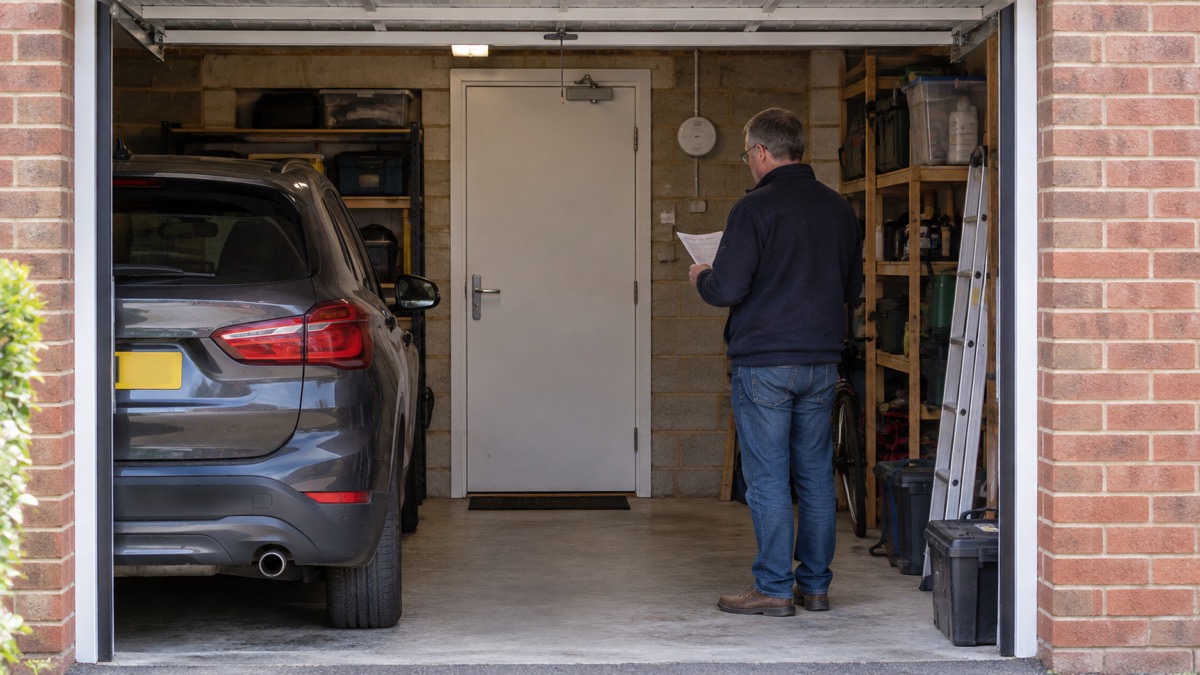
A door that joins your garage to your house is the shortest route from outside into your home. Police services in Northern Ireland put it plainly: keep your garage always locked, especially if it has a connecting door to the house, because a burglar could get in and open the inner door without being seen1. The same door also has to hold back fire and smoke, and keep car exhaust and fumes out of the rooms where you sleep.
So it has three jobs at once: it must be secure, it must resist fire and close by itself, and it must seal well enough that fumes stay in the garage. Most households have never checked any of the three. The good news is that the checks are simple and take minutes: does it close firmly onto the latch, are the gaps small, is there a certification mark, and does it lock.
What the door between your garage and house has to do
Think of the connecting door as the inner gate of a small compound. The outer gate is the main garage door, and police advise ensuring it is shut and locked6. But the outer door is often flimsy, or left open while you garden, so the inner door is what actually separates a stranger from your kitchen. Police in Northern Ireland warn that a burglar who gets into the garage can open the inner door without being seen1. Fire services add a second reason to keep garage entry points secure: arson prevention advice is to keep entry points to buildings secure, including sheds or garages, perimeter walls, fencing and gates7.
The door also has a fire job. Fire doors are designed to stop fire and smoke spreading, and provide lifesaving passive protection from the effects of both heat and smoke8. In a high-rise building, fire doors can help contain a fire for up to 30 minutes9. A garage fire, with fuel, paint and stored items, is exactly the kind of fire you want held back from the house.
And it has an air job. A garage can fill with car exhaust, petrol or solvent fumes, or gas from a boiler. The connecting door is the barrier that keeps those out of living space. That is why the seal matters as much as the lock.
Fire protection: a fire-resisting door that closes by itself
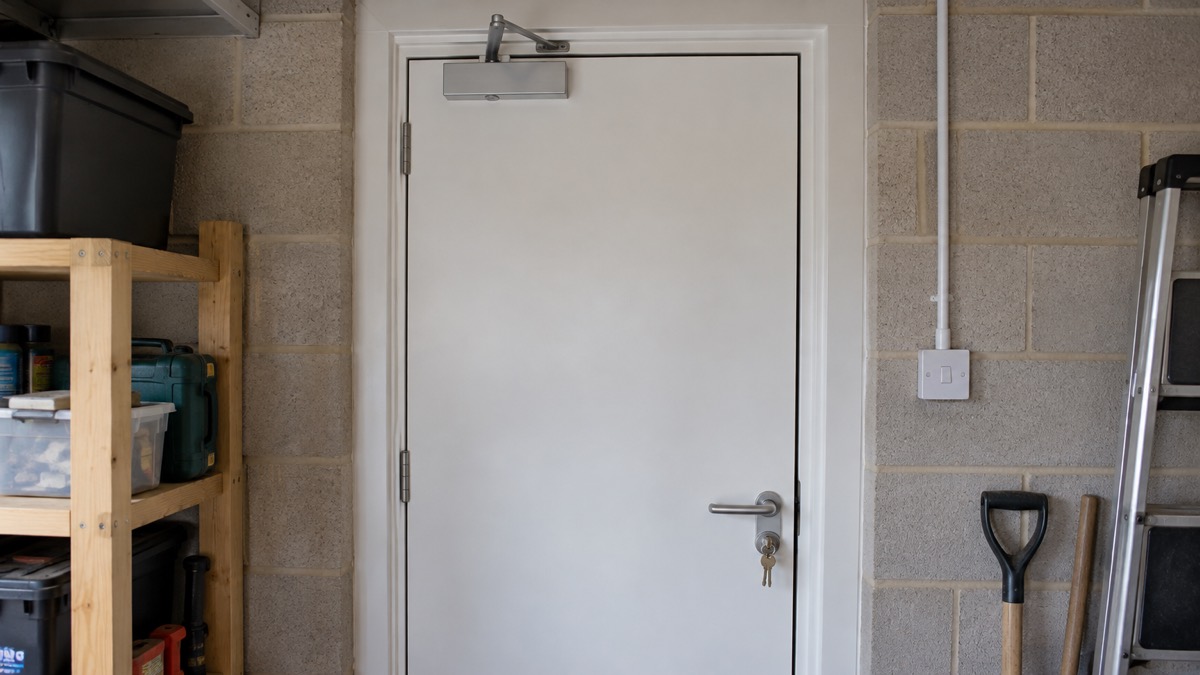
A fire door is not just a solid door. It is a tested assembly of door, frame, seals and closing device, and it only works when it is closed. Fire services are blunt about this: a fire door only works when it is closed and is completely useless if it is wedged open or cannot close fully3. Fire doors in communal areas should always close behind you2, and in high-rise buildings they are designed to close automatically to prevent smoke spreading into escape routes8.
Self-closing devices are the mechanism. Fire doors are fitted with self-closing devices which can be fitted to the top of the door or within the frame3. If your connecting door has one, test it: open it halfway and let go. It should swing shut and latch. If it drifts or sticks, it needs adjusting.
| Check | What good looks like | Why it matters |
|---|---|---|
| Certification mark | A label or plug on top (or occasionally the side) of the door3 | Without a certification mark you cannot be sure it really is a fire door3 |
| Closing action | Closes firmly onto the latch without sticking on the floor or frame3 | A fire door that cannot close fully is useless3 |
| Gaps | Top and sides consistently less than 4mm; under the door up to 8mm, depending on the door3 | Big gaps let smoke through |
| Condition | No visible damage, no damaged self-closing device, not wedged open8 | Damage undermines the door's protection |
If you live in a flat or a leasehold property, the rules may sit with someone else. Fire service guidance says leasehold tenants should examine the details of their lease and consult the landlord, as they may be responsible for ensuring a suitable fire rated door with all of its compatible components is fitted3.
Keeping car exhaust and fumes out of the house
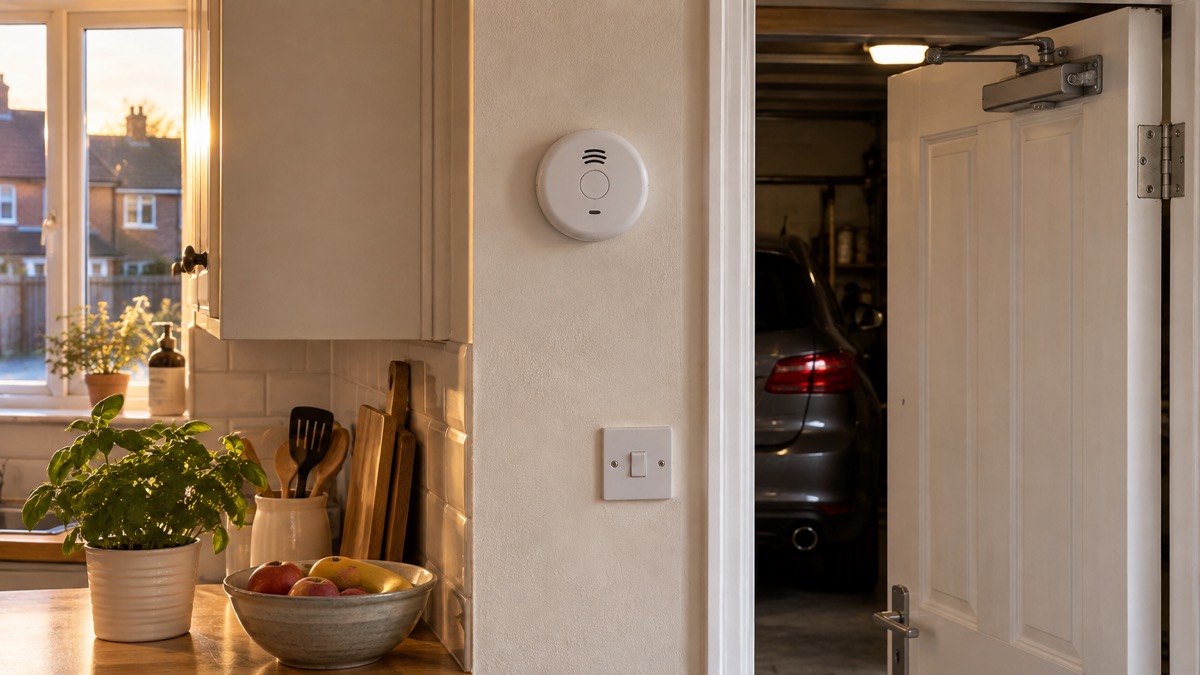
A garage attached to a house is a place where engines run, fuel is stored and boilers sometimes sit. The connecting door and its seal are what keep those fumes out of the rooms where you sleep. Fire services recommend placing a carbon monoxide alarm in rooms where you have a fixed combustion appliance, such as a gas fire, gas boiler, log burner or open fireplace10. They also advise installing alarms near potential sources and in sleeping areas11.
Placement matters. Official guidance says to mount alarms on the wall or ceiling according to the manufacturer's instructions, at a height of 1 to 3 metres above the ground, away from obstacles or ventilation sources, and make sure they are easily audible from all areas of the house12. Housing standards guidance for rented homes goes further: carbon monoxide alarms should be installed in every room used as living accommodation that contains a fixed combustion appliance (excluding gas cookers), positioned at head height, either on a wall or shelf, approximately 1 to 3 metres away from a potential source12. Other fire service guidance says alarms should be installed ideally near bedrooms and living areas13, and on each level of the home, particularly near sleeping areas14.
If you can smell gas, do not rely on the door seal. Open doors and windows15, and follow the gas safety advice for your supplier. If a vehicle is running in or near a garage, keep the garage door open and never leave an engine running in an enclosed space. Winter storm guidance makes the same point for cars stuck in snow: when the engine is running, open a window slightly to avoid carbon monoxide poisoning, and periodically clear snow from the exhaust pipe16.
Locks and security on the internal garage door
The internal door should lock, and the key should be findable in an emergency but not reachable from outside. Fire services advise keeping exits clear so people can escape, and making sure everyone in the home can easily find the keys for doors and windows17. Tenants get the same advice: keep door and window keys somewhere accessible, ideally close to the windows and doors, but with security in mind18.
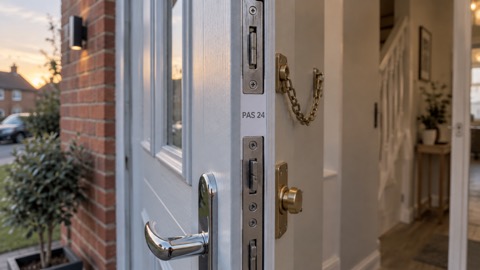
On the door itself, the lock is only as good as the door and frame. Police guidance on door security points to tested and certified doors: tested and certified uPVC doors are more secure, as they have a highly secure multi-locking mechanism using a system of hooks and latches19. For new doors, police in Scotland advise buying ones certified by Secure by Design20, and police in England and Wales describe PAS 24:2022 as doors tested to British standards and insurance approved19. If your connecting door has a letterbox, a letterbox guard fitted to the rear prevents someone reaching in and opening the door or fishing for items nearby19.
Glass is the other weak point. Police advise that glazing can be reinforced by using special film or by installing laminated glass panels19, and for new doors, make sure any glass is laminated20.
| Option | What it does | Suits |
|---|---|---|
| Standard lock on a solid door | Keeps the door shut; basic separation from the garage | Most homes, if the door and frame are sound |
| Multi-point locking (certified uPVC) | Hooks and latches along the edge, much harder to force19 | Replacement doors, or where the old door is failing |
| Laminated glass or security film | Holds glazing together when struck19 | Doors with glass panels |
| Letterbox guard | Stops reach-through and fishing19 | Doors with a letterbox |
For the wider picture on cylinders, standards and making entry harder, see Doors and Locks: Standards, Cylinders and Making Entry Harder. If you are moving in or have just bought the property, the Moving Into a New Home: Locks and Keys Checklist covers changing locks and checking what you inherited.
Checks that show the door still works
Run through these checks twice a year, and after any storm. Storm advice is to close and securely fasten doors and windows21, and to close and secure all doors, gates and windows21, so a windy night is a good prompt to look at the connecting door too.
- Close it and watch. It should close firmly onto the latch without sticking on the floor or the frame3.
- Look for light. Check the gaps around the top and sides are consistently less than 4mm when closed; the gap under the door can be slightly larger, up to 8mm, but ideally you should not see light under the door3.
- Find the certification mark. Look for a label or plug on top (or occasionally the side) of the door; without a certification mark you cannot be sure it really is a fire door3.
- Test the self-closer. Open it and let go; it should shut and latch by itself3.
- Check the lock and glazing. Confirm the lock works from both sides and that any glass is laminated or filmed19.
- Clear the doorway. Keep the area around internal doors clear so they can be closed, because closing doors limits the spread of fire and smoke22.
If you want a professional view, police say a member of the Master Locksmiths Association can check if your door is secure and the material it is made of, reinforce the frame, often with London and Birmingham bars, and check if locks and hinges are British Standard approved19. Fire services offer a Home Fire Safety Checker that asks a series of questions to work out the level of risk in your home, or the home of someone you care for23.
If the door fails these checks, replacement is the reliable answer. Police in Scotland advise buying new doors certified by Secure by Design20, and in England and Wales look for PAS 24:2022 tested doors19. For the wider context on securing the rest of the house, start with Home Security: A Household Guide, and for the specific risks of a garage under a flat or in a shared building, see Flats and Shared Entrances: Door Entry and Communal Doors.
Sources (23)
- Securing doors and windows, nidirect, 2024-08-27
- Fire doors and why they are important, Greater Manchester Fire and Rescue Service, 2026-10-29
- Fire doors, London Fire Brigade, 2026-10-25
- Smoke alarms and carbon monoxide detectors: Carbon monoxide (CO) alarms - Warwickshire County Council, Warwickshire County Council
- Tenants, Devon and Somerset Fire and Rescue Service, 2026
- House security, Police Service of Northern Ireland, 2026-11-02
- Arson prevention, Devon and Somerset Fire and Rescue Service, 2026-01-30
- Fire safety in high-rise buildings, Devon and Somerset Fire and Rescue Service, 2026-07-29
- Residential High-rise - South Wales Fire and Rescue Service, South Wales Fire and Rescue Service
- Carbon monoxide, Greater Manchester Fire and Rescue Service, 2026-05-20
- Carbon Monoxide, Cheshire Fire and Rescue Service
- Housing standards, Cherwell District Council, 2026-10-29
- Safe home heating, Warwickshire County Council, 2026-10-29
- Safe home heating, Warwickshire County Council, 2026-10-29
- Gas supply issues, Buckinghamshire Council, 2026-10-29
- Severe weather, Pembrokeshire County Council, 2026-10-29
- Keeping you safe at home, North Wales Fire and Rescue Service, 2026-10-28
- How to make an escape plan | Devon and Somerset Fire and Rescue Service, Devon and Somerset Fire and Rescue Service
- Door security, Avon and Somerset Police, 2026-11-02
- Break-in and housebreaking, Police Scotland, 2026-11-02
- Strong winds and heavy rain warning information and advice, nidirect, 2026-01-27
- Hoarding fire safety advice, North Yorkshire Fire and Rescue Service, 2026-10-25
- Evacuating your home, Nottinghamshire County Council, 2026-10-29
 Moving Home Locks Checklist
 After a Break-In Checklist
 Holiday Security Checklist
 Fitting an Anti-Snap Cylinder
 British Standard Door Locks
 Double Locking a uPVC Door
 Police Preferred Key Safes
 Where to Fit a Key Safe
 Letterbox Guards
 Measuring a Euro Cylinder
 PAS 24 Doors and Windows
 Securing Patio Doors
 Smart Lock Battery Life
 Smart Locks in a Power Cut
 Smart Locks in Rented Homes