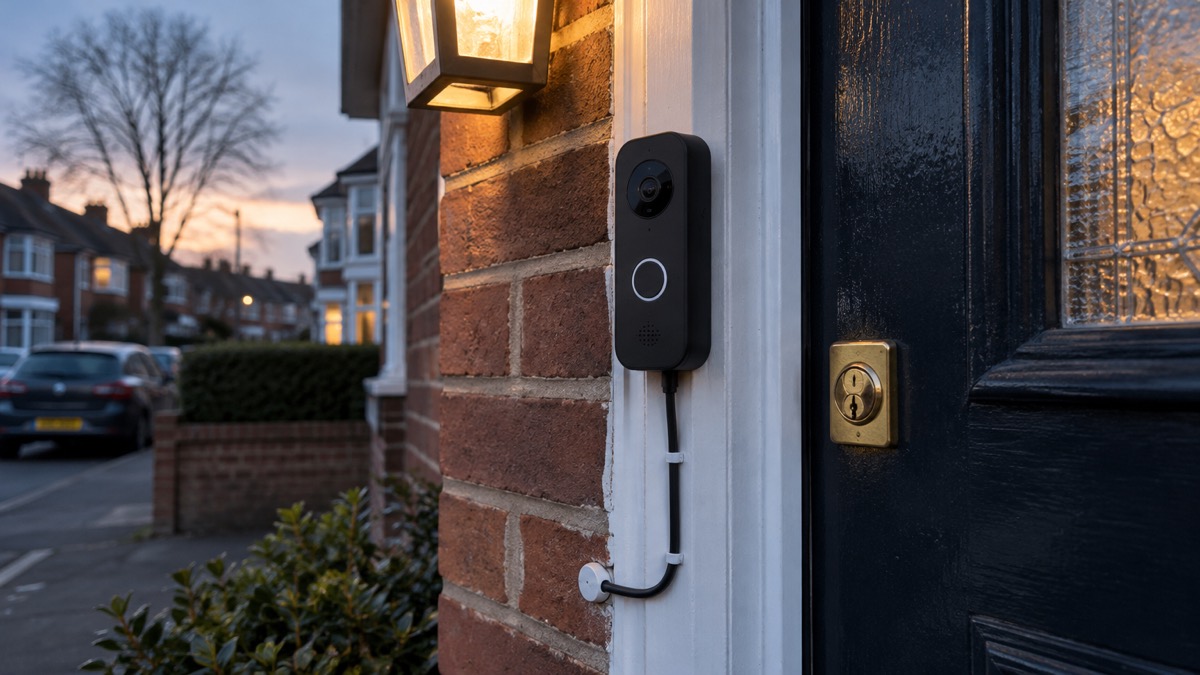
The Ajax DoorBell is a wired video doorbell with a 4 MP camera, a 155 degree horizontal viewing angle and built-in AI that tells people, pets and vehicles apart1. It is made by Ajax Systems and designed to work on its own or as part of an Ajax alarm system, where it can use the system's wireless link as a backup when Wi-Fi drops1.
If you are considering one, the decisions that matter are the power supply, where you fit it and what happens when the power or your broadband goes down. It runs on 12 to 24 volts direct current or 16 to 24 volts alternating current, and needs more current if you keep a wired chime connected through the supplied BellKit1. The maker recommends fitting it 4 to 5 feet above the ground and out of direct sunlight1.
This page sets out what the doorbell does, the specifications that decide whether it suits your door, how to power and fit it safely, and what to expect in a power cut. It does not cover price, and it does not rank it against other doorbells.
What the Ajax DoorBell is and who it suits
The maker describes it as a video doorbell with built-in AI, a PIR sensor and control through the Ajax apps1. The AI sorts what it sees into people, pets and vehicles, so you are not alerted every time a cat crosses the path1. It has one PIR sensor and a motion detection field of 120 degrees horizontally and 100 degrees vertically, wider than the camera's own 90 degree vertical view, so it notices movement slightly before someone is fully in frame1.
Video is encoded in H.264 and carried over JetSparrow, a peer-to-peer video protocol the maker developed and describes as fast and encrypted1. Audio uses G722 with noise suppression and echo cancellation always active, which matters on a busy street because it keeps two-way speech intelligible1. The maker states that authentication runs through Ajax Cloud without local access rights, so the doorbell depends on the maker's cloud service for sign-in even when it is wired to your own network1.
It is designed for outdoor and indoor use and carries an IP54 rating, which means protection against dust and splashing water rather than immersion1. That suits a porch or a sheltered door reveal. It is not a device to leave fully exposed to driving rain on an unsheltered wall.
It suits a household that already has, or plans to have, an Ajax hub, because the wireless backup and the app control are built around that system. It also suits anyone with existing doorbell wiring who wants a wired unit rather than one that needs its battery changing. If you have no wiring at the door and no appetite for running a low-voltage cable, a battery doorbell is the simpler route; our comparison of battery and wired video doorbells sets out the trade-offs.
Camera, detection and what it can see
The camera is a 4 MP CMOS sensor recording at up to 2688 by 1520 pixels, with a 155 degree horizontal and 90 degree vertical viewing angle1. In plain terms that is a wide, slightly letterboxed view: enough to see a caller and the step they are standing on, and often a little of the path either side. The maker gives night vision range as up to 20 ft, with the infrared intensity adjusted automatically in real time to avoid overexposure, so a face close to the lens is less likely to wash out1.
Motion detection reaches up to 13 ft, depending on the sensitivity level set in the device settings, and there are three levels, adjusted by a professional installer or a user with admin rights in the Ajax apps1. Independent buying advice from Which? suggests good doorbells spot someone up to 2.5 metres away, so the maker's 13 ft figure sits comfortably within what that guidance expects2. In practice, the sensitivity setting is the control that decides whether you get alerts for every passer-by or only for someone on your path.
| Setting | What the maker gives | What it means at the door |
|---|---|---|
| Camera | 4 MP CMOS, up to 2688 × 1520 px | Clear enough to recognise a caller in good light1 |
| View | 155° horizontal, 90° vertical | Wide view of the doorstep and path1 |
| Night vision | Up to 20 ft, auto-adjusting intensity | Usable after dark to the end of a short front path1 |
| Motion detection | Up to 13 ft, 120° horizontal, 100° vertical | Catches approach before the person reaches the door1 |
| Sensitivity | 3 levels, set by a PRO or admin user | The main control over false alerts1 |
| Object detection | People, pets, vehicles, by AI | Fewer alerts from animals and passing traffic1 |
Power supply: what the doorbell needs
The doorbell takes 12 to 24 volts direct current or 16 to 24 volts alternating current at 50 or 60 Hz, and the maker gives its power consumption as 10 W1. The current it draws depends on whether you keep a wired chime working through the BellKit supplied in the box1.
| Supply | With a wired chime (BellKit) | Without a wired chime |
|---|---|---|
| 24 V DC | 3 A or more | 0.5 A or more |
| 12 V DC | 3 A or more | 1 A or more |
| 24 V AC | Not stated separately | 0.4 A or more |
| 16 V AC | Not stated separately | 0.6 A or more |
| Recommended AC with BellKit | 16 to 24 V, 10 VA or more | Not applicable |
| Recommended DC with BellKit | 12 to 24 V, 3 A or more | Not applicable |
All figures in this table are the maker's1. The pattern is worth reading carefully: keeping a mechanical chime means the supply has to deliver far more current than the doorbell alone needs, because the chime's solenoid draws the difference. If your existing transformer is a modest one sized for a chime only, it may not meet the 3 A figure, and the doorbell may misbehave or the chime may not ring. Have an electrician check the transformer's rating before you rely on it.
Independent buying advice notes that wired doorbells require existing doorbell wiring to power the camera2. That is a general statement about the category; the maker's own figures above are the ones to work to for this model, and they allow a wider range than a fixed supply alone.
The built-in battery and what happens in a power cut
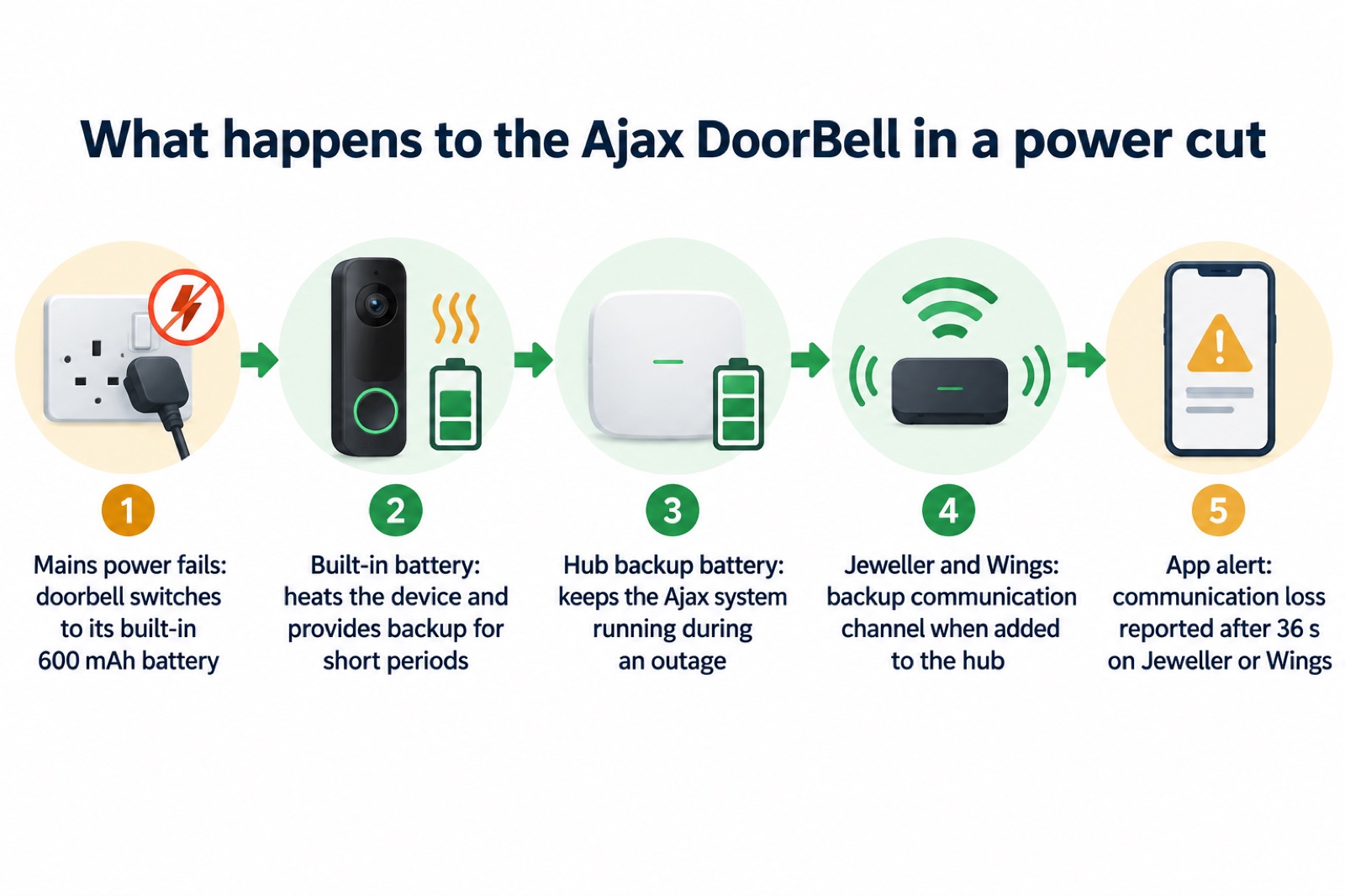
The doorbell has a built-in rechargeable lithium-ion battery of 600 mAh1. The maker states its purpose plainly: it is intended to heat the device in a cold climate and to provide a backup power supply for short periods1. It is not a battery that runs the doorbell for days. Read the maker's wording as a short bridge across a brief interruption, not as an alternative to mains power.
That distinction matters in a UK power cut. Ajax's own support guidance explains how the wider system behaves: Ajax hubs, except the Superior Hub Hybrid, have a built-in backup battery that keeps the system running during a power outage, and third-party wired devices are kept powered by a module's backup battery, a pre-installed battery or the hub's backup battery depending on the device3. The doorbell's own battery is described by the maker in the narrower terms above, so do not assume it will keep recording for the length of a long outage.
If you want the doorbell to keep working through cuts, the practical answer is the hub. Adding the doorbell to an Ajax hub gives it a second communication path over the maker's Jeweller and Wings wireless technologies, which the maker says serve as a backup channel when the device is added to the hub1. Jeweller is described across the maker's manuals as a two-way radio protocol with block encryption and device authentication, regular pinging of devices, notifications of jamming and connection loss, and a range of up to 2,000 m without obstacles4. One manual gives the range as up to 6,550 ft without obstacles such as walls, doors or inter-floor constructions, and another gives a different figure; the two figures disagree, so treat the range as generous indoors but not guaranteed through thick walls7.
The doorbell reports loss of communication over Jeweller or Wings, and the Wi-Fi loss threshold can be set by the installer1. Those are the windows in which the app will tell you something has gone wrong.
Staying connected and storing the video
The doorbell connects over a 2.4 GHz 802.11 b/g/n Wi-Fi module1. It stores video in one of two ways: to an NVR, or to Ajax Cloud Storage1. There is no memory card in the maker's specification, so the choice is between a recorder on your own network and the maker's cloud. Which you pick decides what survives a broadband outage and who holds the footage.
The maker states the doorbell is conformant with ONVIF Profile S and implements ONVIF H.265 encoding, transmission of motion detection and AI recognition events, and control over wide dynamic range and other image settings1. It also states the device is not ONVIF profile or add-on conformant1. In practice, check that your recorder supports Profile S before you plan around it, and test the integration rather than assuming it.
For comparison, other makers approach storage differently: Reolink's battery and wired Wi-Fi doorbells take a microSD card up to 512GB and work with a compatible NVR and Home Hub, while its PoE models take up to 256GB and also support FTP and NAS9. Arlo's wireless doorbell offers live streaming, doorbell calls, motion notifications and two-way audio without a subscription, with local storage through a SmartHub or Base Station10. These are different designs, not better or worse ones; they simply put the recording in different places.
Whichever route you take, the account that controls the doorbell deserves the same care as the camera itself. Our guide to camera and doorbell accounts explains how to stop strangers getting in, and filming beyond your boundary covers what you may record when the camera sees past your gate.
Where to fit it, and how to fit it safely
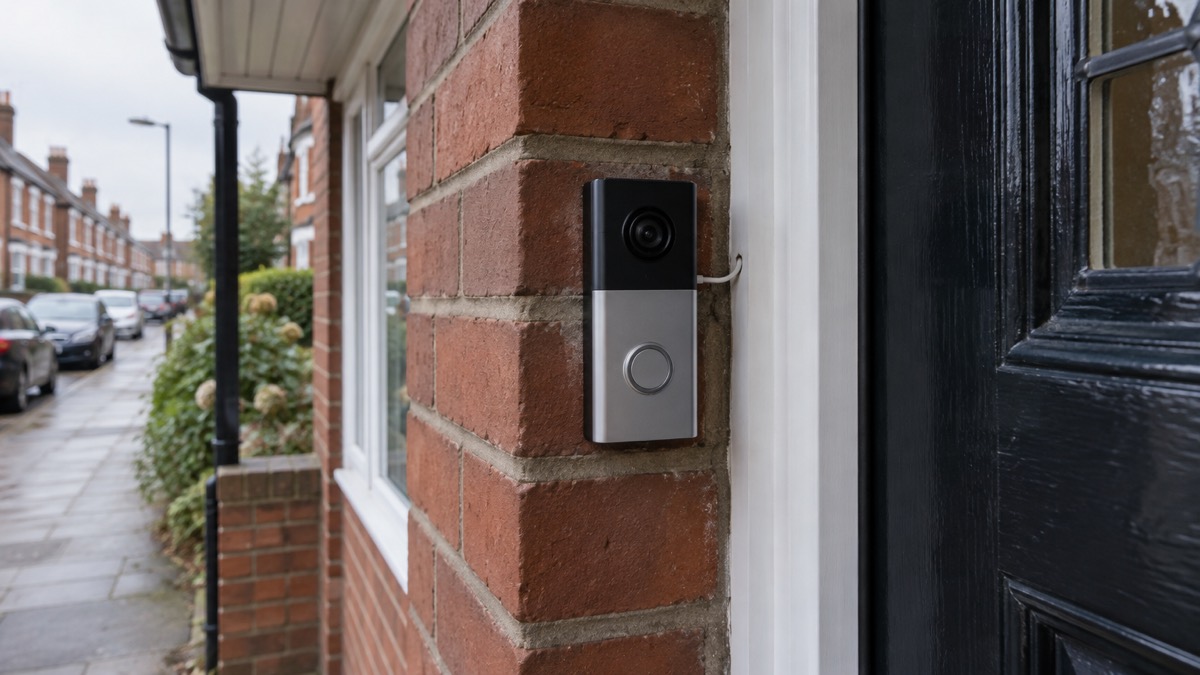
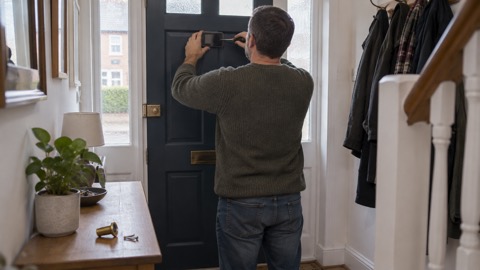
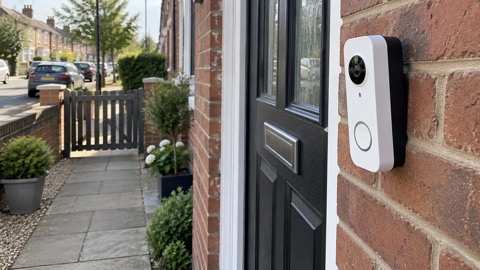
The maker recommends installing the doorbell at a height of 4 to 5 feet and warns that it should not be installed in direct sunlight, which may cause overheating and damage to the device's electrical components1. Independent buying advice puts the best height for a doorbell at around four feet, or 1.2 metres, to the bottom of the unit, so the two views agree closely2. At that height the camera looks at a caller's face rather than their chest or the top of their head.
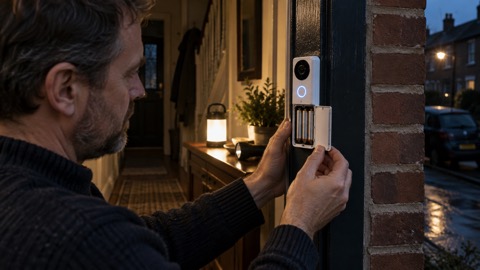
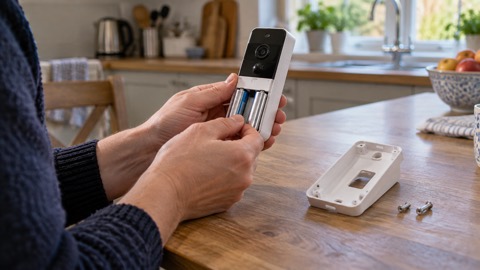
The box contains the SmartBracket mounting panel, two wedge brackets, the BellKit for connecting to a wired chime, an installation kit and a quick start guide1. The wedge brackets let you angle the unit towards a path or drive rather than straight out. The maker gives the operating humidity as up to 90 per cent, so a damp porch is within its rating but standing water is not1.
The maker's tamper feature sends notifications of attempts to remove the device from the mounting panel1. That is useful on a door that faces a street or a shared path. For the wider question of how a doorbell fits into your home's defences, our guide to video doorbells covers the category, and doors and locks covers the door itself.
Tamper alerts, weather rating and warranty
The doorbell carries an IP54 rating and is designed for outdoor and indoor use, operating from minus 13 to 140 degrees Fahrenheit and up to 90 per cent humidity1. That range covers UK conditions comfortably, including a hard frost. The maker's note that the built-in battery is intended to heat the device in a cold climate explains part of why the battery is there at all1.
The maker gives a warranty of 24 months1. A distributor listing for Ajax alarm products separately states a two-year warranty, which matches11. Keep the proof of purchase and the installation record, because a warranty claim on a wired device will usually ask who installed it and how it was powered.
The maker lists an extensive set of certifications: the Radio Equipment Directive with a certificate issued by TIMCO Engineering, EN 300 220 parts 1 and 2, EN 300 328, EN 18031 parts 1 and 2, a RoHS test report issued by Shenzhen NTEK Testing Technology, EN IEC 63000, the EMC Directive with EN 55032 and EN 55035, EN 301 489 parts 1, 3 and 17, the Low Voltage Directive with EN IEC 62311 and EN 62368-11. If your insurer asks whether a device is certified, that list is what to point to.
For context on what certification means for security products generally, Northern Ireland's official guidance on securing doors and windows advises buying doors and windows certified by Secure by Design and notes that alarms and CCTV should meet British Standards PD666212. Police Scotland's break-in advice covers the same ground for householders north of the border13. The DoorBell's own list is a product safety and radio compliance set rather than a police approval scheme, so check separately if police approval is a condition of your insurance.
Support, warranty and where to get help
Support for the DoorBell runs through Ajax Systems and its apps, where a professional installer or an admin user configures sensitivity, communication loss thresholds and storage1. If you are having one fitted as part of a wider system, our guide to checking an alarm installer is approved explains what to ask before you sign.
If you already run an Ajax system, the hub is the part that keeps things working when the power goes. Our pages on the Ajax Hub (2 Plus, 2, Plus) and the Ajax Hub Jeweller explain what each does, and keeping your home protected in a power cut covers the household side of an outage.
For the door itself, the home security section gathers the guides on locks, alarms, cameras and doorstep crime. If you are weighing a doorbell against a separate outdoor camera, video doorbell or outdoor camera sets the two side by side.
Sources (14)
- DoorBell specifications, Ajax Systems, 2026-11-02
- How to buy the best smart video doorbell, Which?, 2026-10-16
- How an Ajax system operates in case of a power outage, Ajax Systems, 2026-08-19
- Hub 2 user manual, Ajax Systems, 2026-10-27
- FireProtect 2 Smoke/Heat detector, Ajax Systems, 2026-11-02
- MotionProtect Outdoor user manual, Ajax Systems, 2026-06-08
- Hub BP user manual, Ajax Systems, 2026-10-28
- ReX 2 Jeweller specifications, Ajax Systems, 2026-11-02
- Reolink video doorbells, Reolink, 2026-11-03
- Arlo doorbells, Arlo, 2026
- Small lock box for NVR or DVR, CCTV Direct, 2026-11-02
- Securing doors and windows, nidirect, 2024-08-27
- Break-in and housebreaking, Police Scotland, 2026-11-02
- Alarms advice for domestic properties, Secured by Design, 2023

 Arlo Essential 2K Doorbell
 Blink Battery Doorbell 2K+
 Blink Video Doorbell
 EZVIZ HP3 Pro
 Google Nest Doorbell Battery
 Ring Battery Video Doorbell
 Ubiquiti UniFi Doorbell Lite
 Ubiquiti UniFi G4 Doorbell Pro