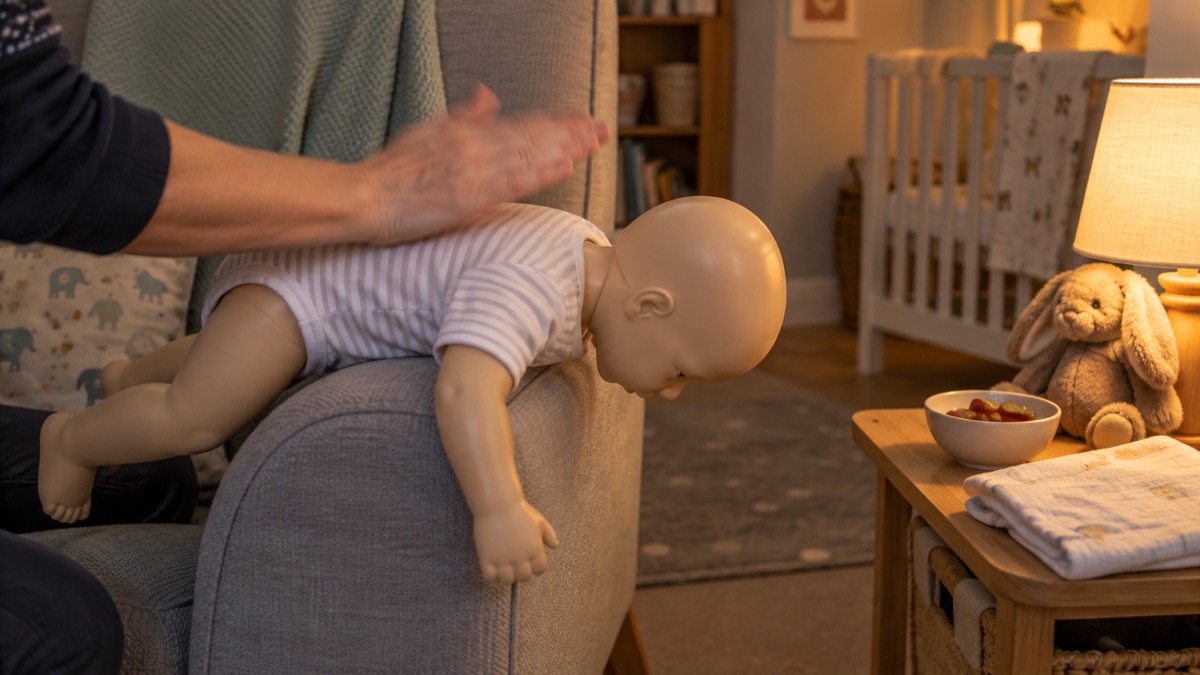
If a child is choking, the first thing to work out is whether they can still move air. Ask them "are you choking?" If they can breathe, speak or cough, they may be able to clear their own throat, so encourage them to keep coughing1. If they cannot cough, cry, speak or breathe, the airway is blocked and you need to act at once: shout for help, then give up to five firm back blows between the shoulder blades2.
What you do next depends on age. A baby under one gets up to five back blows, then up to five chest thrusts, never abdominal thrusts3. A child over one gets up to five back blows, then up to five abdominal thrusts, holding them around the waist and pulling inwards and upwards above the belly button2. Keep repeating the cycle until the blockage clears, help arrives or the child becomes unresponsive, and call 999 if it does not clear2.
Choking is quiet. A child who is choking cannot breathe, so there may be no sound to alert you4. That is why watching a child while they eat matters as much as knowing the first aid. This page sets out what to do for a baby and for an older child, when to call 999, what to do if they become unconscious, and how to make choking less likely at mealtimes and at play.
Coughing, crying or speaking: let them clear it themselves
A child who is coughing is still shifting air, and that cough is the most effective thing for clearing the blockage. Ask them "are you choking?" and if they can breathe, speak or cough, they may be able to clear their own throat1. Encourage them to keep coughing, and if the object is in their mouth, ask them to try to spit it out7.
Do not put your fingers in their mouth to hook the object out. Official guidance warns that they may bite you accidentally7. A blind finger sweep can also push a blockage further down.
The signs to look for are difficulty breathing, speaking or coughing, signs of distress, and a child pointing to their throat or grasping their neck1. A child who is choking may be clutching at their chest or neck and will not be able to speak, breathe or cough2. On white skin the skin may begin to look blue (cyanosis)8.
If the coughing stops being effective, if it is silent or they cannot breathe in properly, shout for help immediately and check whether they are conscious5. That is the moment to move from encouraging them to starting back blows.
When the blockage clears, you will usually see it come out of their mouth and the child will start to breathe again, and you can ask them if they are feeling better2. If back blows and thrusts were needed, the child should still be checked by a medical professional afterwards, because abdominal thrusts can cause internal injury.
Babies under one: five back blows, then five chest thrusts
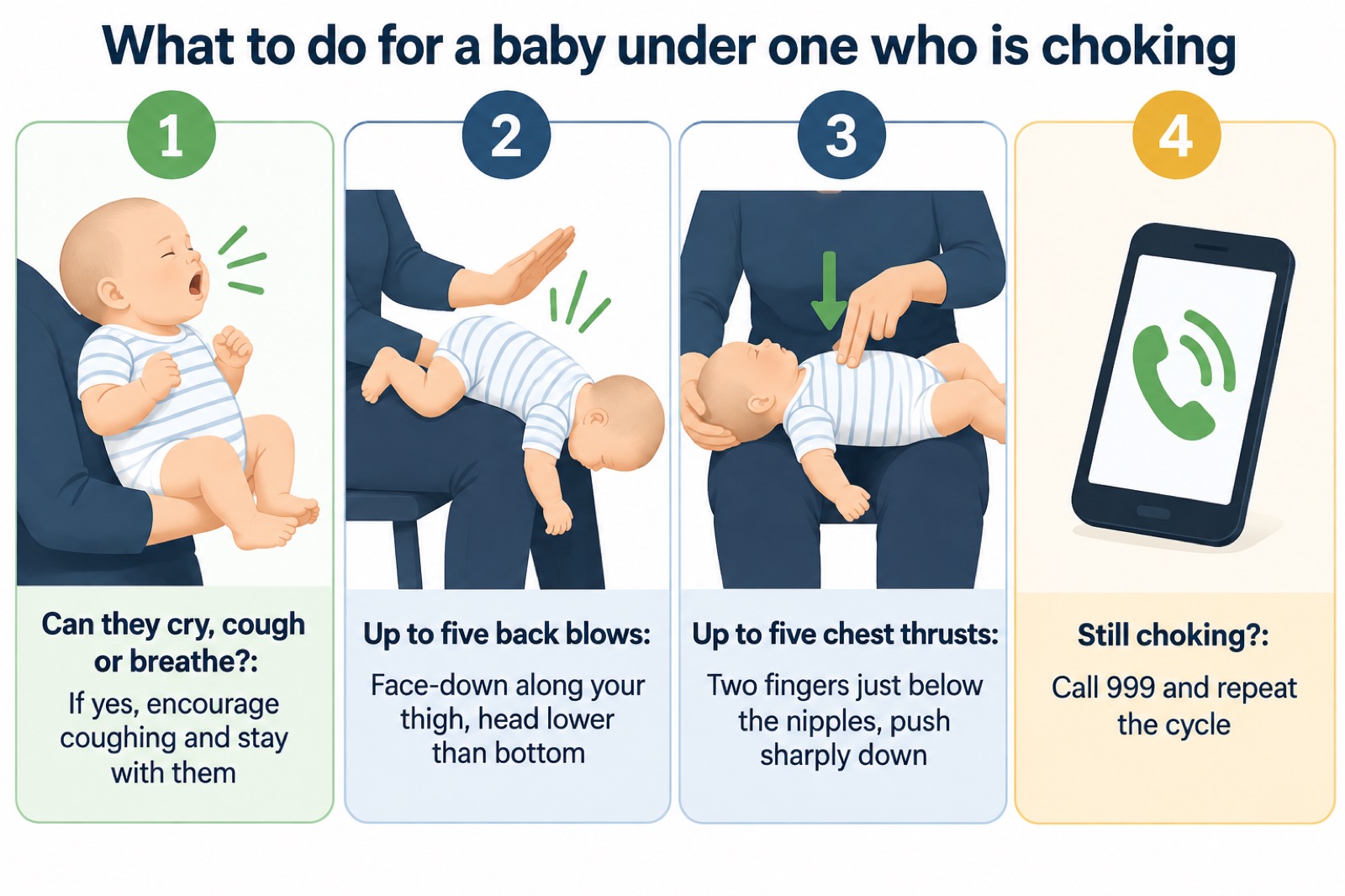
For a baby aged one and under, the sequence is back blows first, then chest thrusts. Abdominal thrusts are not used on babies3.
- Give up to five back blows. Hold the baby face-down along your thigh with their head lower than their bottom. Hit them firmly on their back between the shoulder blades up to five times3.
- Give up to five chest thrusts. Turn the baby over so they are facing upwards. Place two fingers in the middle of their chest just below the nipples and push sharply downwards up to five times3.
- Call 999 if they are still choking after back blows and chest thrusts3.


The Resuscitation Council UK's paediatric choking algorithm for 2025 sets out the same cycle for a conscious infant: alternate five back blows, then five chest thrusts9. If back blows do not dislodge the blockage, use chest thrusts instead of abdominal thrusts3.
A baby who is choking will not be able to cry, make noise, cough or breathe3. That silence is the sign to act on. If the baby becomes unconscious at any time, move on to baby basic life support10.
Children over one: back blows and abdominal thrusts
Help children more than a year old in the same way as adults. Give up to five firm blows on the back, reducing the force of the blows for a smaller child11. A small child can be laid face down on your lap as you would a baby6.
If back blows do not clear the blockage, move on to abdominal thrusts. Hold the child around the waist and pull inwards and upwards above their belly button2. The Child Accident Prevention Trust explains that squeezing above the belly button from behind forces air out of the lungs to clear the object4. The First Aid Industry Body gives the same technique: place your fist between the navel and the bottom of the breastbone, grasp it with your other hand, and pull sharply inwards and upwards up to five times11.
Then call 999 if the blockage does not dislodge, and continue cycles of back blows and abdominal thrusts until it dislodges, help arrives or the child becomes unresponsive2. Recheck their mouth between every blow or thrust1.
| Age | First | Second | Never |
|---|---|---|---|
| Baby under one | Up to five back blows3 | Up to five chest thrusts3 | Abdominal thrusts3 |
| Child over one | Up to five back blows2 | Up to five abdominal thrusts2 | Leaving them to fetch help6 |
When to call 999 and what to do while you wait
Call 999 if the blockage does not come out after trying back blows and either chest or abdominal thrusts, and keep trying the cycle until help arrives5. St John Ambulance says to call 999 or 112 for emergency help straight away if the blockage has not cleared, then repeat five back blows and five abdominal thrusts until help arrives, rechecking their mouth between every blow or thrust1.
Choking is one of the emergencies the ambulance service lists as a reason to call 999, alongside strokes, chest pains and breathing problems12. The Northern Ireland Ambulance Service also lists choking among the situations where you should call 99913.
Put the phone on speakerphone so your hands are free to keep helping6. If someone else is with you, ask them to make the call while you carry on. Do not leave the child at any stage6.
The NHS lists other situations where a child needs 999: if they stop breathing, are struggling to breathe, are choking, are unconscious, are limp and floppy, will not wake up, have a seizure or fit, have a swollen mouth, lips, throat or tongue, have blue, grey, pale or blotchy skin, lips or tongue, seem suddenly confused or distressed, or have swallowed a poison or too much medicine15. For choking specifically, the instruction is simple: keep the cycle going until the object comes out or the ambulance crew takes over.
If the child becomes unconscious
If the child becomes unresponsive, put them on a firm, flat surface and shout for help. Call 999, putting the phone on speakerphone so your hands are free, and do not leave the child at any stage5.
The Resuscitation Council UK's 2025 algorithm says that for an unconscious child you should open the airway and try rescue breaths, then continue with paediatric basic life support9. For an infant, if you cannot achieve effective breaths, begin chest compressions immediately to try to relieve the obstruction16. If the infant loses consciousness at any time, follow baby basic life support from step 417.
This is where the choking page meets the CPR pages. CPR on a child is not the same as CPR on an adult: the ratio of breaths to compressions and the depth of compressions differ. Our guide to CPR on a child and the page on CPR on a baby under one set out the steps in full. If you have not done CPR before, the call handler can talk you through it while the ambulance is on its way.
Preventing choking at mealtimes and play
Food is the most common thing for babies and toddlers to choke on18. Young children can also choke on small objects17. Babies and toddlers examine things around them by putting them in their mouths19, and the Child Accident Prevention Trust describes mouthing as a normal developmental stage that helps with sensory development, self-soothing and immune system building20. It is not something to punish; it is something to plan around.
At mealtimes:
- Stay with your child while they eat. Encourage them to sit still, because running around while eating could make them choke18.
- Make sure children sit down to eat and drink, and do not lie down, walk or run19.
- Think about size, shape and texture when preparing food6.
- Avoid risky foods until your child is a more competent eater21.
- Never prop a baby up with a bottle. The Child Accident Prevention Trust warns that if a baby is left alone with a bottle propped up to feed, there is a serious risk of choking, because babies need an adult to help them feed21. NHS guidance says the same17.
At play, keep small objects out of reach17. Children are more likely to choke if they slip or trip while eating, and small, sticky or slippery foods are a particular risk19. Teaching older children to sit still at the table and to tell an adult if a younger child is struggling is part of the same picture; our page on teaching children basic life-saving skills and how to ring 999 covers that.
Sources (21)
- Child choking, St John Ambulance, 2026-10-28
- Choking child, British Red Cross, 2026-10-29
- Choking baby, British Red Cross, 2026-10-29
- Choking factsheet 2024, Child Accident Prevention Trust, 2024
- Choking, Hillingdon Child and Young People's NHS, 2026-10-29
- How to stop a child from choking, NHS, 2024-10-28
- Choking first aid, East Sussex Healthcare NHS Trust, 2025-11
- Choking and gagging on food, NHS, 2026
- Paediatric choking algorithm 2025, Resuscitation Council UK, 2025-10
- Baby basic life support, Leeds Teaching Hospitals NHS Trust, 2025-06-04
- Baby and child first aid booklet, First Aid Industry Body, 2025-08
- Using 999, East of England Ambulance Service, 2026-10-28
- When to call 999, Northern Ireland Ambulance Service, 2026-10-29
- How to give a child CPR, NHS Inform, 2026-07-24
- What to do if your child has an accident, NHS, 2025-12-18
- Choking infant | Wirral University Hospital NHS Foundation Trust, Wirral University Hospital NHS Foundation Trust
- Child safety, Berkshire Healthcare NHS Foundation Trust, 2026-10-29
- Baby and toddler safety, NHS, 2026-02-19
- Keeping kids safe: choking, RoSPA, 2026-10-26
- Poisoning prevention, Child Accident Prevention Trust, 2026-02-26
- Choking prevention, Child Accident Prevention Trust, 2026-03-17
 Baby and Child Kit Checklist
 Bleeding Control Kit Checklist
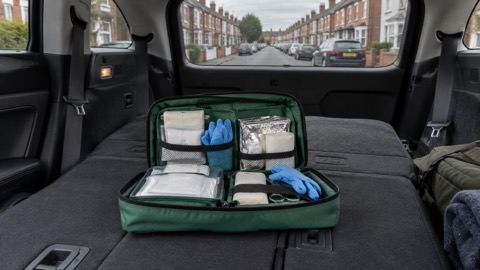 Car Kit Checklist
 CPR on a Baby
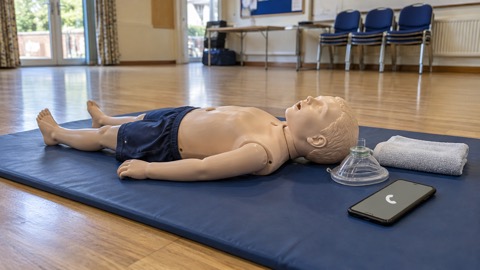 CPR on a Child
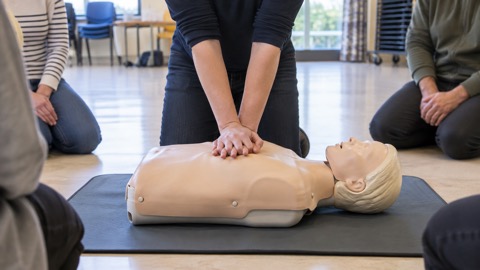 Chest Compression Rate and Depth
 Rescue Breaths or Hands-Only CPR
 Checking Breathing
 Agonal Breathing and CPR
 Breathing During CPR
 Recovery Position and Spine
 Cardiac Arrest vs Heart Attack
 Heart Attack First Aid
 Defibrillator Pad Placement
 Defibrillator on a Child